3/5/26 Roundup: Quiet Momentum

Brian Cubellis | Chief Strategy Officer
Mar 5, 2026
A consequential week. Federal Reserve access for a crypto-native bank, Morgan Stanley formally entering the bitcoin ETF market, a presidential broadside against the banking lobby, new research on how AI agents think about money, and a price recovery that held through genuine geopolitical shock.
Below we cover all five items, followed by a spotlight on a new blog from Onramp and our standard Chart, Quote, and Podcasts of the Week.
Quiet Momentum
Five Signals, One Direction
1. Kraken Becomes the First Digital Asset Firm to Receive a Federal Reserve Account
Kraken Financial, the Wyoming-chartered banking arm of Kraken, was granted a Federal Reserve master account this week, making it the first digital asset company in U.S. history to gain direct access to the Fed's payment infrastructure. Through this account, Kraken can settle directly on Fedwire without relying on intermediary banks, reducing friction and cost for institutional clients.
Some nuance is warranted. The Kansas City Fed approved what it describes as a "limited purpose account" for an initial one-year term, meaning Kraken will not earn interest on reserves or access emergency lending facilities available to traditional banks. Still, the structural significance is real. For years, crypto firms have struggled with debanking and dependence on fragile correspondent banking relationships. Direct Fed access eliminates that vulnerability and provides a legal and operational roadmap for other digital asset firms still fighting for similar access.
Why it matters: It signals that digital asset firms operating with sound regulatory discipline and full-reserve models can participate in the same infrastructure as traditional financial institutions. The architecture of legitimate digital banking is beginning to take shape.
2. Morgan Stanley Files for a Spot Bitcoin ETF, Names Coinbase and BNY as Custodians
Morgan Stanley filed an updated S-1 with the SEC for the Morgan Stanley Bitcoin Trust this week, naming Coinbase Custody and BNY Mellon as bitcoin custodians, with BNY also serving as administrator, transfer agent, and cash custodian. Most assets will be held in cold storage, with a portion moving to online wallets during share creation and redemption windows.
Morgan Stanley is not a firm that launches products impulsively. That it is formally entering the bitcoin ETF space is a meaningful institutional conviction signal and speaks to the depth of unmet client demand across its advisor network. From a custody architecture standpoint, however, distributing responsibilities across two institutions introduces some diversification but each remains a single counterparty with concentrated control over the keys it manages.
In a Multi-Institution Custody structure, no single institution ever holds unilateral signing authority and a quorum of independent custodians is required to authorize any transaction. The product is a significant step forward for institutional access. The deeper conversation around fault-tolerant custody architecture remains an open one.
Why it matters: Morgan Stanley's entry expands bitcoin access through one of the most trusted distribution networks in global wealth management. It also reinforces why custody architecture deserves more scrutiny than the headline typically receives.
3. BPI Study: AI Agents Prefer Bitcoin as Money
The Bitcoin Policy Institute released research this week testing how 36 frontier AI models from six providers, including Anthropic, OpenAI, Google, DeepSeek, xAI, and MiniMax, would behave as autonomous economic agents across 9,072 open-ended monetary scenarios. No currencies were suggested. No answers were predetermined.
Bitcoin came out on top at 48.3% of all responses. Stablecoins followed at 33.2%. Not a single model chose fiat as its top preference, and over 90% of responses favored digitally-native money overall. Bitcoin dominated store-of-value scenarios specifically at 79.1%, the strongest consensus on any single question in the study. Preferences also rose with model capability, suggesting that more sophisticated reasoning converges on the properties bitcoin uniquely satisfies: fixed supply, permissionless access, censorship resistance, and borderless settlement.
Why it matters: When AI systems reason from first principles about what makes sound money, they arrive at the same conclusion Austrian economists have reached for decades. That convergence, absent ideology or incentive, is worth paying attention to as autonomous agents become significant participants in economic networks.
4. Trump Takes on the Banking Lobby Over the CLARITY Act
On Tuesday evening, President Trump posted to Truth Social accusing banks of holding the CLARITY Act hostage over their opposition to stablecoin yield provisions. "The Banks are hitting record profits," he wrote, "and we are not going to allow them to undermine our powerful Crypto Agenda."
The backdrop: the GENIUS Act, signed into law last July, bars stablecoin issuers from paying yield to holders but left ambiguous whether exchanges and intermediaries could do so. Banks have since lobbied to close that gap through the CLARITY Act, which passed the House but stalled in the Senate Banking Committee after Coinbase withdrew support over the yield amendment. Trump's post is his most direct public rebuke of the banking lobby on crypto policy to date, framing it as both a consumer issue and a geopolitical one. Prediction markets currently price the CLARITY Act at roughly 72-74% likely to pass in 2026, up from around 62% the prior week.
Why it matters: The stablecoin yield debate is a proxy for whether the regulatory apparatus will protect the banking sector's deposit monopoly or permit genuine competition from digital alternatives. The administration has now made its position clear. The legislative path remains uncertain, but the directional signal is unambiguous.
5. Price and Market Context: The Case for a Local Bottom
At the time of this writing, bitcoin hovers in the low $70k range, recovering steadily from the drawdown that accelerated through February and into early March. The backdrop was genuinely difficult. U.S. military strikes against Iran sent Brent crude spiking toward $80-82 per barrel, reignited inflation fears, pushed gold higher, and weighed on Asian equities. The dollar strengthened sharply on Monday following the initial shock.
And yet bitcoin held. Long liquidations during the peak of the geopolitical shock totaled approximately $300 million, a contained figure relative to the $2.5 billion wiped out in early February. ETF inflows remained net positive during the strikes. The sellers who were going to sell appear largely to have already done so. Meanwhile, the inflationary implications of elevated oil prices work structurally in bitcoin's favor, as they do for any asset with a supply schedule that cannot be expanded by monetary decree.
The resilience observed this week is also consistent with a deeper narrative shift. In an environment of deteriorating institutional trust, active military conflict, and resurging inflation, a neutral, borderless, fixed-supply monetary network occupies a different position than a speculative asset. That recognition is building slowly. The price action this week is consistent with it.
Price context: Bitcoin is trading in the low $70k range, recovering from a low near $60,000. Sellers appear exhausted, the inflationary backdrop supports the structural thesis, and geopolitical deterioration continues to build the case for neutral, apolitical money.
NEW ONRAMP BLOG
The Cantillon Effect: How New Money Creates Winners and Losers
We recently published an educational deep-dive on one of the most important and underappreciated concepts in monetary economics. The insight is simple: when new money enters an economy, it does not arrive uniformly. It enters through institutions closest to the central bank and flows outward from there. Those who receive it first spend it before prices adjust. Those who receive it last only experience the inflation, without the purchasing power that preceded it.
The post-1971 data tells the story clearly. After Nixon severed the dollar's convertibility to gold, U.S. M2 expanded roughly 30-fold. Productivity continued to rise. Real wages largely stagnated. Asset values inflated first, because newly created money reached asset owners before it reached workers. Bitcoin's hard cap of 21 million is a direct architectural response to this dynamic. New bitcoin cannot be issued to purchase assets ahead of price adjustment, because new bitcoin cannot be issued on demand.
For any reader building a durable framework for why Bitcoin matters beyond price cycles, this piece is a clean and accessible entry point.
Read here: The Cantillon Effect
CHART OF THE WEEK
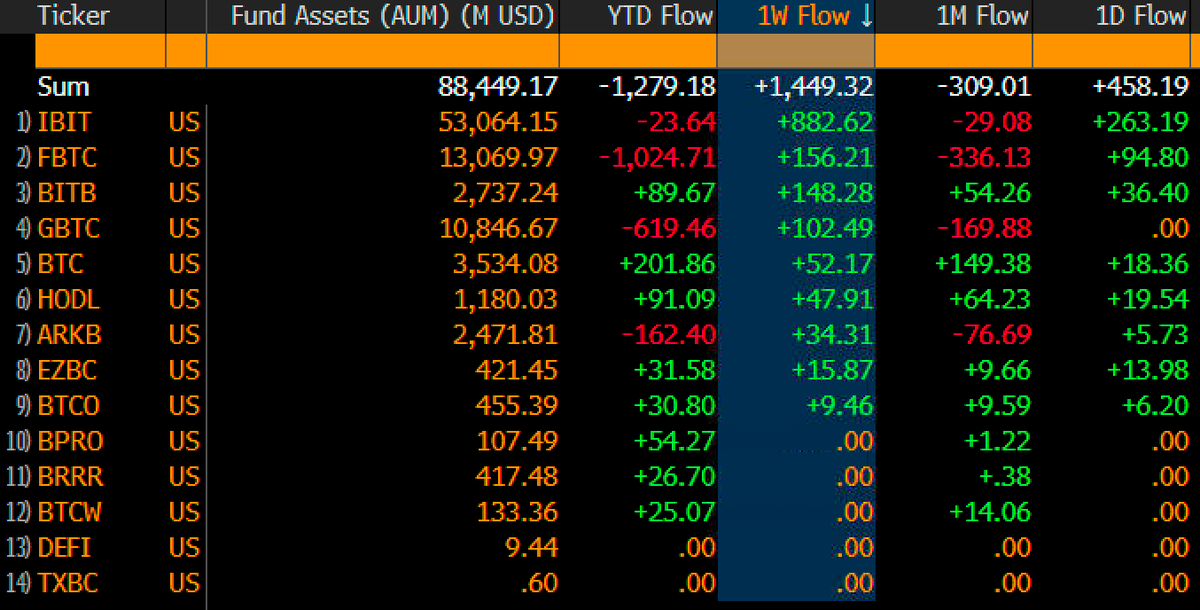
"Boomers to the rescue again as bitcoin ETFs record $1.5b of inflows in the past 5 days after another big day yesterday. Biggest haul in a while, just about all of the original ten spot ETFs seeing action too = breadth and depth. This after a 50%(!) drawdown and most underwater. Even I'm impressed."
— Eric Balchunas on X
QUOTE OF THE WEEK
"For decades, central banks promised they were the guardians of monetary stability while systematically debasing every currency they touched. The dollar lost 96% of its purchasing power since 1913, but somehow we're supposed to trust these same institutions with our economic future.
Bitcoin doesn't ask permission from Janet Yellen or Jerome Powell. It simply exists — incorruptible, unconfiscatable, and utterly indifferent to the political machinations of state monetary monopolists who built their power on the ability to print wealth out of thin air.
And the beautiful irony? While governments scramble to regulate, ban, or co-opt it, millions of people worldwide are quietly opting out of their rigged game entirely. The revolution isn't being televised — it's being mined, one block at a time."
PODCASTS OF THE WEEK
Jane Street's Secret Plot to Kill Bitcoin
The Last Trade: Jackson, Michael, and Liam break down the Jane Street / Terra Luna lawsuit, what's really driving bitcoin's drawdown, why your privacy is more compromised than you think, and why AI and bitcoin are two sides of the same coin.
Jack Dorsey Just Gave Every CEO Permission to Fire Half Their Company
Final Settlement: Tech layoffs and what the market reaction reveals, how AI is reshaping workforce economics and consumer spending, the stablecoin infrastructure buildout and what it means for payment companies, and the latest signals on bitcoin adoption from both retail and institutional corners.
CLOSING NOTE
Onramp provides bitcoin financial services built on multi-institution custody. To learn more about our products for individuals and institutions, schedule a consultation to chat with us about your situation and needs.
Until next week,
Brian Cubellis