Research
Research & insights
In-depth bitcoin research and insights from industry experts. Analysis you won't find anywhere else.
Research
In-depth bitcoin research and insights from industry experts. Analysis you won't find anywhere else.

Brian Cubellis | Chief Strategy Officer
Mar 19, 2026
The Fed held rates steady yesterday, but the real story is what it admitted it cannot do. A scorching PPI print, a deteriorating labor market, an oil shock with no end date, and a central bank that acknowledged it has "not made as much progress on inflation as it had hoped." The stagflation trap is tightening, and the committee has no clean way out.
Below we cover the Fed's predicament in detail, followed by our standard Chart, Quote, and Podcasts of the Week.
Inflation Is Running Hot, the Labor Market Is Cracking, and the Central Bank Has No Good Options
The Federal Reserve held rates steady yesterday at 3.50-3.75%, as expected. The vote was 11-1, with Governor Miran again dissenting in favor of a cut. Markets had priced this outcome at 99% probability.
The real story is what the data, the projections, and Powell's own words revealed about the corner the Fed has backed itself into.
Hours before the decision, the Bureau of Labor Statistics released February's Producer Price Index. Headline PPI rose 0.7% month-over-month, more than double the 0.3% consensus. Year-over-year producer inflation hit 3.4%, the highest since February 2025. Core PPI rose 0.5% on the month and 3.9% annually.
The composition matters more than the headline. Over half the increase came from services costs, which climbed 0.5%. Portfolio management fees rose 1%. Securities brokerage and advisory services jumped 4.2%. This is not tariff-driven goods inflation that fades. This is sticky, demand-side pressure in sectors the Fed has no direct lever to address.
The best security available for your bitcoin without the technical burden. It's time to upgrade.
Core PCE, the Fed's preferred gauge, is running at 3.1%. The updated projections raised the committee's 2026 inflation forecast to 2.7%, up from 2.5% in December. And critically, none of this data captures the full effect of the Iran war oil shock. Brent has surged back above $100. The largest oil supply disruption in history, roughly 20% of global output offline through the Strait of Hormuz, has not yet begun to flow through the inflation data.
Powell acknowledged as much, noting that near-term inflation expectations have risen "likely reflecting the substantial rise in oil prices." He conceded the U.S. has "not made as much progress on inflation as it had hoped."
February's jobs report showed the economy lost 92,000 jobs, the weakest reading since the pandemic. Total job gains for all of 2025 came in at just 116,000 after revisions, the lowest outside a recession since 2002. Unemployment has ticked to 4.4%. The FOMC downgraded its language on the labor market from "signs of stabilization" to "little changed."
This is the side of the mandate that normally calls for rate cuts. The problem is obvious: cutting into a 3.4% PPI print and a 3.1% core PCE print is capitulation on price stability.
Cut rates to support employment, and you validate inflation that is already running nearly a full point above target and about to accelerate from the energy shock. Hold rates to fight inflation, and you squeeze a labor market that is already contracting. Do nothing, and both problems compound.
Powell essentially admitted the bind: if the war had not happened, "we would be in a very different place" on rate cuts.
The dot plot confirmed the shift. The median still shows one cut this year, but Powell revealed that four or five members moved from projecting two cuts to one. Seven of 19 participants now see zero cuts in 2026. Futures traders pushed the next expected reduction out to December. The rate-cutting cycle that began with three consecutive reductions in late 2025 may be over before it accomplished anything.
What makes this different from prior Fed pauses is the number of forces converging simultaneously, each reinforcing the others.
The Iran conflict is an exogenous shock with no visible end date. Powell said it is "too soon to know" the impact and that if the committee could have skipped publishing projections this quarter, "this would be a good one." That level of admitted uncertainty from a sitting Fed chair is remarkable.
The tariff overhang from 2025 continues working through the supply chain, adding a second inflationary impulse. Yesterday's PPI showed goods prices up 1.1%, food up 2.4%, energy up 2.3%.
AI disruption is quietly reshaping the labor side of the equation. The same technology that is repricing software company valuations (and destabilizing private credit portfolios, as we covered last week) is also accelerating white-collar displacement. The economy lost 92,000 jobs in February, but the composition of those losses reflects something deeper than a cyclical slowdown.
When companies can replace headcount with tooling that improves quarterly, the traditional relationship between rate cuts and hiring breaks down. Lower borrowing costs do not incentivize firms to hire humans they have already replaced with software.
And Powell's term expires May 15. Kevin Warsh is expected to replace him. The political pressure to cut has been intense and, by Powell's own description, "unprecedented." The institutional independence of the central bank is being tested at the same time its policy framework is failing to produce answers.
The Fed is frozen, and the freeze is not temporary. Stagflation is the one macro environment where discretionary monetary policy has no clean answer. The playbook works when inflation and unemployment move in opposite directions. When they move together, the committee debates, publishes projections it admits may be meaningless, and waits for clarity that may not arrive.
For investors, the practical implication is that the cavalry is not coming. The assumption baked into most risk asset pricing over the past year was that rate cuts would resume and liquidity would expand. That assumption is now in serious jeopardy. The private credit stress we detailed last week, where borrowers are bleeding from three years of elevated floating-rate costs, does not improve in this environment. Corporate balance sheets built on cheap capital do not heal when the central bank cannot bring itself to cut.
The assets that perform in this environment are the ones that do not depend on the committee getting it right. Hard assets with fixed supply, no counterparty risk, and no sensitivity to whether the next dot plot shows one cut or zero. Gold has been telling this story for nearly two years. Bitcoin is the same thesis with better portability, verifiability, and divisibility.
When the most powerful financial institution on earth admits it cannot see the road ahead, the case for owning an asset whose monetary policy requires no forecasting, no consensus, and no committee has rarely been more straightforward.
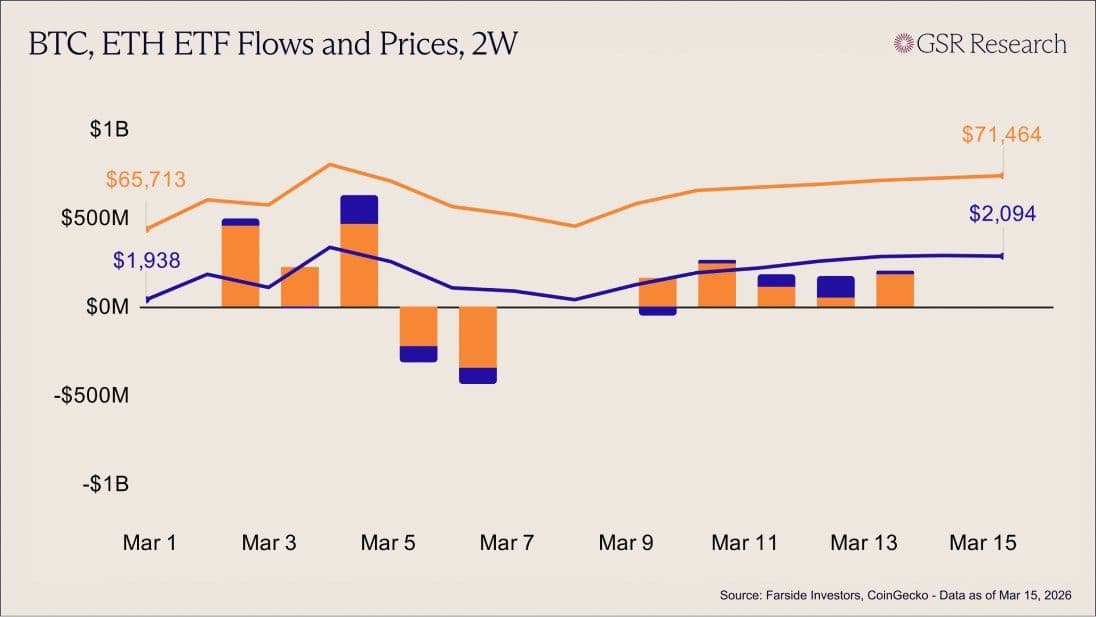
"First all-green BTC ETF week since late Sept 2025 — +$763M net across 5 sessions"
"Ultimately, this war is going to result in tremendous blame for anyone associated with it. It's a no-win scenario to blow up this much infrastructure for so many people. Simply not worth it for whatever objective they thought they were going to attain. But unless you're actually in a position to stop the madness, the pragmatic thing to do is: scramble to mitigate the fallout to yourself, your business, and your people."
$120 Oil, Gold Trapped, Drone Wars, Credit Cracks — Bitcoin Won't Stop
The Last Trade: Jackson, Michael, and Brian break down the US military operation in the Middle East, $120 oil, bitcoin's resilience as a wartime asset, the 20M BTC supply milestone, Kraken's Fed master account, private credit cracking, and the IRS's new crypto audit form.
Travis Kalanick, Tech Layoffs, & the Rebuilding of Everything
Final Settlement: Brian, Michael, and Liam break down Travis Kalanick's return with robotics company Atoms, 90,000 AI-driven layoffs before Q1 ends, McKinsey's AI chatbot getting hacked, Druckenmiller on stablecoins and Bitcoin, Kraken's Fed master account, and why the companies that survive from here will look nothing like the ones that came before.
Onramp provides bitcoin financial services built on multi-institution custody. To learn more about our products for individuals and institutions, schedule a consultation to chat with us about your situation and needs.
Until next week,
Brian Cubellis