Research
Research & insights
In-depth bitcoin research and insights from industry experts. Analysis you won't find anywhere else.
Research
In-depth bitcoin research and insights from industry experts. Analysis you won't find anywhere else.

Brian Cubellis | Chief Strategy Officer
Apr 9, 2026
Last week we mapped the broader rotation away from dollar-based settlement amid ongoing global conflict.
This week, The Financial Times reported that Iran is demanding bitcoin, specifically, for oil tanker passage through the Strait of Hormuz. The prior reporting from Bloomberg had Iran running the same tolling system on yuan and stablecoins. Something may have changed in the intervening week, and that's the story.
Below we unpack why Iran's settlement stack may be migrating from stablecoins to bitcoin, what the kill switch problem reveals about every token with an issuer, and why a sovereign under sanctions pressure reaching for bitcoin is the clearest manifestation yet of what the protocol was built to do. Followed by our standard Chart, Quote, and Podcasts of the Week.
Two caveats up front.
The first is on sourcing. The story that triggered this piece rests on a single named source, a spokesperson for Iran's Oil, Gas and Petrochemical Products Exporters' Union, speaking to the Financial Times. Iran has not formally announced the policy through official state channels, and some of the technical claims in the FT story don't hold up under scrutiny. It's entirely possible this arrangement never materializes in the form described, or quietly gets walked back in the coming days.
The best security available for your bitcoin without the technical burden. It's time to upgrade.
The second caveat is more important. Nothing in what follows should be read as championing sanctions evasion, endorsing the Iranian regime, or rooting for geopolitical conflict as a bitcoin tailwind. What we are doing is observing, honestly, how the world's monetary architecture is evolving under real pressure.
Bitcoin was designed from day one to be neutral, permissionless, and censorship resistant. Those properties don't discriminate between users we like and users we don't. That's precisely what makes bitcoin work as a settlement layer. Bitcoin is for enemies. When an adversarial state begins reaching for bitcoin under sanctions pressure, that's simply a data point in the real-world manifestation of what the protocol was engineered to do.
With both caveats logged, here's why the logic holds regardless of whether the headline survives the week.
According to the Financial Times, Iran will require oil tankers transiting the Strait of Hormuz during the two-week US-Iran ceasefire to pay a toll of roughly $1 per barrel, settled in bitcoin. A fully loaded supertanker could owe close to $2 million. Empty vessels pass free. Tankers email Iranian authorities with cargo details in advance, Iran assesses the ship and sets the fee, and the vessel is then given a short window to settle in BTC before being cleared. Decisions on passage are overseen by Iran's Supreme National Security Council, and maritime analysts expect only 10 to 15 ships per day to transit under the new rules, compared to roughly 135 before the war.
A week earlier, Bloomberg had reported a similar arrangement with one critical difference. In that version, the IRGC was collecting Hormuz tolls in Chinese yuan or stablecoins, primarily USDT. The FT story represents a meaningful shift in that account. Stablecoins are out. Bitcoin is in.
To understand why the bitcoin angle matters, consider what Iran wasn't choosing.
Dollars and SWIFT are off the table by definition, those are the rails being actively used against Iran. Gold has the right monetary properties but can't settle in the minutes a tanker needs to transit a chokepoint. Yuan requires trusting the PBOC and leaves Iran exposed to whatever Beijing decides is politically convenient on any given day. And stablecoins, until very recently Iran's preferred rail, had just revealed their fatal flaw.
Iran's central bank accumulated over half a billion dollars in USDT through 2025. Then Tether started freezing the wallets. Tens of millions tied to the central bank were blacklisted last June, with another tranche linked to IRGC and Houthi networks frozen this past March. Iran learned, empirically and painfully, what bitcoiners have been saying for years. Any token with an issuer has a kill switch, and that kill switch will eventually be used.
So if Iran's settlement stack has quietly migrated from stablecoins to bitcoin, that's revealed preference under adversarial pressure. A sovereign treasury operation ran into a hard constraint and was forced to look further down the spectrum of counterparty risk until it found something that couldn't be frozen by anyone.
Plenty of commentators have pointed out, fairly, that some of the technical claims in the FT story don't stand up. The spokesperson reportedly said bitcoin payments "can't be traced," which isn't right. Bitcoin is pseudonymous and fully traceable on-chain, and OFAC has been sanctioning Iranian BTC addresses since 2018. He also described settlement as happening in "a few seconds," which isn't how base layer bitcoin works. A base layer transaction takes roughly ten minutes to confirm in a block, and multiple blocks for final settlement confidence.
Worth noting though, Lightning Network transactions do settle in seconds, so there's a world in which the quoted settlement time is technically achievable over Lightning. Whether an Iranian oil union spokesperson was making that distinction or just speaking loosely is anyone's guess. Most likely the latter. But the Lightning caveat is a reminder that the bitcoin stack has matured beyond the base layer in ways that make some of these use cases more plausible than a purist reading would suggest.
The bigger point is that the technical garbling obscures rather than undermines the thesis. The property that actually matters to a sanctioned state isn't privacy. It's censorship resistance. Nobody can freeze a bitcoin transaction mid-settlement, reverse it after confirmation, or seize funds from a wallet whose keys they don't hold. Traceability is a surveillance problem you can live with. Confiscation is a property rights problem you can't. Iran cares about the second one, because the second one is what just cost them tens of millions of dollars in frozen USDT.
Gold has monetary properties. The dollar has network effects. Stablecoins have speed and dollar exposure. Bitcoin offers something none of the others can, which is final settlement without a trusted third party. In a unipolar world you don't need that. You just use the hegemon's rails. In a multipolar world, where the hegemon's rails have been weaponized and every alternative comes with its own counterparty dependencies, you need a settlement layer that adversaries can use without trusting each other. The only asset on the menu where the counterparty is math is bitcoin.
This is the point where the reported Hormuz toll stops being about Iran and starts being about the architecture of global settlement itself. A sovereign chokepoint operator, forced into a corner, reached for the one asset that offers unconditional finality. The implementation may be crude. The execution may be chaotic. The policy may even be walked back tomorrow. None of that changes the fact that the decision tree, when traced carefully, leads exactly where protocol believers have been saying it would lead for years. When you remove every trusted intermediary one by one, what you have left is bitcoin.
Whether this particular arrangement ever sees a single tanker settle in BTC is almost beside the point. The fact that it's being seriously discussed, at this level, in this context, by a state under active military pressure, is the story. Bitcoin held its own against physical gold through the early days of the war and is generally outpacing most assets as the conflict drags on.
If the Hormuz story proves out, it pushes the narrative one step beyond store-of-value behavior under stress. It suggests bitcoin is also being considered as a medium of exchange between parties who cannot trust each other and cannot use each other's rails. That's what a neutral reserve asset actually is in practice. Not something everyone agrees to love. Something everyone can transact in without having to agree on anything else first.
Other sanctioned countries are watching. So are the unsanctioned ones, who can do the math on how quickly the sanctioned list can grow. The logic of the protocol doesn't require anyone to believe in it. It only requires that the alternatives remain stagnant or keep getting worse. They will. And the superior neutral reserve asset will continue its quiet coming of age, one stress test at a time.
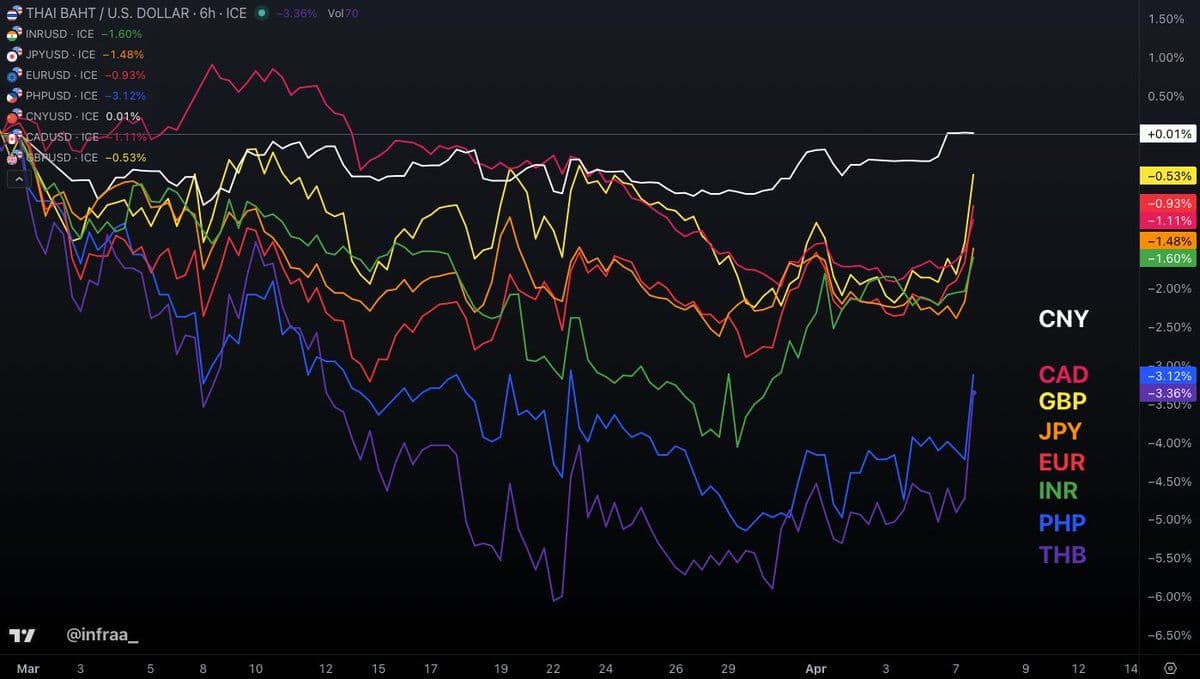
"Interestingly, since the start of the war, the only currency that has not weakened relative to the dollar is the Chinese Yuan. This comes amidst reports of tolls being paid in CNY and significant questions about the underlying foundations of the petrodollar."
“We really wanted to show our commitment by having that lower fee. The demand, especially from the high-net-worth investors, has been quite high. Viewed at the firm level, this is an asset class that is not going away.”
— Allyson Wallace, global head of ETFs at Morgan Stanley
Warren Buffett Just Admitted What Bitcoiners Already Know
The Last Trade: Jackson, Michael, and Brian break down the Google quantum whitepaper hype, the Strait of Hormuz crisis going binary, Oracle's 30,000-person layoff wave, Warren Buffett calling for 0% inflation, and why ground beef at $7 a pound tells you everything the CPI won't.
$280M Stolen, OpenAI Buys TBPN, & Coinbase Joins the Banks
Final Settlement: Michael, Liam, and Brian break down the Drift hack and what it says about digital asset security, then move through quantum threats to bitcoin, OpenAI's TBPN acquisition, New Hampshire's bitcoin-backed muni bonds, Paradigm entering prediction markets, and AI's growing impact on corporate structures.
Quantum Panic, Gold Debate, & AI Cures Cancer
THE ₿ROADCAST EP. 27: Bram, Brian, and Michael follow the incentives behind the quantum panic, make the case for bitcoin's adaptability, and debate gold vs. bitcoin in a fractured settlement landscape. Plus Buffett's truth-telling, the death of diamonds, OpenAI's valuation problem, and whether AI is really about to cure cancer.
Onramp provides bitcoin financial services built on multi-institution custody. To learn more about our products for individuals and institutions, schedule a consultation to chat with us about your situation and needs.
Until next week,
Brian Cubellis