Back to Basics

Brian Cubellis | Chief Strategy Officer
· Updated
Back to Basics is a July 2026 report from Onramp covering bitcoin fundamentals, the shortcomings of paper bitcoin, and the case for accumulating now. With BTC roughly 50% below its late-2025 high while equities and gold sit near records, the report argues this is an unusually attractive time to buy real bitcoin on a fixed schedule and hold it in cold storage. Onramp supports that approach with three independent institutions protecting the assets, so that no single party can lose them.
The Full Report
The full text of Back to Basics, first published by Onramp Research on July 16, 2026.
Bitcoin fundamentals, the limits of paper exposure, and the case for accumulating now
Introduction
Bitcoin trades today at about half of its late-2025 high, even as equities and gold stand at or near records of their own. For a different asset, that divergence might signal trouble. For bitcoin, whose supply is fixed and whose adoption remains at a relatively early stage, it has more often marked an opportunity than a warning.
Periods like this one, when prices are subdued and attention has moved elsewhere, are a useful time to return to first principles. What follows is organized in three parts. The first reviews ten ideas that underpin the case for owning bitcoin. The second explains why owning the asset directly is materially different from holding one of the many instruments that track its price. The third sets out the data that makes the present moment an unusually attractive one in which to accumulate.
Part I. The Basics
1. Money is a technology for storing value over time
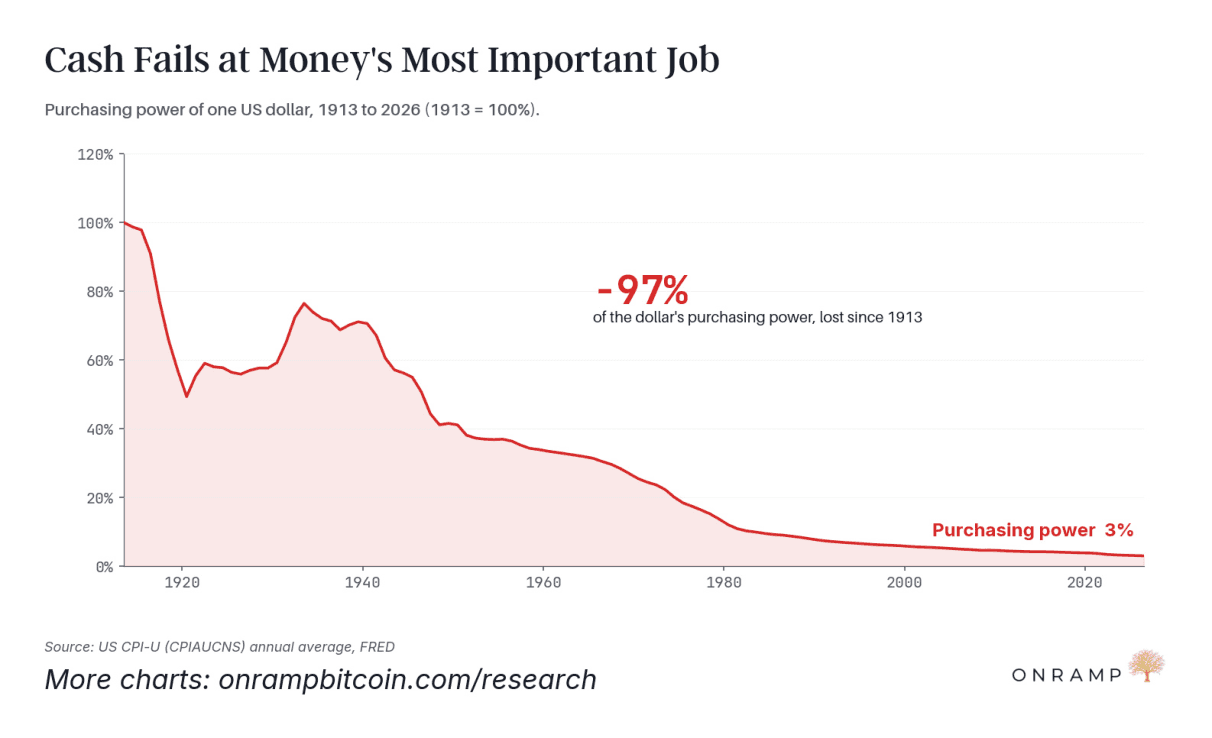
Money serves several functions, but the one that matters most to a saver is its capacity to store value over time. A sound money allows a person to convert present effort into a claim on future goods and to hold that claim, intact, until it is needed. Judged against this standard, the cash most people hold performs poorly. It works well enough as a medium of exchange, but as a means of preserving wealth across years or decades it has a long record of erosion.
This shortcoming is easy to overlook, because the unit of account so rarely changes. Wealth is measured in dollars, prices are quoted in dollars, and incomes arrive in dollars, so the currency itself recedes into the background and is seldom examined as an asset in its own right. Holding cash is nonetheless a position like any other. It carries an expected return, and over long horizons that return, measured in purchasing power, has been negative.
2. Fiat currencies are designed to lose value
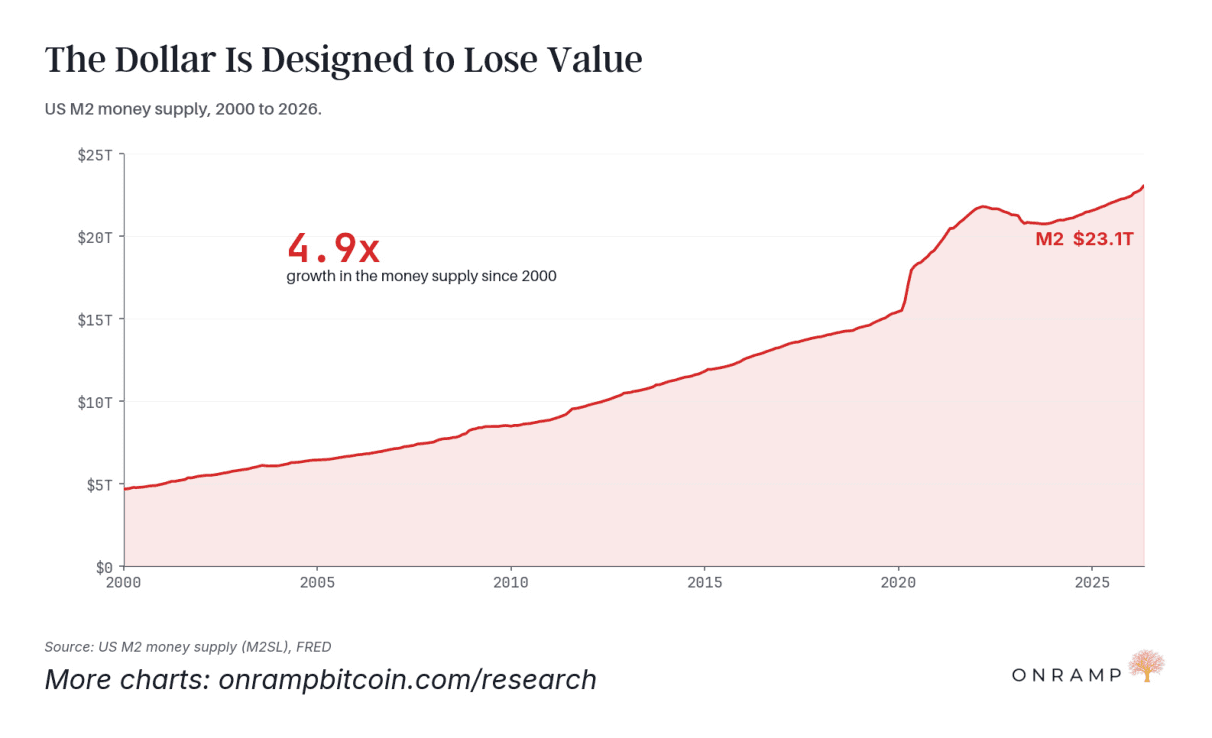
The decline in the dollar’s purchasing power over the past century is a matter of design rather than mismanagement. The monetary system rests on a money supply that expands over time, and as the supply grows, each existing unit commands a smaller share of the available goods. Central banks treat a steady, moderate rate of this erosion as an explicit objective, which suggests that the loss of value is a policy choice rather than an accident.
The effects of monetary expansion are distributed unevenly. Those who receive newly created money first, governments financing deficits and the institutions closest to them, transact before prices have adjusted, while holders of existing balances bear the cost through a weaker currency. The same pressure works against instruments commonly regarded as conservative, since a bond returns a fixed sum in a currency that is itself depreciating. Because the wider system carries debts that can be serviced only if the currency continues to weaken, the incentive to expand the supply is structural and durable. For a saver, the practical conclusion is to hold some portion of wealth in an asset whose supply cannot be enlarged.
3. Scarcity gives money its integrity
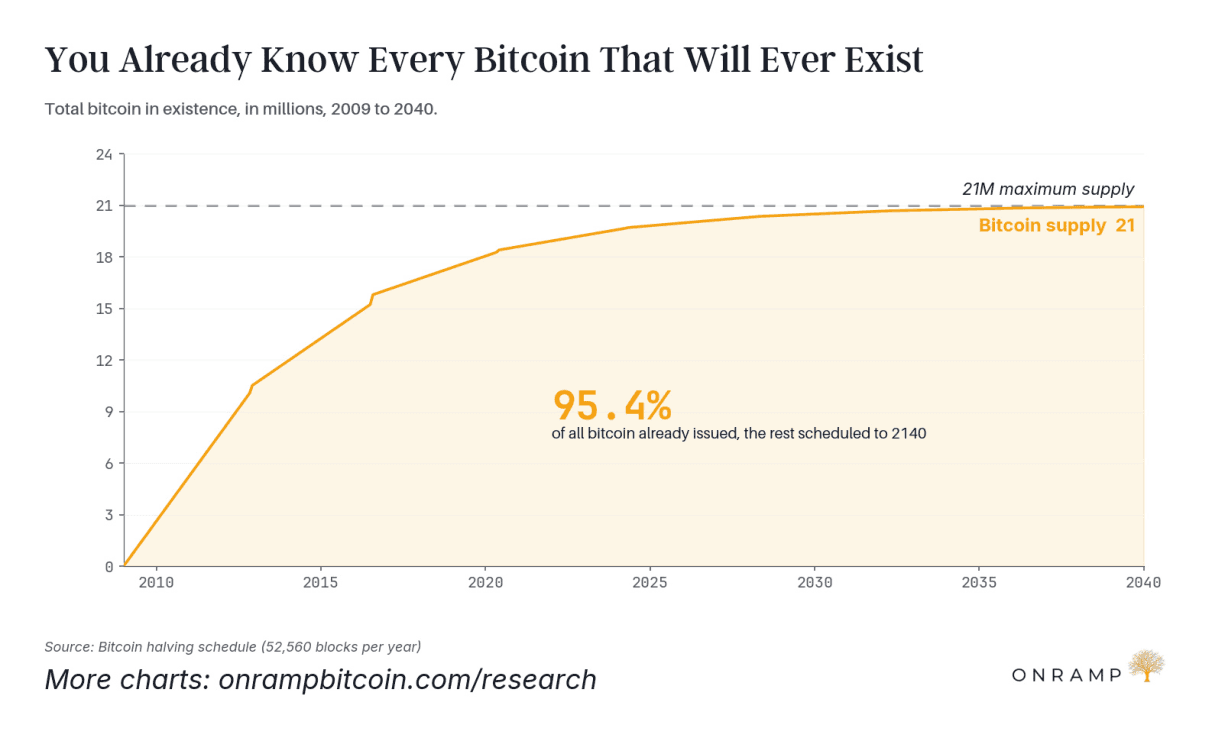
Gold functioned as money across many centuries largely because its supply could not be increased at will. New gold entered the market slowly, and that constraint gave holders confidence that their savings would not be diluted. Bitcoin adopts the same principle and carries it to an absolute limit. The protocol permits a maximum of 21 million units, the figure is fixed in the network’s rules, and no authority has the ability to raise it.
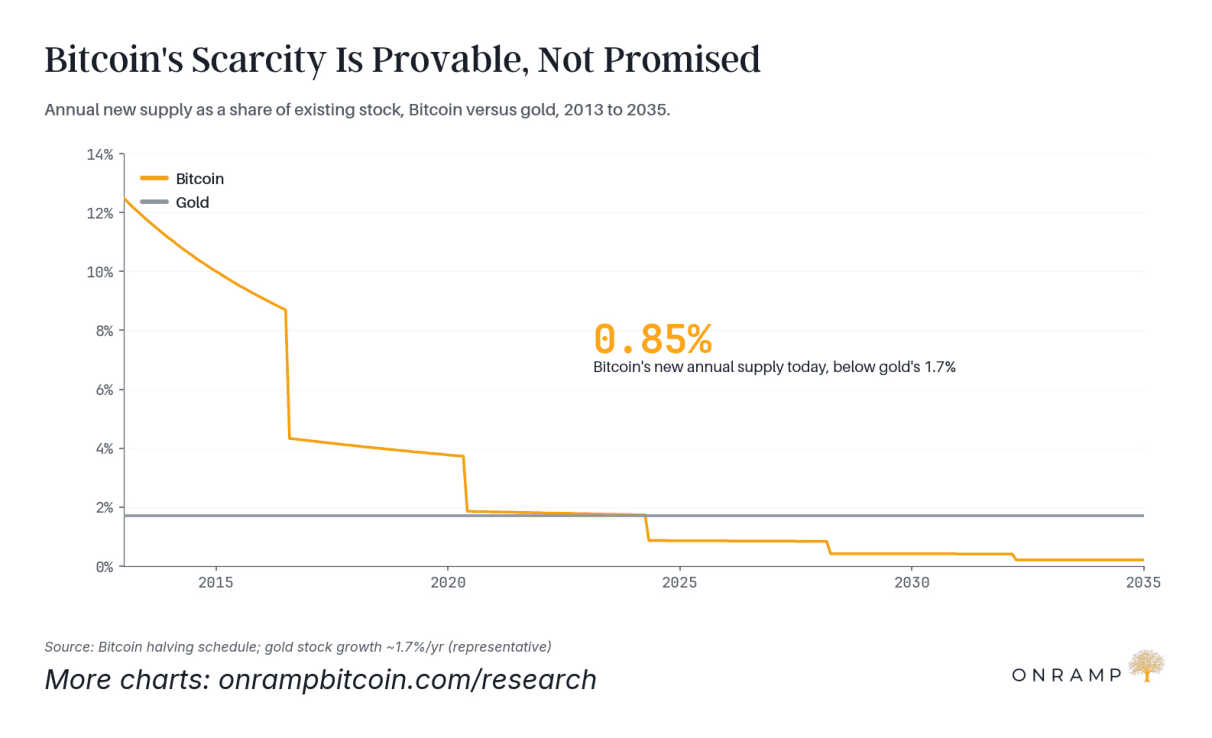
What sets bitcoin’s scarcity apart is that it can be verified rather than merely trusted. Most assets described as scarce can in fact be produced in greater quantity when conditions warrant, and even gold’s above-ground stock grows by roughly one to two percent each year through mining. Bitcoin’s rate of new issuance only declines, and the cap is enforced by the same distributed network that secures the ledger. The outcome is a scarcity that any participant can confirm independently and that no single party can revoke.
4. Bitcoin’s supply follows a fixed, public schedule
New bitcoin is issued to the miners who secure the network, and the size of that issuance is reduced by half approximately every four years, in an event known as the halving. The schedule continues until issuance reaches zero, an endpoint expected around the year 2140. Because the rules are public and fixed, the entire future supply of bitcoin can be calculated today with precision.
This stands in contrast to the discretionary character of fiat issuance, in which the quantity of money is adjusted in response to economic conditions and expanded considerably during periods of stress. Bitcoin’s issuance permits no such discretion. As the block reward diminishes toward zero over the coming decades, transaction fees are expected to compensate miners for securing the network, and the rate of new supply falls below that of gold and beneath the inflation rates central banks target. The value of this arrangement to a long-term holder lies in its predictability, since the future scarcity of the asset is not subject to revision.
5. Decentralization makes the rules credible
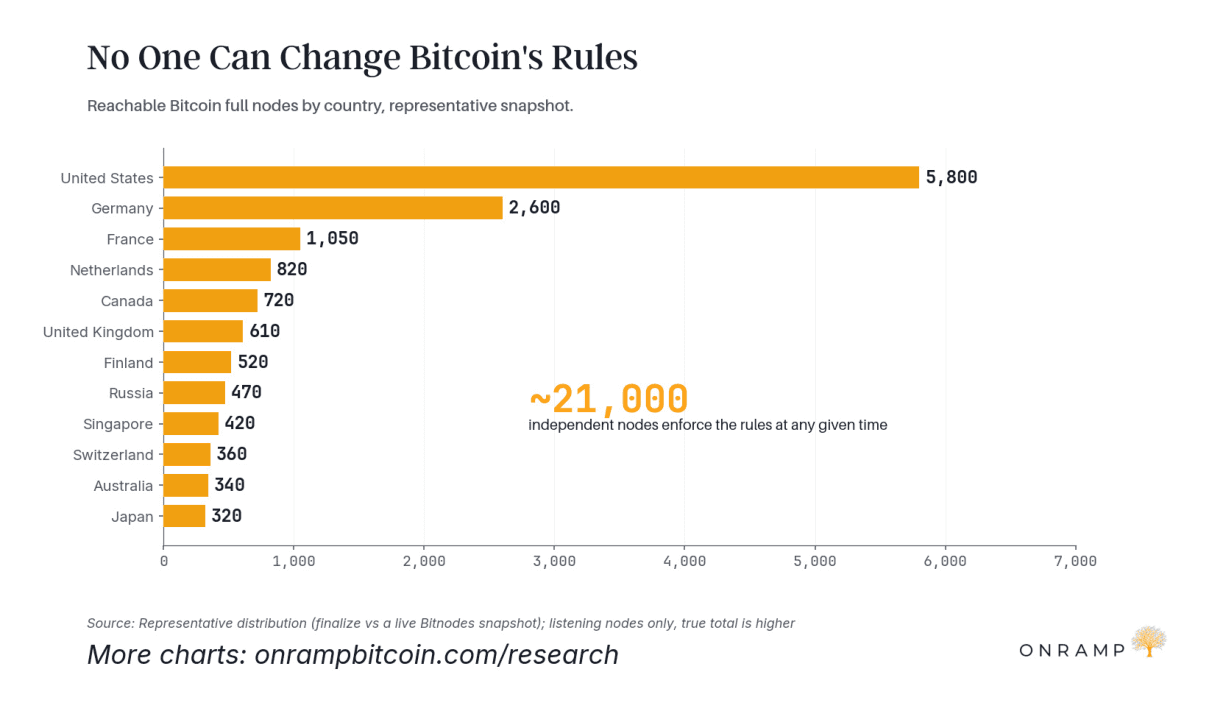
A monetary rule is meaningful only if it cannot easily be broken. Bitcoin’s supply limit and issuance schedule are credible because they are enforced by a large number of independent participants, each running software that rejects any transaction or block that violates the rules. There is no central administrator and no governing body empowered to alter the terms. This is the specific sense in which the protocol is described as trustless: participants need not rely on the good faith of any institution, because the network itself confirms that the rules have been observed.
Authority within the system rests with users rather than with miners or firms. Miners assemble and propose new blocks, but the broader population of users running full nodes determines which blocks are accepted, and a block that breaks the rules is rejected regardless of the resources spent to produce it. The cost of operating a node is low enough that an ordinary individual can verify the state of the network without relying on a third party. On the occasions when influential parties have sought to change bitcoin’s core rules, this dispersed base of users has proven decisive in preserving them.
6. Proof of work secures the network and uses energy productively
Bitcoin’s ledger is protected by a mechanism called proof of work, under which miners expend energy competing to add each new block. This expenditure is what makes the transaction history costly to produce and prohibitively expensive to alter, since rewriting past records would require an attacker to outspend the combined effort of every honest participant. The network’s security is, in effect, purchased with energy.
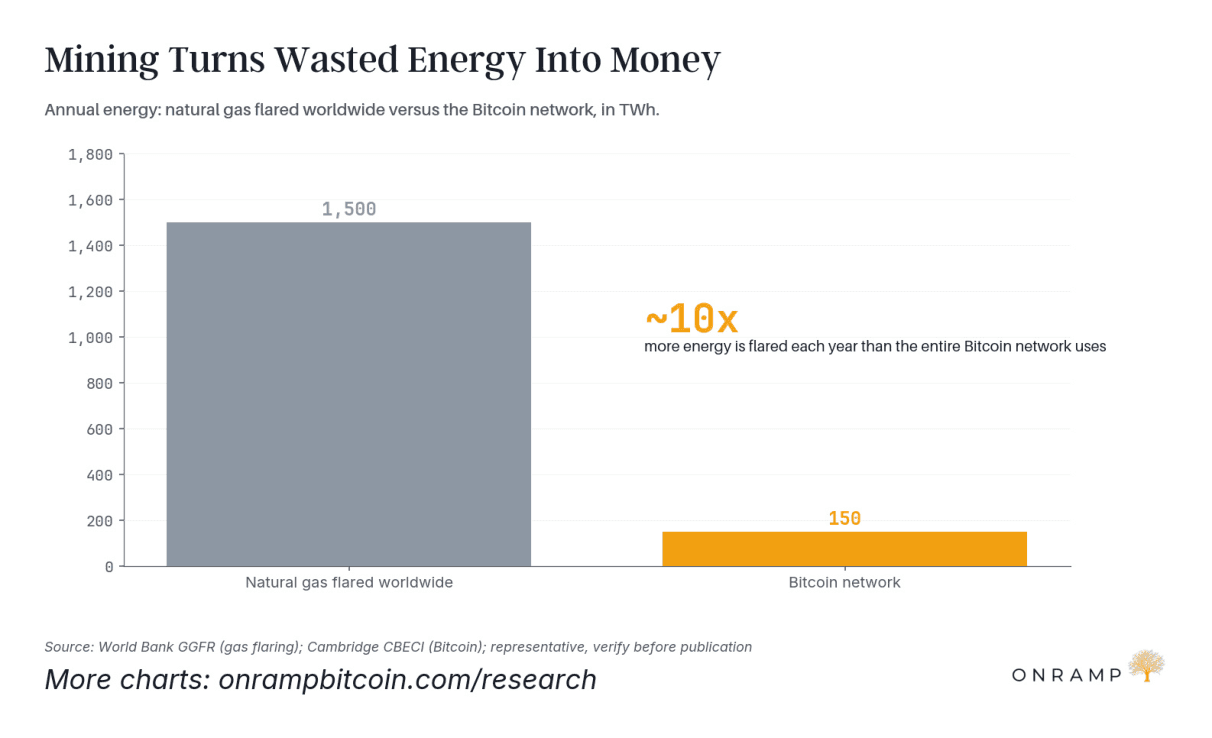
The character of that energy use is more constructive than its critics tend to acknowledge. A miner can begin or halt operation almost instantly and can locate wherever power is available, including places far from any population center. This mobility is genuinely novel, in that it allows energy to be converted into a globally tradable monetary good from virtually any location, without the supporting infrastructure that other industries require. In practice, miners frequently consume power that would otherwise be wasted, including natural gas flared at remote well sites and surplus output from hydroelectric, wind, and solar facilities during periods of weak demand. Because mining can be interrupted on short notice and sited almost anywhere, it provides a flexible source of demand for stranded or intermittent power, which can improve the economics of energy production and give grid operators a load they are able to curtail when consumption rises.
7. Bitcoin extends gold’s monetary role into a digital form
Gold prevailed historically as a monetary metal because it was scarce, durable, and difficult to counterfeit, and these same properties explain why central banks continue to hold it. Bitcoin assumes that role while improving on the attributes that limited gold’s usefulness. It can be transferred across the world within minutes, divided into very small fractions, audited by any observer, and authenticated by the network rather than by a specialist. The relationship is one of succession rather than replacement, and gold remains a credible store of value that can reasonably be held alongside bitcoin.
Gold’s limitations, tolerable in earlier eras, have grown more consequential in a digital and globalized economy. It is cumbersome to move, difficult to divide precisely, and effectively impossible for an individual to audit when held in distant vaults, which is part of why so much of it came to be concentrated in the reserves of states and large banks. Those same institutions have been accumulating gold at a notable pace in recent years, an indication that demand for a neutral store of value outside the fiat system remains substantial. Bitcoin meets that demand with fewer frictions, and its monetization is proceeding over years and decades rather than the centuries that gold required.
| Property | Gold | Bitcoin |
|---|---|---|
| Supply | Grows 1 to 2% a year | Capped at 21 million |
| Divisibility | Coarse, hard to split | To 1/100,000,000 |
| Portability | Heavy, costly to ship | Sent worldwide in minutes |
| Verifiability | Needs an assay | Anyone can verify |
| Counterfeiting | Can be diluted or plated | Impossible to forge |
| Custody | Vaults, states and banks | Self-custody by anyone |
Gold and Bitcoin across the properties of a monetary good.
Source: Monetary properties of gold and Bitcoin
8. Volatility is a feature of early monetization, mitigated by time
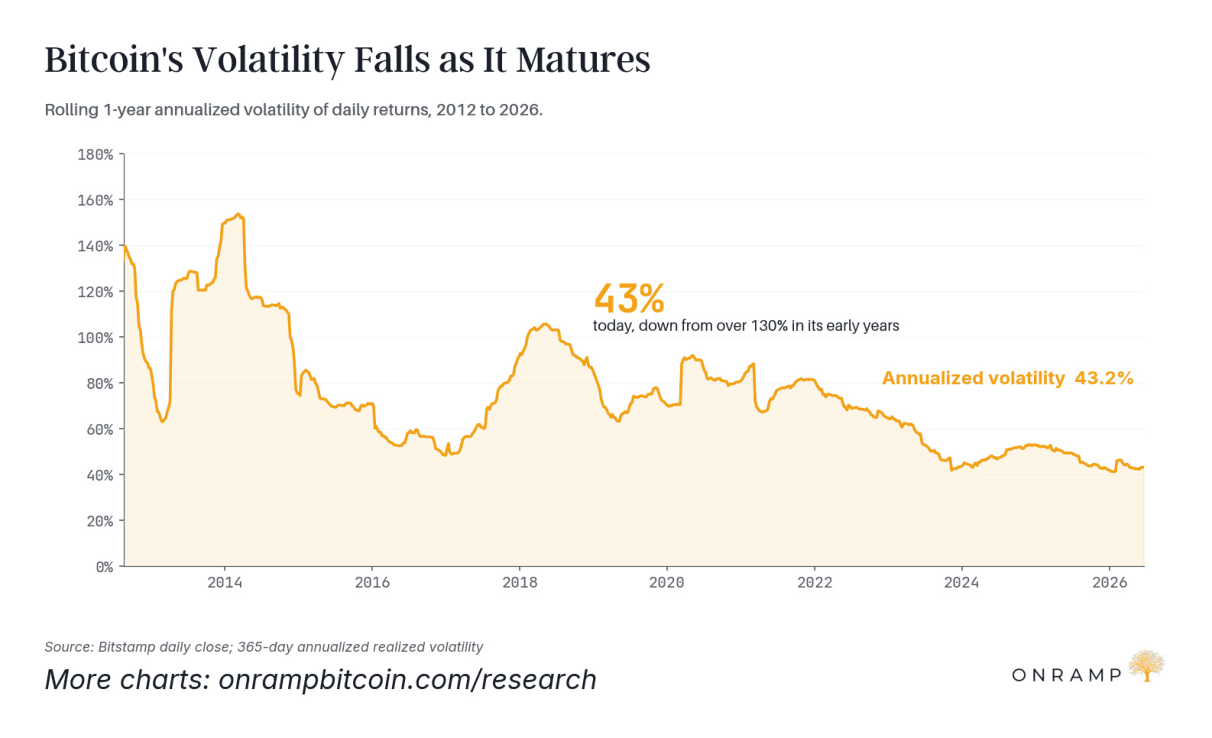
Bitcoin’s price is volatile, and that volatility reflects its standing as an asset still being adopted and still being priced by a market in the process of assessing it. Declines of fifty percent or more have occurred several times, and on each prior occasion the subsequent recovery eventually carried the price beyond its former peak. The investors who have fared best have generally been those with horizons long enough to allow these fluctuations to resolve, rather than those attempting to anticipate them.
For this reason a mechanical approach to accumulation has tended to outperform a discretionary one. Purchasing a fixed amount at regular intervals (or “Dollar Cost Averaging”) removes the need to identify market bottoms and allows lower prices to work in the buyer’s favor, since each contribution acquires more bitcoin when the price is depressed. Volatility operates in both directions, and periods of decline transfer holdings from less patient owners to more patient ones. An investor can manage the experience by sizing the position so that a significant drawdown remains tolerable, and by recognizing that for someone still accumulating, lower prices are an advantage. Over a sufficiently long horizon, the volatility characteristic of an asset being monetized in real time tends to diminish.
9. Owning bitcoin differs from owning a claim on it
A substantial share of what is bought and sold under bitcoin’s name is not bitcoin but a claim on it: a fund share, a balance held at an exchange, or a structured product that represents the asset indirectly. Such instruments can track bitcoin’s price closely, and several serve legitimate purposes, but each is an obligation of a counterparty on whose solvency and conduct the holder comes to depend.
The distinction tends to remain abstract until a period of stress makes it concrete. The recent difficulties among certain bitcoin-linked credit products illustrate the point, in that the holders of a wrapper under strain discover that exposure to bitcoin’s price is not equivalent to possession of the asset. Bitcoin was created precisely to allow value to be held without reliance on an intermediary, and a paper claim reintroduces the dependency the asset was designed to remove.
| Bitcoin you hold | A claim on it | |
|---|---|---|
| What you hold | The asset | An IOU |
| Who holds the keys | You | A third party |
| Counterparty risk | None | Yes |
| If the custodian fails | Unaffected | At risk |
| Settlement | Final, on-chain | A ledger entry |
| Access | Permissionless | Gated |
What you actually hold: bitcoin versus a paper claim on it.
Source: Direct ownership versus claims on bitcoin
10. Real ownership means holding bitcoin in cold storage
Having chosen to own bitcoin rather than a claim on it, the holder must decide how to custody it. The protocol may be trustless, but custody is a practical matter of managing trust, since the keys that control the asset must reside somewhere. The meaningful distinction is between holding bitcoin in cold storage under keys the owner controls and entrusting it to a single custodian or a paper instrument. The former constitutes genuine ownership, and it can be achieved through self-custody, through collaborative custody in which a partner assists with securing and recovering keys, or through multi-institution custody in which control is divided among several independent parties.
Among these approaches, multi-institution custody is well suited to wealth intended to be held for long periods or passed across generations. It preserves the assurance of cold-storage ownership while distributing keys across independent institutions, so that no single party can move the assets and no single failure can result in their loss. It is also the most practical option for the many holders who would rather not manage keys themselves, since it provides genuine ownership without requiring a household to operate its own security infrastructure. This is the model around which Onramp is built.
| Single custodian | Self-custody | Collaborative | Multi-institution | |
|---|---|---|---|---|
| Real ownership | No | Yes | Yes | Yes |
| Counterparty risk | Full | None | None | None |
| Long-term ready | No | Yes | Yes | Yes |
| Keys held by | Custodian | You alone | You + partner | Institutions |
| Key management | Theirs | You run it | Shared | Hands-off |
Four ways to custody bitcoin, each with its own trade-offs.
Source: Bitcoin custody models
Part II. Paper Bitcoin
The substitution
Over the past several years, the distinction between owning bitcoin and owning an instrument that tracks its price has eroded in the public mind. The various wrappers were introduced for sensible reasons, chiefly to make exposure convenient and to allow it to be held within existing brokerage and retirement accounts. In time, however, the claim came to stand in for the asset, and many investors who consider themselves bitcoin owners in fact hold a promise issued against it. The two are not equivalent, and the difference becomes apparent under stress.
What direct ownership provides
The case for holding bitcoin directly rests on a set of properties that no wrapper conveys. Bitcoin is a bearer asset, which means that control of the keys constitutes ownership in full, with no account to be approved and no external party able to reverse, freeze, or reclaim the holding. It is also a form of outside money, an asset that is no one’s liability and that exists apart from the network of credit and counterparties through which the rest of the financial system operates. These characteristics are what allow bitcoin to be verified by any holder, transported across borders as a memorized phrase, and settled with finality irrespective of the decisions of banks or governments.
A paper claim returns this outside money to the interior of the system. As soon as bitcoin is held as a fund share, an exchange balance, or a structured payout, it becomes the liability of an issuer, and the holder is once again situated within the counterparty network that bitcoin was designed to circumvent. What remains after this transformation is the price, a beta to bitcoin that rises and falls with the asset, while most of the properties that gave the asset its distinctive value are surrendered. The exchange is an unfavorable one, because price exposure is the most easily replicated part of the proposition. Exposure to a price can be obtained by many means, whereas the bearer quality, the absence of a counterparty, and the finality of settlement cannot, and these are precisely what the wrapper removes.
This is not to suggest that such instruments are fraudulent. Many are administered by capable and reputable firms and function exactly as described. The difficulty is structural rather than ethical, since even a faultlessly managed claim introduces layers, a custodian, an administrator, a counterparty, that the asset itself does not carry, and any of these can fail for reasons unrelated to bitcoin. The instruments also differ in how far they sit from the underlying asset. A balance at an exchange is the obligation of a platform that may have lent the coins elsewhere; a fund share is a claim upon a fund that in turn holds a claim with a custodian; a yield-bearing product passes a borrower’s risk to the holder in the form of a return; a share in a bitcoin-holding company embeds the asset within a business carrying its own leverage and dilution; and the engineered credit instruments now under visible strain behave in practice like equity presented in the form of a bond. With each step away from the asset, the holder gains some measure of convenience, yield, or leverage and accepts an additional party between themselves and their bitcoin.
The two arguments used to justify paper exposure
Most arguments for holding paper rather than bitcoin reduce to one of two claims about the investor, each presented as prudence. The first holds that individuals cannot be trusted to custody the asset themselves, that managing keys is too difficult and too hazardous, and that a managed structure is therefore the safer course. The underlying risks are real, but the appropriate response to a difficult custody problem is to select a custody arrangement suited to one’s circumstances, not to relinquish ownership. Self-custody is attainable for anyone willing to learn its requirements, and for those who would rather not manage keys, multi-institution custody makes cold-storage ownership accessible by distributing keys among independent parties, removing any single point of failure and lifting the operational burden from the holder, while still allowing them to retain control. Addressing the custody question by surrendering ownership solves the wrong problem.
The second claim holds that the investor cannot withstand the asset’s volatility and requires a wrapper to make it bearable. This argument is weaker still, because the wrapper does not in fact reduce the volatility; a fund share moves with the asset, and a share in a bitcoin-holding company often moves more sharply once its premium begins to fluctuate. Volatility is in any case more manageable than the argument allows. By sizing a position so that a substantial decline remains tolerable, and by recognizing that lower prices benefit anyone still accumulating, an investor can treat volatility as a condition to be managed rather than one to be avoided. It is, moreover, an ordinary feature of an asset being monetized in real time, and it tends to moderate as that process advances. The wrapper offers relief from a difficulty the investor was already equipped to handle, and it charges the asset’s essential properties as the price of that relief.
Part III. The Market Opportunity
The fundamentals establish why bitcoin is worth owning, and the preceding section explains why it is worth owning directly. The remaining question concerns timing, and here the current data is informative. Four observations are relevant: the modest depth of the present drawdown relative to bitcoin’s history, the pattern of recoveries that have followed comparable declines, the results of steady accumulation measured against other assets, and the unusual circumstance of bitcoin trading at a discount while most other assets stand at record highs.
The present drawdown is modest by historical standards
The current decline is severe enough to weigh on sentiment, which by conventional measures sits in territory associated with fear, and the price rests near its long-term moving average. Measured against bitcoin’s own history, however, a decline of roughly one half is comparatively shallow. Each of the major bear markets that preceded it was substantially deeper, and each was followed, in time, by a new all-time high.
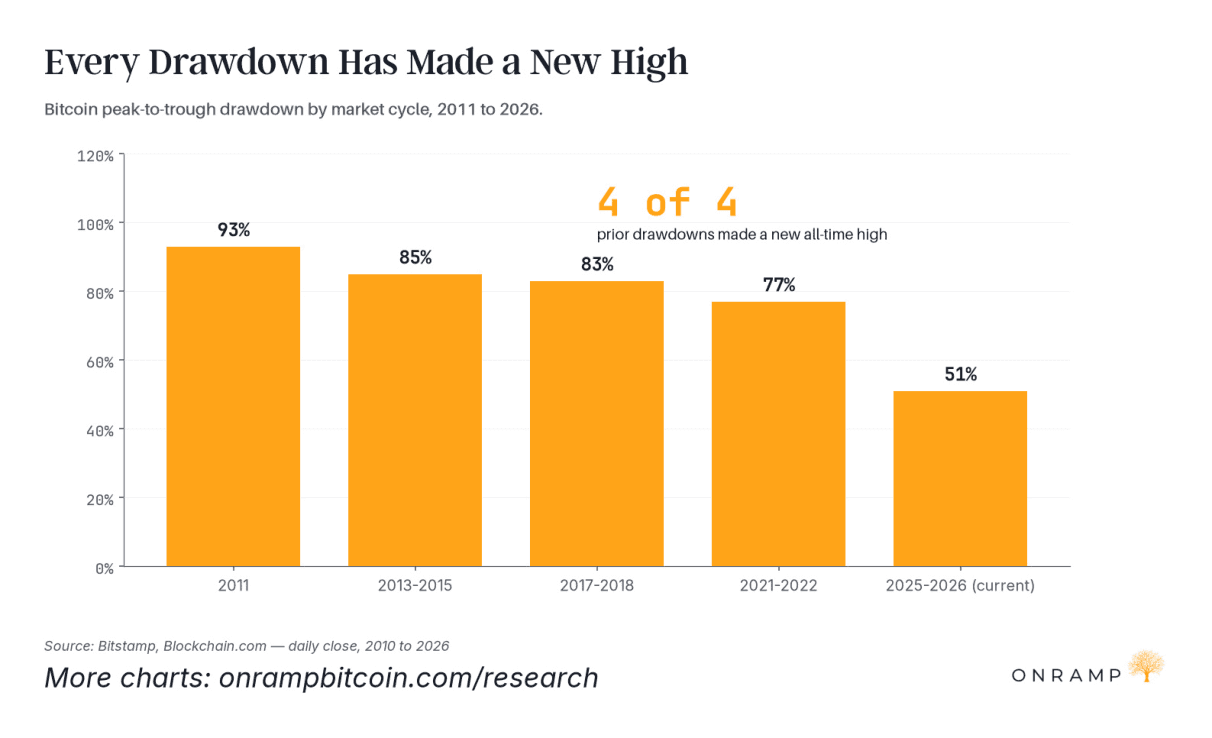
This history does not rule out a further decline, which is always possible. It does indicate that investors who purchased while bitcoin stood well below its peak, during periods of pronounced pessimism, have generally been rewarded for their patience.
Recoveries have followed comparable declines
Bitcoin has tended to move in extended cycles of broadly similar shape. The price advances to a peak, declines as later buyers capitulate, consolidates over a period of months, and subsequently recovers to and beyond its prior high. The present cycle stands roughly seven months past its peak and approximately one half below it, which places it at an earlier and shallower stage than the equivalent points in previous cycles.
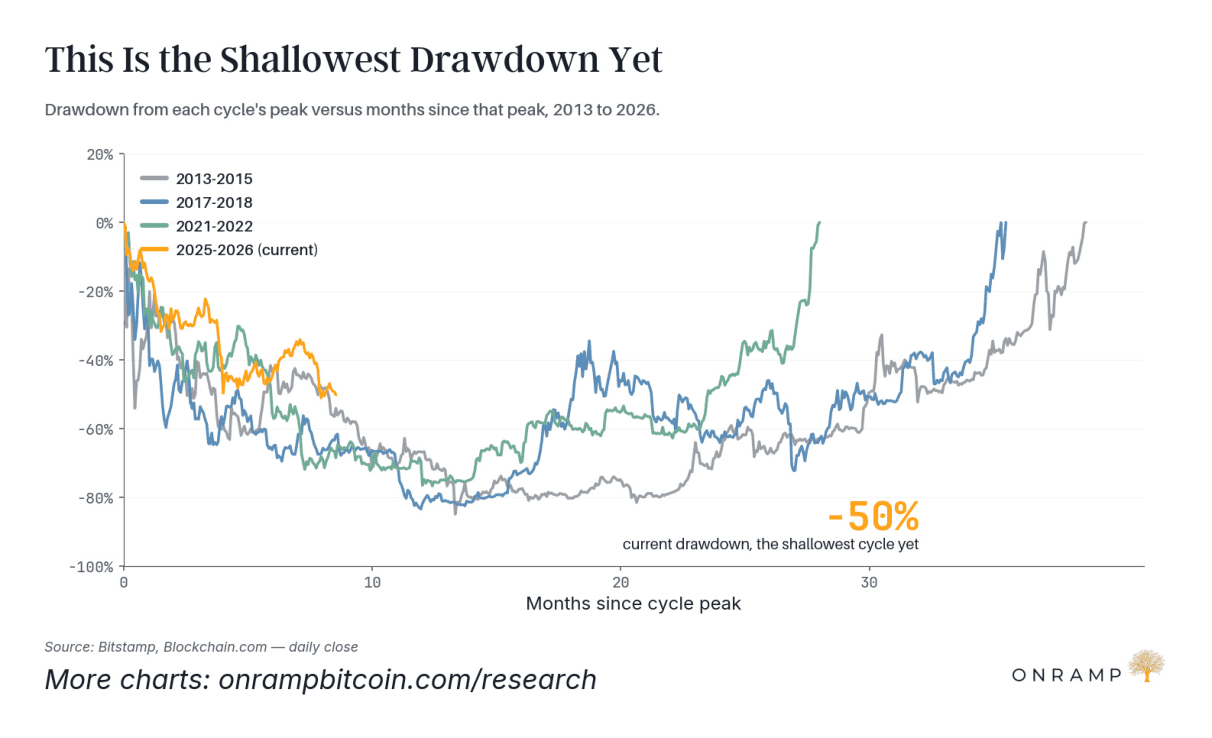
No cycle is bound to repeat, and historical patterns offer guidance rather than assurance. What the record suggests is that the moments least comfortable to buy into have, with the benefit of several years, frequently proven the most consequential.
Steady accumulation has compared favorably
For a volatile asset undergoing monetization, accumulation on a fixed schedule is a more defensible approach than attempting to time entries, and it is the method the campaign’s new recurring-purchase functionality is intended to support. Contributing a fixed sum at regular intervals removes the need for prediction and allows price weakness to benefit the buyer. Measured over the past five years, this approach applied to bitcoin has compared favorably with the same approach applied to other major assets, notwithstanding bitcoin’s current discount to its high.
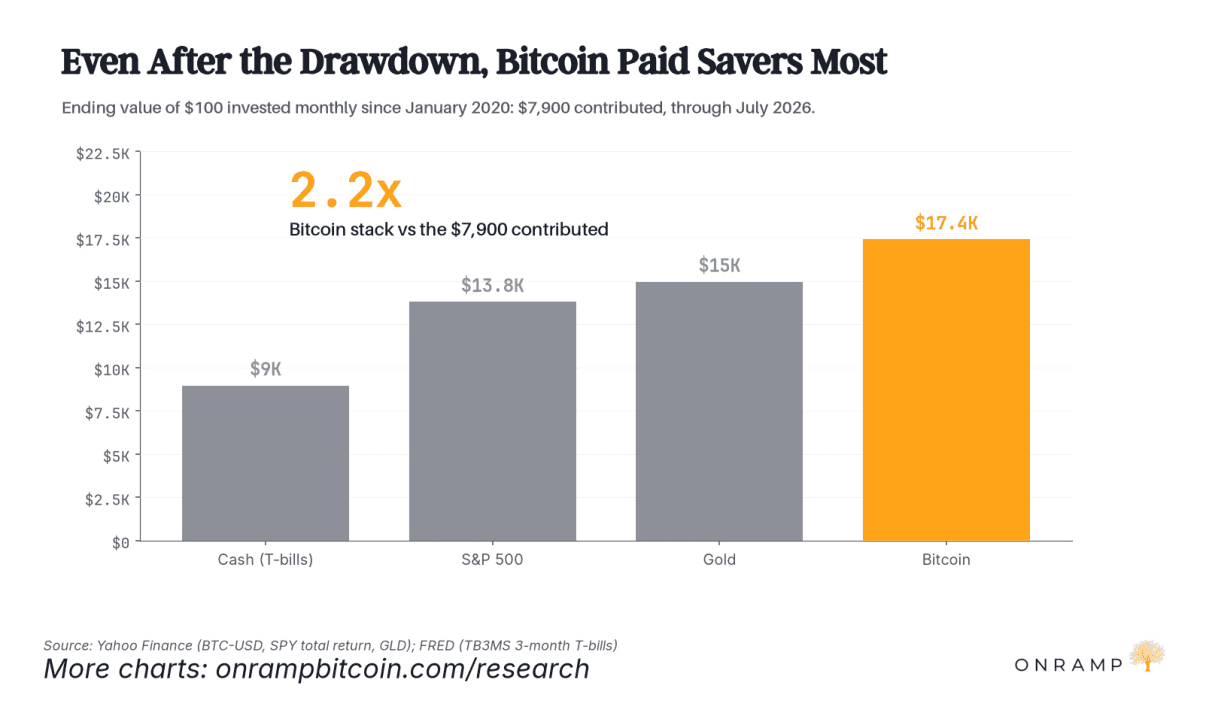
An accumulating investor need not have bitcoin at its peak to be in profit, because a meaningful portion of the contributions were made at considerably lower prices, and a decline of the present kind is typically when the most productive accumulation occurs.
Bitcoin is discounted while other assets are not
The most notable feature of the present market is less bitcoin’s decline in isolation than the context surrounding it. Equity indices are at or near record highs, gold stands close to its own peak, and equity-market volatility is low, conditions that together describe a market priced richly across most assets. Within that environment, bitcoin is among the few major assets available at a meaningful discount to its level of only months earlier.
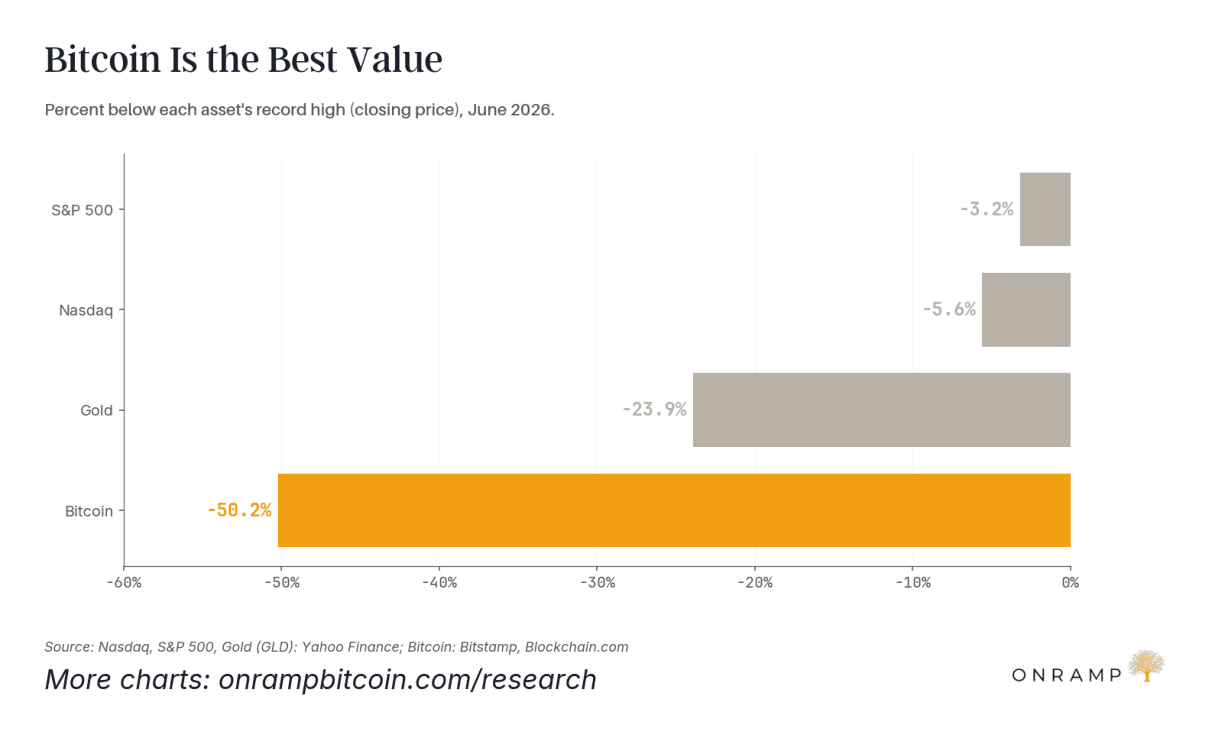
For an investor weighing where to direct additional savings, this comparison is central. One may purchase assets at their highs, with sentiment elevated and little margin of safety, or acquire the asset whose long-term thesis remains intact and whose price has fallen by half while sentiment is subdued. The fundamentals set out in the first part of this report are unaffected by the decline in price. A lower price on an asset of fixed supply and expanding adoption is, if anything, the thesis operating in the investor’s favor.
Conclusion
Bitcoin’s fundamentals are independent of its price, and they continue to strengthen as the network matures, adoption broadens, and the asset becomes better understood. Bitcoin remains a fixed-supply monetary asset, secured by energy and enforced by a distributed network, that carries forward the role gold has performed for millennia in a form suited to a digital economy. It rewards direct ownership and a long holding period, and the difference between holding the asset and holding a claim against it has real consequences for the owner.
This summer, Onramp is getting back to the basics. With bitcoin trading at half its peak while nearly everything else sits at a record, there has rarely been a better moment to stack real bitcoin at a discount instead of settling for a paper claim on it. The approach is simple and requires no forecasting: buy on a regular schedule while prices are low, and hold what you accumulate in custody you genuinely control, distributed across independent institutions so that no single party can move it and no single failure can lose it. That is the substance of getting back to the basics: to own real bitcoin, held in a manner that no single party can compromise, and to begin while the price remains favorable.
Get back to basics with Onramp
The approach the report recommends requires no forecasting: buy on a regular schedule while prices are low, and hold what you accumulate in custody you genuinely control.
Onramp is making that easier to act on, with recurring buys at no cost, alongside Multi-Institution Custody, secured by three independent institutions, so no single party can move your bitcoin and no single failure can lose it.