The Legacy Layer: Bitcoin IRAs & Estate Planning

Glenn Cameron | Global Head, Onramp Institutional
Retirement planning and inheritance planning are the same exercise on different horizons: storing value today so it arrives intact decades from now. This report examines the four ways to hold bitcoin in a retirement account, what each wrapper does at death, and the one variable that should never change as the planning grows more sophisticated.
The Legacy Layer, part of Onramp's New Money Stack research series, argues that the custody architecture holding a bitcoin position should stay constant while the tax wrapper around it changes, from IRA to beneficiary designation to trust to perpetual dynasty structure, with no single point of failure at any stage.
The report's three conclusions
1. An IRA is an excellent wrapper for building a position and a poor one for passing it on. Nothing inside an IRA is taxed while the owner lives, which makes it the right home for a bitcoin position during the accumulation decades. At death, most heirs must empty an inherited IRA within ten years, and bitcoin held in an IRA gets no step-up in basis, unlike bitcoin held outside one.
2. Over generational horizons, custody is the primary variable. A South Dakota dynasty trust has no expiry date. The common-law rule it replaced capped trusts at roughly a century. No exchange, single custodian, or piece of consumer hardware has existed for even fifteen years. When the asset and the strongest legal structure are both built to last indefinitely, how the asset is custodied inside that structure is the question that needs solving.
3. The custody architecture should not change as the tax wrapper changes. Beneficiary designation, trust titling, and perpetual dynasty structures can all apply to the same bitcoin in the same custody solution. This dissolves the historical trade-off in which every step toward better estate planning meant a step backward on custody.
Secured for you. Ready for them.
Planning in decades
Every financial instrument encodes an assumption about time
Since the United States ended gold convertibility in 1971, the dollar has lost roughly 87% of its purchasing power, and the American saver has been taught to shorten their horizon accordingly. The response is visible in current data: Robinhood now earns more from options than from equities, zero-day options have reached a record 48% of retail options volume, and the two largest prediction markets traded $44.8 billion in a single month of 2026.
Bitcoin reverses that arithmetic. An asset with a fixed terminal supply, no issuer, no maturity date, and no counterparty at the asset layer is one of the few things an ordinary person can hold with a horizon measured in generations. The comparison that matters is the horizon of the container against the horizon of the asset.
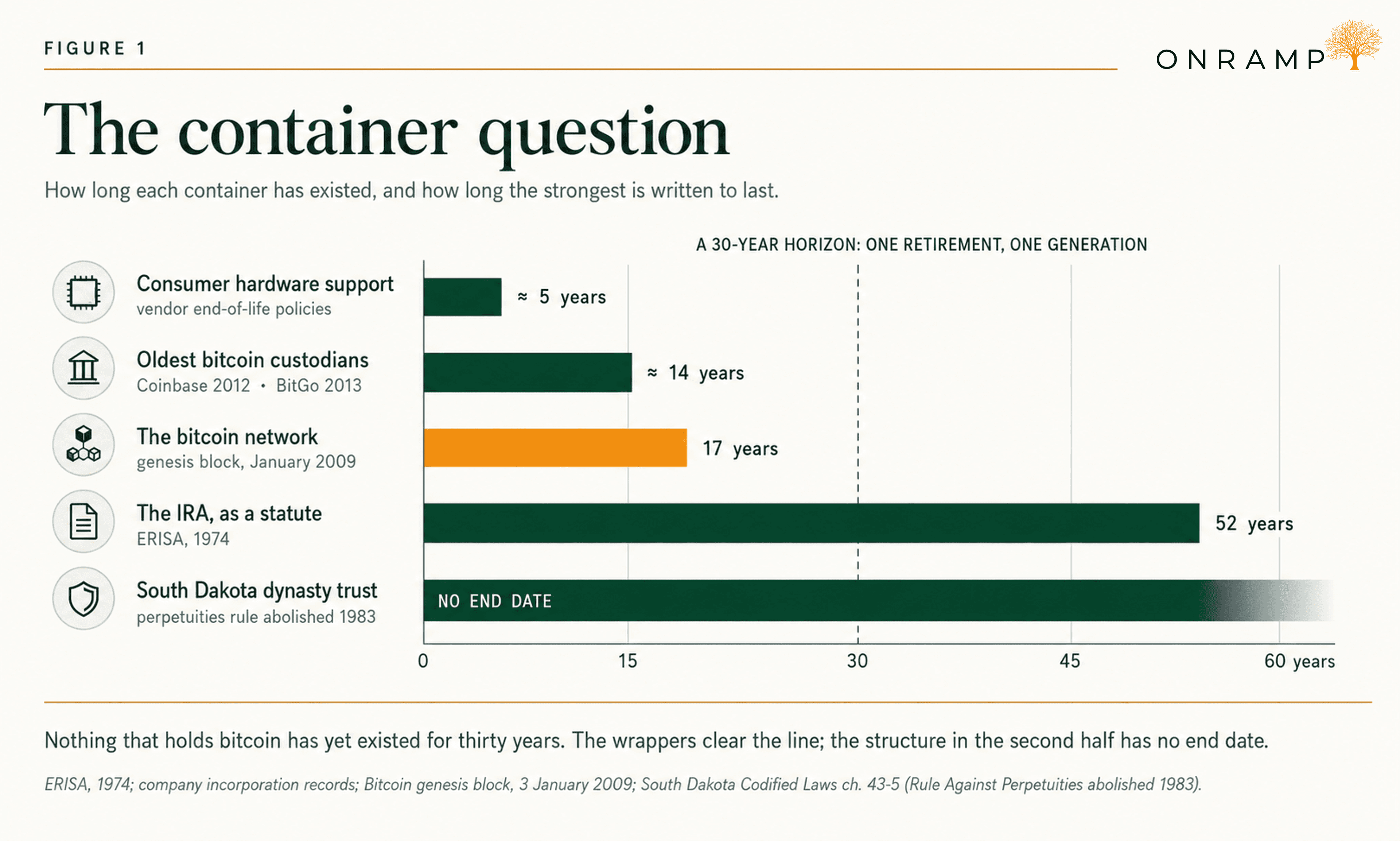
Nothing that holds bitcoin has yet existed for thirty years. The legal wrappers clear the line. The structure with no end date is the one the second half of the report is built around.
The universe of bitcoin IRAs
There are four ways to hold bitcoin in a retirement account
Exchange-traded fund exposure inside an ordinary brokerage IRA is the least expensive route and transfers cleanly at death through standard beneficiary designations. A single-custodian self-directed IRA holds actual bitcoin through an established provider with simple onboarding. A collaborative multisig IRA lets the client participate in the signing quorum directly. A Multi-Institution Custody IRA holds actual bitcoin behind a 2-of-3 quorum of independent institutions, with no key material held by the client and no single institution able to move the position alone.
Those are the only four options because of what the law requires. In McNulty v. Commissioner (2021), the Tax Court ruled that an IRA owner who took personal possession of the account's assets had taken them out of the IRA and owed tax on their full value. The court had no quarrel with the normal arrangement, in which the custodian stays responsible for the account and hires specialists to help manage the keys. That is how a Multi-Institution Custody IRA works, and it keeps the account inside the line the court drew.
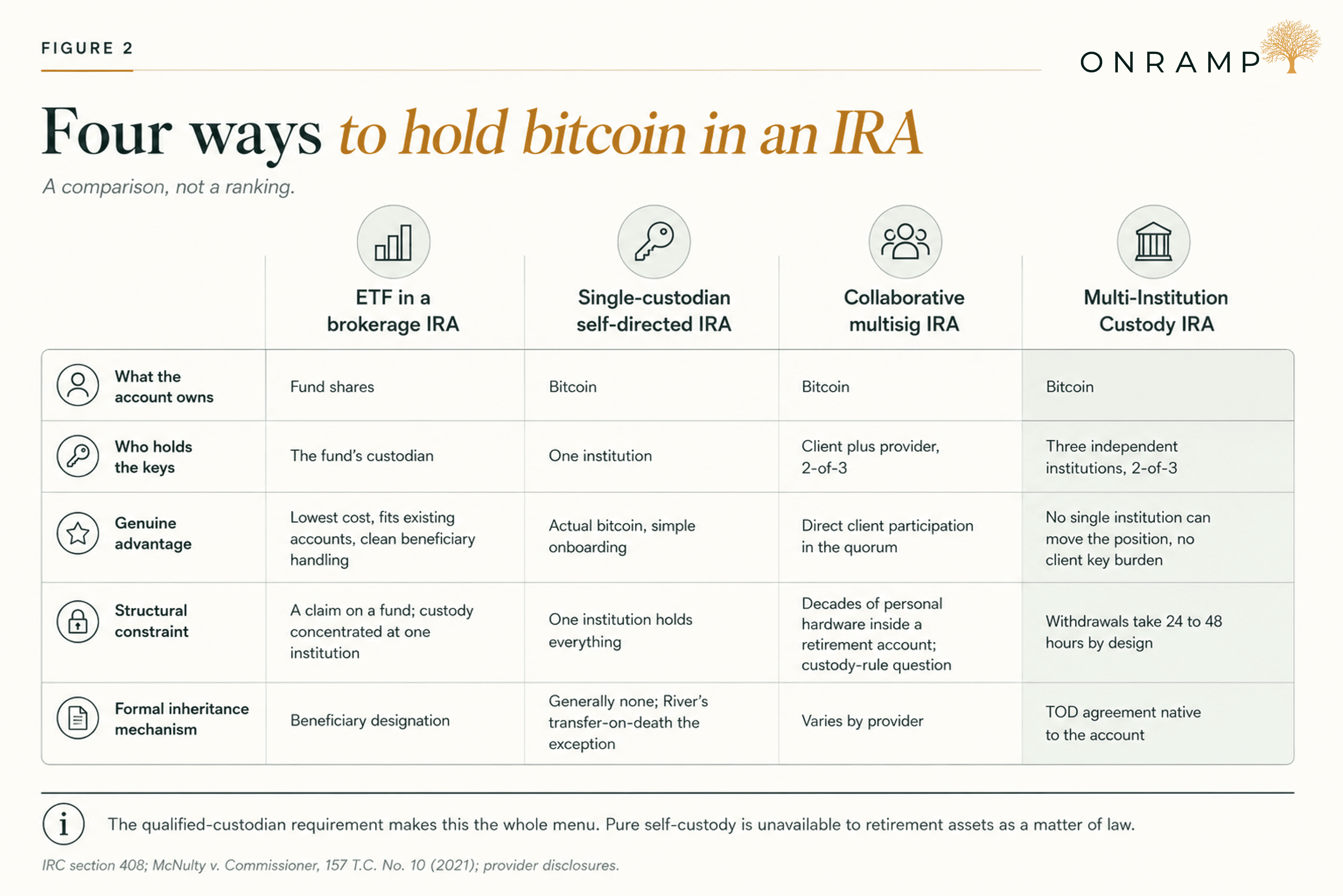
A comparison, not a ranking. The qualified-custodian requirement makes this the whole menu.
One counterparty between you and your retirement
The record of what concentration costs is documented, not hypothetical
Between July 2022 and August 2023, Celsius, Voyager, FTX, BlockFi, Genesis, and Prime Trust moved from going concerns to bankruptcy courts and receiverships. Prime Trust matters most in that list because it was a regulated custodian rather than an exchange. Retirement assets are the worst place for that kind of concentration, because the time horizon guarantees exposure to the full cycle of institutional failure modes. A position held for thirty years does not need any single institution to be bad. It needs every institution it touches to stay solvent, honest, and independent for longer than any of them has existed.
Provider selection answers the question of who looks strongest today. Architecture answers the question of what survives the turnover, which makes it the primary variable.
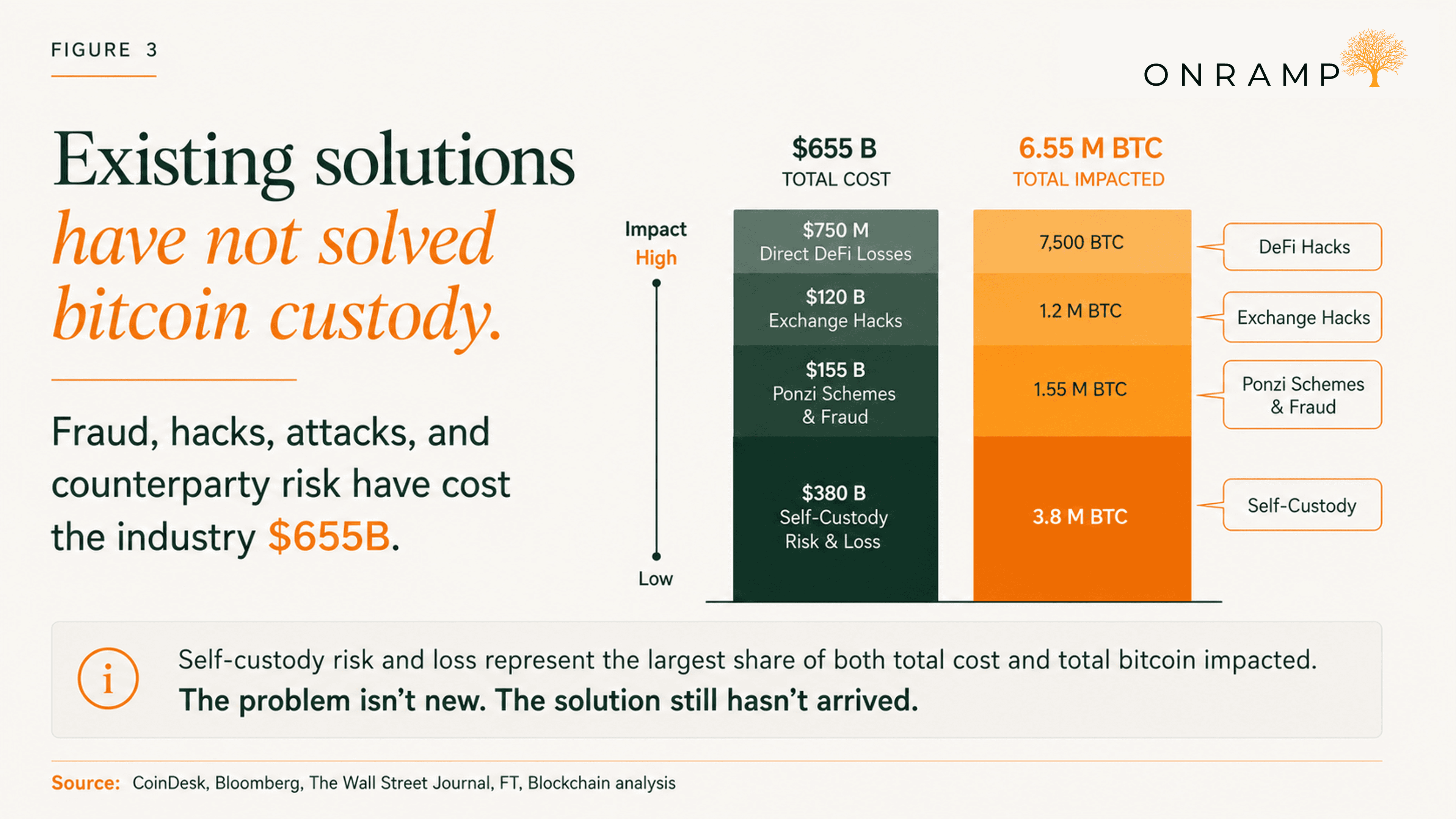
Self-custody risk and loss represent the largest share of both total cost and total bitcoin impacted.
The inheritance gap
A spare key is not a deed
Bitcoin inheritance is a two-part problem. The first part is key management, so the asset is not lost at death. The second is legal title transfer, so it passes to the intended beneficiary instead of causing a dispute. Even with a plan for handing over the keys, the keys do not give a beneficiary the deed.
The failure modes are familiar to every estate practitioner: treasure-map instructions lost or found by the wrong people, timelocks stranding assets when the estate needs liquidity, executors unable to locate holdings they were never told existed, keys written into wills becoming public record, heirs inheriting a hardware device having never signed a transaction. Most single-custodian platforms offer no formal inheritance mechanism at all. The gap is the investor who wants actual bitcoin rather than fund shares, values privacy, and wants an estate plan with no single point of failure.
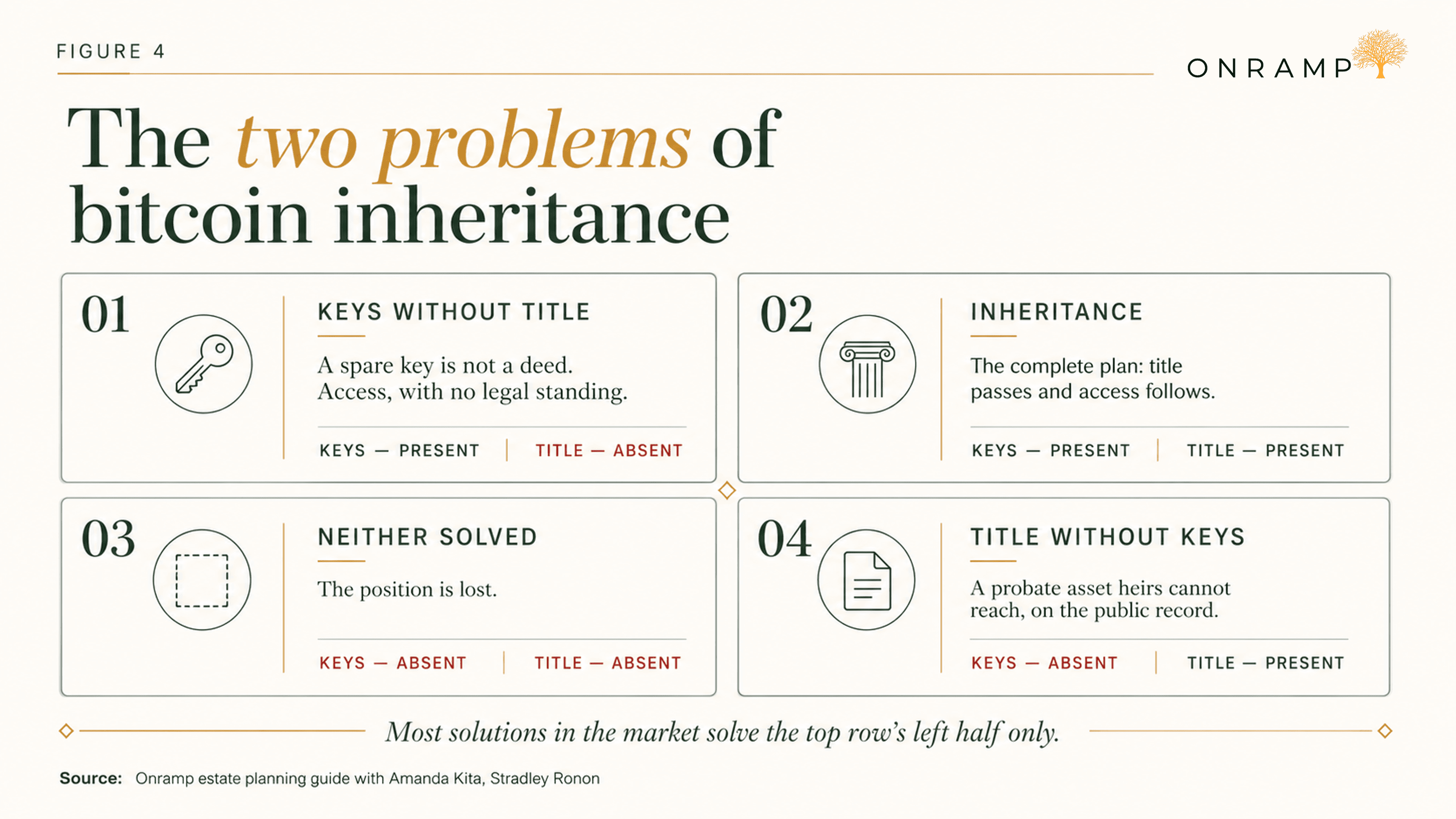
Most solutions in the market solve for keys only.
The tax and legal landscape
The rules are settled, and the two least discussed of them matter most
The One Big Beautiful Bill Act fixed the federal estate, gift, and generation-skipping transfer exemption at $15 million per individual and $30 million per married couple from January 1, 2026, permanent and indexed for inflation from 2027, with a top rate of 40%. Roughly a dozen states plus the District of Columbia levy estate taxes and five levy inheritance taxes. Bitcoin is property under IRS Notice 2014-21, which means inherited bitcoin held outside a retirement account takes a stepped-up basis to fair market value on the date of death.
Two points deserve more than a passing mention. First, bitcoin inside a retirement account follows IRA distribution rules, not the step-up rule. Second, broker reporting on Form 1099-DA began in 2026, and bitcoin transferred in from external addresses arrives with the basis fields blank, which makes the holder's own records the only continuous account of what was paid and when.
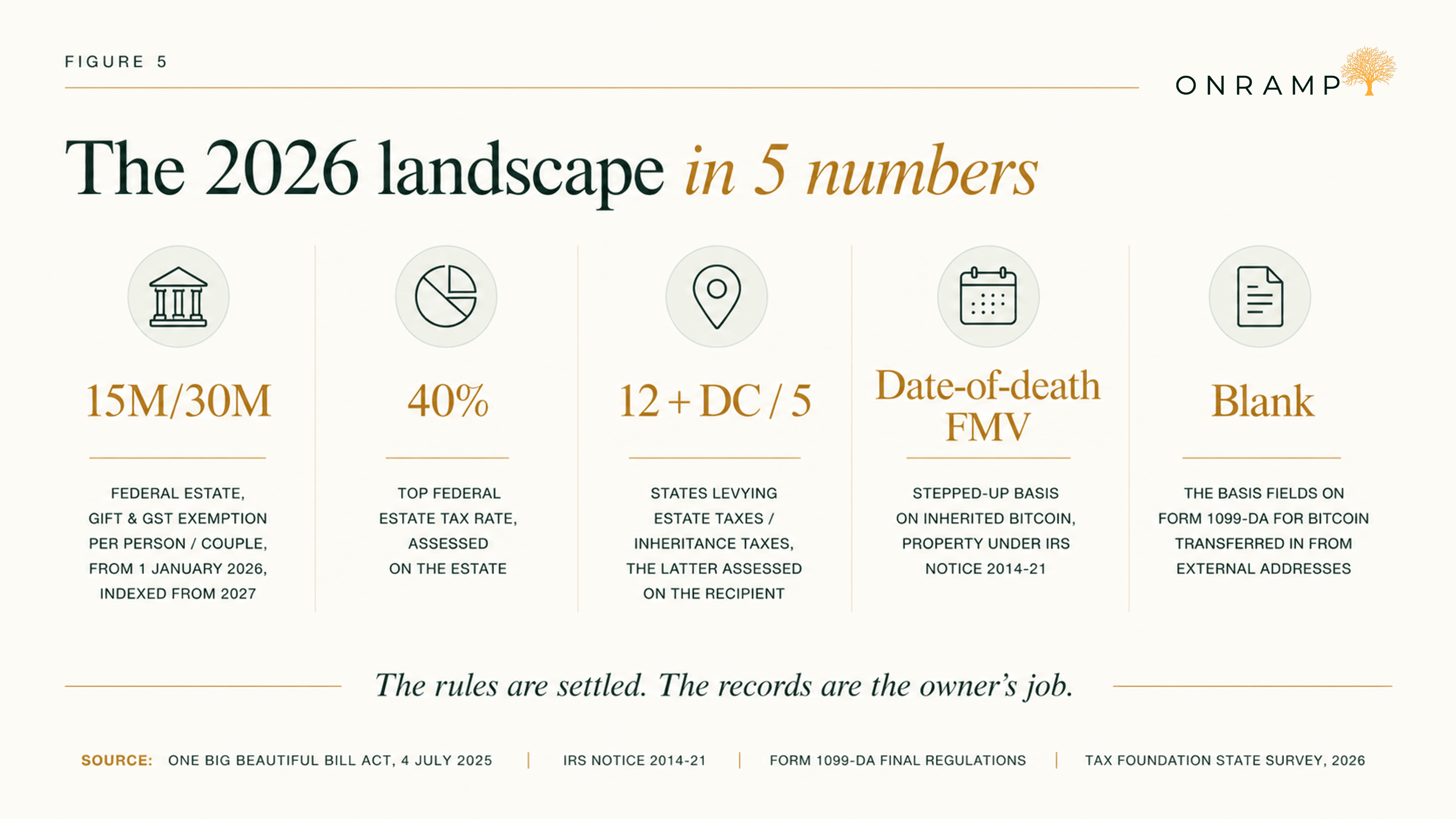
The rules are settled. The records are the owner's job.
Which wrapper, and for whom
The same position, three wrappers, two phases
The arithmetic can be modeled without a price forecast, per dollar of account value at the owner's death, at top federal rates with state taxes excluded. Inside a Traditional IRA, the entire balance reaches heirs as ordinary income, so each dollar arrives as roughly 63 cents, on a schedule set by law rather than by the family. Bitcoin held in a taxable account until death receives a step-up that eliminates the embedded gain, so each dollar arrives whole. A Roth balance also arrives whole, free of federal income tax, but the ten-year clock still runs.
During accumulation the ranking reverses. A taxable account pays up to 23.8% federal on every realized gain, while nothing inside an IRA is taxed. Death is where the two IRA types part ways, and either way the Internal Revenue Code sets the distribution schedule on precisely the asset many people bought for multi-generational reasons.
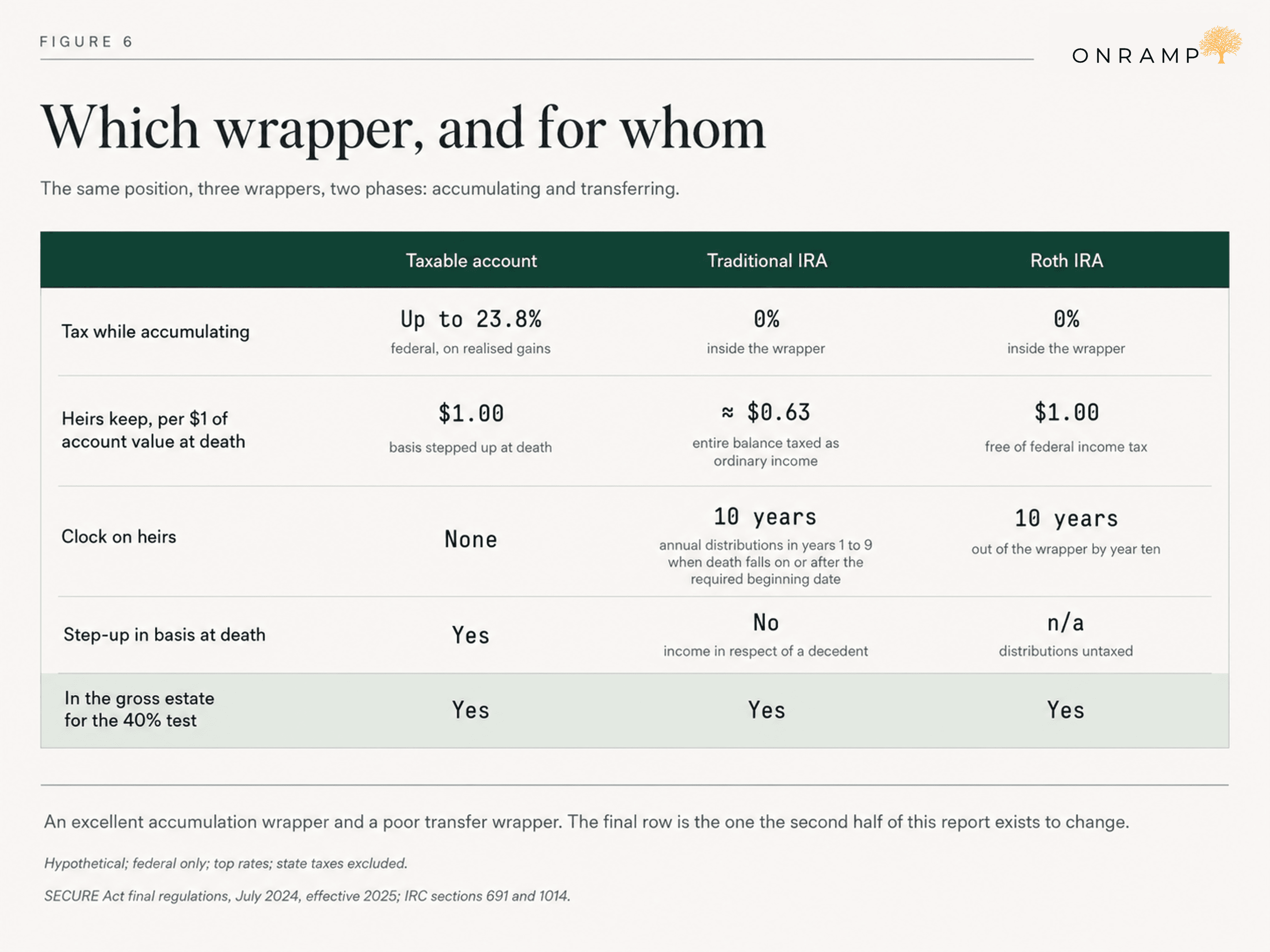
An excellent accumulation wrapper and a poor transfer wrapper. The final row is the one the second half of the report exists to change.
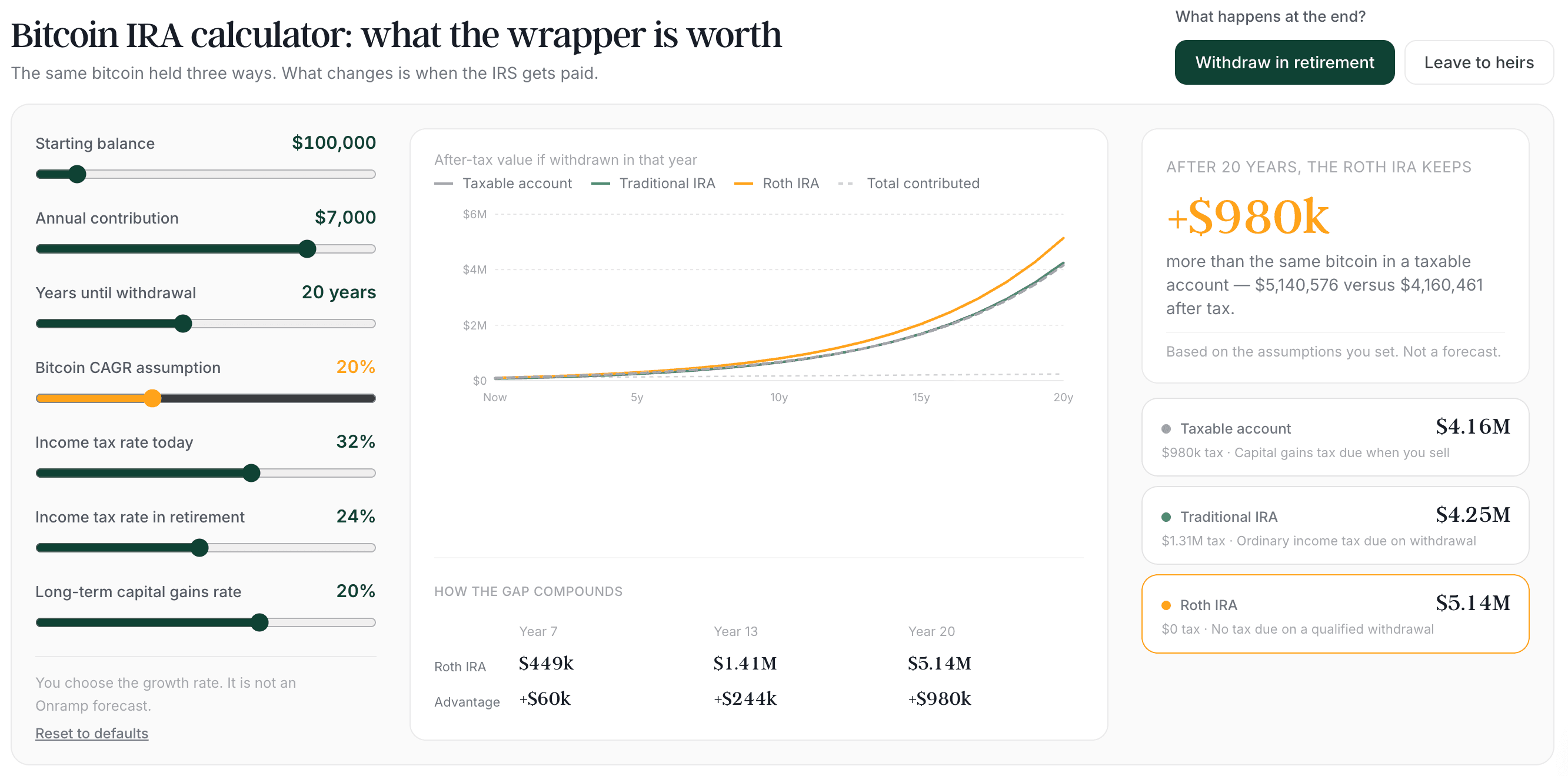
What would your heirs actually keep? The report's wrapper arithmetic, applied to your own position. Compare a taxable account, a Traditional IRA, and a Roth per dollar at death, at current federal rates.
Inheritance as a native service
A beneficiary should inherit bitcoin the way they inherit a brokerage account
At Onramp, inheritance is a property of the account rather than a plan the family has to execute. Every Core account includes a segregated multi-institution vault titled in the client's name or their trust's name. The client designates primary and contingent beneficiaries and signs a Transfer on Death agreement, which makes the account a non-probate asset. Title passes without probate, intestacy statutes, or public record, and basis steps up at date-of-death value.
Because no key material ever sat with the account holder, there is no seed phrase for an heir to find, no device to locate, and no single person whose death or incapacity breaks the chain. The quorum outlives the account holder, and separately, Onramp maintains custody insurance through Canopius, a Lloyd's of London syndicate covering its custody operations. The retirement account and the inheritance mechanism are legal layers on top of the same vault, so nothing migrates and no new counterparty enters when the holder moves from accumulation to transfer planning. The architecture holding the position at 40 is the architecture that hands it over at 90.
The dynasty trust progression
The planning gets more sophisticated. The custody underneath it does not change.
Beneficiary designation and the TOD agreement are the baseline, adequate for many estates on their own. Trust titling is the next rung, with the vault titled directly to a revocable trust. Above that sits Dynasty Trust Services, launched in August 2025 with First Covenant Trust & Advisors as regulated trustee under South Dakota trust law, covering dynasty trusts, intentionally defective grantor trusts, domestic asset protection trusts, and spousal lifetime access trusts.
Here is the paradox. Many of the largest holders accumulated by refusing to trust any single entity, and traditional trust structures have required them to hand assets to exactly one. Embedding a Multi-Institution Custody quorum inside the irrevocable structure dissolves that trade-off. A structure with no end date cannot rest on a single institution and be expected to survive a century. Under a multi-institution quorum, an institutional keyholder that fails or is compromised can be replaced without the structure collapsing around it. Below roughly 25 bitcoin, or where only modest appreciation is expected, the complexity and cost are not obviously worth it. Above that, the structure raises the questions every family faces anyway: what the wealth is for, and whether the inheritor is ready to receive it.
Every step toward better estate planning no longer requires a step backward on custody.
Closing Notes
What structure can hold the same position, in the same custody, through retirement, through death, and beyond?
The full report answers that question across eighteen pages and seven figures, with the statute, case law, and tax regulations cited throughout.
For the deeper treatment of perpetual structures, learn more about Onramp Bitcoin Dynasty Trusts:
FAQ
Frequently asked questions
Can you hold bitcoin in an IRA? Yes. Bitcoin can be held in an IRA through a bitcoin ETF in a brokerage IRA, a single-custodian self-directed IRA, a collaborative multisig IRA, or a Multi-Institution Custody IRA. All four use a qualified custodian as Section 408 of the Internal Revenue Code requires; holding your own keys inside an IRA is not permitted.
What happens to a bitcoin IRA when the owner dies? Under the SECURE Act, most heirs other than a spouse must empty an inherited IRA, Traditional or Roth, within ten years. A Traditional IRA balance is taxed as ordinary income when distributed. Bitcoin inside an IRA does not receive a step-up in basis.
Does inherited bitcoin get a step-up in basis? Bitcoin held outside a retirement account takes a stepped-up basis to fair market value on the date of death under IRC section 1014, because bitcoin is property under IRS Notice 2014-21. Bitcoin inside an IRA follows IRA distribution rules instead.
What is the federal estate tax exemption for 2026? $15 million per individual and $30 million per married couple, fixed by the One Big Beautiful Bill Act from January 1, 2026, permanent and indexed for inflation from 2027. The top federal rate above the exemption is 40%.
What is a bitcoin dynasty trust? A bitcoin dynasty trust is an irrevocable trust, typically under South Dakota law, that holds bitcoin outside the grantor's taxable estate indefinitely, with no end date, no forced distributions, and no public filings. Onramp's Dynasty Trust Services are administered by First Covenant Trust & Advisors as regulated trustee.
How does Onramp handle bitcoin inheritance? Every Onramp Core account includes a segregated Multi-Institution Custody vault with a Transfer on Death agreement. The client names primary and contingent beneficiaries, the account passes outside probate, and because no key material sits with the client, beneficiaries need no seed phrases, hardware, or technical expertise.
What is The New Money Stack Series? The New Money Stack is Onramp's institutional research report series on bitcoin as a long-horizon asset and the infrastructure built around it. The Legacy Layer, published August 2026, is part of that series.
Disclosures
This report is research and analysis, not a recommendation to adopt any legal or tax structure. It is published for informational and educational purposes only. Onramp is not a law firm, an accounting firm, or a tax practice, and nothing in this report is legal, tax, accounting, or investment advice. Estate, retirement, and tax outcomes depend on individual circumstances, on state law, and on facts this report cannot know. Before acting on anything described here, consult your own attorney, accountant, and financial advisor. References to McNulty v. Commissioner and to other authorities are summaries for context, not legal analysis of any reader's situation. Tax figures and rules described are federal, are current as of August 2026, including provisions of the One Big Beautiful Bill Act and the SECURE Act final regulations, and are subject to change. Illustrations assume top federal rates, exclude state taxes, and are hypothetical. Trustee services described in connection with dynasty trust structures are provided by First Covenant Trust & Advisors as regulated trustee under South Dakota trust law; Onramp does not act as trustee. Custody descriptions are simplified for illustration and are governed in full by the applicable account agreements. Bitcoin is a volatile asset. Its price can fall as well as rise, and holding it involves risk, including the possible loss of value. References to third parties, including River, Coinbase, BitGo, CoinCover, First Covenant Trust & Advisors, and Stradley Ronon, are for context only and imply no endorsement in either direction; all trademarks belong to their owners.