The Neutral Reserve Layer: Sovereign Bitcoin Holdings

Glenn Cameron | Global Head, Onramp Institutional
The world's central banks are moving their reserves toward assets no government controls. That demand has already put gold back on top of the reserve system, and it is starting to reach bitcoin. This report maps every sovereign bitcoin position line by line, sorts each one by how the state came to own it, and attaches a confidence level to every entry.
Key Highlights
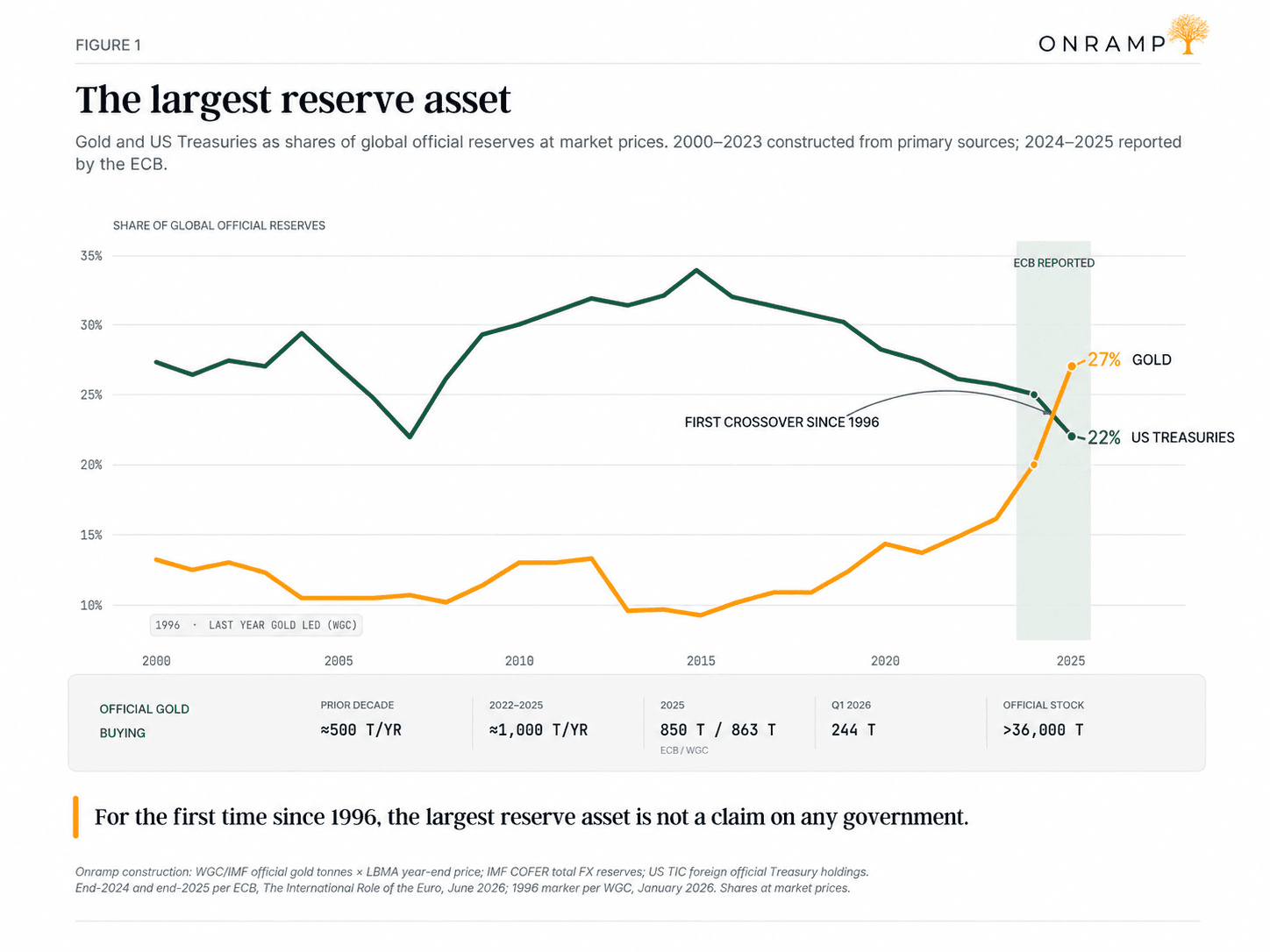
- For the first time since 1996, gold ended 2025 as the largest central bank reserve asset, at roughly 27% of global reserves against 22% for US Treasuries
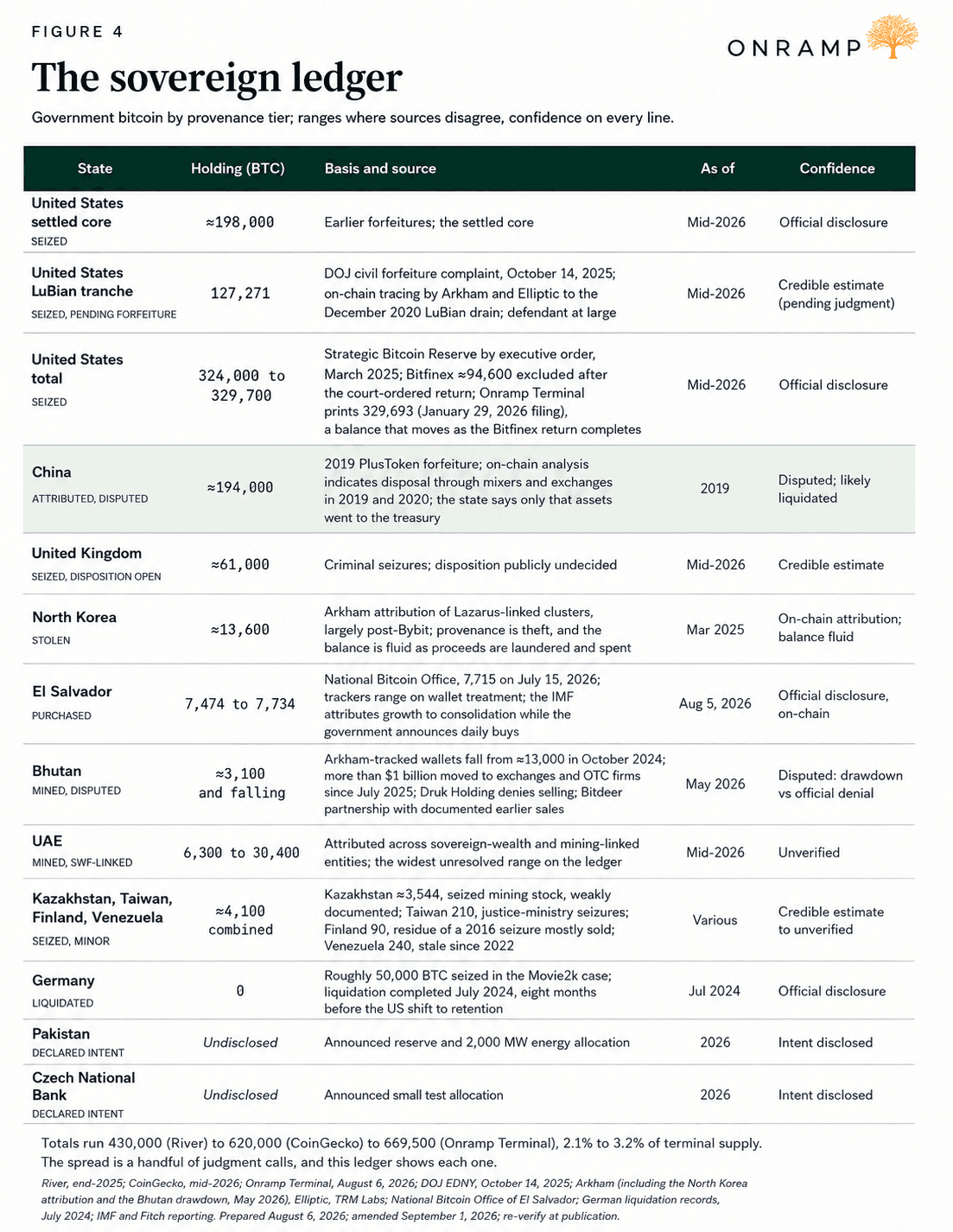
- Governments hold 2% to 3% of the 21 million bitcoin that will ever exist, roughly 430,000 to 620,000 BTC, and nearly the entire range is one disputed line: China
- The United States holds the largest position at 324,000 to 329,700 BTC, with roughly 40% still pending forfeiture judgment
- Roughly a dozen countries host more than 1% of global hashrate, but state-linked mining is a single-digit share of the network and no G7 government mines
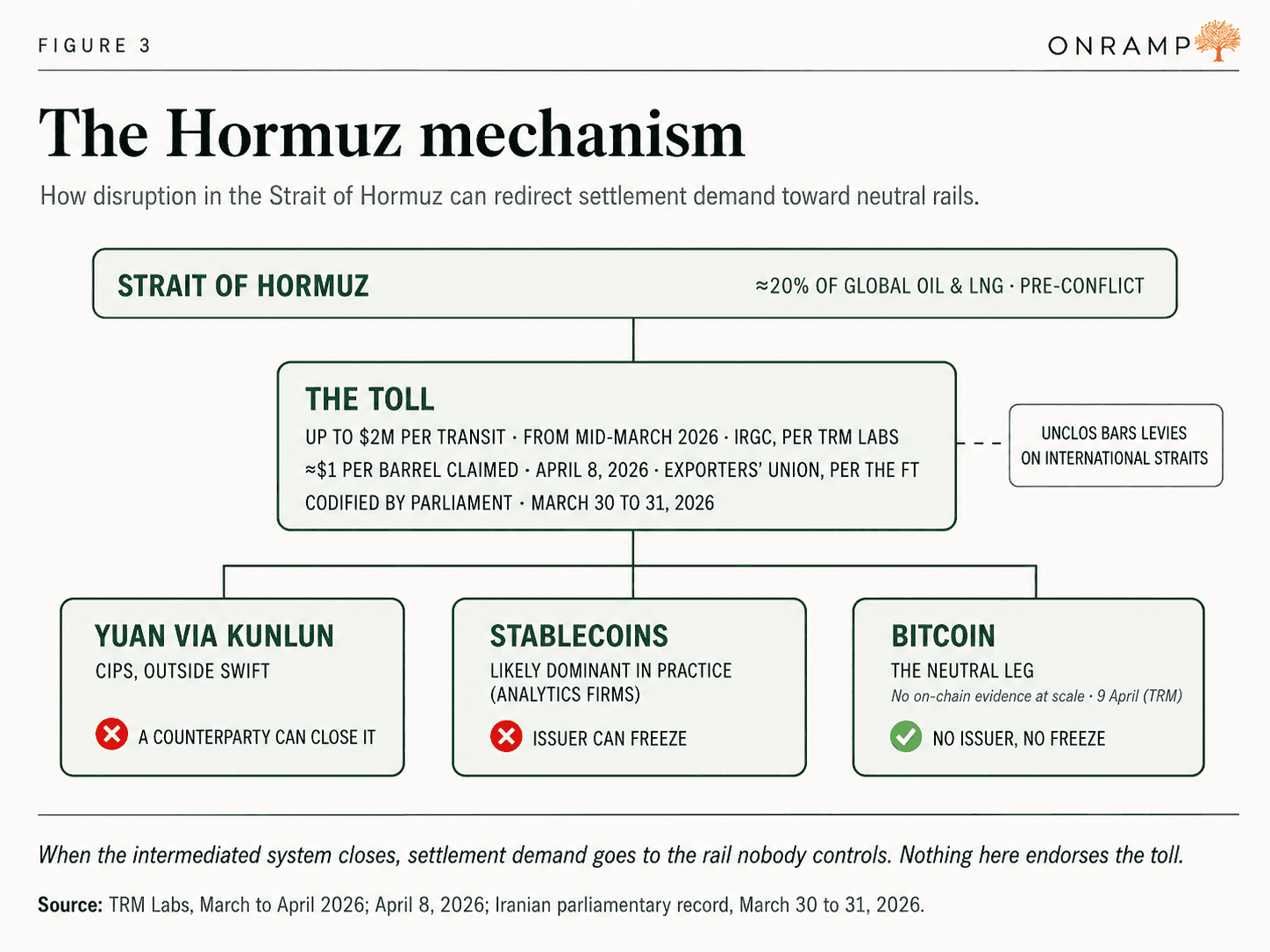
- In 2026, Iran priced Strait of Hormuz tanker passage partly in bitcoin, the first live state settlement on a rail no government can shut
- The sovereign ledger carries a provenance tier and one of five confidence levels on every line, and will be updated quarterly
What Central Banks Are Buying
At the end of 2025, for the first time since 1996, the largest reserve asset held by the world's central banks was not a claim on any government
The European Central Bank reported it in June 2026: gold ended 2025 at roughly 27% of global central bank reserves against 22% for US Treasuries, from 20% and 25% a year earlier. The crossover followed four consecutive years of official buying averaging 1,000 tonnes a year, roughly double the pace of the prior decade, and central banks now hold more than 36,000 tonnes, a stock last seen in the Bretton Woods era. The ECB adds that the move largely reflects valuation effects, and the buying story and the price story reinforce each other; the crossover stands either way. The deeper reason arrived in 2022, when the freezing of roughly $300 billion of a G20 central bank's reserves taught every reserve manager watching that a Treasury position depends on a relationship, and relationships can be revoked.
Gold, and Its Limits
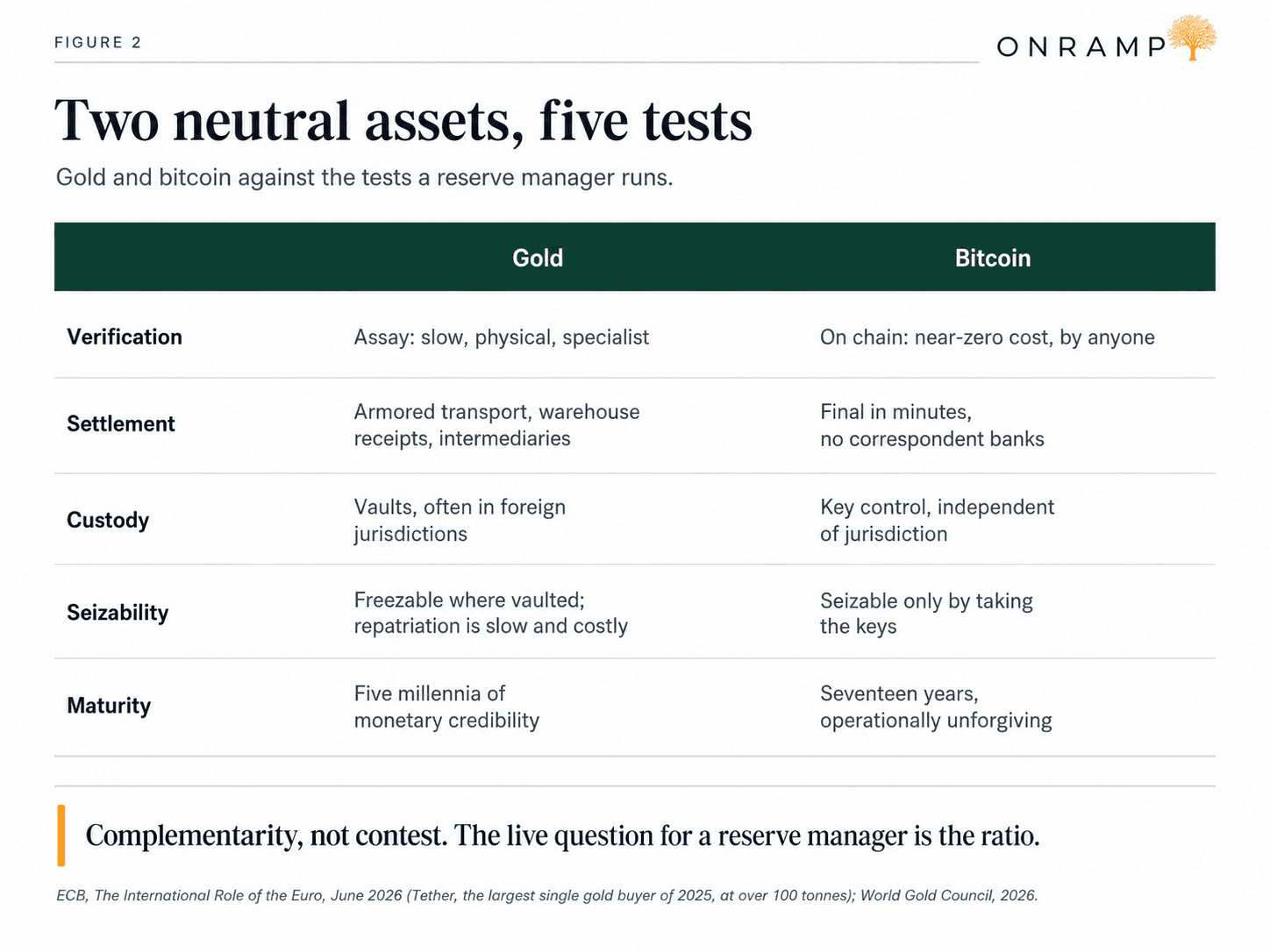
Gold's return proves the demand for neutral reserves. Gold alone cannot serve it.
Gold has five thousand years of monetary credibility, no issuer, and no counterparty, but its limits are physical: verification takes an assay lab, movement takes armored transport and intermediaries, and vaulted metal in a foreign jurisdiction can be frozen as easily as a Treasury. Bitcoin has the same monetary properties, a fixed supply with no issuer and no counterparty, and adds what gold cannot: verification by anyone in seconds, movement anywhere as information, and seizure only by taking the keys that control it. The ECB's own report records that the largest single gold buyer of 2025 was Tether, the stablecoin issuer, at over 100 tonnes, an early sign of the gold world and the bitcoin world meeting on the same balance sheet.
Case Study: The Hormuz Toll
In 2026, a state used bitcoin to get paid when the banking system was closed to it
After the US-Iran conflict began in February 2026, the IRGC charged vessels transiting the Strait of Hormuz up to $2 million per transit, and a spokesperson for Iran's oil exporters' union told the Financial Times that laden tankers would owe roughly $1 per barrel, payable in bitcoin. The record is messy, and the report carries every caveat: analytics firms believe stablecoins likely dominated in practice, and TRM Labs saw no on-chain evidence of payment at scale as of April. The mechanism stands regardless. A stablecoin issuer can freeze funds on request, so a sanctioned user gets convenience from Tether but no safety, and for payments that must not be stoppable, that leaves bitcoin. Nothing in the report endorses the toll; the point is that when banks close their doors, payments move to the one rail no government can shut.
The Sovereign Ledger
Nobody can count sovereign bitcoin precisely. The honest number is a range, and the width of the range has one main cause.
Published totals for government bitcoin run from roughly 430,000 BTC (River, end-2025) to roughly 620,000 (CoinGecko, mid-2026), and nearly the entire gap is China's disputed 194,000 BTC from the 2019 PlusToken forfeiture, which on-chain analysis indicates was sold in 2019 and 2020. The United States holds the largest attributed position at 324,000 to 329,700 BTC, formalized as the Strategic Bitcoin Reserve by executive order in March 2025; roughly 198,000 BTC is the settled core, while the 127,271 BTC LuBian tranche remains in forfeiture proceedings. The United Kingdom holds about 61,000 BTC with the disposition publicly undecided. El Salvador, the only state with a continuous public purchase program, holds roughly 7,700 BTC. Germany's line correctly reads zero after liquidating roughly 50,000 seized BTC by July 2024, and Bhutan, sovereign mining's cleanest case, is now the ledger's first drawdown in progress, falling from roughly 13,000 BTC to about 3,100 against an official denial. Every line carries a provenance tier, seized, purchased, mined or declared intent, and one of five confidence levels.
The Hashrate Map
A government that seizes bitcoin was chasing criminals and ended up holding coins. A government that dedicates megawatts to mining set out to acquire them.
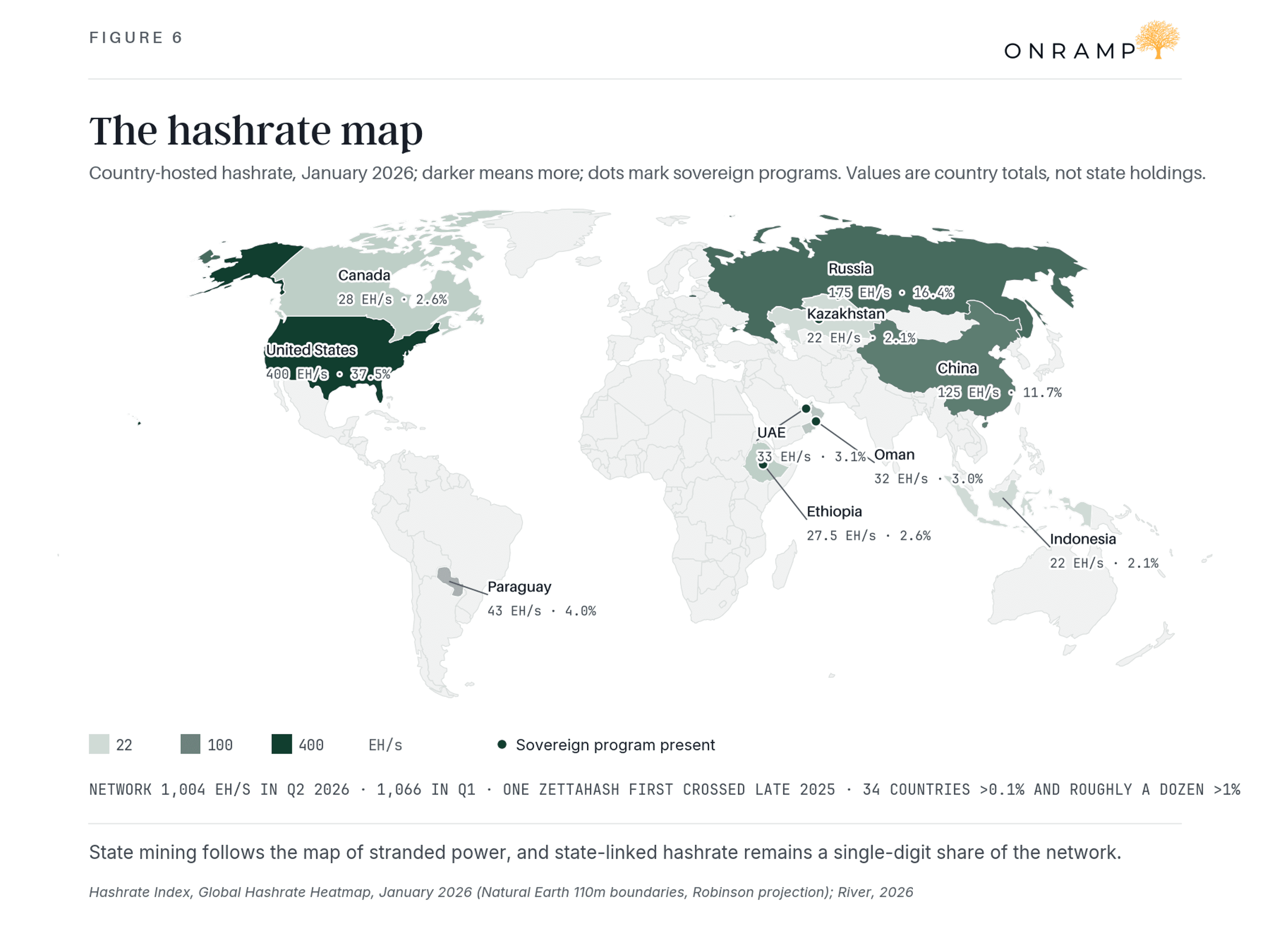
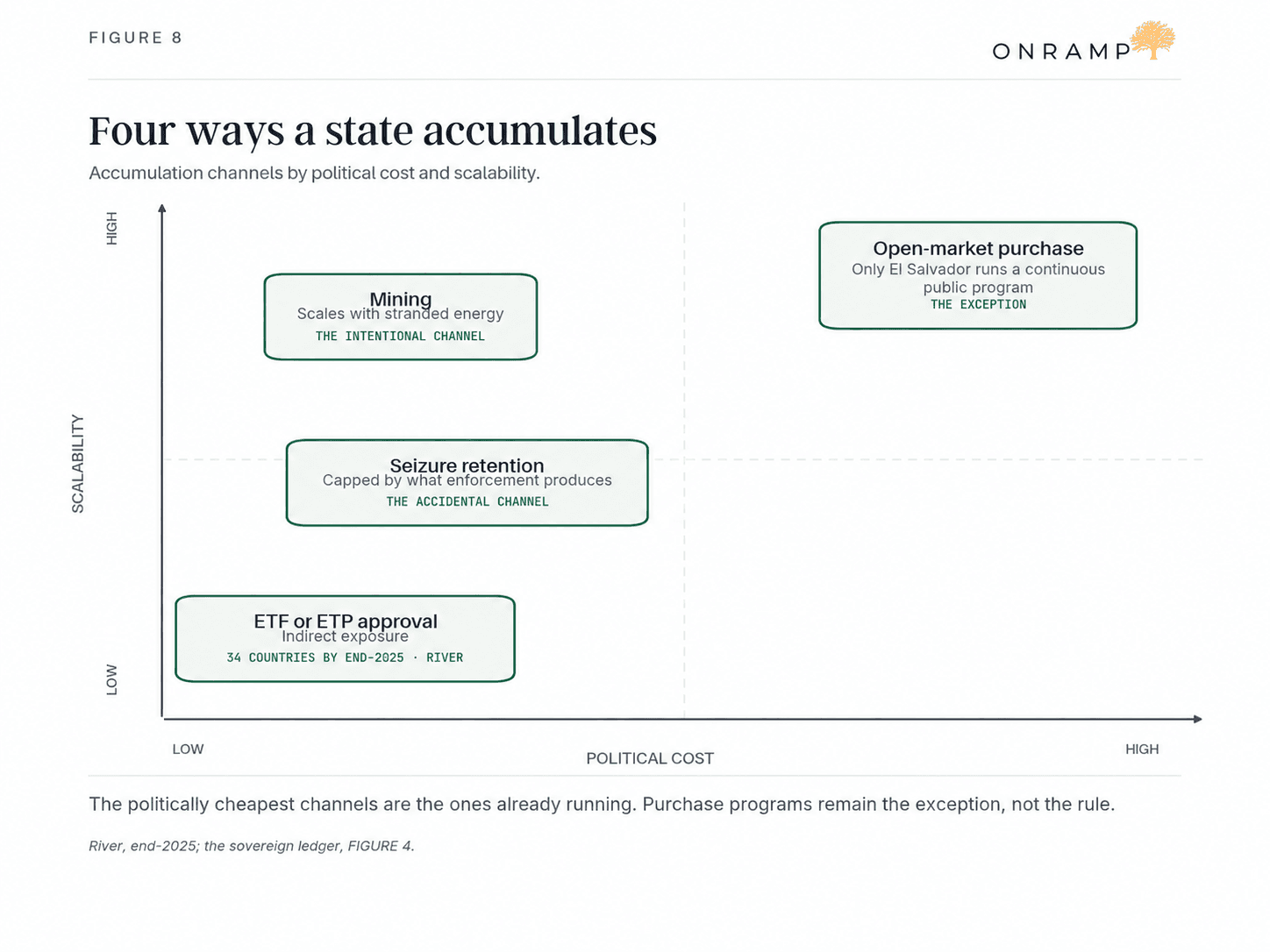
Global hashrate crossed one zettahash late in 2025, and about 34 countries host more than 0.1% of the network, with roughly a dozen hosting more than 1%. Hosting is private industry; a smaller set of states mine deliberately, as policy. Oman launched Omanhash in June 2026, a mandatory state pool for all licensed miners at about 10 EH/s, built by the same vendor as Kazakhstan's btcpool.kz, making it the first hard test of state control over pool infrastructure. The UAE mines through entities linked to its sovereign wealth funds, Iran's licensed miners must sell what they mine to the central bank, and Pakistan has announced a 2,000 megawatt allocation. Mining turns stranded power into a reserve asset without spending a dollar of reserves, which makes it the politically cheapest way for a state to accumulate. The absences complete the map: no G7 government mines, and G7 governments hold roughly nine of every ten state-owned coins, all of them seized rather than mined. Deliberate mining belongs to the energy-rich periphery.
Implications
In a world with more than one power center, demand runs toward assets nobody can revoke and payment rails nobody controls. Bitcoin is both.
The gold crossover proved that the most conservative allocators on earth will pay for neutrality. Quarter to quarter, the path will look unspectacular: states keeping what they seize, mining where power is cheap, adding small positions, settling where sanctions bite. Official gold buying ran near 1,000 tonnes a year for four years with no single year announced as a turning point, and at the end of it the world's central banks held more gold than US Treasuries for the first time in twenty-nine years. Bitcoin's version of the process is earlier and smaller, and it faces a constraint gold never had: the supply stops at 21 million. This report makes no price forecast. The game theory is playing out slowly but predictably.
Closing Notes
Which states hold bitcoin, how did they get it, and what would deliberate accumulation actually look like?
The full report answers those questions across twenty pages and eight figures, with a source and confidence level on every ledger line and the method published alongside it.
FAQ
Frequently asked questions
How much bitcoin do governments own in 2026? Governments hold between 2% and 3% of the 21 million BTC that will ever exist, roughly 430,000 to 620,000 BTC. The range depends on whether China's disputed 194,000 BTC is counted; on-chain evidence indicates those coins were sold in 2019 and 2020.
How much bitcoin does the US government own? The United States holds 324,000 to 329,700 BTC as of mid-2026, formalized as the Strategic Bitcoin Reserve in March 2025. Roughly 198,000 BTC is settled from earlier forfeitures, while 127,271 BTC from the October 2025 Prince Group action remains in forfeiture proceedings.
Does China still hold 194,000 bitcoin? Probably not. On-chain analysis indicates most or all of China's PlusToken coins moved through mixers to exchanges and were sold in 2019 and 2020. The Neutral Reserve Layer carries China's balance as disputed and likely liquidated, which explains most of the gap between published global totals.
Did gold overtake US Treasuries as a reserve asset? Yes. Per the ECB, gold ended 2025 at roughly 27% of global central bank reserves against 22% for US Treasuries, the first time gold has led since 1996. The ECB notes the move largely reflects valuation effects alongside four years of elevated official buying.
Which countries mine bitcoin as government policy? State-linked hashrate remains a single-digit share of the network. Oman runs a mandatory state pool at about 10 EH/s, the UAE mines through sovereign-wealth-linked entities, Iran requires licensed miners to sell to the central bank, and Bhutan converted surplus hydropower into a reserve before its 2026 drawdown. No G7 government mines.
Is El Salvador still buying bitcoin? El Salvador holds roughly 7,700 BTC and remains the only state with a continuous public purchase program. The government announces daily purchases while the IMF attributes recent increases to wallet consolidation under the December 2024 facility; the report carries both the accumulation and the ambiguity.
What is The New Money Stack Series? The New Money Stack is Onramp's institutional research report series on bitcoin as a long-horizon asset and the infrastructure built around it. The Neutral Reserve Layer, published September 2026, is part of that series, and its sovereign ledger will be updated quarterly.
Disclosures
This report is research and analysis published for informational and educational purposes only. Nothing in it is legal, tax, accounting, or investment advice, and it makes no price forecast. Holdings figures, hashrate estimates, and attributions are drawn from the sources named in the report, including on-chain attribution, official disclosures, tracker estimates, and press reporting, each carried at the stated confidence level; hashrate location and ownership cannot be measured from the chain, and every such figure is an estimate. All figures were verified as of the dates stated in the report's method section and are subject to revision as sources update; the sovereign ledger will be updated quarterly. References to third parties, including River, CoinGecko, BitcoinTreasuries, Arkham, Elliptic, TRM Labs, Hashrate Index, VanEck, the European Central Bank, the World Gold Council, the Financial Times, and CoinDesk, are for context only and imply no endorsement in either direction; all trademarks belong to their owners. Nothing in this report endorses the transit levies described in the Hormuz case study. Bitcoin is a volatile asset. Its price can fall as well as rise, and holding it involves risk, including the possible loss of value.