July 24, 2026 Roundup: The Graduating Class

Brian Cubellis | Chief Strategy Officer
Free. Every week. One story that matters, read all the way down.
A fifty percent drawdown is ordinarily where conviction in an asset dies. In bitcoin it appears to be where true conviction is formed. Long-term holder supply has never been higher, a third of all coins have not moved in five years, and the supply that actually trades has thinned to a few million bitcoin.
This week we walk through the data behind those dynamics, the mechanism that converts drawdowns into dormancy, and the arithmetic that follows when finite supply meets a demand cohort that compounds daily.
The Graduating Class
Long-term holder supply is arguably a vague characterization. How long is long-term? The most commonly used definition is coins that have not moved for at least 155 days. By this measure, this week marked a new all-time high of 16.8 million bitcoin in this cohort, per the Onramp Terminal. That is 83.7% of everything ever mined, five out of every six bitcoin in existence, and it arrived with the price around ~$65k, roughly half of the October 2025 peak.
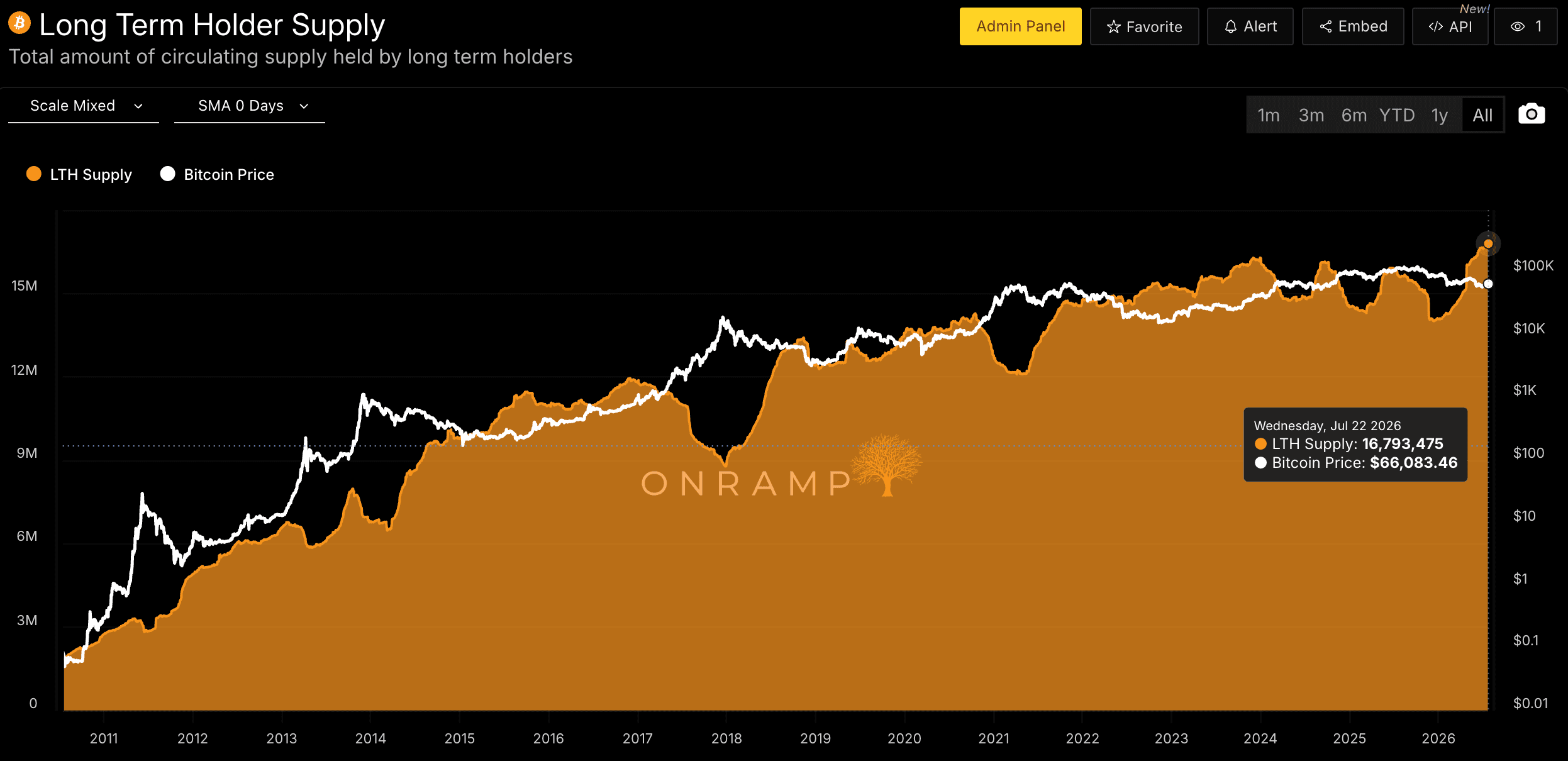
The juxtaposition of dormant supply rising versus price declining is notable. Price is set at the margin, by whoever happens to be selling this week. The duration of existing supply is set by long-term accumulation, and it compounds quietly. A drawdown of this magnitude is normally read as faith draining out of an asset. The bitcoin ledger records something closer to the opposite: the consolidation of faith and growing conviction.
The Graduation Mechanism
Every cycle imports a new cohort of short-term holders. They arrive during the exciting part, when bitcoin is in the news and it feels like the obvious trade. Then volatility arrives and this cohort gets tested. Some sell, treating the drawdown as a verdict on fundamentals, and the market sheds them.
The ones who stick around do something different. They start asking why an asset with no issuer, no CEO, and no marketing budget kept producing blocks every ten minutes. They learn what the difficulty adjustment does, why the halving matters, what sounds money really represents. The fundamentals keep strengthening in ways that have nothing to do with price, and at some point, quietly, their coins cross 155 days unmoved. They have graduated.
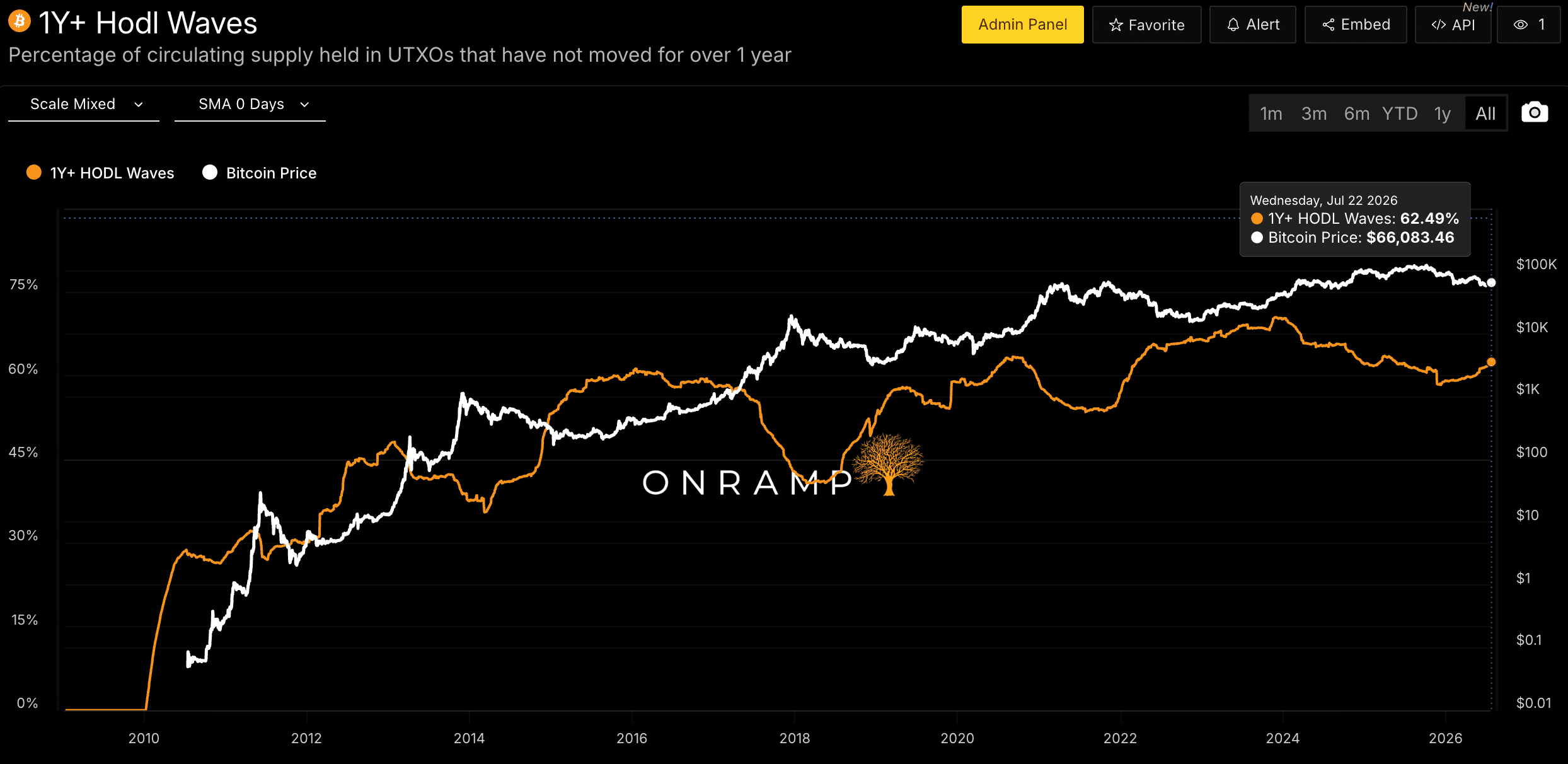
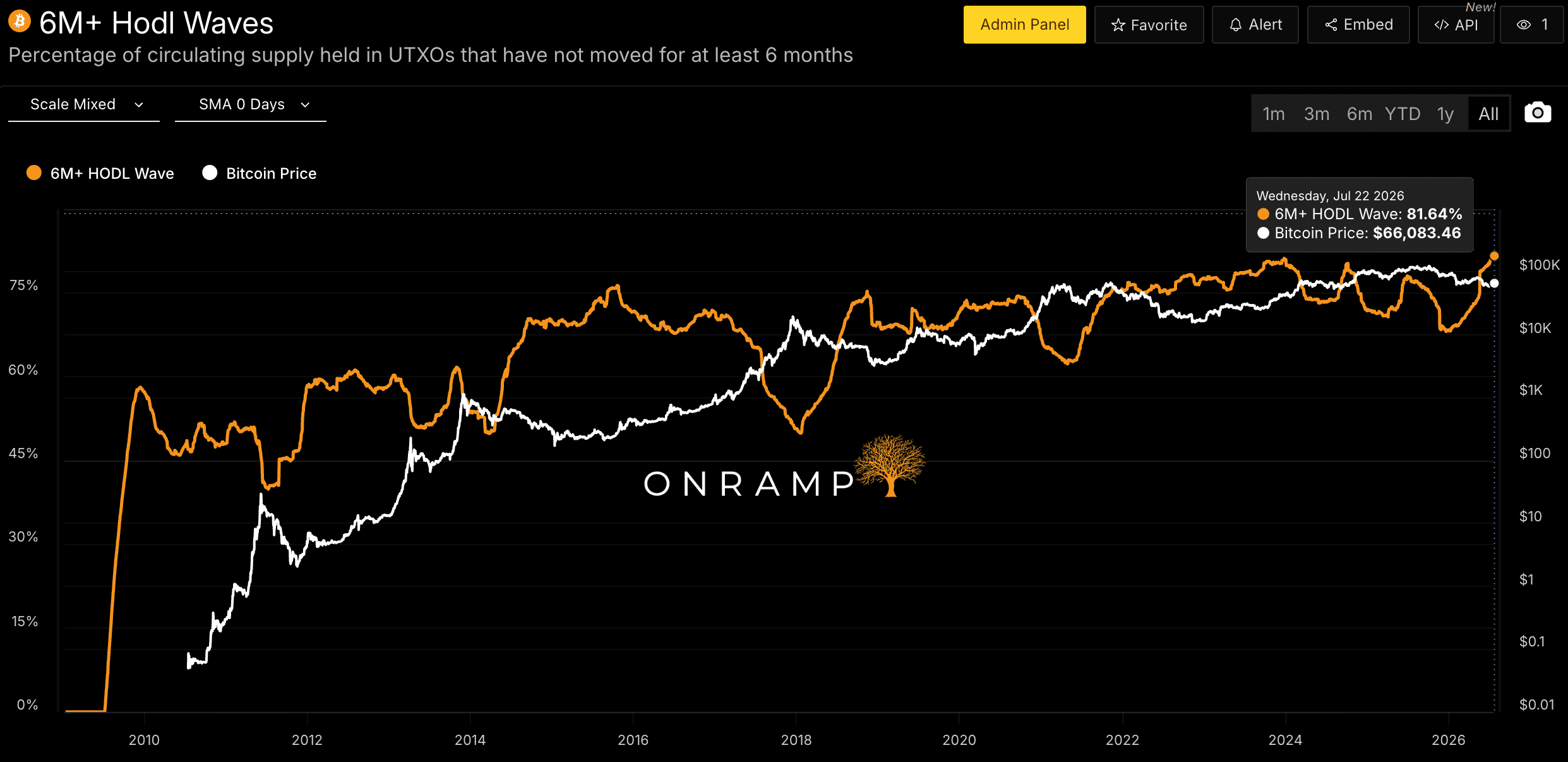
HODL wave data lays out the ladder rung by rung. As of this week, 81.6% of supply has not moved in six months, 62.5% has not moved in a year, 42.9% has not moved in three years, and 33.2%, another new all-time high, has not moved in five.
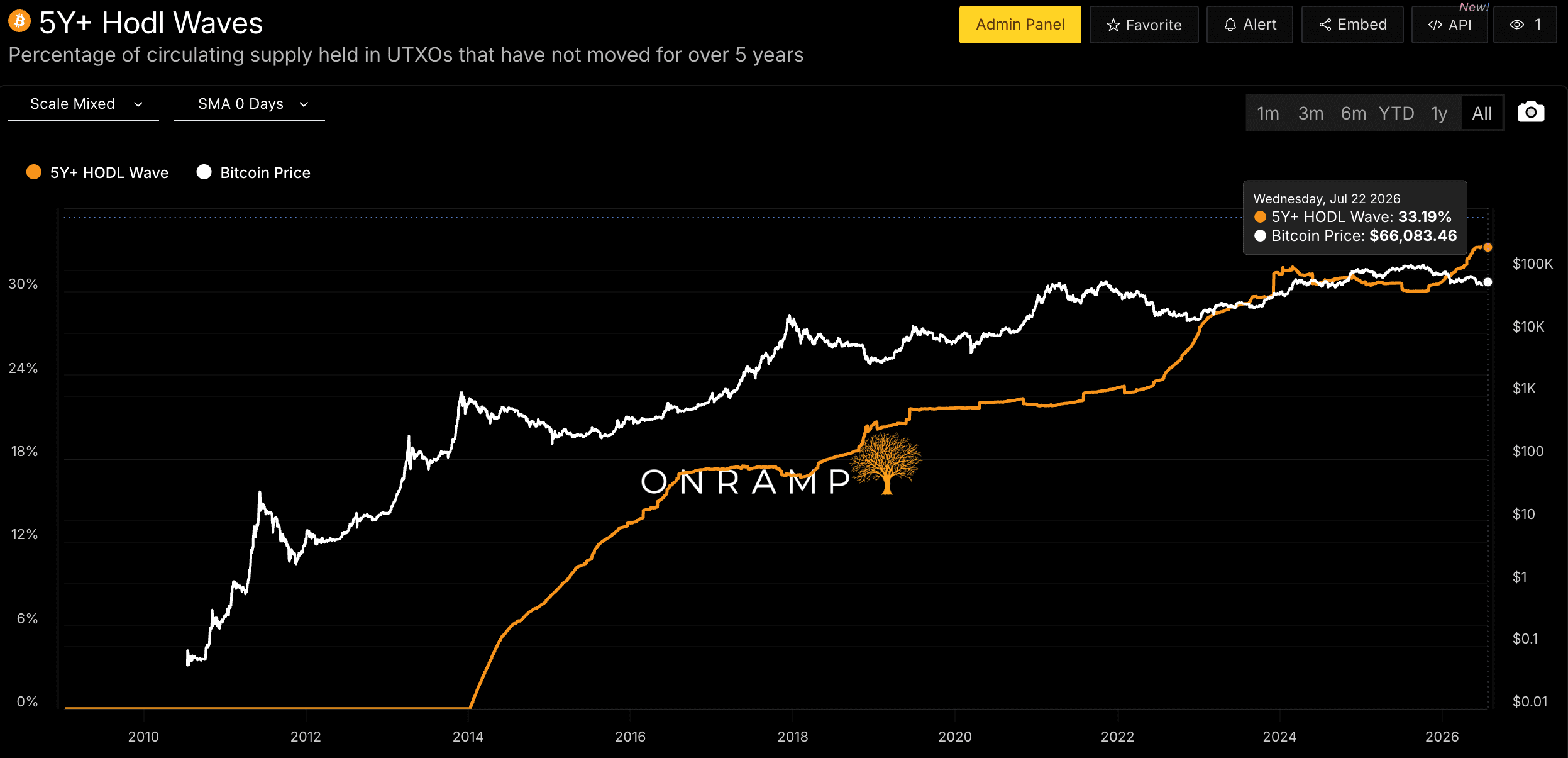
A third of all bitcoin has now sat untouched since the summer of 2021, held through the 2022 bear market, the 2024 halving, last year's run to new highs, and this year's drawdown. Behavior like that belongs to savers, not traders, and it is what an asset looks like when it is being adopted as a store of value rather than flipped as a position.
The Other Side of the Ledger
None of this makes the long-term supply a permanent fixture, and the same data records the outflows as clearly as the accumulation. The one-year HODL wave peaked near two-thirds of all coins in 2024, then slid toward the mid-50s before recovering. That slide is mostly churn: coins bought during the run to new highs changed hands again within a year, their owners never crossing into long-term status at all.
The deeper cuts happened too. Satoshi-era coins, dormant since the earliest years, came to market through 2025 and sold into strength, and even the headline long-term holder metric dipped sharply last November before resuming its climb. People who bought very early eventually take something off the table: they trim positions, settle estates, fund lives.
One caveat applies across all of this supply analysis. A coin moving is not the same as a coin selling; custody upgrades, key rotations, and estate transfers all leave footprints on the ledger that look identical to distribution. Movement is nonetheless the most reasonable proxy we have, because the contrapositive is exact: coins that are not moving cannot be sold.
What matters here is the direction of travel, and it has run one way for seventeen years. The one-year band has recovered to 62.5% and is rising. The three-year band sits near its record at 42.9%. The five-year band has never been higher. Each cycle's floor in dormant supply settles above the previous cycle's peak, and the sellers are being absorbed by buyers with structurally longer time horizons.
The Supply Side of the Ledger
Consider what is actually left to trade. On March 9 of this year, the network mined its twenty millionth coin. As of this writing, 939,919 bitcoin remain to be mined, ever. Estimates of permanently lost coins run from 2.3 million to nearly 4 million depending on the methodology. The six-month wave puts the float in direct terms: if 81.6% of supply has not moved in half a year, then the universe of coins that have changed hands recently, every exchange balance, every ETF flow, every OTC desk, every new coin from miners, amounts to roughly 3.7 million bitcoin.
The Supply Response (Or Lack Thereof)
The property the broader market has never properly grappled with is this: every other commodity answers demand with supply. Oil rallies and shale rigs spin up within months. Gold rallies and exploration budgets expand while above-ground stock keeps growing at its steady 1.5% annual clip. Copper takes a decade to permit, but it comes. Rising price summons new supply, in every market, for all of history. That is the mechanism that has always relieved demand pressure, and it is the mechanism bitcoin abolishes by design.
Demand can double and issuance remains roughly 450 coins a day, because the difficulty adjustment recalibrates every two weeks to hold the schedule regardless of how much computing power arrives. Additional hashpower does not raise issuance; it raises the cost of earning the same issuance.
Rare art and collectibles are finite as well, but a Rothko is not fungible, not divisible to eight decimal places, and its authenticity rests on experts rather than mathematics. Bitcoin stands alone as a provably finite asset that functions as money, governed by a decentralized protocol, seizure-resistant and immutable.
The Demand Side of the Ledger
Meanwhile the demand cohort compounds. UBS's Global Wealth Report, published three weeks ago, counts 57.5 million dollar millionaires in the world, with 2025 alone minting nearly a million more, a pace of about 2,680 per day. Coincidentally, the number of bitcoin addresses holding any balance at all stands at a record 56,806,414 and has kept climbing through the entire drawdown.
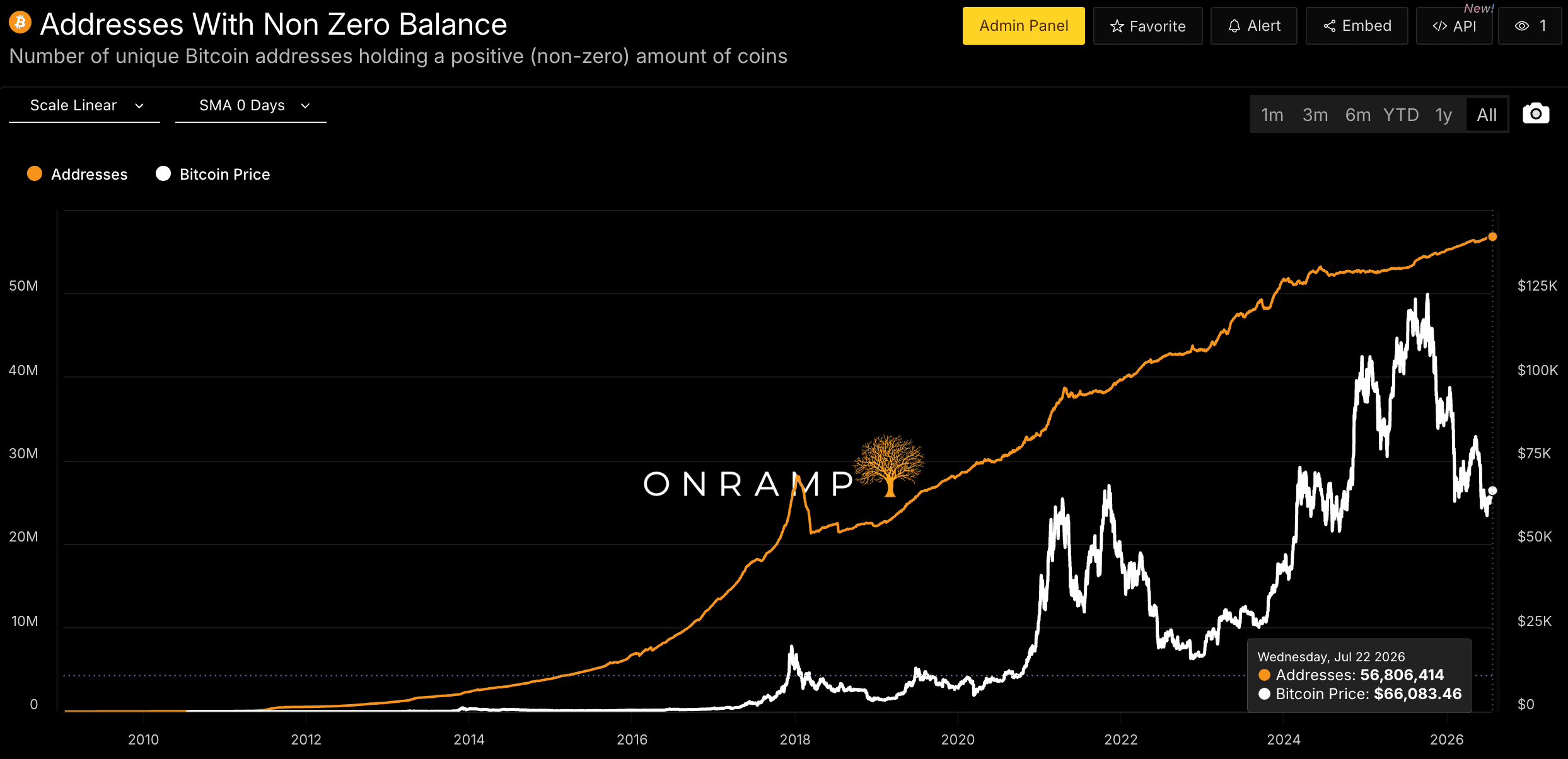
The arithmetic from here is not complicated. If every millionaire on earth decided to own a single bitcoin, there are perhaps 16 or 17 million effective coins to divide among 57.5 million people. Less than a third of a coin each, before counting a single institution, treasury, fund, or nation state. The world creates 2,680 new millionaires a day; the network creates 450 new coins a day, falling to 225 in April 2028. Demand-side population growth outruns new issuance by a factor of six, every day, against an ever-shrinking float of coins that actually trade.
The Long Arc
One more chart completes the picture. The long-term holder MVRV Z-Score, which measures how far the cohort's market value sits above its aggregate cost basis, reads 0.60 today. Every major cycle top in bitcoin's history printed between 5 and 13 on this metric, the zones where long-term holders sat on years of unrealized gains and trimming a position became much more attractive. Today's reading belongs to the opposite end of that history, the territory of bear market lows and quiet accumulation periods.
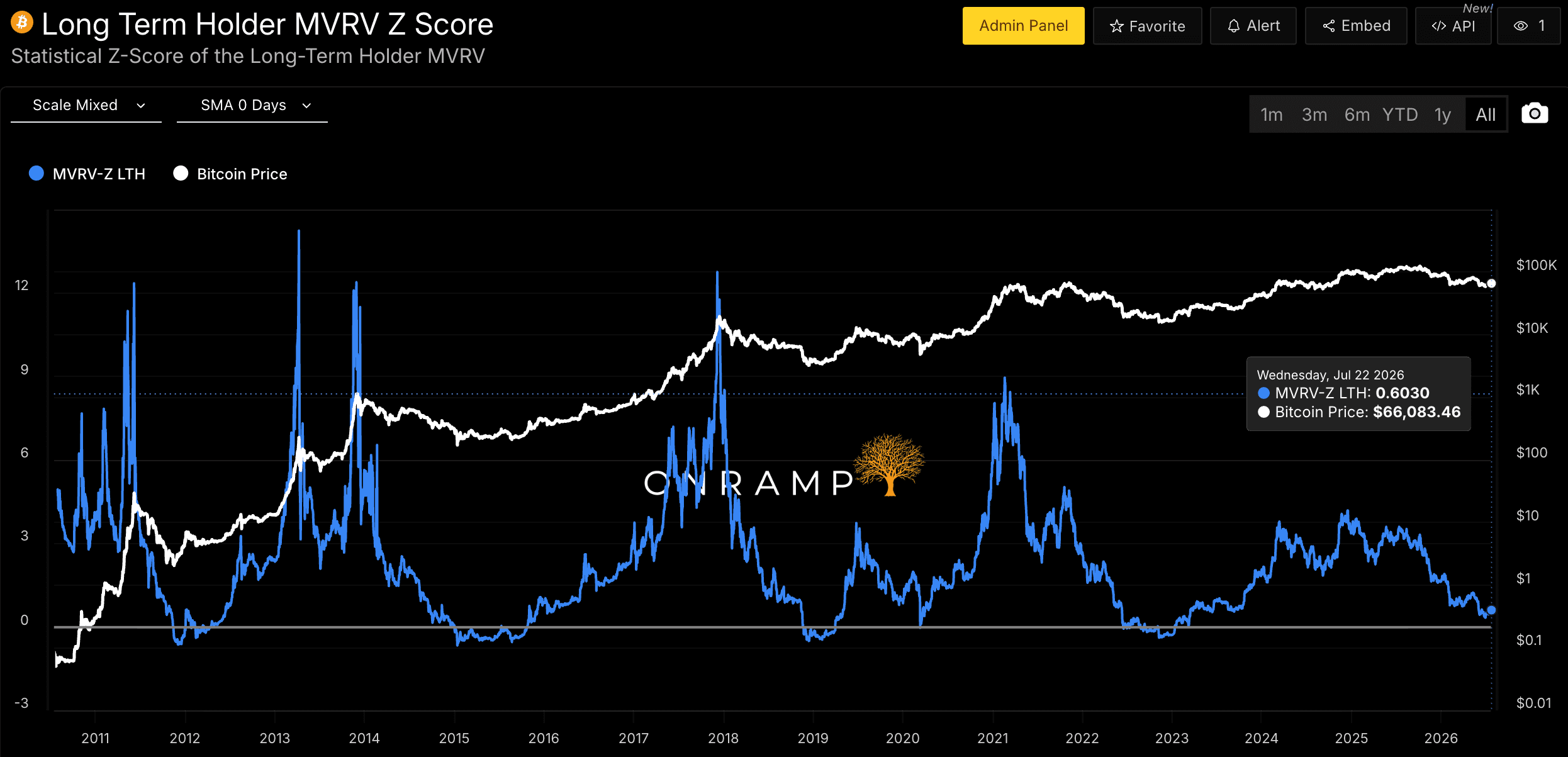
That context says something important about who is doing the holding. Much of the 16.8 million coins in long-term hands are not clutched by holders sitting on once-in-a-lifetime profits waiting for an exit. A cohort assembled at these levels acquired its bitcoin without the cushion of large unrealized gains, and holders formed in that environment have historically become the next cycle's floor. Depressed prices are where durable conviction actually comes from. The data suggests that process is well underway.
The thesis, then, reduces to a simple premise. If the network is decentralized and secure, if the 21 million cap is intact, and if demand for a seizure-resistant, verifiably scarce savings asset keeps growing, then price appreciation against that finite supply is the only possible resolution.
Each cycle repeats the process: another class graduates, the floor rises, and the float available to everyone else shrinks. The market still prices bitcoin in days. Its true owners are pricing it in years, or decades.
CLOSING NOTE
Onramp provides bitcoin financial services built on multi-institution custody. To learn more about our products for individuals and institutions, schedule a consultation to chat with us about your situation and needs.
Until next week,
Brian Cubellis