October 9, 2026 Roundup: A Case Study in Time Preference

Brian Cubellis | Chief Strategy Officer
Free. Every week. One story that matters, read all the way down.
Bitcoin traded down to about $80,300 on Thursday, roughly 8% below its October 2 high near $87,200. By this morning it was back around $83,000.
Over the course of the week, a number of explanations were offered. Government wallets were dumping coins on Coinbase. An Ethereum researcher was warning that AI would soon crack bitcoin’s cryptography. A lab technician in Siberia may have died of the plague, and Brent crude was back over $100.
Short-term narratives tend to arrive after the price has moved, and they say very little about the fundamental properties of what is being priced. Bitcoin is a monetary asset early in its monetization, and its volatility is the market repeatedly repricing how much of the world’s value it will eventually hold. The sensible way to own an asset in that phase is to steadily accumulate and save. Trading around the swings leaves most people with fewer coins than they started with.
Voting and weighing
Austrian economists define time preference as the rate at which a person discounts the future against the present. Sound money lowers it. When savings hold their purchasing power, deferring consumption is the rational choice. Money that loses value by policy pushes people toward spending, leverage and speculation. That is a fair summary of the past few decades of monetary policy, and a large part of the drift toward financial nihilism.
Benjamin Graham said the market is a voting machine in the short run and a weighing machine in the long run. Bitcoin’s weight comes from properties that don’t change week to week: a fixed, public supply schedule, rules no company or government can rewrite, and a world of fiat currencies that expand by design. This week’s vote took price down 8%, and it is already reversing. Measured day by day, every four-year holding period since late 2014 has ended higher. The worst, bought at the April 2021 top, still gained 32%.

The government wallets
On October 6 and 7, government-linked wallets moved roughly 9,261 BTC, about $770 million, to Coinbase Prime, according to Galaxy Research. A separate batch carried USDT forfeited in the FTX and Alameda cases. Bombastic posts on social media decided within hours that Washington was selling.
The transfers don’t show that. The US Marshals Service has used Coinbase Prime as its custodian for seized assets since 2024, so Prime is the default destination for forfeited coins. Prime also executes trades, which means a deposit there is consistent with custody, restitution to victims or a sale, and the chain can’t tell them apart. The government sent about $297 million in bitcoin and ether to Prime in July under the same uncertainty. The March 2025 executive order creating the Strategic Bitcoin Reserve also bars selling the government’s bitcoin, though not assets like USDT.
But hey, suppose they did sell. Galaxy puts government-linked holdings at around 319,000 BTC, so this batch would trim the stockpile slightly and move coins into private hands, which improves the distribution of a monetary network. Policy also happens to be moving the other direction. Central banks have bought gold at a historic pace for several years, and regulatory frameworks for digital assets are taking shape in most major economies. The United States now holds bitcoin in a formal reserve, and more sovereigns are starting to treat it as gold’s digital counterpart in the neutral reserve asset category.
Bunker mode
Earlier this week Justin Drake, an Ethereum researcher, urged the crypto industry to plan for “bunker mode.” The premise is that AI is becoming good enough at mathematics to eventually break the elliptic curve cryptography behind bitcoin signatures.
Drake has historically been an advocate for Ethereum, which competes (albeit poorly) with bitcoin for capital and attention. So his incentives prompting a sensationalist post on X may be skewed, but he is also wrong. Yehuda Lindell, head of cryptography at Coinbase and a career academic on the topic, explained why on Wednesday:
- There is no evidence that hardness assumptions which have held for decades are failing.
- AI proving difficult theorems says nothing about whether problems believed to be inherently hard can be solved.
- If ECC fell, attackers could forge the certificates behind bank websites and push signed malicious updates to phones and computers everywhere. Bitcoin would be among the smaller problems.
A claim with no evidence that also can’t be disproven, he wrote, is the very definition of FUD.
Quantum computing is the more serious version of the question. Google’s March paper cut the estimate for breaking bitcoin’s signatures to under 500,000 physical qubits. No machine near that scale exists, and bitcoin developers are already working on migration proposals and other scripting solutions.
Russia and the money supply
A 28-year-old technician at the Irkutsk Anti-Plague Institute died on October 2, and 197 contacts were placed under observation. Russian health authorities attribute the death to pneumonia of unknown origin. We don’t know what happened and won’t guess.
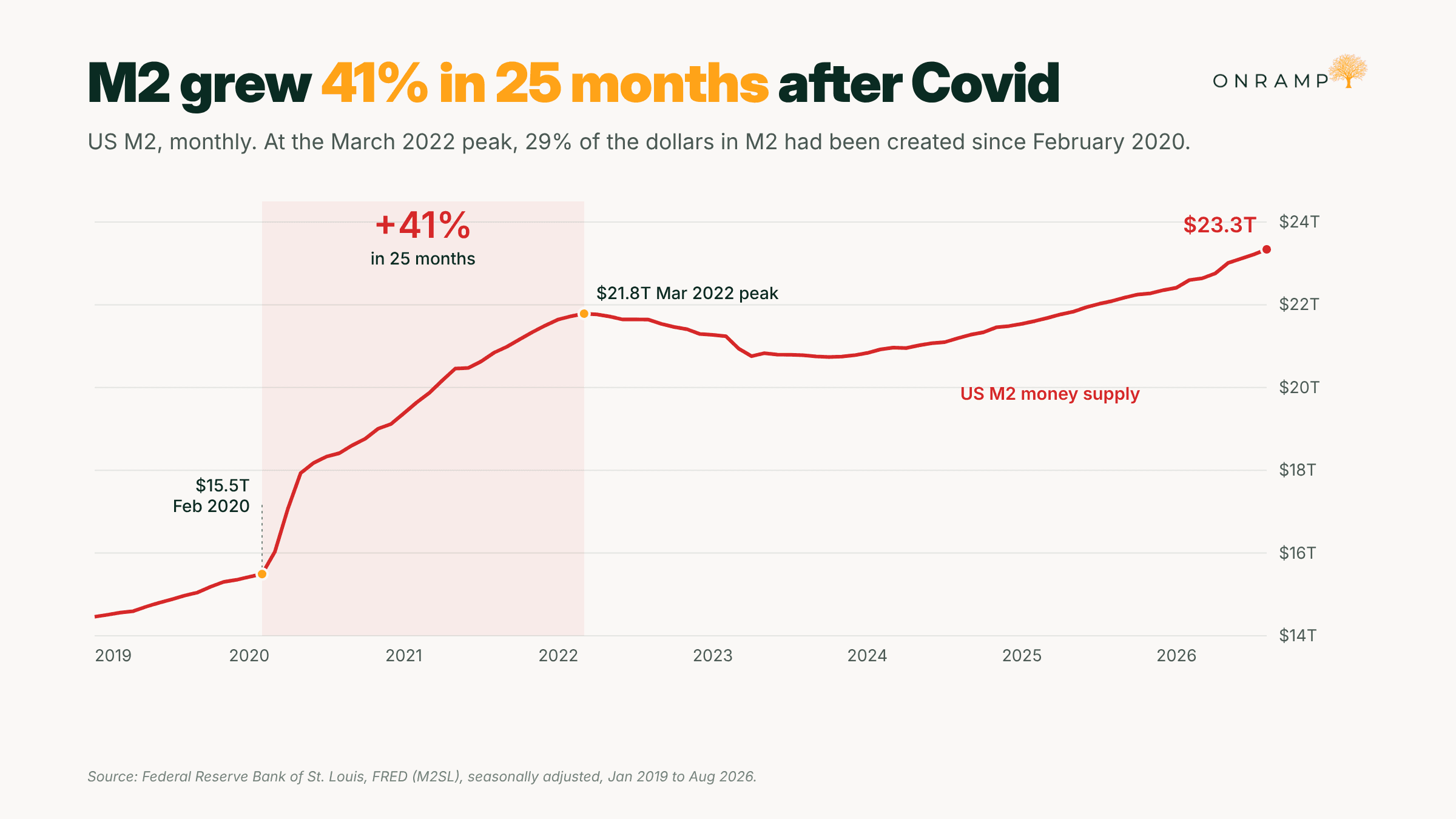
We do know how the last health emergency was financed. US M2 rose from $15.5 trillion in February 2020 to a peak of $21.8 trillion in March 2022, an increase of 41% in 25 months. The new money reached asset holders long before it reached wages, which is the Cantillon effect in its plainest form. Another crisis on that scale would almost certainly get the same response, and cause fixed-supply assets to reprice violently higher.
Rates and deficits
The fiscal data matters more than any of the week’s headlines. The 30-year Treasury yield closed at 5.67% on Wednesday, its highest close since July 2002. Thursday’s 30-year auction cleared at the highest yield since August 2000, and the CBO put the fiscal 2026 deficit near $2 trillion, up 12% on the year.
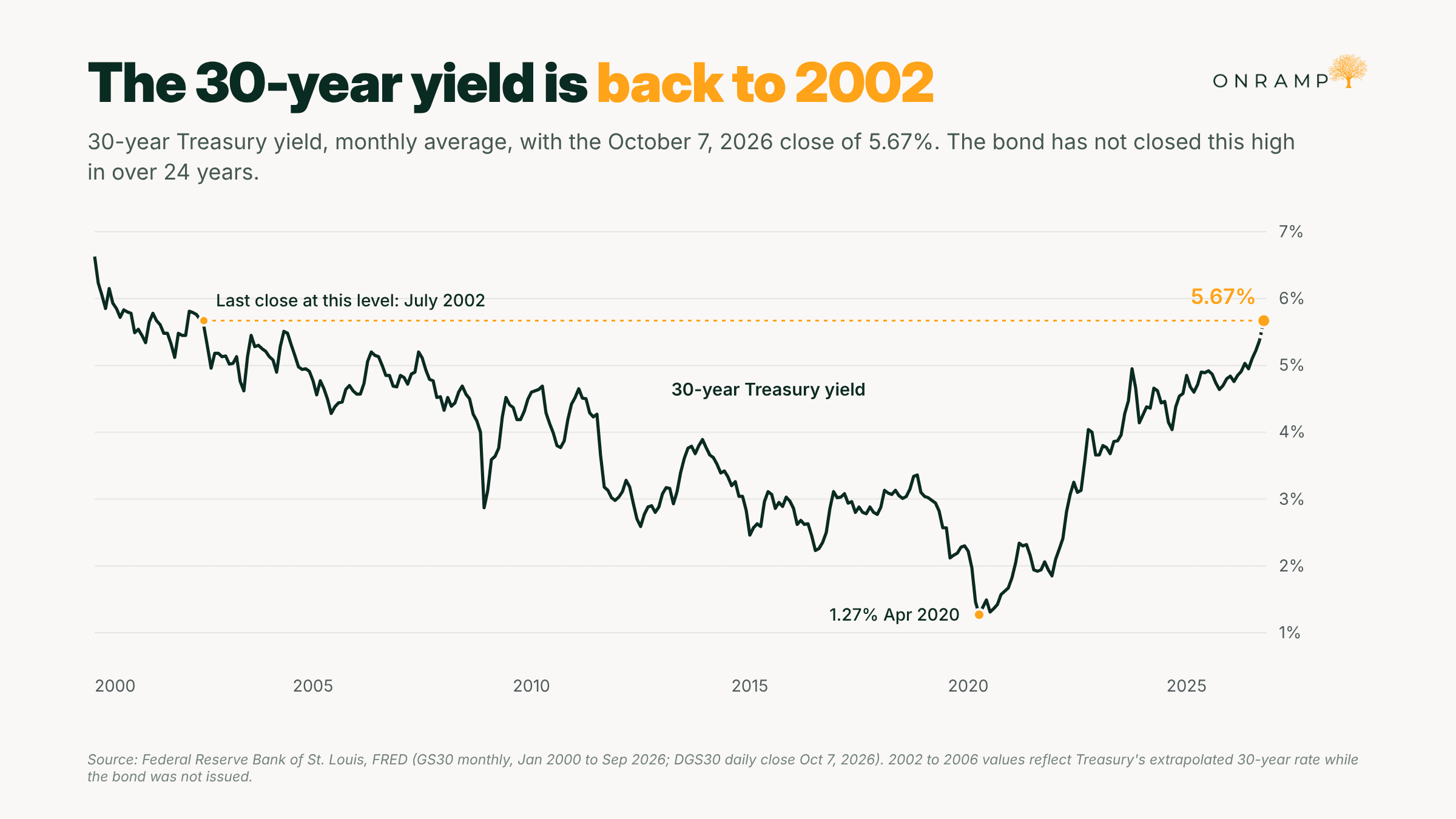
Borrowing on this scale outside a recession has little precedent, and lenders want the most compensation in a generation to hold long bonds. Spending cuts and tax increases have no political constituency. That leaves inflation and financial repression, and both work by eroding the real value of the currency along with the debt. Long-horizon capital is acting accordingly. US spot bitcoin ETFs took in about $6.4 billion in the third quarter, their strongest quarter of 2026, including $3.5 billion in August alone.
Agents and the cost of compute
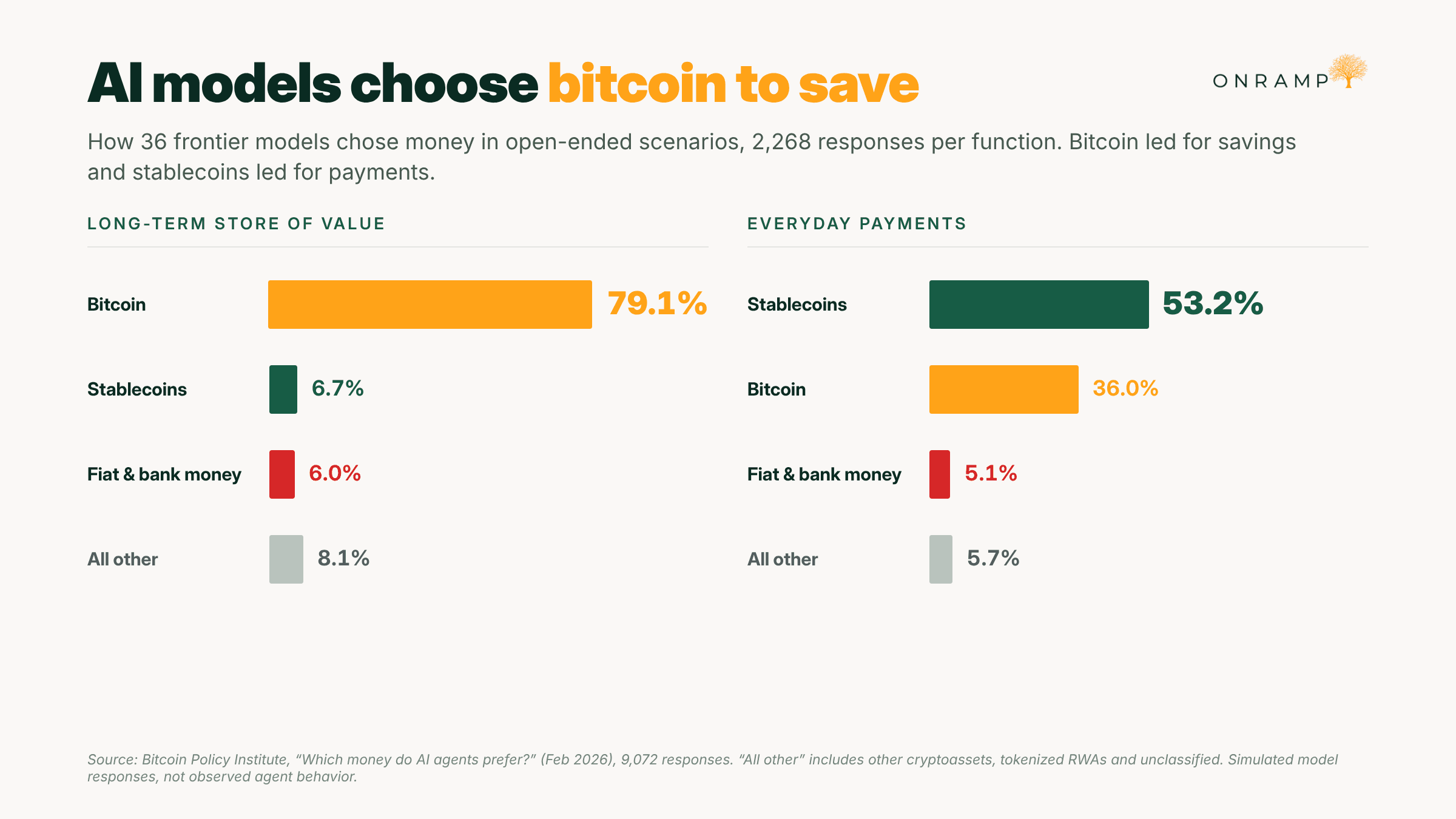
The longer-term driver markets may understand least today is AI agents becoming economic actors. BlackRock’s digital assets team made the case in The Machine-Native Economy, published September 22. Agents that buy data, book services and rent compute need payment rails that run continuously and settle transactions worth fractions of a cent, and BlackRock expects stablecoins to carry most of that volume.
The paper also cites a Bitcoin Policy Institute study of 36 frontier models across 9,072 responses. The models chose bitcoin as a long-term store of value 79.1% of the time and preferred stablecoins for payments. BlackRock reads that as a possible AI-native monetary structure, with stablecoins as working capital and bitcoin as savings. It also notes these were simulated responses rather than observed behavior.
Jason Lowery’s Softwar thesis goes further. Lowery treats proof of work as a way to impose physical cost on digital activity, and a post this week applied that idea to AI. Intelligence can get around nearly any informational constraint, such as an identity check or a rate limit, and it gets cheaper to run every year. It cannot produce energy or compute for free, and bitcoin is transferable proof that both were spent. In the post’s words, “no amount of intelligence can reason around physics.”
Attach small bitcoin payments to certain kinds of online activity, priced so a person barely notices. An agent operating at ten thousand times human scale then faces a cost it can’t absorb, and spam, botnets and synthetic identities become expensive in a way moderation never managed.
The idea goes back to Adam Back’s Hashcash, proposed in 1997 as a proof-of-work defense against email spam and cited in the bitcoin whitepaper. Lowery’s broader conclusions are theoretical and many in the bitcoin space contest his assumptions. But as a view of where an internet full of machine traffic could go, it deserves more attention than it gets.
Where that leaves us
Bitcoin dipped, the explanations followed, and the price was recovering before most of them had stopped circulating. The government moved seized coins as it routinely does, an Ethereum researcher raised a threat that cryptographers reject, and the reports from Siberia remain unconfirmed.
Over the same days, the 30-year yield returned to 2002 levels, the deficit widened, and the world’s largest asset manager published research taking seriously the idea that machines may save in bitcoin. A holder using bitcoin as savings technology had no reason to act on anything that happened this week, and several reasons to keep doing what they were already doing.
Closing Note
Onramp provides bitcoin financial services built on multi-institution custody. To learn more about our products for individuals and institutions, schedule a consultation to chat with us about your situation and needs.
Until next week,
Brian Cubellis