August 21, 2026 Roundup: Transitory Gaslighting

Brian Cubellis | Chief Strategy Officer
Free. Every week. One story that matters, read all the way down.
In this week's Roundup: the debt crossed $40 trillion on Wednesday, and hours later the Treasury doubled buybacks of its own long-dated bonds to suppress the highest yields since 2007.
- The Treasury is buying back its own debt with money it does not have, issued at the short end. Nothing is retired. The structure just gets shorter and more fragile.
- The official response is that everything is fine: growth will handle it, tariffs will pay for it, the deficit has peaked. The 30-year erased the intervention's effect within 48 hours.
- The market disagreed. Gold climbed back toward its January record, and bitcoin posted the largest three-day dollar advance in its history, reaching $79,500 this morning.
- Beneath it all, a strategy is taking shape: stablecoins as captive demand for T-bills, quiet talk of revaluing the federal balance sheet, and careful messaging throughout.
Forty trillion dollars of debt, a Treasury intervening in its own bond market, and a week of officials insisting nothing is wrong. Hard assets disagreed.
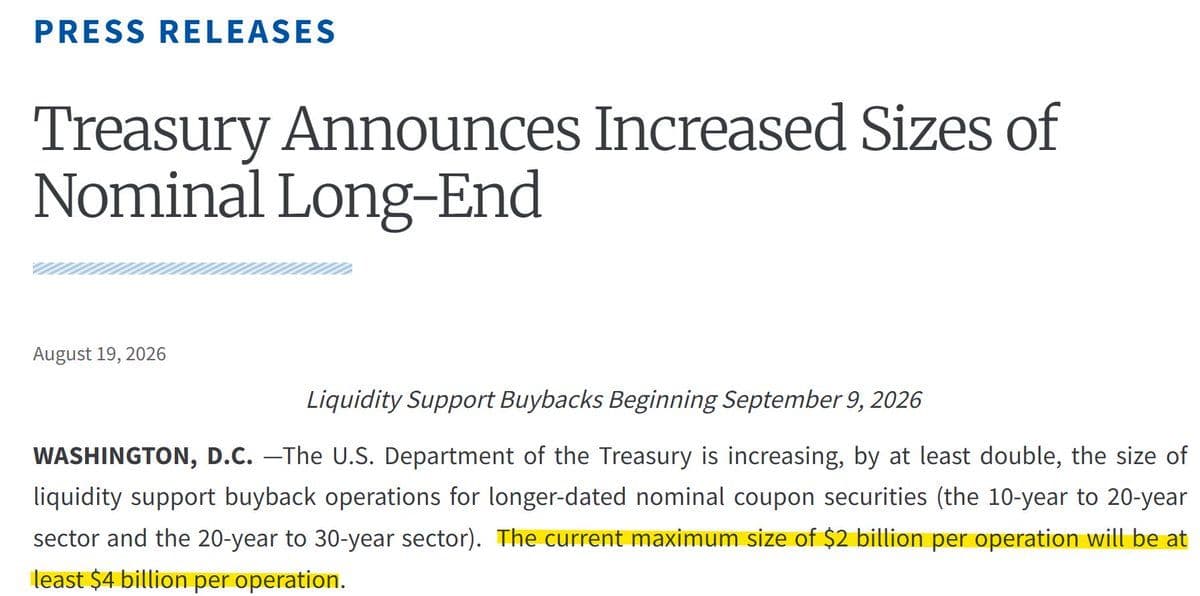
Somewhere in the middle of Wednesday, August 19, two numbers crossed paths. The gross federal debt of the United States touched $40 trillion for the first time in history, less than six months after it touched $39 trillion. Hours later, the Treasury Department announced it would double the size of its buyback operations in the long end of its own bond market, purchasing up to $4 billion per operation in the 10- to 30-year sectors, where yields had spent the week at levels last seen in 2007.
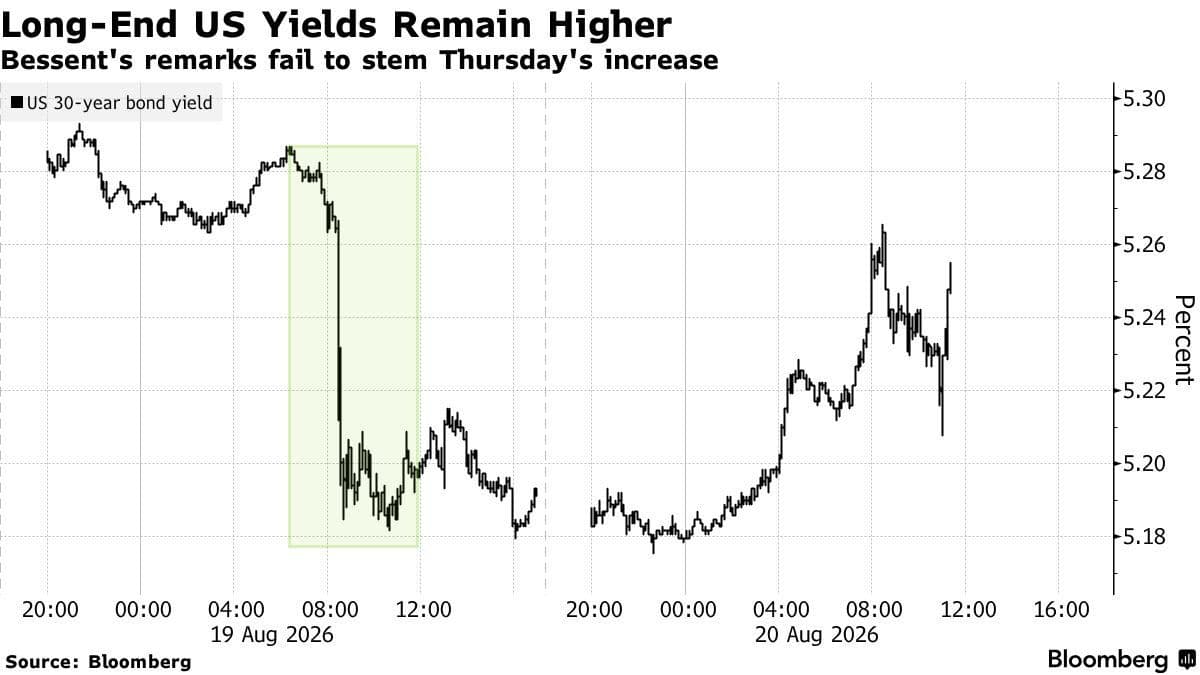
The market's response was immediate, and it has not stopped. The 30-year yield, which touched 5.34% on Tuesday, fell back below 5.2% on the announcement, then began climbing again within 48 hours. Gold surged more than 4% on Wednesday alone and has kept climbing, trading at $4,660 an ounce this morning, up roughly 37% from a year ago and at its highest level since late January.
Bitcoin rallied more than 8% within hours of the announcement, then kept going, reaching as high as $79,500 this morning. From Monday's low to Friday's high is nearly $16,000, the largest three-day dollar advance in bitcoin's history. The first leg alone liquidated $1.74 billion in short positions over 24 hours, the second-largest short wipeout on record.
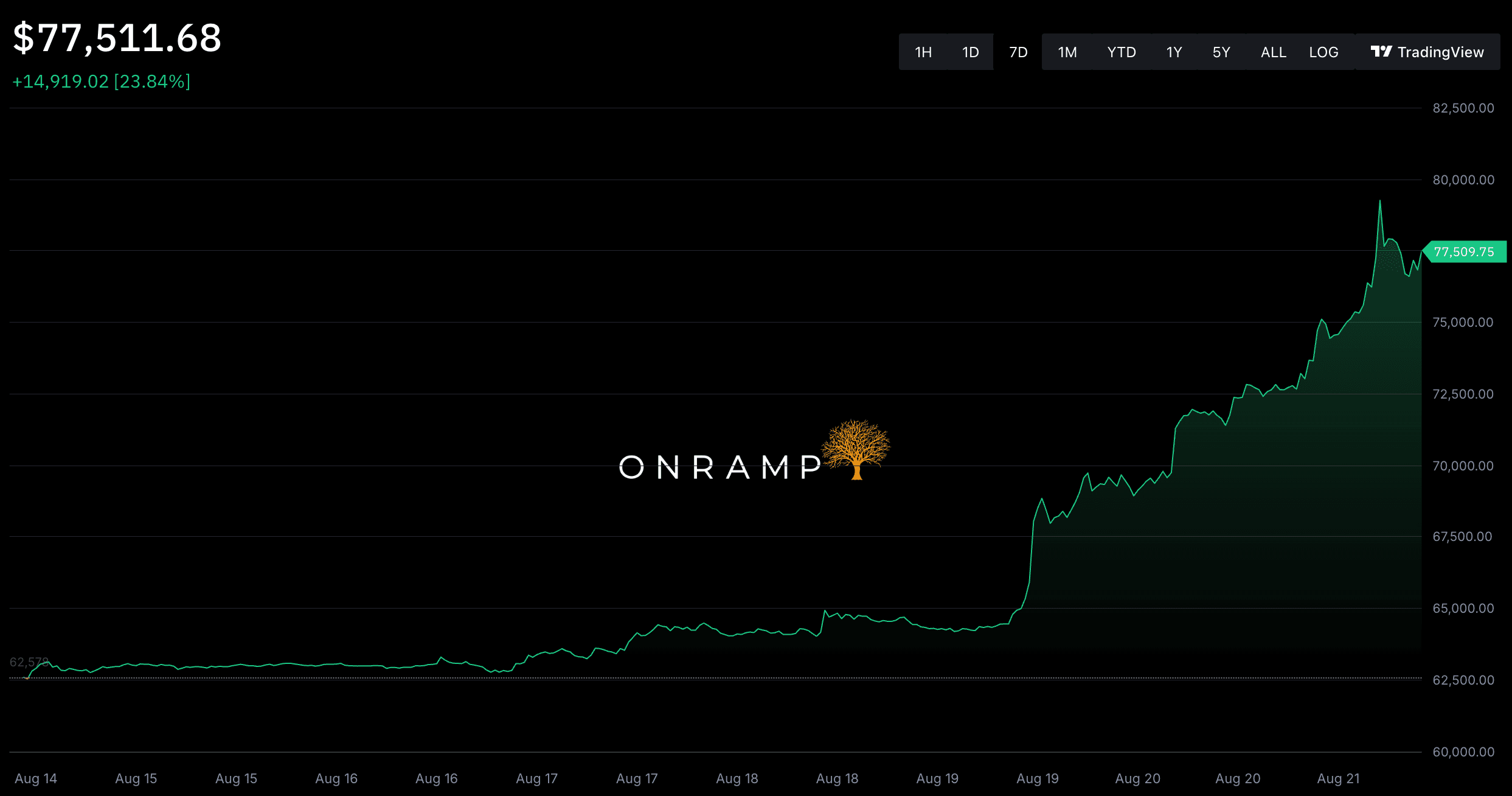
Consider what that reaction means. The United States government intervened in the market for its own debt, and the assets that gained the most were the two hardest forms of money on earth.
Buyback breakdown
Strip away the language of the press release and the mechanism is simple. The Treasury is spending money it does not have to repurchase debt it cannot afford, funded by issuing new debt, mostly at the short end of the curve where the bills roll over fastest. No debt disappears in this process. The maturity profile of the largest debt stock in human history is being quietly shortened so that the price of the long end stops broadcasting the true signal of the situation.
The official framing is liquidity support. The Treasury's statement cited "strong sponsorship from market participants," a phrase that deserves more scrutiny than it received. Sponsorship, in this context, means that dealers and asset managers are lining up to sell their long-dated Treasuries back to the government that issued them. When a market's most enthusiastic participants are the ones heading for the exit, sponsorship is a polite word for surrender.
This is no ordinary bond-market sell-off, and if it persists it marks the beginning of a structural economic shift more enduring and more globally consequential than previous episodes of volatility. Financial engineering of this kind is short-dated unless followed by fundamental policy adjustment, and that it risks collateral damage along the way. No such adjustment is coming. The deficit is running above $2 trillion annually. Interest expense alone has reached $1.2 trillion so far this fiscal year, the second-largest line item in the federal budget behind Social Security.
The theater
The public-facing response to all of this has been a study in managed perception. The President, asked whether Americans should worry about the bond market, said the country is doing so well despite interest rates, then resumed his campaign for lower ones. The Treasury Secretary spent the week projecting calm about a debt trajectory that his own department's actions contradict hourly. You do not double emergency buybacks in a market you believe to be healthy. You do it in a market you believe to be fragile, while saying the opposite, which is itself a policy tool.
By Thursday the Secretary was telling reporters the buybacks could exceed the announced $4 billion per operation and that the deficit has likely peaked, on the same day the long bond was handing back the entire effect of the intervention. The window for the enlarged operations runs September 9 through November 4, closing one day after the midterms. Every element of this policy, down to its expiration date, serves the appearance of control.
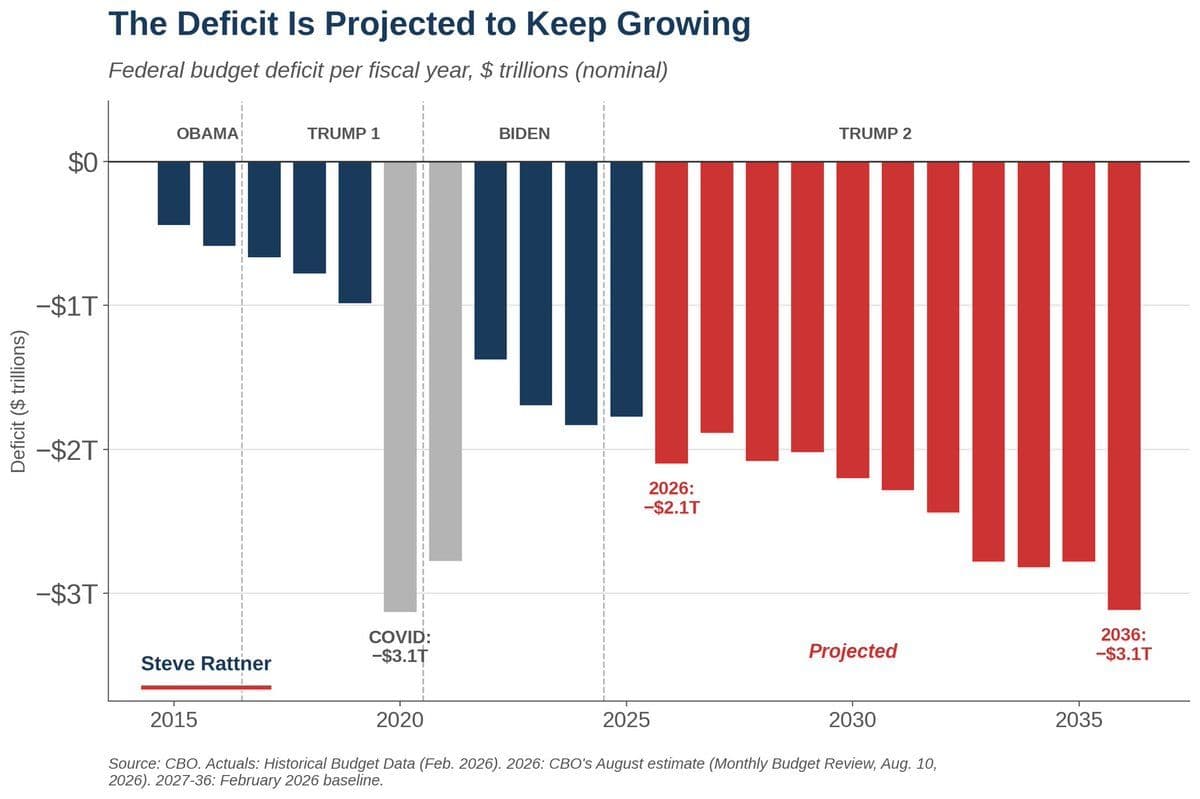
There is a word for this. Gaslighting is often reduced to lying, but the mechanism is more specific: you restructure the environment until the person observing it doubts their own reading. When the official response to $40 trillion in debt and 19-year-high yields is that growth will handle it, that tariffs will pay for it, that the prior administration caused it, the observer is being asked to distrust arithmetic. The arithmetic is not complicated. A government that spends more than its entire revenue on entitlements and interest, before funding a single aircraft carrier, has exactly one path forward. Every action taken this week was a step toward debasement acceleration.
Luke Gromen has tracked this trajectory for years and put the current phase plainly: the choices available to the United States have narrowed to crushing the dollar or crushing the bond market, and Wednesday's intervention announced which one they intend to protect. The bond market gets the buyback. The currency absorbs the cost.
The strategy underneath
What makes this week more significant than a routine rescue is how the pieces fit together. The administration is doing more than reacting to a bond sell-off. Deliberately or by gravitational pull, it is assembling a coherent architecture for extending the dollar system through its insolvency.
Start with stablecoins. The GENIUS Act has converted dollar-backed tokens into regulated vessels for Treasury bill demand, and the Treasury Secretary has said openly that stablecoins will buttress the dollar's reserve status and drive a surge in demand for T-bills.
Every wallet in Lagos, Buenos Aires, or Istanbul holding a digital dollar is an indirect financing source for the federal government at the front of the curve. The United States is exporting its currency digitally and importing the demand for its debt, a privatized petrodollar recycling loop for the twenty-first century.
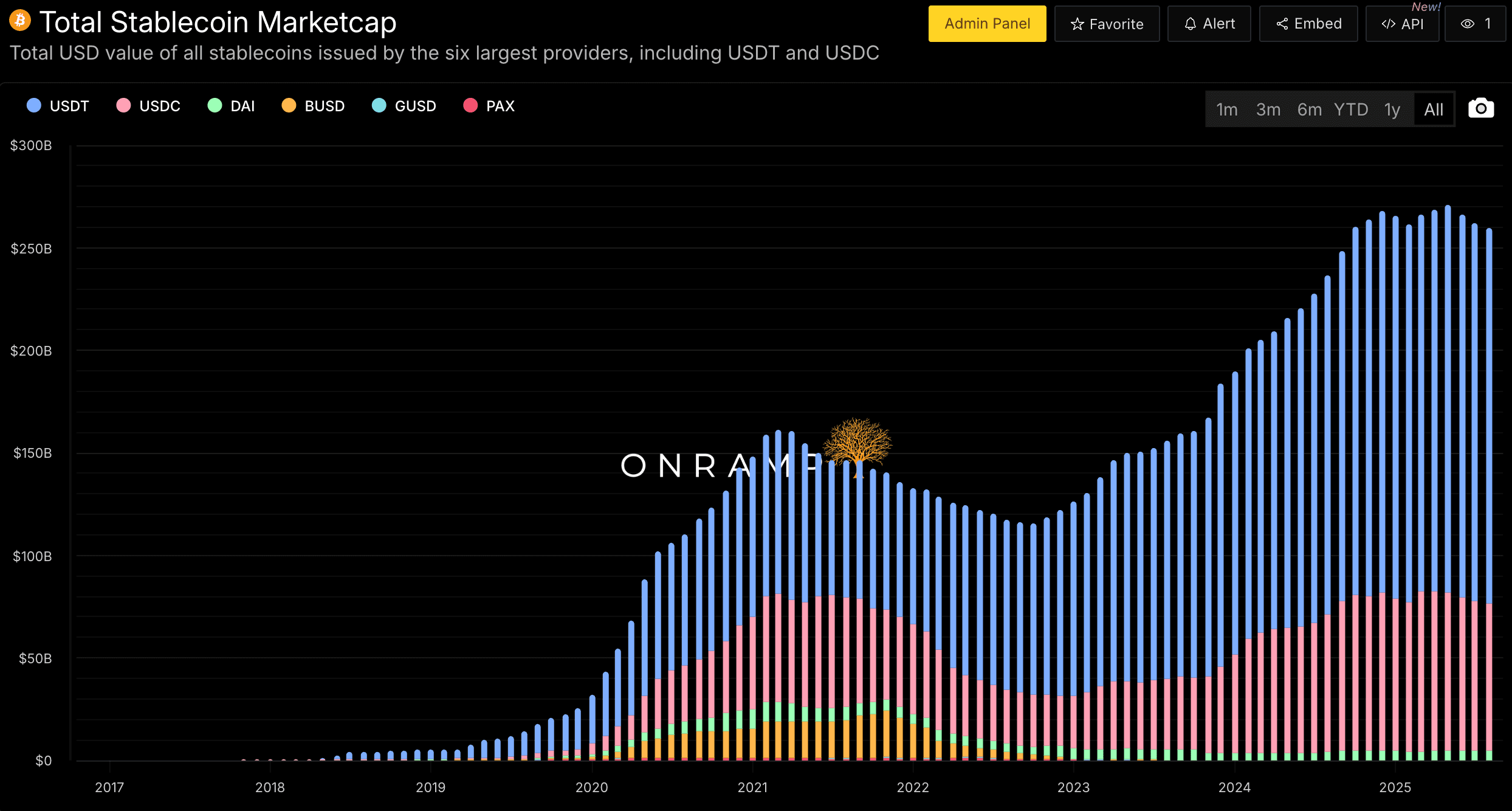
Then consider the shortening. By leaning on bills and retiring duration through buybacks, the Treasury transforms the debt structure into something acutely sensitive to short rates, which is precisely the structure you would choose if you intended, eventually, to get those rates down by whatever means necessary.
Add the quiet discussion now circulating about monetizing the asset side of the federal balance sheet, revaluing gold certificates chief among the ideas, and the shape of the endgame becomes visible. Suppress the long end. Find captive buyers at the short end. Revalue what you hold. Inflate away what you owe. Manage the messaging throughout.
Why bitcoin exists
The bitcoin thesis is an observation about incentives. Governments that cannot cut spending and cannot default honestly will default through the denominator instead. This week delivered the full mechanism: a debt milestone arriving months ahead of schedule, a bond market revolt at the long end, an emergency intervention dressed as routine operations, and a coordinated chorus of officials insisting the fire alarm is not a fire alarm.
Bitcoin repriced violently higher for a very simple reason. The week was a live demonstration of its founding premise. A government intervened in the market for its own promises, and within hours capital moved toward the assets that require no promises at all. Gold, which has played this role for five thousand years, climbed in lockstep toward its January record. When the oldest hard money and the newest hard money move together on the same news, they are accurately measuring the unit they are priced against.
None of this is new. The same mechanism ran in 2008, again in March 2020, and in every quiet expansion of the Fed's and Treasury's toolkit in between. Each episode resolves the same way: the institution is defended, the denominator pays, and a few more people do the math on what they actually own. Bitcoin has spent seventeen years absorbing these confirmations one at a time. This week the confirmation came from the Treasury's own press release.
Closing Note
Onramp provides bitcoin financial services built on multi-institution custody. To learn more about our products for individuals and institutions, schedule a consultation to chat with us about your situation and needs.
Until next week,
Brian Cubellis