September 25, 2026 Roundup: The Price of a Promise

Brian Cubellis | Chief Strategy Officer
Free. Every week. One story that matters, read all the way down.
The Fed's rate hike was meant to buy credibility, and the long end of the bond market has called the bluff.
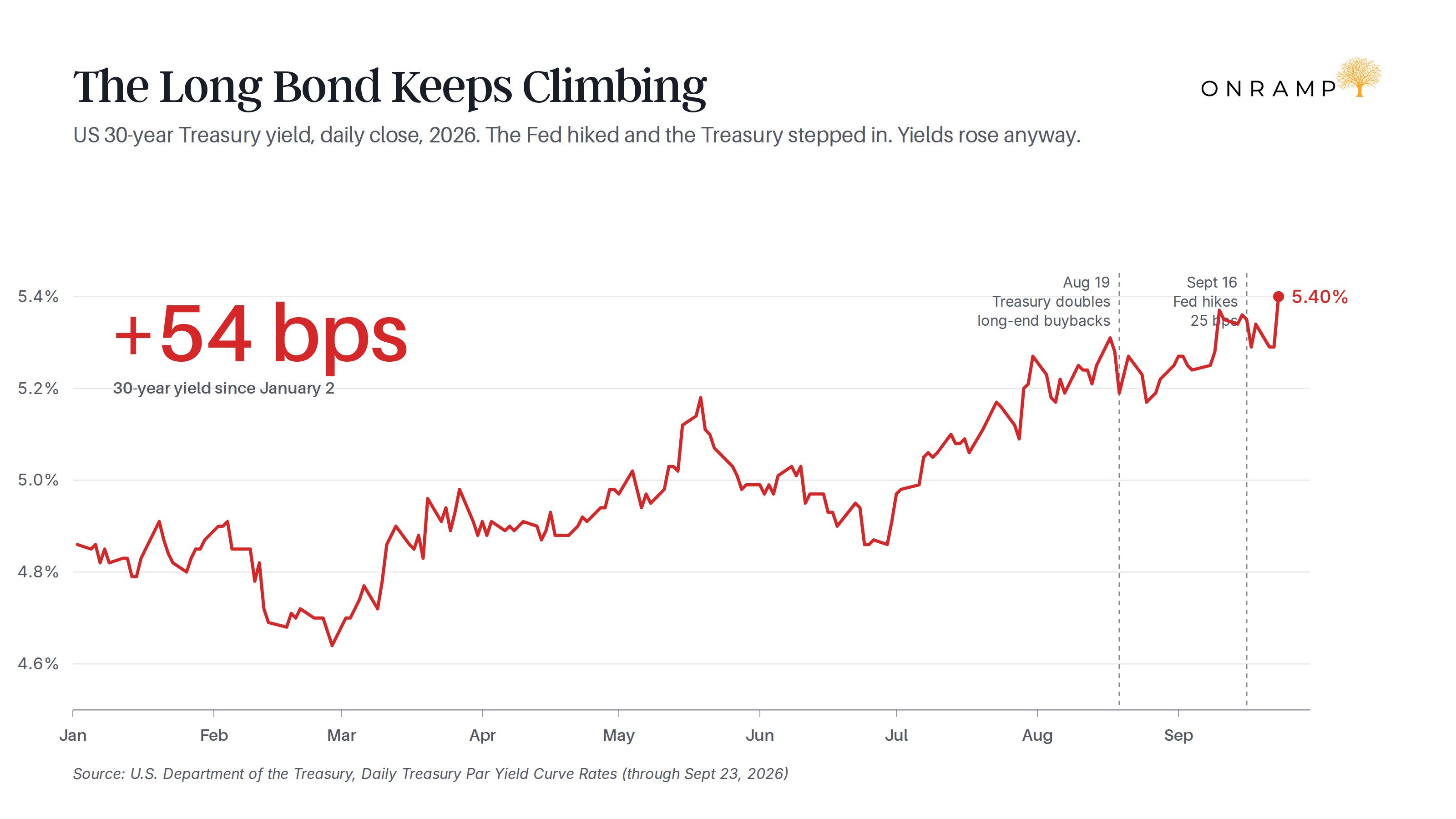
Thirty-year yields have kept climbing since the decision. The Treasury has gone from doubling its long-end buybacks to tripling them in under a month, and yields are higher now than before either step.
Bitcoin has been trading the trajectory of those buybacks since the first was announced in August, and this week ETF buyers put more than $2 billion behind that read.
The Price of a Promise
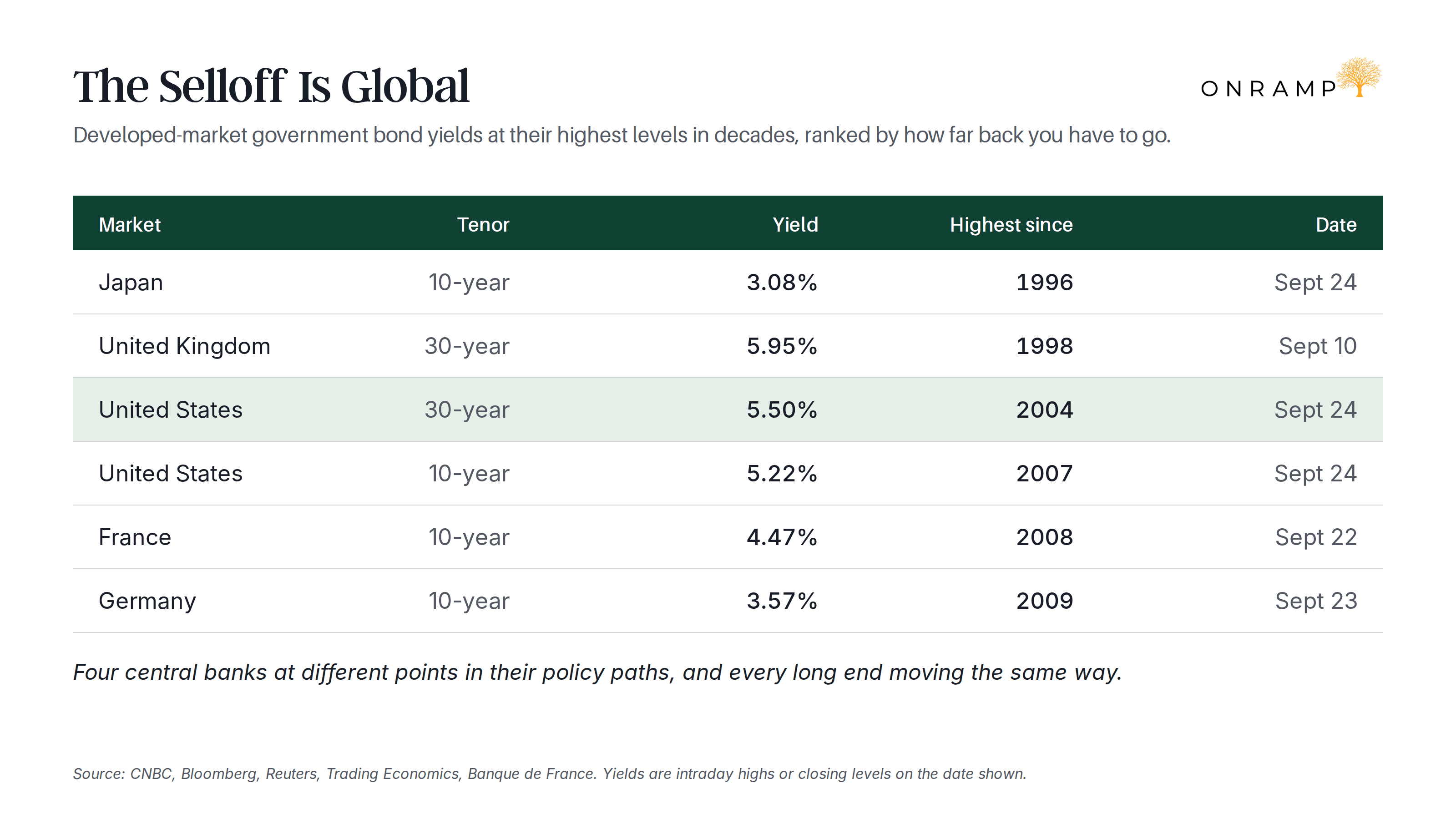
On Thursday the 30-year Treasury touched 5.50%, a level last seen in 2004, and the 10-year printed its highest yield since the summer of 2007. The move was not confined to Washington. Japan's 10-year reached its highest level since 1996, and gilts and Bunds pushed to fresh multi-year highs alongside it. The long end of the curve is expressing a judgment the front end cannot.
Beyond the Fed's Reach
On September 16 the Fed raised rates for the first time since July 2023. By the book, a central bank that tightens into an inflation scare buys credibility, and long-term yields should theoretically settle as the market concludes inflation will be contained. The opposite happened. Long yields kept rising, and a poorly received $70 billion five-year auction only accelerated the move.
The Fed sets the price of overnight money. The price of thirty-year money is set by lenders deciding whether to commit capital to a government for a generation, and they are now demanding materially more to do so. Part of that premium reflects the oil shock. The rest is term premium, the compensation investors require for uncertainty about what the currency they are repaid in will be worth. Said another way, the long bond is the most candid real-time measure we have of confidence in the issuer.
A Global Repricing
Central banks in Washington, London, Frankfurt and Tokyo sit at different points in their policy paths, yet their long ends are moving together. When markets with different inflation rates, different policy rates and different politics reprice in unison, the common variable is fiat money itself.
What these issuers share is a debt stock large enough that rising rates compound on themselves. Japan's government debt exceeds 200% of GDP, and interest is projected to absorb more than a quarter of government spending this fiscal year. US federal debt passed $40 trillion in August. Meanwhile the marginal buyer is retreating. Net foreign private demand for Treasuries fell to $16.6 billion in June, just as issuance climbed.
For three decades, near-zero yields at home pushed Japanese savings abroad and made Japan the largest foreign holder of Treasuries. With JGBs now yielding above 3%, a growing share of that capital has reason to stay home, and every yen that does is demand Washington and London no longer have. Rising supply meeting a thinning bid is how sovereign yields end up at multi-decade highs on three continents at once.
The Spiral
The arithmetic is unforgiving. Higher yields raise the interest bill, the larger bill widens the deficit, the deficit is financed with more issuance, and the added supply pushes yields higher still. A heavily indebted sovereign caught in that loop has few exits. Genuine austerity is politically unavailable, and default is unthinkable for the issuer of the world's reserve currency. What remains is debasement: holding borrowing costs below the rate of inflation and letting the currency carry the weight of the debt. Every intervention so far points in that direction.
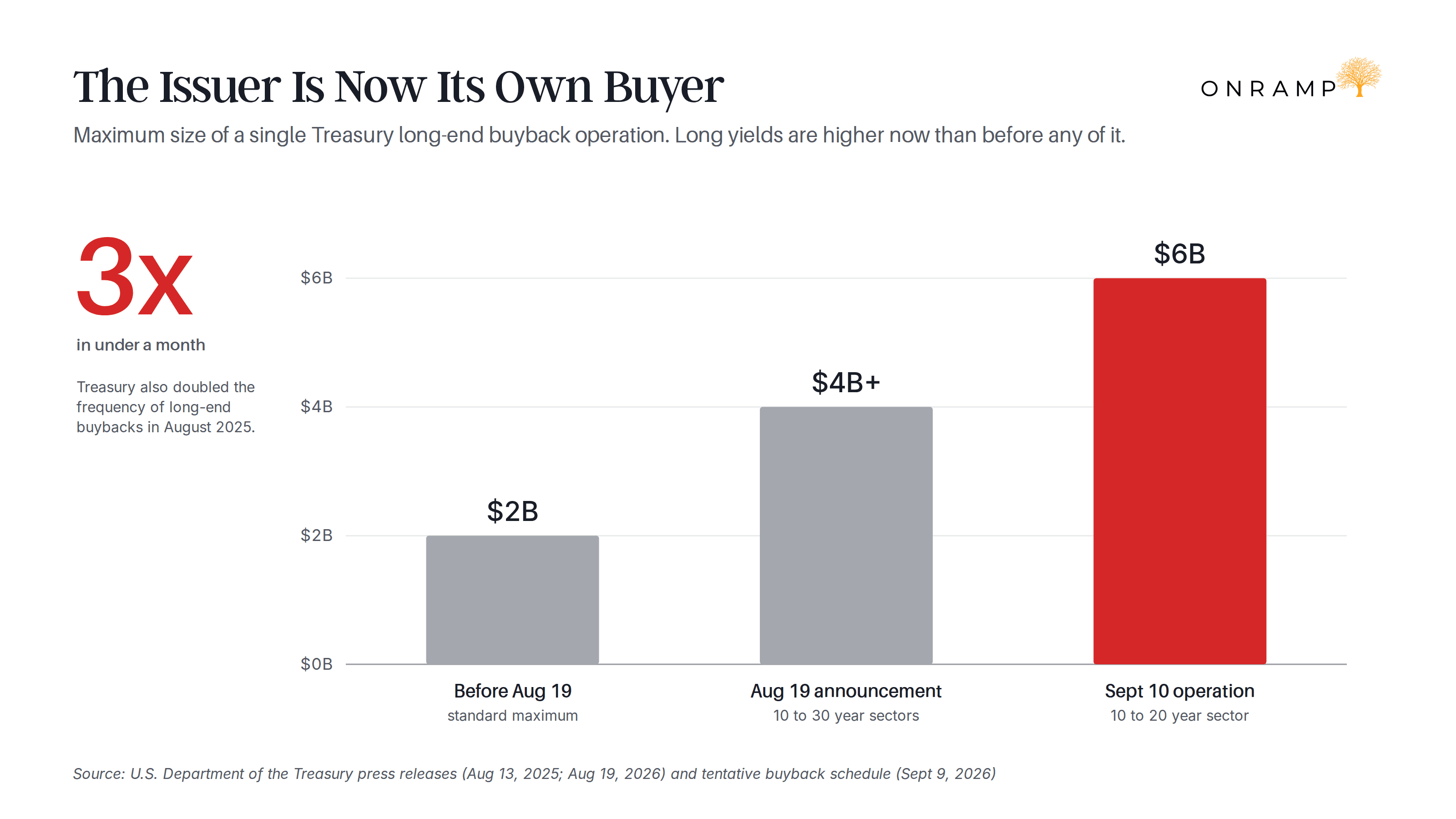
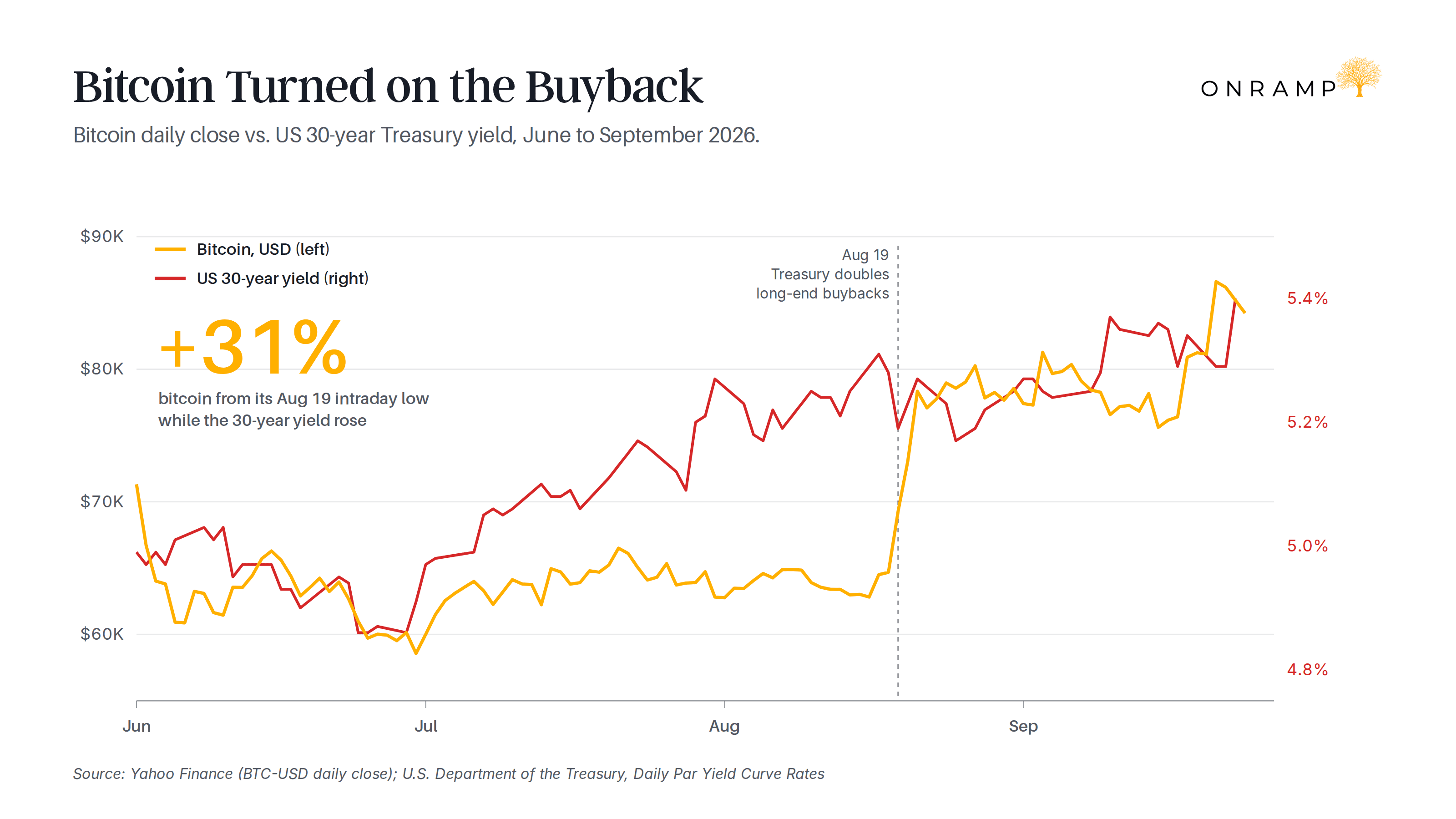
The clearest evidence comes from the Treasury itself. On August 19 it announced it would at least double the maximum size of its long-end buyback operations, from $2 billion to $4 billion per operation across the 10- to 30-year sectors. Three weeks later it scheduled a single operation of up to $6 billion in 10- to 20-year paper. Both steps followed a decision a year earlier to double how often those buybacks run.
The market's response is the most telling part. The 30-year fell to 5.19% on the day of the August announcement and closed at 5.40% on Wednesday. Tripled support was absorbed, and the selling continued. If doubling and then tripling have failed to cap yields, the next step will be larger, and Treasury has already said it will revisit buyback sizes at its November 4 refunding. The logical endpoint is the government absorbing the duration the private market no longer wants, whatever label is attached to it. Economically, that is the monetization of debt.
The Bitcoin Signal
Bitcoin understood the August announcement immediately. It rose from roughly $64,100 to nearly $70,000 on the day. Spot bitcoin ETFs have since absorbed more than $5 billion of net inflows, reversing $4.3 billion of outflows over the first seven and a half months of the year. The bid has not faded. From Sunday night into Monday, bitcoin ran from about $81,000 to $87,400, its highest price since January. ETFs took in nearly $1 billion on Monday, their largest day of 2026, followed by another $715 million on Tuesday. Flows for the year are now positive.
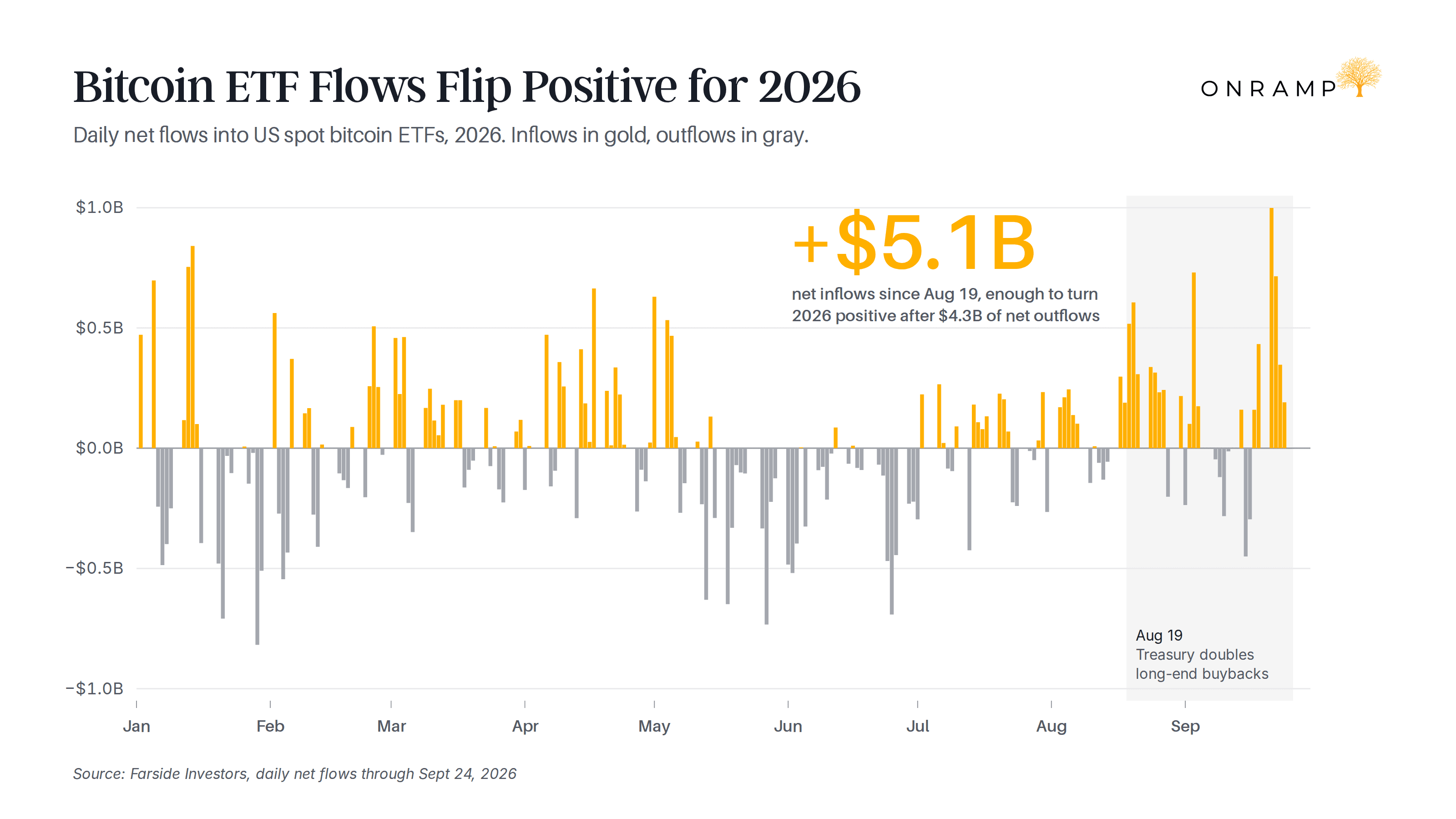
The rally also carried bitcoin back above the average cost basis of ETF holders, estimated at roughly $82,000. For the first time since January, the typical ETF investor is sitting on a gain rather than waiting to get back to even. That matters for behavior. Holders below their entry price tend to sell into rallies to recover what they paid, while holders in profit are far less inclined to part with the asset.
Bitcoin now trades around $84,000, more than 30% above its August 19 low, while the 30-year yield sits higher than it did that morning. Conventional models would have the two moving against each other, since a higher risk-free rate raises the hurdle for any asset without a coupon. They have moved together because bitcoin has looked past the level of yields to the policy response that level makes inevitable. Every rate hike adds to the government's own interest bill and draws the next intervention closer. Tighter policy and further debasement are expressions of the same fiscal constraint.
Neutral Reserves
For half a century sovereign debt served as the world's reserve asset because it was the safest promise available. This year that promise acquired a visible price. For a foreign reserve manager, holding another government's bonds now means holding its fiscal trajectory and its political leverage as well. In a world splitting into competing blocs, both carry more weight than they once did.
The natural beneficiaries are reserve assets that no government issues and no government can freeze. Gold is the incumbent, and central banks have accumulated it at a historic pace in recent years. Bitcoin is its digital counterpart, with a fixed supply schedule, no issuer, and final settlement without an intermediary. As the unit of account debases, both should be rerated against it. What we are watching is a structural shift in what the world is willing to hold as money, and the fiscal math moves in only one direction.
The Thirty-Year Bet
A buyer of the long bond at 5.50% is lending until 2056 on a single proposition: that a government carrying $40 trillion of debt, whose Treasury is already buying back its own bonds, will preserve the purchasing power of the currency it repays in. The alternative is a money whose supply is fixed for the entire term and which requires no trust in any issuer.
Thirty years is a long time to trust a borrower already buying back its own promises.
Closing Note
Onramp provides bitcoin financial services built on multi-institution custody. To learn more about our products for individuals and institutions, schedule a consultation to chat with us about your situation and needs.
Until next week,
Brian Cubellis