September 4, 2026 Roundup: Every Print Needs an Alibi

Brian Cubellis | Chief Strategy Officer
Free. Every week. One story that matters, read all the way down.
Washington is blaming the war for the bond market's repricing. The war is the excuse. The cause is $40 trillion of debt, and the resolution will arrive through the printing press.
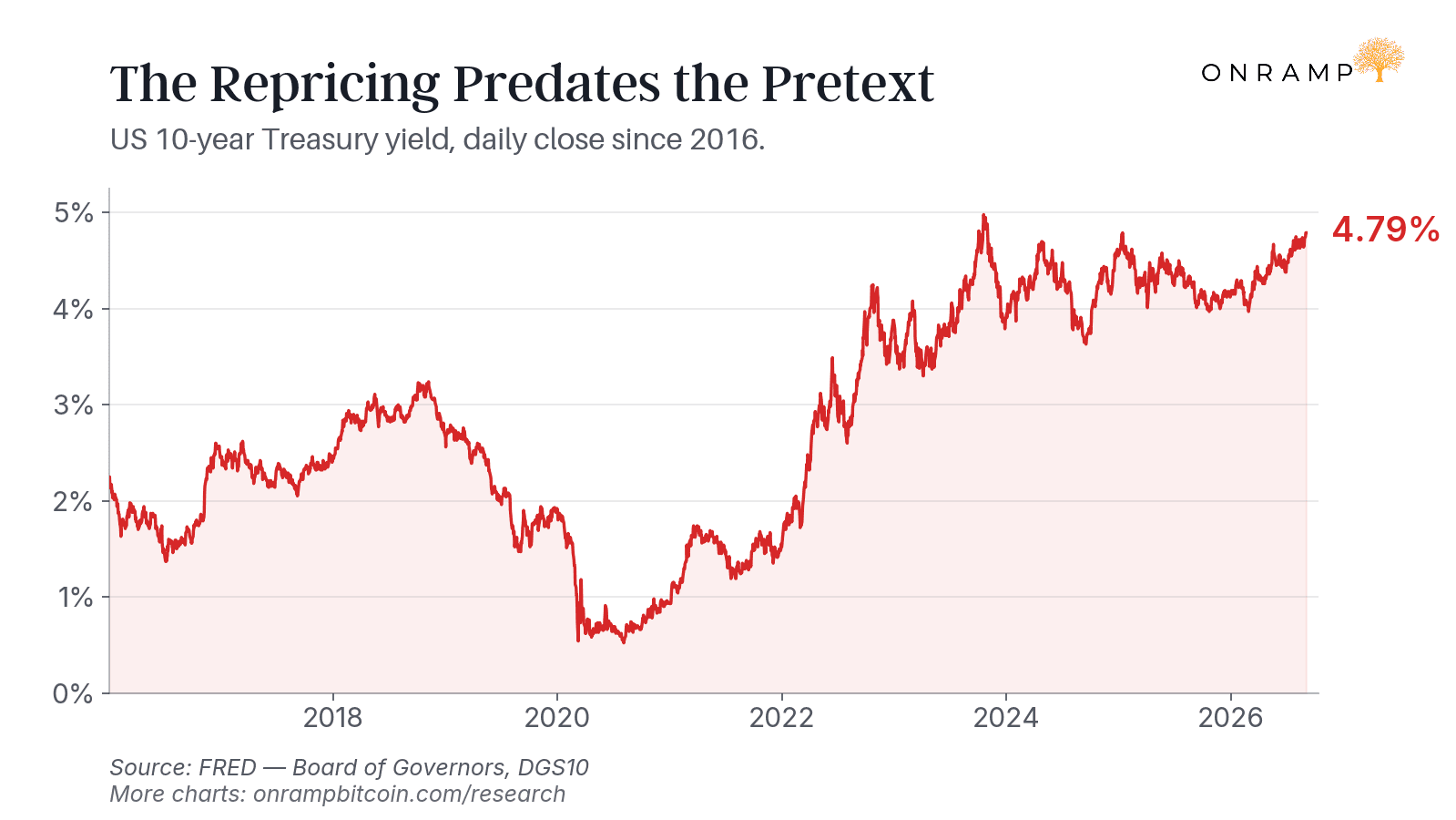
» The 10-year Treasury yield has not closed below 4% since the US attacked Iran on February 28, and it now stands at 4.77%, near a three-year high.
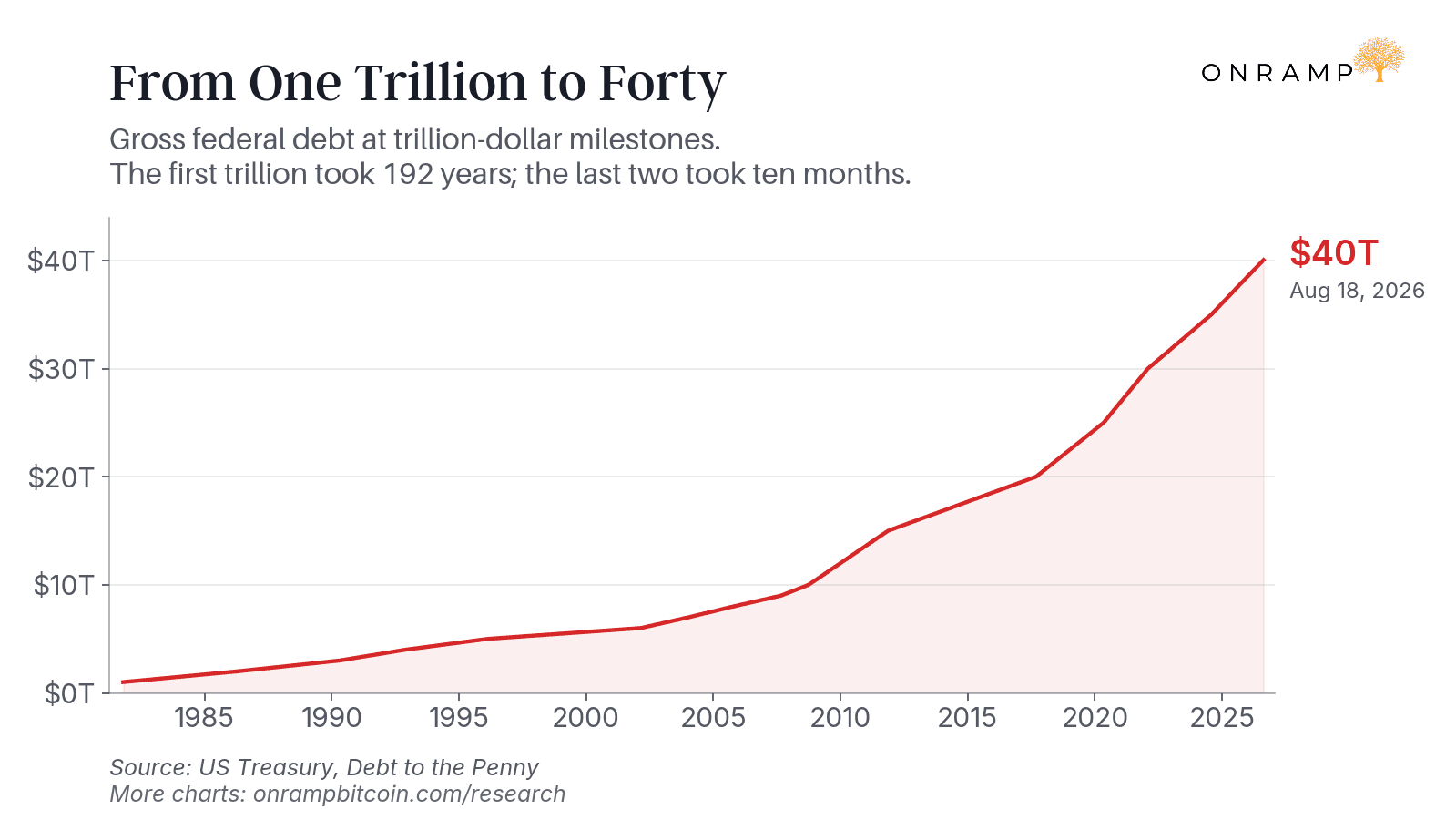
» Gross federal debt crossed $40 trillion on August 18, double its level of a decade ago. The war filled the front pages that week.
» Kevin Warsh's Jackson Hole speech was meant to restore Fed credibility and raised long yields instead, while The White House demanded rate cuts in public.
» Every emergency monetary expansion since 1797 has been introduced as temporary and kept as permanent. The next one will be announced as a response to the war.
» The bitcoin-gold correlation is at a six-year high; investors are positioning for the print rather than waiting for the announcement.
Every Print Needs an Alibi
The 10-year Treasury yield has not closed below 4% since the day the United States attacked Iran. That was February 28. On Thursday the note closed at 4.77%, near a three-year high.
The standard explanation for the move is the war itself. Fuel is expensive, inflation expectations have risen, and lenders are demanding more compensation. This explains the last few months reasonably well. It does not explain why gross federal debt crossed $40 trillion, or why the officials responsible for the policy response spent last week contradicting one another in public.
The Alibi
The war's contribution to the bond market is real. Retail diesel reached $5.68 a gallon this week, about $2 more than a year ago, and October futures rose 13% in a week on Ukrainian strikes against Russian refineries and the collapse of the ceasefire. Diesel moves freight, farm machinery, and construction equipment, so it enters the price of nearly everything.
Fuel, however, is the only pressure on Treasuries that a negotiation can remove. The debt stock, the term premium, and the credibility of the issuer are not on any ceasefire agenda. And while the fuel story occupied the headlines, the debt stock crossed a line.
On August 18, gross federal debt passed $40 trillion for the first time, roughly double its level of a decade ago. The debt stood at $38 trillion last October, so the most recent two trillion took about ten months. The war filled the front pages that week.
There is a straightforward way to test which force is doing the work. If a peace deal arrives, diesel retreats, and the 10-year remains near 4.8%, then the energy story was the visible part of a repricing with much older causes.
Podium Policy
The officials responsible for the response spent the week saying three different things. Each of the three avoids the giant fiat elephant in the room.
Start with the chairman. On August 28, in his first Jackson Hole address, Kevin Warsh told the assembled central bankers that "money matters," accepted on the institution's behalf "the responsibility for 65 months of sustained, elevated inflation," and announced that forward guidance had overstayed its welcome. Yields rose after the speech. Some prognosticators attribute the rise to a Fed risk premium: a chairman who will not say what he intends to do next forces lenders to guess, and lenders charge for guessing.
There is also a deeper omission. When Paul Volcker made the money supply the target in October 1979, federal debt held by the public stood near a quarter of GDP, and a 20% funds rate was painful but affordable. Against $40 trillion of debt, the same resolve becomes interest expense, and the interest expense becomes more deficit. The chairman understands this arithmetic. It did not appear in the speech.
The Vice President wants the opposite policy. "We think the Fed should cut interest rates," JD Vance told reporters on Thursday, adding that "it would be great if the Fed could help out." Housing affordability is the stated reason. The mechanism fails on its own terms. Last fall's cuts were followed by higher mortgage rates, because mortgages price off the long end of the curve, and the long end prices the government's borrowing needs rather than the Fed's announcements. A cut delivered under political pressure would likely raise those borrowing costs, not lower them.
That same afternoon, Governor Christopher Waller asked markets to "give disinflation a chance," a line borrowed from John Lennon. The implied odds of a September rate hike fell from 63% to a coin flip within hours, and stocks and bonds rallied together. One governor and one sentence repriced the September meeting by thirteen points.
Put the three positions together. The chairman concedes that money matters and cannot act on it. The White House demands cheaper money. A governor counsels patience and the front end rallies while the long end ignores all three. None of these men is confused. Each is managing a different audience, and each knows it. The Fed blames Congress for the deficits, the White House blames the Fed for the rates, and everyone blames Tehran for the inflation. The polite term for this is messaging. The accurate one is gaslighting. What nobody mentions, from any podium, is the debt.
The Vocabulary of Emergency
The arithmetic itself is simple. Interest on $40 trillion compounds faster than the revenue raised against it, and the difference is borrowed. More borrowing means more issuance, more issuance means more upward pressure on yields, and higher yields mean more interest expense. The loop feeds itself.
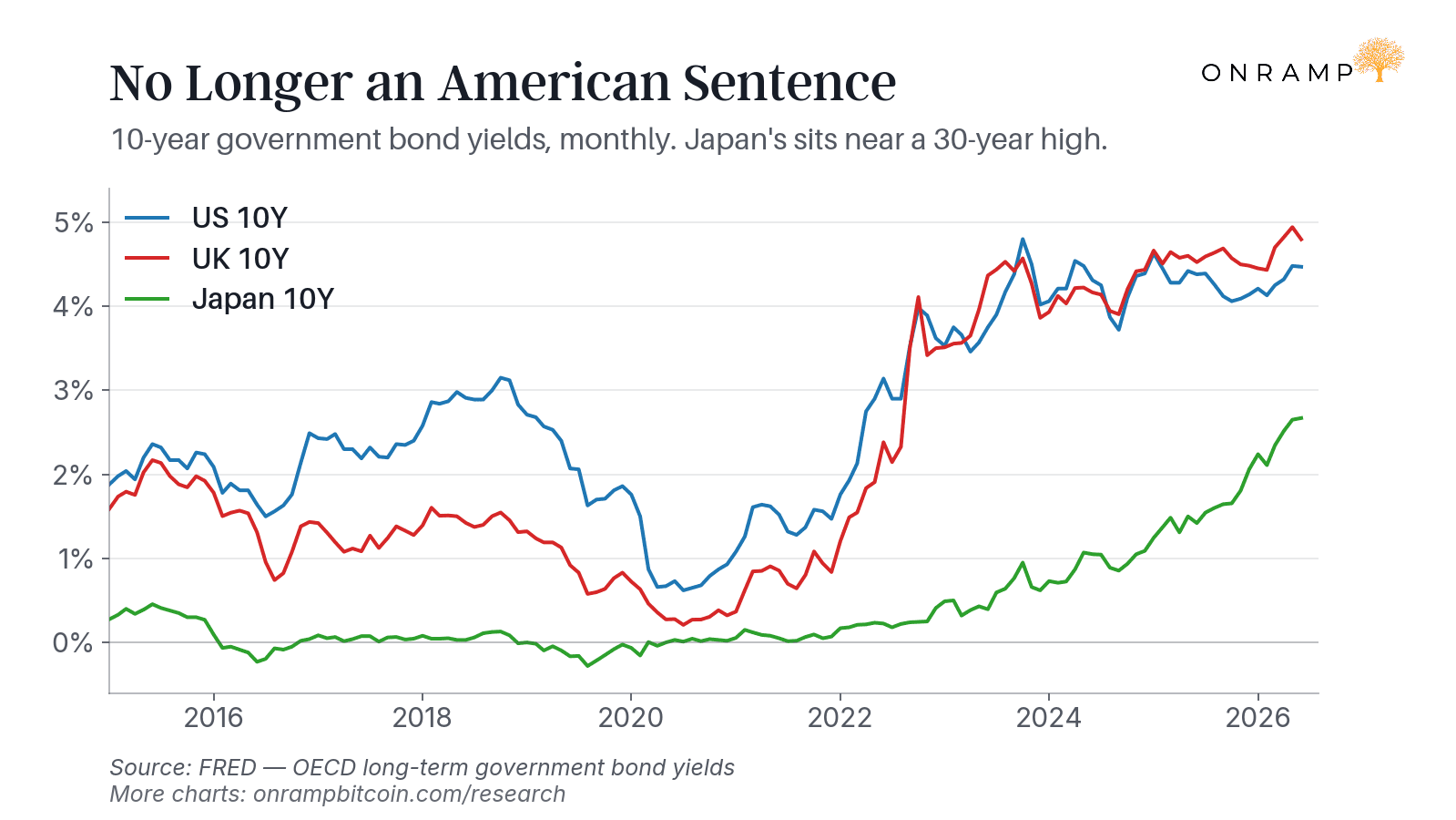
Nor is it only America's loop. The term premium is rising across the developed world, Japan's 10-year yield sits near a 30-year high, and the United Kingdom is being forced toward spending cuts. Neither Japan nor Britain has a diesel problem. What they share with the United States is a debt stock that has outgrown the political will to service it honestly.
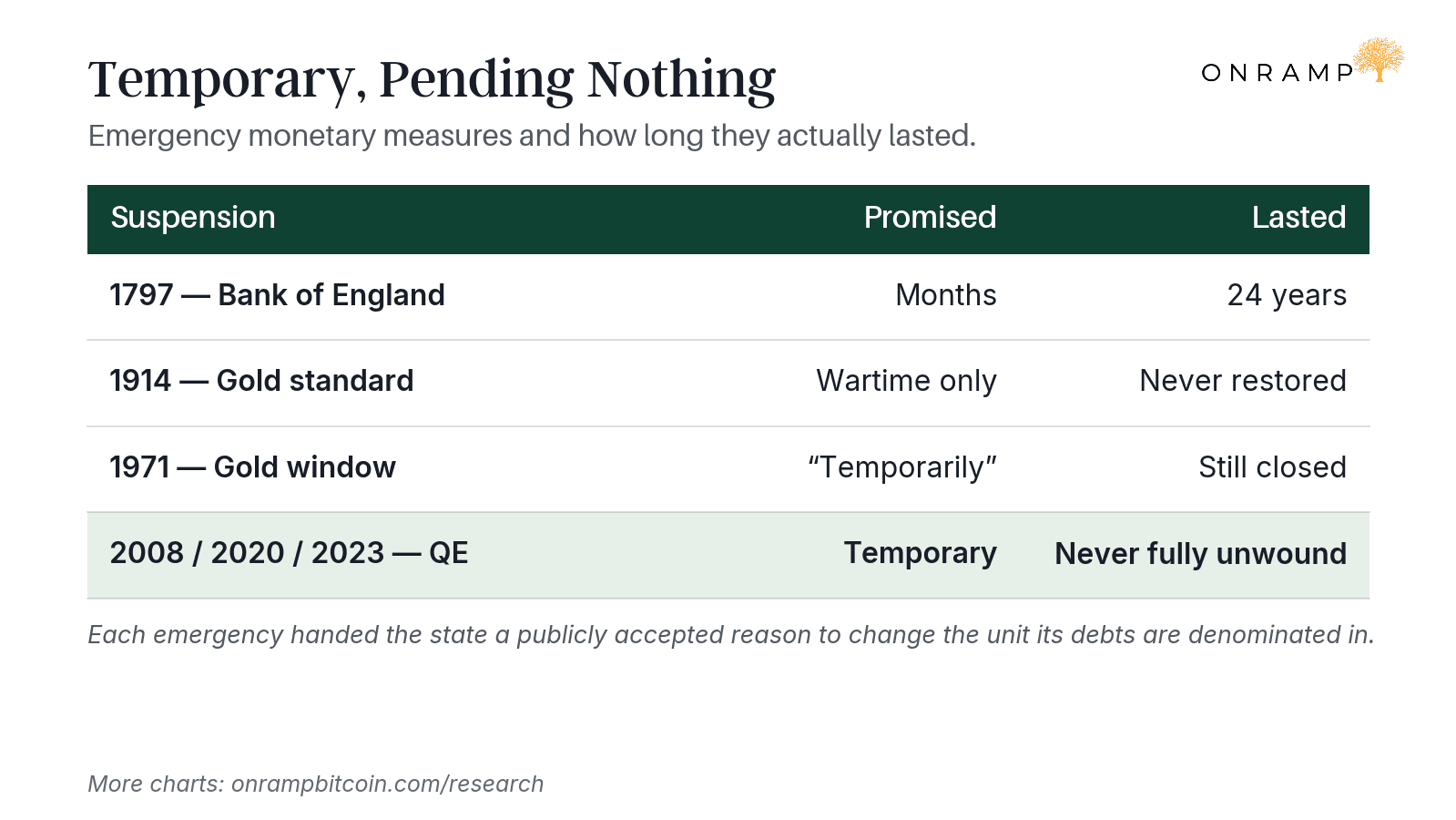
A government in this position has three options: run surpluses, default openly, or reduce the real value of the debt through inflation. The first two are politically unavailable. The third is the one history knows well. In 1797 the Bank of England suspended gold convertibility to finance the war with France; the measure was meant to last months and lasted 24 years.
In 1914 the belligerents abandoned the classical gold standard within weeks, as a temporary wartime expedient that was never unwound. In 1971 the gold window closed under the fiscal weight of Vietnam and the Great Society, on the same temporary basis.
The emergencies were real. The responses were permanent, because each emergency handed the state the one thing it normally lacks: a publicly accepted reason to change the unit in which its debts are denominated.
In 2008 the Federal Reserve's balance sheet roughly tripled and never returned to its prior size. In 2020 it nearly doubled in a matter of weeks and never returned to its prior size. In 2023 a regional banking scare produced a brand-new lending facility in days. The instruments change and the tempo quickens, but the direction has held for decades. Each round exists to move the reckoning past the next election, and the can being kicked is the currency itself.
Treasury's expanded buybacks, announced in August and effective September 9, put the debtor in the market as a regular buyer of its own bonds. To put it simply: announcing that you found another credit card you have not maxed out, in a stack of twenty, does not inspire confidence.
The war accelerates this process rather than causing it. Wars are expensive, wartime deficits run larger, and wartime gives officials the excuse to do what the arithmetic already required. When the long end refuses to clear at a price the Treasury can afford, the response will arrive as an emergency measure, it will be blamed on events, and it will involve the creation of money. This is the documented behavior of the system across three crises in eighteen years, each one larger than the last. The debasement will not slow down from here. It accelerates, because the compounding beneath it accelerates.
The Response Function
Investors have begun to position for it. The 90-day correlation between bitcoin and gold reached a six-year high this week, a level last seen after the COVID stimulus, and the 30-day measure touched 0.67, its highest reading in at least seven years. Money is moving from assets that depend on policy toward assets that sit outside it.
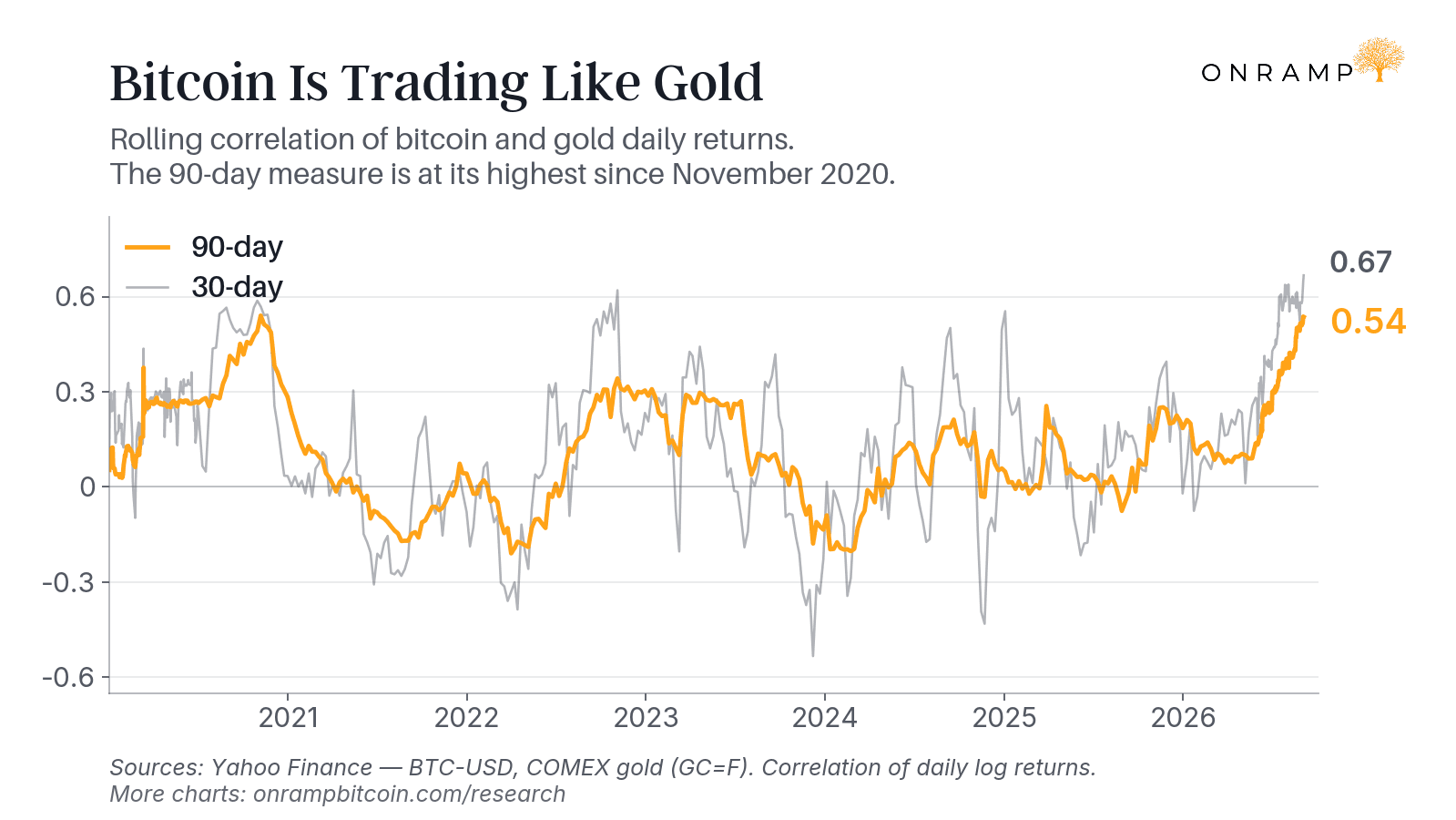
The last time bitcoin and gold moved together this closely, the market spent the better part of a year waiting for the Fed to concede what it had already concluded about the word transitory. Gold is the established version of this position, the one central banks themselves keep adding to. Bitcoin is the same thesis with a harder supply rule and more convexity.
None of this requires the people involved to be villains. Warsh is probably sincere, Vance is playing politics, and Waller is reading the data in front of him. The incentives do the work. A government borrowing at this pace cannot allow strangers to set the price of its borrowing, so it will set the price itself, gradually at first and then less gradually, and every step will be described as a response to events. There will always be an event available.
The alternative requires no event. Bitcoin's supply schedule was set in January 2009, has never been amended, and holds no press conferences. When the print comes, no one in Washington will call it debasement. They will call it necessary.
Closing Note
Onramp provides bitcoin financial services built on multi-institution custody. To learn more about our products for individuals and institutions, schedule a consultation to chat with us about your situation and needs.
Until next week,
Brian Cubellis