August 28, 2026 Roundup: A Condition, Not a Trade

Brian Cubellis | Chief Strategy Officer
Published
Free. Every week. One story that matters, read all the way down.
In this week's Roundup: Treasury's second intervention in a month, the difference between a trade and a condition, and why gold and bitcoin have started moving as one.
» Two interventions in twenty-seven days: the yen operation in July, then expanded buybacks and talk of spending Treasury's own cash on its own debt.
» Buybacks funded by bills shorten the maturity structure and move the problem. The only proposal that actually moved the thirty-year is the one no official can defend in public.
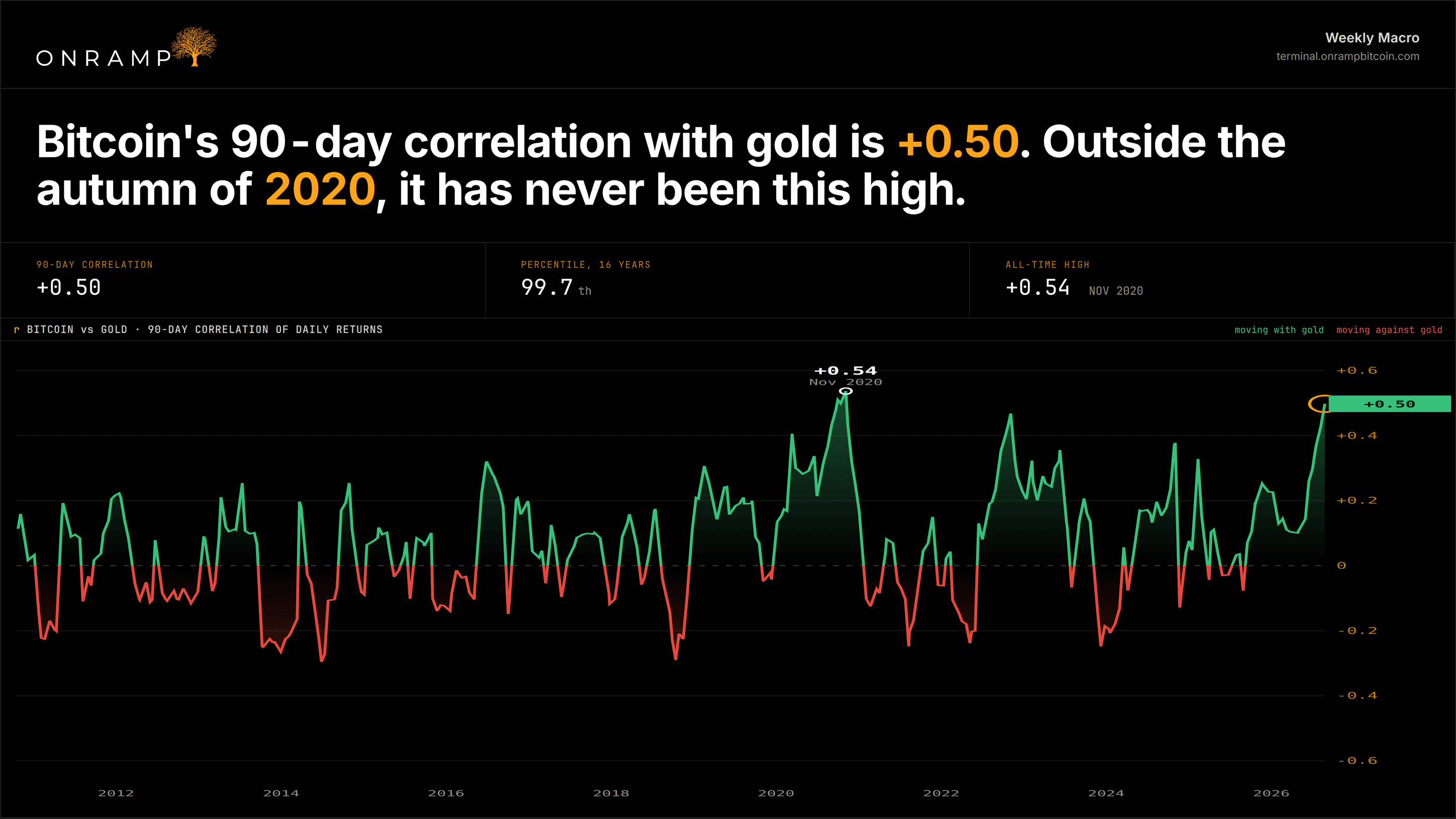
» A trade can be unwound. A condition of the system cannot. Gold and bitcoin are moving together at the strongest correlation since 2020, a full reversal from the spring decoupling.
» Warsh speaks at Jackson Hole this morning. Both branches of the Fed's response arrive at the same destination.
A Condition, Not a Trade
Treasury's latest intervention bought the bond market a few weeks of quiet and paid for it in institutional credibility, and the simultaneous bid in gold and bitcoin says investors increasingly understand that debasement is a condition to be lived through rather than a trade to be unwound.
In the space of twenty-seven days, the United States Treasury intervened twice in global markets. On July 31, it joined Japan in a coordinated operation to support the yen, the first American intervention on behalf of the Japanese currency since 1998, an effort that saw Tokyo spend an estimated $87 billion over two days. Weeks later, with the thirty-year Treasury yield pressing a nineteen-year high above 5.3%, the department expanded its long-bond buyback program from roughly $2 billion to at least $4 billion per operation, then let it be known it was studying something more direct: drawing on its approximately $1 trillion cash balance to purchase its own debt outright.
Interventions of this kind were once the punctuation of crises. They now arrive on a schedule. The national debt crossed $40 trillion this year, and at ~5% the arithmetic of servicing it has begun to dictate the behavior of the institutions charged with managing it. What follows is an attempt to place the week's events in their proper taxonomy, because the framing dominating the financial press, the return of the "debasement trade," gets the essential fact wrong.
Trades Have Exits
A trade is a position. It has an entry, a thesis, a crowded middle, and an exit. Trades get unwound, and the language of the trade comforts people precisely because it implies the crowd will eventually take profits and go home.
The word debasement comes to us from an era when the operation was physical. Between 1544 and 1551, Henry VIII and his son's regents reduced the silver content of the English coinage from the sterling standard to roughly a third of it, financing wars with France and Scotland with the difference.
The Great Debasement was never announced as a program. It proceeded in steps, each presented as an expedient, each defended as temporary, and by the time Elizabeth I restored the coinage in 1560 the crown had extracted years of ordinary revenue from the savings of anyone who held money. The Tudor Treasury had no auctions to suspend and no buybacks to expand. It had only the coin itself, and it spent the coin's credibility the way modern treasuries spend their balance sheets: gradually, and then with enthusiasm.

source: Onramp Terminal
That is the correct frame for the present moment. Debasement is a condition of a monetary system, a policy regime with a direction and a logic of its own. It does not unwind when positioning stretches. It pauses when credibility needs restocking, and resumes.
The Mechanics of Postponement
Treasury will retire long-dated bonds and fund the purchases by issuing bills. Nothing is extinguished in this operation. Duration moves from the long end of the curve to the front, which lowers today's thirty-year yield at the cost of shortening the average maturity of the debt stock and making future interest expense more sensitive to every future rate decision.
The TGA trial balloon is stranger still. The buyback expansion sat in the market for days without effect. Only the suggestion that Treasury might spend its own cash account on its own bonds pulled the thirty-year off its high and down toward 5.17%. Consider what that admission implies. The part of the package that worked is the part no official can defend in public, a finance ministry contemplating its checking account as a price-support mechanism for its own liabilities.
Meanwhile, the Secretary has encouraged the Federal Reserve to enlarge its FIMA repo facility, a standing offer to lend dollars against foreign official holdings of Treasuries, which the Peterson Institute correctly read as a further blurring of monetary and fiscal operations. Each of these moves is defensible in isolation. Together they form a pattern, and the exchange rate on institutional credibility is deteriorating faster than the exchange rate on the dollar.
The Reunion
Three months ago, gold and bitcoin were moving in opposite directions more reliably than at any point since 2022, the 90-day correlation of their daily returns sinking to negative 0.88 in the spring. Gold carried the geopolitical hedge while bitcoin traded as high-beta liquidity exposure, and the two assets appeared to have settled into separate constituencies. That sorting has now collapsed. The rolling correlation sits near 0.5, the highest reading since 2020 and the second highest on record, as gold climbs roughly 15% this month back above $4,600 and bitcoin is back near $80,000.
source: Onramp Terminal
The 2020 comparison is the instructive one. The last time the two moved this closely, the Federal Reserve was expanding its balance sheet by trillions and the fiscal authority was mailing checks to households. When the dominant driver of both assets is monetary, the market stops distinguishing between the analog and the digital expression of the same idea.
Scarcity outside the system is scarcity outside the system, whether it is pulled from the ground or produced by a protocol. What the correlation is recording, beneath the statistic, is a renaissance in the original sense of the word: the recovery of an old understanding that the soundness of money is the foundation on which every other financial calculation rests, and that gold and bitcoin are the two clearest instruments of that understanding.
The Fork at Jackson Hole
The last time the United States suppressed its own yield curve, from 1942 to 1951, the arrangement held through a world war and broke down only when inflation approached double digits during the Korean conflict and the Federal Reserve forced the Treasury-Fed Accord of March 1951, reclaiming control of its balance sheet. Chair Warsh delivers his first Jackson Hole keynote this morning, and the Financial Times describes him and the Treasury Secretary as being on a collision course.
If the Fed leans against the Treasury, long yields resume their climb and the next intervention will need to be larger. If the Fed accommodates, fiscal dominance ceases to be a framework for interpreting policy and becomes the operating manual for it. The two branches arrive at the same destination at different speeds.
Renaissances are named in retrospect, but they are lived in the present tense, by people who stop trusting the old instruments before the historians arrive to explain why. Gold has absorbed that conclusion for five thousand years. This month the market extended it to bitcoin and priced the two as expressions of the same conviction. Whether or not the historians eventually call this a sound money renaissance, that is what the early chapters of one look like.
The interventions will keep coming, and they will keep growing. Hard assets are pricing the condition they cannot treat.
Closing Note
Onramp provides bitcoin financial services built on multi-institution custody. To learn more about our products for individuals and institutions, schedule a consultation to chat with us about your situation and needs.
Until next week,
Brian Cubellis