October 2, 2026 Roundup: Quietly Up the Wall of Worry

Brian Cubellis | Chief Strategy Officer
Free. Every week. One story that matters, read all the way down.
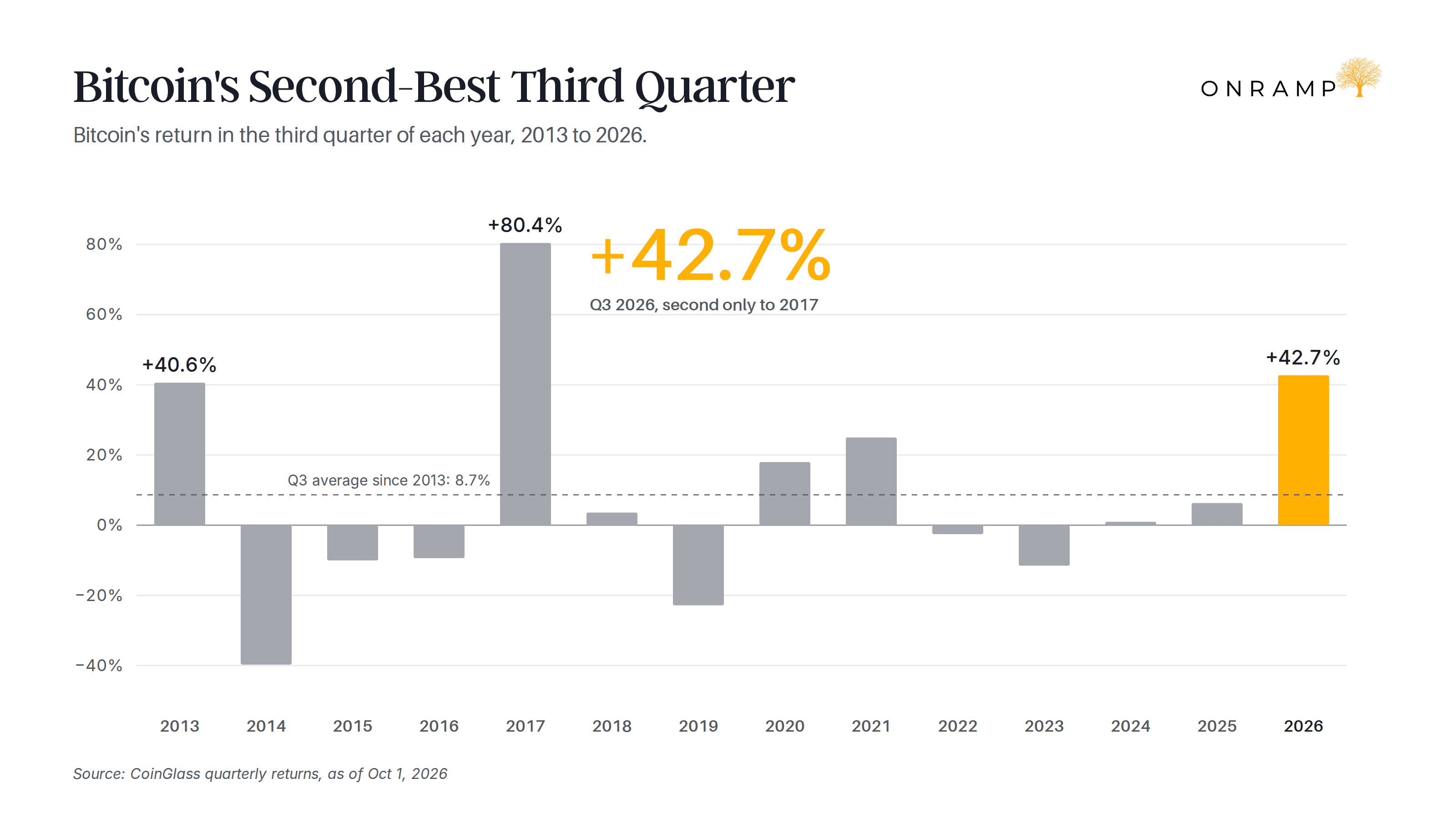
Bitcoin closed the third quarter up nearly 43%, its second-best third quarter on record behind only 2017. And it’s kept going. This morning it traded near $87,000, its highest price since January and about 49% above its summer low.
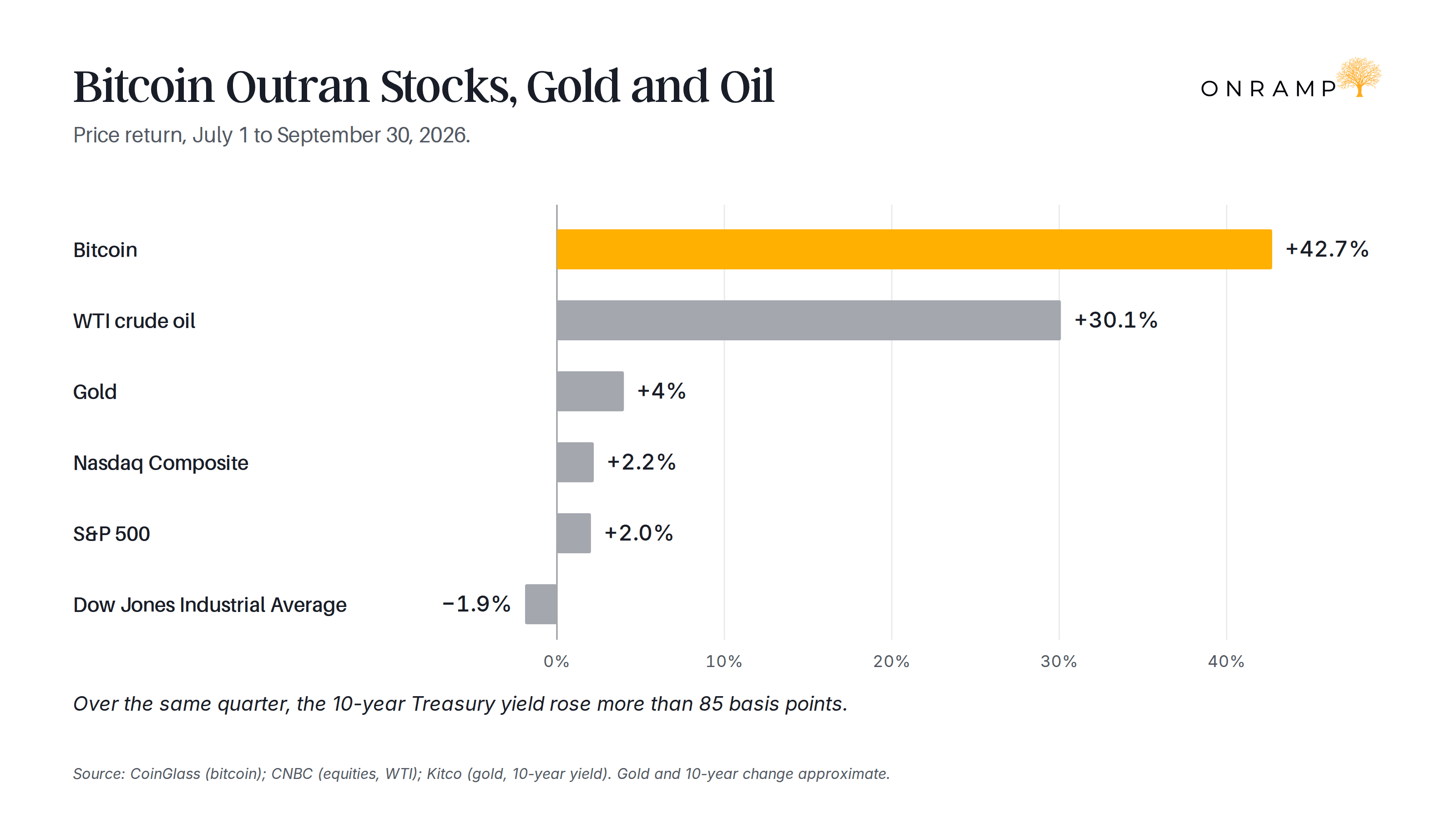
But it hasn’t felt that way. The quarter’s headlines went to hacks, a failed bill and a hawkish Fed. Underneath them, bitcoin outran stocks, gold and oil while the 10-year Treasury yield climbed more than 85 basis points. This was a rally built in spot, through bad news, by patient buyers. Rallies like that tend to last.
The Setup
Go back to July 1 and look at what the next three months held.
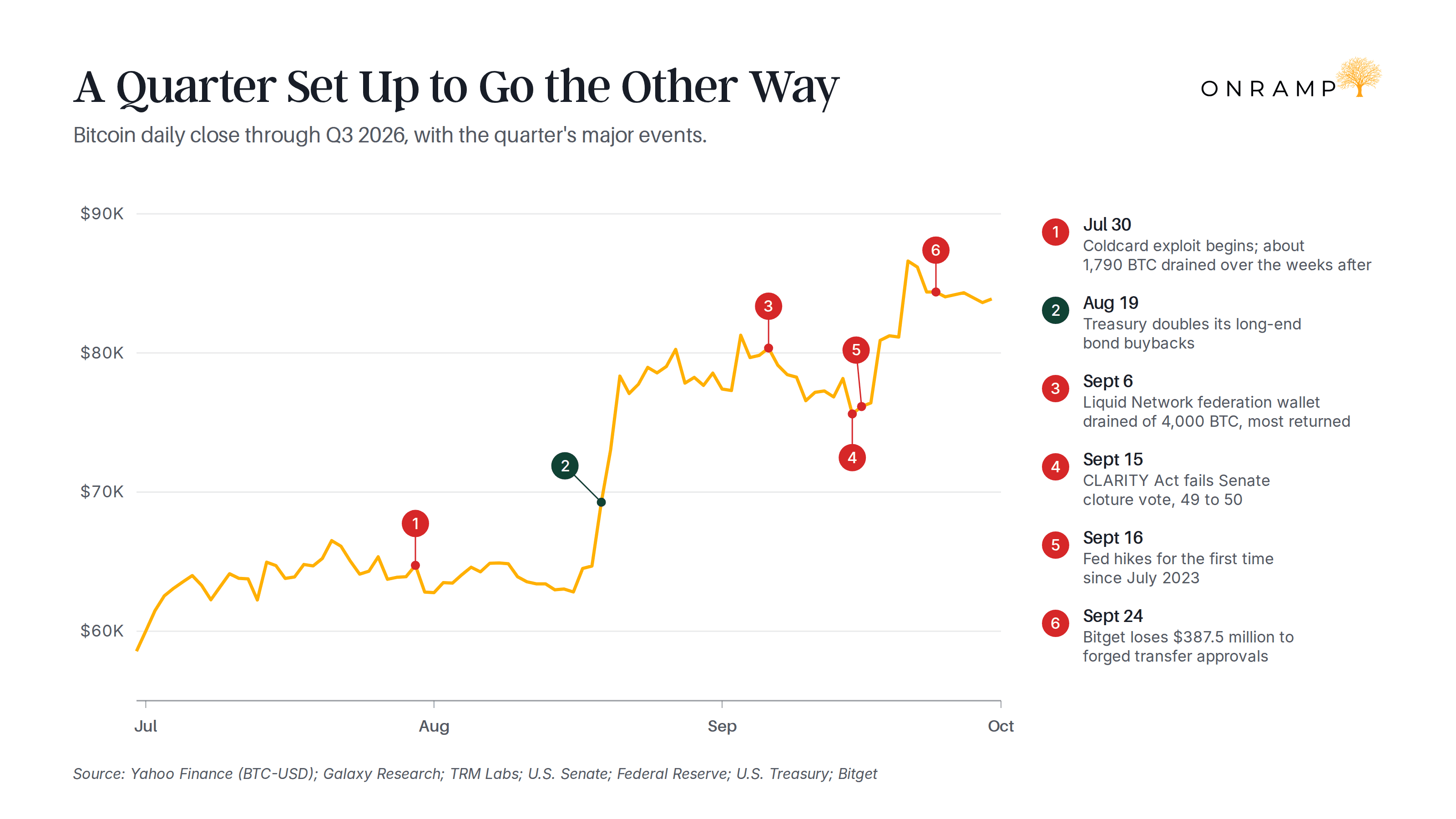
On July 30, an attacker began draining Coldcard hardware wallets through a firmware flaw that shipped in March 2021. The flaw left seed generation predictable enough to reproduce remotely, without anyone ever touching a device. Galaxy Research has since tied roughly 1,790 BTC, about $115 million, to the exploit across nearly 8,900 addresses, much of it belonging to holders who had followed self-custody best practice to the letter. On September 6, a software bug let attackers pull roughly 4,000 BTC from the Liquid Network’s federation wallet, about 95% of its reserves, before most of it was returned.
On September 15, the CLARITY Act failed a Senate cloture vote 49 to 50, effectively ending the industry’s most important legislative effort of the year after more than a year of negotiation. The next day, the Fed delivered its first rate hike since July 2023. On September 24, suspected North Korean attackers took $387.5 million from Bitget by feeding forged transfer approvals into the exchange’s own backend. Through all of it, the long end of the Treasury curve kept selling off, and the 10-year closed the quarter at 5.29%.
Anyone handed that calendar of events on July 1 and asked to price bitcoin would not have penciled in its second-best third quarter on record. And it’s worth noting that none of the quarter’s major breaches touched the bitcoin protocol itself. Each failure sat in a layer built around it: a hardware wallet’s entropy, a sidechain’s federation software, and an exchange’s internal approval system.
What Moved Price
The turn came on August 19. That was the day the Treasury moved to double its buybacks of long-dated debt, stepping in to support demand for its own paper as private demand at the long end softened. The week of the announcement produced bitcoin’s largest one-week dollar gain on record, and August alone delivered a 25% gain. Three weeks later, the Treasury raised the size of a single buyback operation to $6 billion. The most important market signal of the quarter came from the issuer of the world’s reserve asset propping up demand for its own bonds, and bitcoin was the asset that responded.
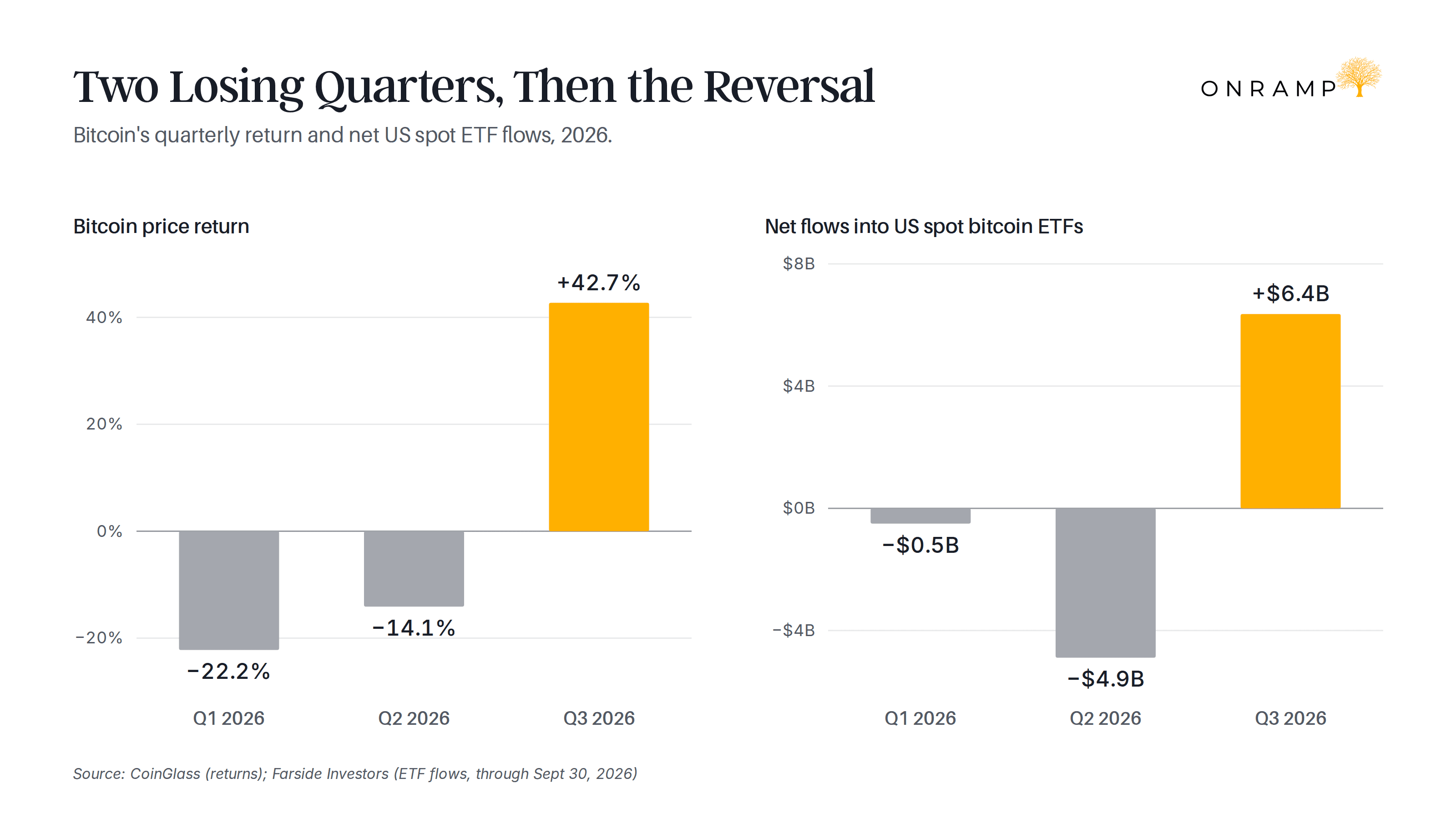
The flow data follows the same timeline. US spot bitcoin ETFs took in $173 million in July, then $3.54 billion in August and $2.65 billion in September, about $6.4 billion for the quarter. More than 80% of it arrived after the buyback announcement. It also reversed roughly $5.4 billion of net redemptions from the first half of the year.
What didn’t drive the move matters just as much. Open interest in bitcoin futures fell from more than $25 billion earlier in September to about $21 billion by month end, so price climbed while leveraged positioning shrank. Rallies built in the derivatives market usually end in liquidation cascades. This one was assembled in spot, by buyers who intend to hold what they bought.
A recent institutional adoption survey offers a view of who sits behind that kind of demand. It interviewed 15 large allocators, including pensions, endowments, foundations and sovereign wealth funds. Not one reduced its allocation through the roughly 50% drawdown from late 2025 into the second quarter, and several added. One sovereign wealth fund said it was funding its allocation by selling foreign exchange and gold reserves.
As it relates to the Fed hike, this time is different (actually). In earlier hiking campaigns, bitcoin traded like a high-beta version of the Nasdaq, and a hike into a bond selloff would have been a reliable reason to sell. This time it dipped toward $75,000 around the decision, then rallied above $87,000 within a week, while the S&P 500 finished September slightly lower. The Fed sets the overnight rate. The long end is set by lenders deciding what a generation of government promises is worth, and over the past quarter they have demanded more compensation regardless of what the Fed does next. Bitcoin appears to looking through any near term fiat manipulation or intervention, and recognizing the long-term structural trend of currency debasement.
Why Nobody Is Celebrating
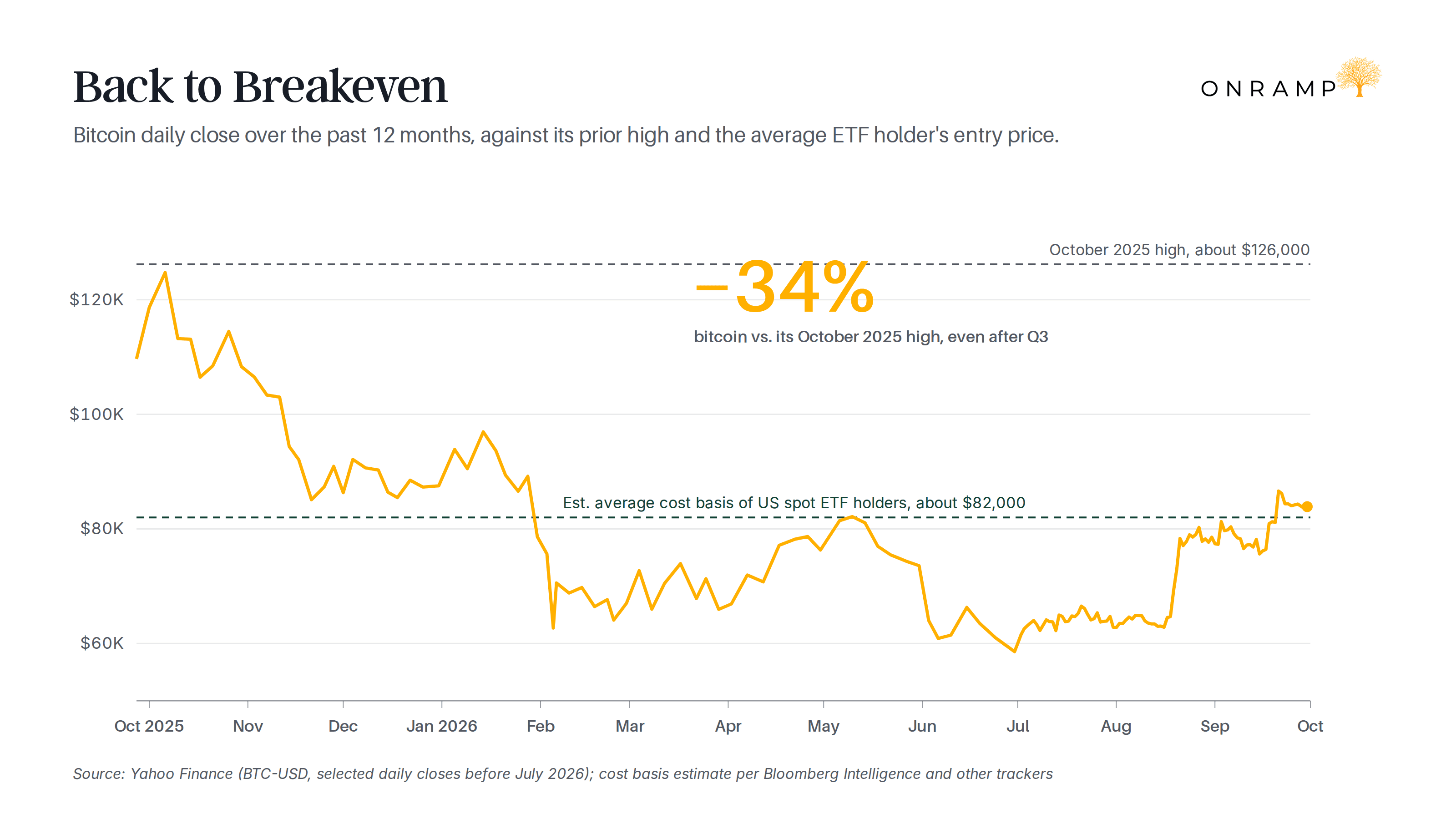
The simplest explanation is arithmetic. Even after a 43% quarter, bitcoin closed September roughly a third below its October 2025 high of about $126,000 and still down about 4% on the year. The average cost basis for US spot ETF holders is estimated near $82,000, so the quarter’s entire rally mostly brought the typical ETF investor back to breakeven. Getting back to even is a relief, and relief rarely produces excitement.
The second explanation is who did the buying. Allocators who hold through a 50% drawdown and add on the way down typically don’t post about it on X. The retail participation that usually turns a rally into a cultural moment has been largely absent. The news flow didn’t help either: three months of hacks, a failed bill and a hawkish Fed is not the raw material of euphoria.
Markets have long been said to climb a wall of worry and die on euphoria. The third quarter had plenty of the first and none of the second. Rallies built on leverage and attention draw a crowd and tend to unwind as loudly as they arrived. A rally built by long-horizon holders who absorbed this much bad news without selling leaves a sturdier base under price.
Into The Fourth
Yesterday, the 10-year touched 5.34%, its highest level since 2002. In hindsight, the third quarter was an illustrative stress test. In three months, bitcoin absorbed the largest hardware wallet exploit of the year, the largest exchange hack of the year, a nine-figure sidechain breach, the collapse of its most important piece of legislation, a rate hike and a global bond selloff. It still finished with one of the strongest quarters in its history.
Assets are usually judged by how they perform when conditions favor them. Bitcoin just showed what it does when conditions are against it. If this is how it behaves with nearly every catalyst running the wrong way, the more interesting question for the fourth quarter is what happens when one finally breaks in its favor.
Closing Note
Onramp provides bitcoin financial services built on multi-institution custody. To learn more about our products for individuals and institutions, schedule a consultation to chat with us about your situation and needs.
Until next week,
Brian Cubellis