September 18, 2026 Roundup: Air Cover

Brian Cubellis | Chief Strategy Officer
Free. Every week. One story that matters, read all the way down.
The Federal Reserve raised interest rates this week for the first time in more than a year, and bitcoin rallied through it. The quarter point will do nothing to quell the inflation it officially targets. The hike is best understood as a purchase of credibility for future easing, delivered while the balance sheet continues to grow. Bitcoin's response suggests the market has read it the same way.
Air Cover
This morning, bitcoin climbed back above $80,000, two days after the Federal Reserve raised its policy rate. Bitcoin first regained that level in late August, sold off through early September as the potential hike came into view, and printed $76,000 on the day of the decision itself. Within 48 hours of the announcement, the price had recovered.
An asset that theoretically trades as a levered claim on liquidity conditions is supposed to fall when the cost of liquidity rises, and bitcoin has spent most of its institutional life obeying that rule. Not this time.
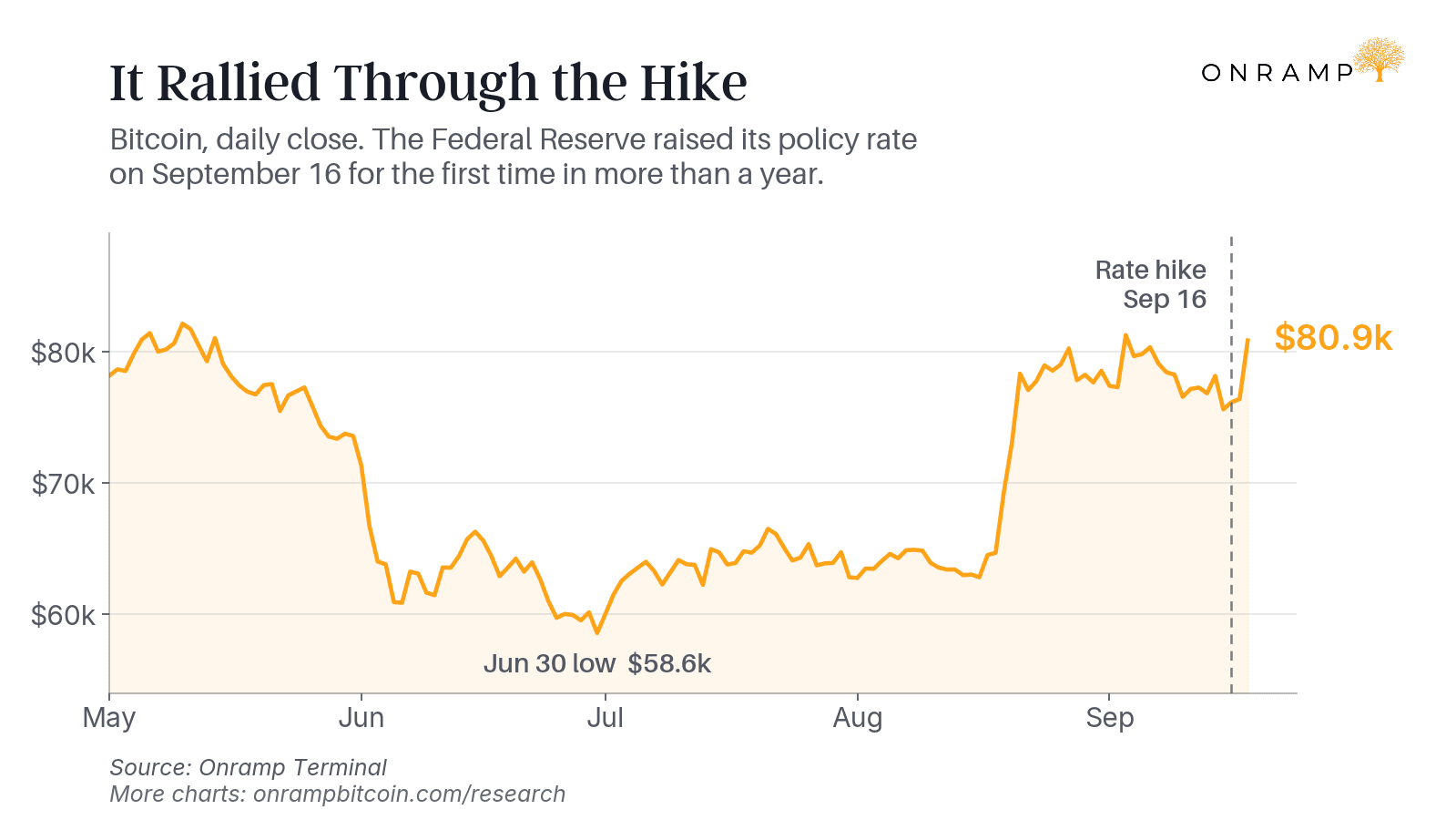
Yes, this is short-term data point, but it's an important one. Bitcoin's price recovery off the lows has now survived contact with an actual rate hike, in the same year the Fed's balance sheet has grown by $150 billion.
A plausible reading of this week is that the marginal buyer has stopped pricing bitcoin as a claim on liquidity conditions and started pricing it as an exit from the denominator. When the currency itself is the risk, the asset with no issuer is the hedge. That is the debasement trade in its simplest form, and the tape suggests it is migrating from thesis to positioning.
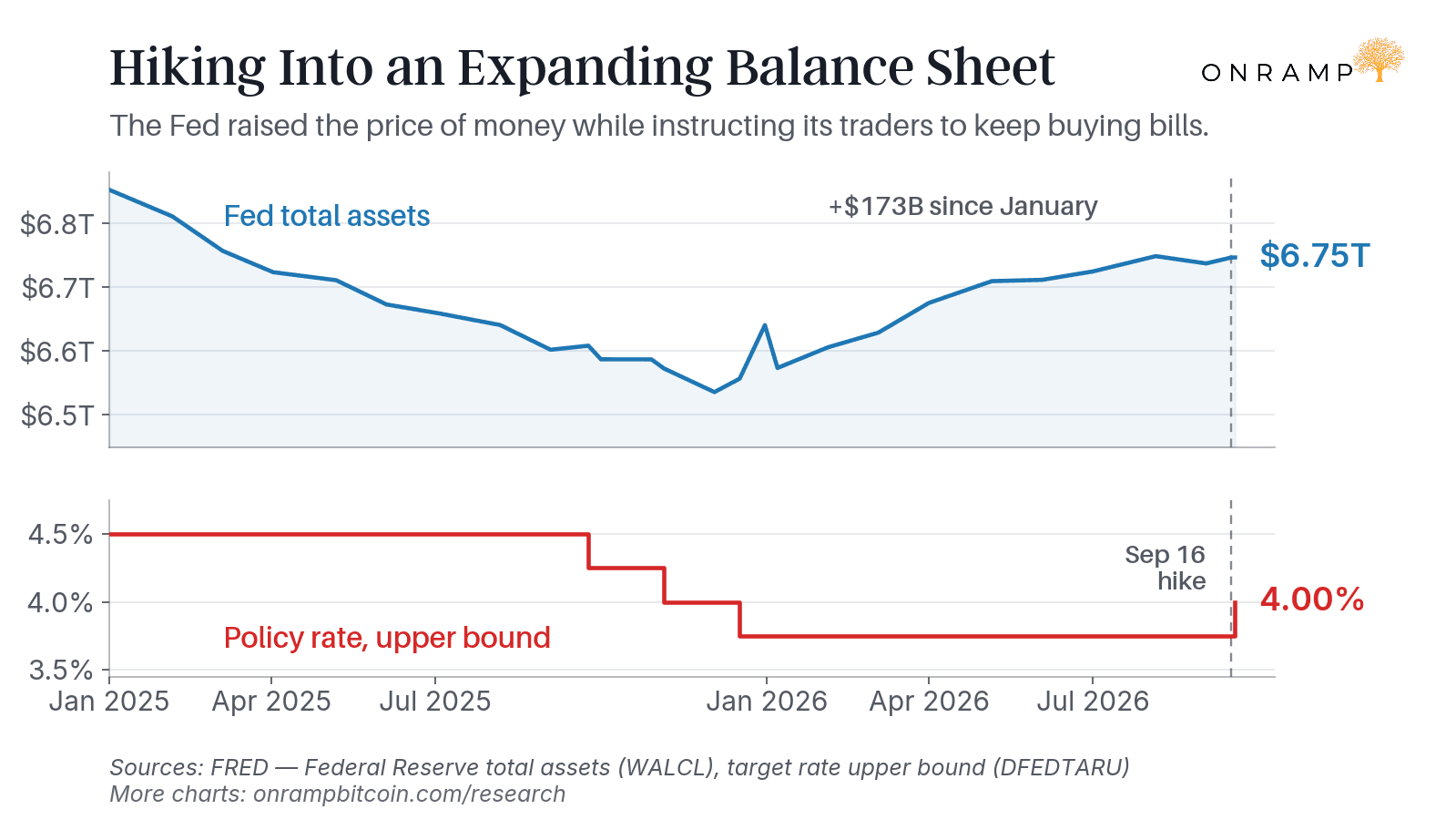
Which brings the week's main event into focus. At 2:00 p.m. on Wednesday, the Federal Open Market Committee voted twelve to zero to lift the target range for the federal funds rate to 3.75-4.00%. Seven weeks earlier, the same committee split nine to three on the same question, with Hammack, Kashkari, and Logan dissenting in favor of the hike that passed this week without objection. The dissenters won the argument, and then the argument vanished.
The Trap
Consider why the committee sat on its hands for a year, under two different chairs, while inflation completed its fifth consecutive year above its proverbial "target" of 2%. The July statement conceded the mechanism in the Fed's own bureaucratic register: inflation remains elevated "in part reflecting supply shocks that have driven price increases in certain sectors, including energy."
It's true, oil is ripping higher because a war has constrained the Strait of Hormuz and global inventories have drawn down by 400 million barrels this year. No interest rate exists at which the Federal Reserve produces another barrel of crude, and everyone at the table knows it. Cutting into a supply shock accelerates the debasement that lifted the general price level to begin with.
Hiking feeds the same disease through the fiscal channel. The gross federal debt has surpassed $40 trillion, debt held by the public stands at 101% of GDP, and net interest will cost roughly $1 trillion this fiscal year, consuming 19 cents of every revenue dollar against 9 cents five years ago.
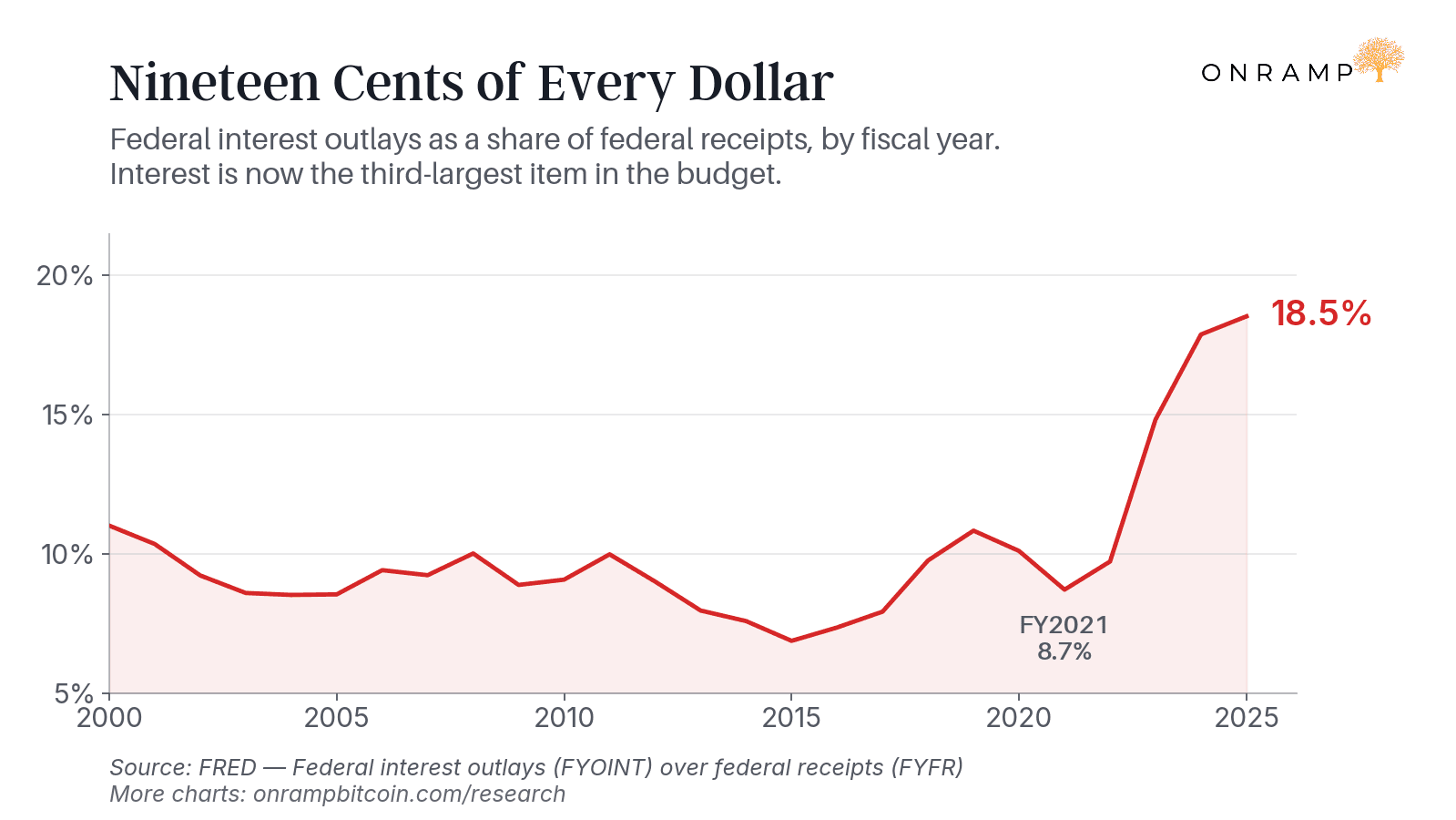
CBO projects interest at the highest share of GDP in records that begin in 1940. Each increase in the policy rate migrates into the average cost of the debt as trillions of it roll, widens the deficit, and forces the issuance that higher rates were supposed to discipline.
The committee spent a year in paralysis because every available action worsened the condition it was meant to treat. In April, Governor Miran cast a lonely dissent for a cut. By July, three regional presidents wanted a hike. By September, the full table voted for one.
Read the Fine Print
What has not changed is the arithmetic. In the same document that raised the price of money, the committee directed the New York Desk, "when appropriate," to increase the System Open Market Account's holdings through purchases of Treasury bills with maturities of three years or less, to roll over every maturing Treasury, and to reinvest all agency principal into bills.
The directive is already operative. Since January, the Fed has bought nearly $250 billion of Treasury bills, its total assets have risen by about $150 billion to $6.7 trillion, and bank reserves have grown to $3.1 trillion. The central bank has spent nine months expanding its balance sheet and has now raised rates while instructing its traders to keep expanding it.
Kevin Warsh built his public case for the chairmanship on the argument that the Fed's balance sheet had entangled monetary policy with fiscal finance and ought to shrink drastically. His first tightening action as chairman requires the balance sheet to keep absorbing government paper so that reserves remain ample. The constraint predates him and will outlast him, because the Treasury market now requires a standing bid from its own central bank to function. The Treasury said as much on August 19, when it expanded its buybacks of long-dated bonds to support market liquidity; dealers offered more bonds than the program could absorb, and yields retraced most of their decline within days.
The Cover
What, then, did the quarter point purchase? Warsh answered that question himself, in August, at Jackson Hole. The speech retired forward guidance as a standing practice, assigned responsibility for 65 months of sustained, elevated inflation to the central bank itself, and closed with the declaration that he stood there "committed to a discipline, not to a decision."
Strip the ceremony away and the speech was a capital raise. Credibility behaves like bank capital in every respect that matters: it accumulates slowly through demonstrated restraint, it sits idle and expensive in quiet times, and it exists to be drawn down in a crisis without triggering a run. A chairman who confesses the institution's failure and then hikes into an energy shock is provisioning.
Something will break, as it always does. An auction will tail badly, a regional bank will wobble, the long end will gap, and the incoming data will soften on schedule. When that moment arrives, the cuts and the liquidity will be described as responsive and prudent rather than inevitable, and the description will be believed because of the quarter point delivered this week. That is what Wednesday bought. Twenty-five basis points is a small price for that kind of cover, and the data will furnish the rest of it when the time comes.
If the hike's real function is to provision credibility for the next easing, then buying bitcoin through the hike is the market's way of front-running the claim.
The Alternative
The underlying problem is older than any of this week's participants. In 1977, Finn Kydland and Edward Prescott published "Rules Rather Than Discretion: The Inconsistency of Optimal Plans," the paper that would eventually earn them the Nobel Prize in 2004.
Their argument was structural rather than psychological. A policymaker who retains discretion will rationally revise his plans when incentives change, the public understands this in advance, and so announced policy fails even when the policymaker is competent and honest. Their illustration was deliberately mundane: a government that declares it will never rebuild homes on the floodplain rebuilds them anyway once the waters recede, and because everyone knows this beforehand, the homes get built.
The modern Federal Reserve is the monument to that paper. The 2% target, the press conferences, the projections, the forward guidance: all of it exists to simulate commitment where discretion remains. At Jackson Hole, Warsh retired the guidance and asked to be judged on discipline instead, which amounts to the monument conceding that the simulation has failed and that personal reputation is the only collateral left in the vault. The Kydland-Prescott problem has not been solved inside the institution. It has been outlived, one chairman at a time, and the cost of the interludes is measured in the purchasing power of everyone holding the currency.
Bitcoin's monetary policy began executing on January 3, 2009, its first block timestamped with a headline about bank bailouts, and it has not been amended since.
The issuance schedule has executed four halvings, on time, through three presidencies, a pandemic, and a war, indifferent to each of them. The supply is auditable by anyone with a laptop, at any hour, without permission, and no committee exists that could vote to change it. There is no press conference because there is nothing to explain and no one empowered to explain it.
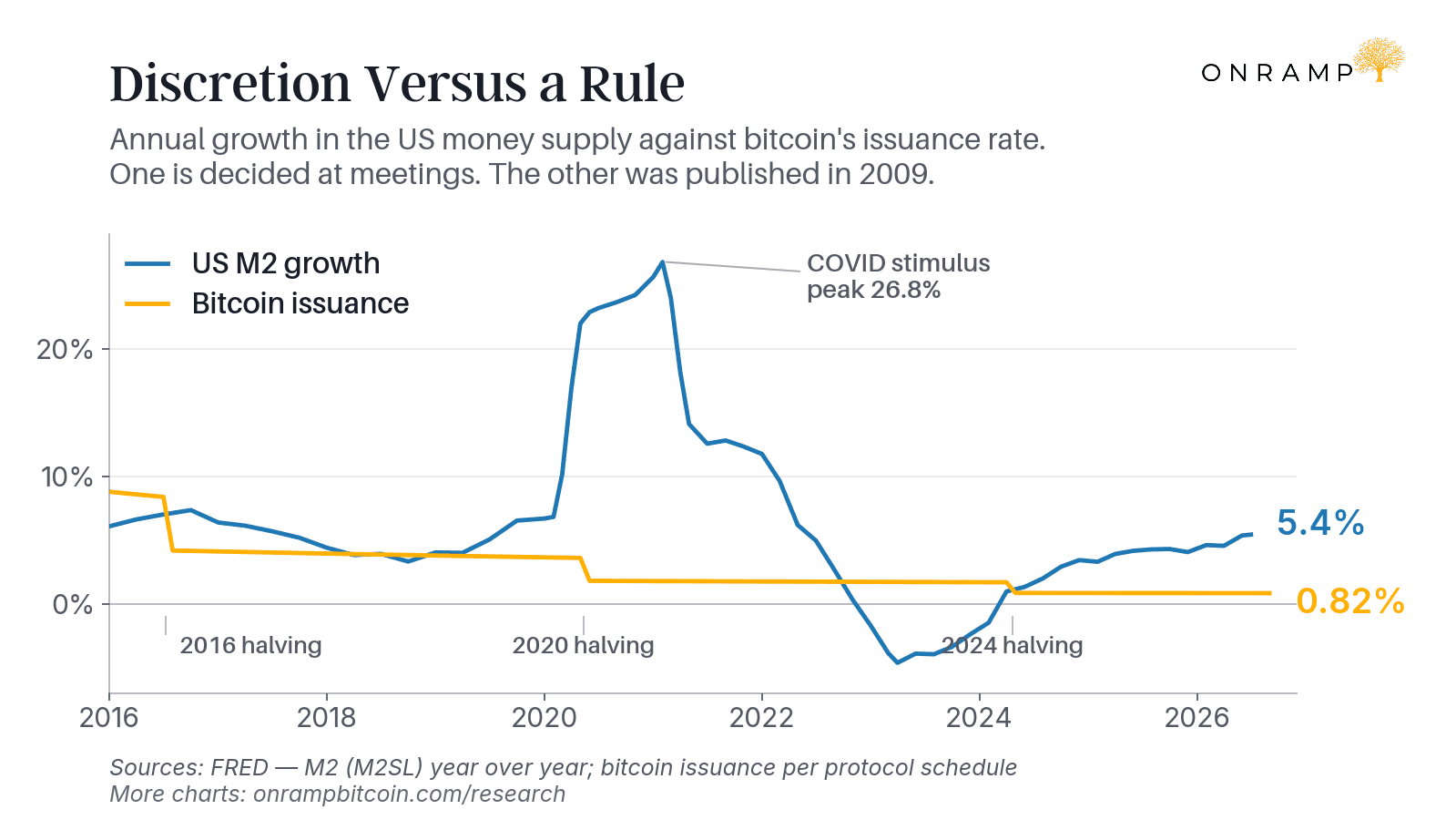
The system requires no credibility because it extends no discretion; verification replaces trust, and the audit never closes. Fifty years of monetary economics demonstrated that discretion cannot be disciplined by recruiting better men to wield it, and this week's choreographed unanimity demonstrated it once more. You do not fix fallible discretion with a more disciplined chairman. You fix it at the design layer, where discretion can be removed.
Closing Note
Onramp provides bitcoin financial services built on multi-institution custody. To learn more about our products for individuals and institutions, schedule a consultation to chat with us about your situation and needs.
Until next week,
Brian Cubellis