July 21, 2026 Weekly Market Brief

Glenn Cameron, CFA · Global Head of Onramp Institutional
Free. Every week. Institutional insights, connected.
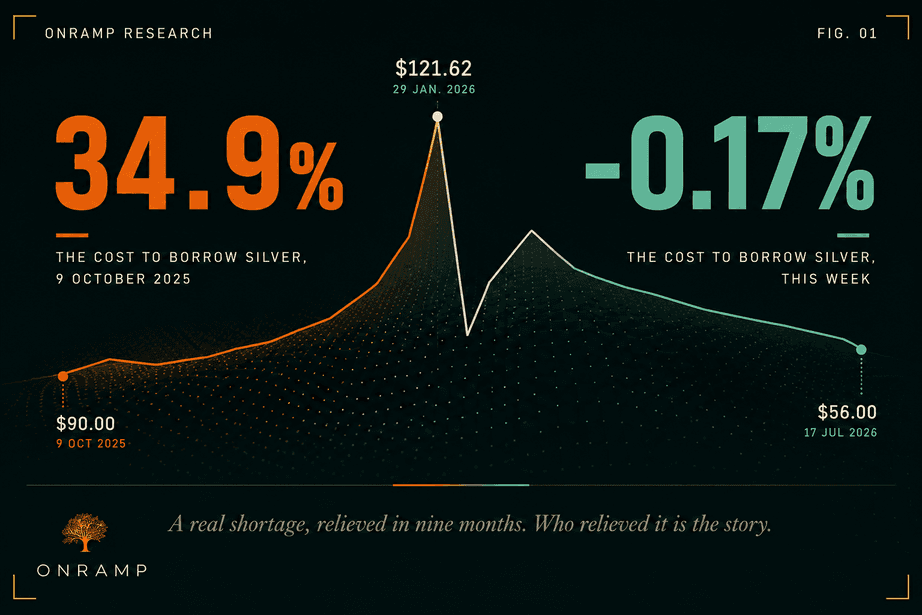
Last October silver's lease rate hit an all-time 34.9 per cent and the price ran to $121; nine months on it trades near $56 and costs less than nothing to borrow. The squeeze was real, but the relief came from the existing stockpile, sold by the people who held it. This week's brief lays the silver round trip against gold's very different 1999 squeeze, and against bitcoin, which is running the same experiment now: worst-ever ETF outflows, Strategy's largest coin sale to fund its preferred dividends, and a stock whose only source of new supply is the decision of the people who already own it.
Last October the world ran short of silver. The cost of borrowing it in London, normally under one per cent a year, reached 34.9 per cent. Funds in India stopped taking new money because they could not find bars. By late January 2026 the price had touched an all-time high above $121. This week silver trades near $56, and the cost of borrowing it has fallen below zero. This is the story of how a real shortage in a hard asset was relieved within nine months, who relieved it, and what that says about bitcoin, which is running the same experiment right now.
The night the metal ran out
On 9 October 2025, something happened in the silver market that the people who trade it had spent whole careers being told was impossible. The lease rate, which is the fee you pay to borrow physical silver for a month and which normally sits below one per cent a year, reached 34.9 per cent in London, the highest ever recorded. At the same time the spot price, the price of metal for delivery now, rose above the price of every futures contract in New York stretching most of a year ahead. That condition is called backwardation, and it is rare for a simple reason: it means buyers are paying a premium not for silver, but for silver today. When today costs more than any tomorrow, the market is telling you the vaults are running empty.
The physical world confirmed it. Bars were flown across the Atlantic because ships were too slow. In India, four of the country's largest fund houses, Tata, Kotak, SBI and UTI, suspended new lump-sum investments into their silver funds because they could not source the certified bars to back them. The head of the Japan Bullion Market Association summed the situation up in one line: the market was telling participants that they needed physical silver now, not paper.
The numbers behind the panic were simple. The London vaults held roughly 155 million ounces of silver that was actually free to move, by the most widely cited estimate, against annual demand somewhere between 900 million and 1.2 billion ounces, and 2025 was the fifth year running in which the world used more silver than it produced. Part of the problem was location rather than existence. Through 2025, fear of American tariffs had pulled an estimated half a billion ounces across to New York, leaving London, where the world actually settles its silver, to run dry. But a deficit is a deficit, and by October the free metal was gone.
What the price did
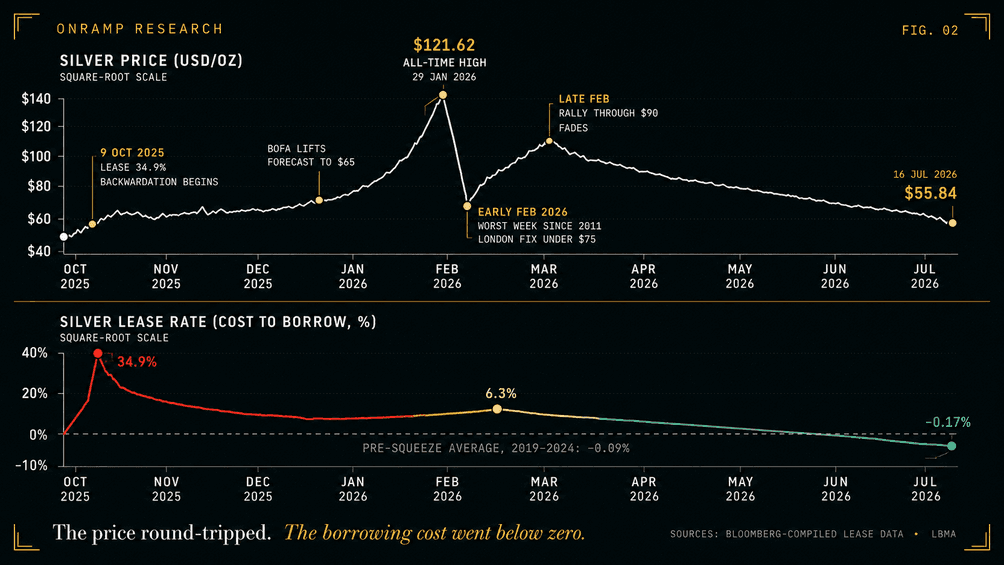
Readers of this brief will recognise the setup. Our brief of 2 June 2026, The Paper Layer, traced three centuries of paper claims built on scarce bearer assets, from the London goldsmiths of the 1690s to the central bank gold leasing of the 1990s, and concluded that this kind of suppression ends when the holders of the real asset start enforcing its scarcity. In October 2025, silver's holders began enforcing it. Bank of America became the first major bank to raise its forecast, to $65 an ounce, writing that breaking the old $50 record was not a technical event but a necessary repricing to balance demand with constrained supply. The price went through $65 within weeks.
On 29 January 2026, silver traded above $121 an ounce, the highest price in its history and roughly four times where it had begun 2025. The event the sound-money world had predicted for forty years, the moment the paper ran out of metal, had finally arrived, in the second most important monetary metal on earth.
The round trip
The retreat came in stages. In the first week of February 2026 the price suffered its worst weekly fall since 2011, dropping through $80 to a London fix beneath $75, while gold fell more than a thousand dollars from its own record near $5,600, set the same week silver peaked. Even then, borrowing silver for a month still cost 6.3 per cent, and metal in London still traded above the New York futures, so the shortage was easing but not gone. A rally back through $90 in late February faded, and by April 2026 the price had settled in the mid-seventies. Then last week, on 16 July, it changed hands at $55.84, fifty-four per cent below the January high and roughly back to where it stood in the week the vaults ran empty, pressed down by talk of an interest-rate rise, a stronger dollar, and the return of the war after the President told Congress the ceasefire with Iran was over.
But the price is the lesser half of the story. The one-month lease rate in London this week is minus 0.17 per cent. Negative: a holder will now, in effect, pay a small fee to have someone else warehouse his metal. And that is not a distortion. It is what a well-supplied silver market normally looks like. In the six years before the squeeze era began, the one-month rate averaged fractionally below zero. Nine months after the tightest conditions in the market's modern history, borrowing silver is easier than its own long-run average. Whatever pushed the price down this month, it did not conjure metal out of nothing. The metal is simply back.
Where the relief came from
No rescue arrived. The price did the work, through every channel at once. Above a hundred dollars an ounce, scrap that had sat in drawers for decades went to the refiners, and industrial users who could delay a purchase, delayed it. The hoard in New York came home: once the tariff fear faded, the same half billion ounces that had drained London flowed back the other way, some of it on the same aeroplanes, with the bullion banks coordinating shipments to keep the system settling. Analysts had sketched this exact path at the peak of the panic, metal returning from New York, lease rates normalising, a sharp correction as the speculative froth came off.
And holders sold. This is the heart of the matter, and it deserves care. At fifty dollars an ounce, almost nobody parts with the family silver. At a hundred and twenty, people queue at the dealer. The same logic ran through the funds. An investor in a silver ETF owns a claim on bars in a vault, and when the price doubled he could take his profit with a tap on his keyboard. On the days the price broke, many did, and when enough shares are sold, the funds shed the bars behind them back into the pool of metal available to lend. There was no villain in any of this and no coordination. There were millions of separate, sensible decisions to take a profit, and the sum of those decisions was the return of the very supply whose absence had caused the squeeze.
The shortage was real. The deficit was real. The squeeze was everything its forecasters had said it would be. And the holders themselves relieved it, because the price paid them to.
An old argument, and its missing half
There is a well-known account of why some commodities become money and others never do, and this episode completes it. In The Bitcoin Standard, Saifedean Ammous describes what he calls the easy money trap. Choose an ordinary commodity as your savings and you set a sequence in motion: your buying lifts the price, the higher price makes production more profitable, producers expand supply, and the new supply eventually crashes the price. The savers lose, and their loss is the producers' gain. Copper, nickel and oil all work this way, which is why none of them has ever stayed money. Gold escapes the trap for physical reasons: it does not decay, so nearly every ounce ever mined still exists, and it cannot be synthesised, so the only new supply is mined at great cost. The stockpile is the work of thousands of years, and new production adds only about 1.5 per cent to it each year. No surge in mining can move that number much. This ratio of existing stock to new flow is his test of a monetary asset, and it is a good test.
Now set this silver episode against that thesis. The thesis says a price spike in a commodity is killed by its producers: the mines respond to the high price with new supply, and the new supply brings the price back down. That is not what happened to silver. Mine production barely moved. The world consumed more silver than it mined in 2025 for the fifth year in a row, and a sixth deficit is projected for 2026. Yet the price still collapsed, from above $121 to the mid-fifties. So where did the selling come from? It came from people who already owned silver. The scrap came out of household drawers. The half billion ounces came out of New York warehouses. The bars behind the ETFs came from investors selling their shares. When a commodity has a large stockpile above ground, the supply that answers a high price does not have to come from mines at all. It can come from the stockpile itself, sold by the people who hold it. Ammous records this without dwelling on it: he notes that the Hunt brothers were beaten in 1980 by the miners and the holders of silver. In 2026 it was almost entirely the holders.
So a monetary asset has to pass two separate tests. The first test is about production: when the price rises, can producers profitably flood the market with new supply? Copper fails this test, which is why copper has never lasted as money. Gold and silver both pass it; their mines are small and slow next to their stockpiles. The second test is about the owners: when the price rises far enough, do the people who already hold the asset keep it, or sell it? Silver has now failed this second test twice, under opposite conditions. In 1980 the Hunt brothers drove the price up by trying to corner the market. There was no shortage of silver in the world, and owners sold into the rally until it collapsed. In 2026 there was a genuine shortage, five years of deficits deep, and owners sold into the rally until it collapsed anyway. A false shortage and a real one produced the same result, so the result cannot have depended on the shortage. It depended on what the owners did.
The two tests are also not independent, because the first works on the second through expectations. An owner deciding whether to sell into a spike is making a forecast about relief. If he believes new supply will answer the price, the sensible move is to sell before it arrives, and when enough owners make the same forecast, their selling is the relief, whether or not the mines ever deliver. Silver's owners had the base rate to hand: the price had spiked and round-tripped before, in 1980 and again in 2011, so silver has trained its own holders to sell spikes, and the owners who remembered those episodes in January 2026 sold early, which is exactly what brought the next round trip on. Stock-to-flow does not decide the second test, but it shapes it, because the ratio tells owners how much rescue to expect from production, and owners act on what they expect. So the full question to ask of any monetary asset is: who owns the stockpile, what do they expect, and what would make them sell?
Why gold in 1999 ended differently
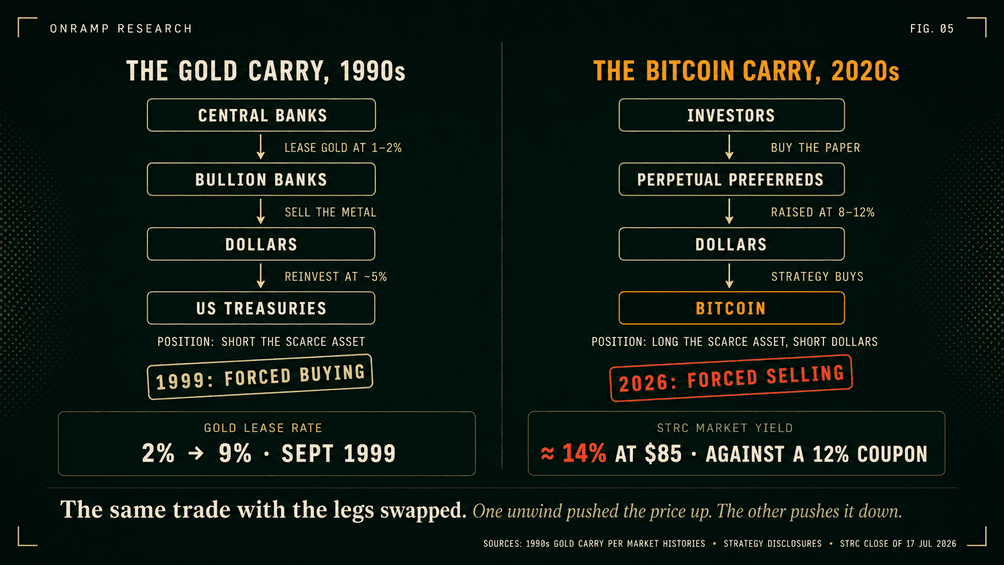
There is one clean precedent for a squeeze in a monetary metal, and it ended the other way. Through the 1990s, central banks leased thousands of tonnes of gold to the bullion banks, who sold it into the market and invested the proceeds; Alan Greenspan assured Congress in 1998 that central banks stood ready to lease gold in increasing quantities should the price rise. Then, on 26 September 1999, fifteen European central banks signed the Washington Agreement, capping their gold sales and freezing their lending. The lease rate jumped from around two per cent to nine within days, as the bullion banks realised they might have to return metal they could not source. Gold rose from about $255 to $326 in the two weeks after the announcement, and from a low near $255 in 2001 it reached $1,900 by September 2011.
Set the two squeezes side by side and the difference is not the metal and not the arithmetic. It is who held the stock. Gold's lendable float sat with a small group of central banks, institutions that treat gold as money, and those institutions made a public, binding commitment to stop supplying it. The metal left the market by decision and stayed out; within a decade the official sector had turned from seller to net buyer, and it has been a net buyer ever since. Silver's stock sits in very different hands, and part of the reason is silver's double identity. Roughly half of each year's silver is consumed by industry, which keeps its stockpile small relative to its use, and puts much of what does exist with fabricators, recyclers and warehouses, owners with no monetary attachment to it at all. The rest is scattered across millions of households and funds. No central bank holds silver today. When silver lost its monetary role in the nineteenth century, it lost the class of owner that could ever sign a Washington Agreement for it. So when the price reached silver's owners in 2026, there was no committee to convene and nothing to sign. They simply sold, one by one. One squeeze was ended by a treaty. The other was ended by profit-taking.
This is also why the question this desk is asked most often, whether hard-asset prices are being suppressed, is not quite the right question. The Paper Layer made the case that the suppression machinery is real. Silver has now shown what decides whether it holds: not the size of the deficit, but what the holders do when the price finally tests them. Gold's holders in 1999 withdrew their metal, and the repricing ran for a decade. Silver's holders in 2026 sold theirs, and the market went back to normal in nine months.

The same experiment, running now
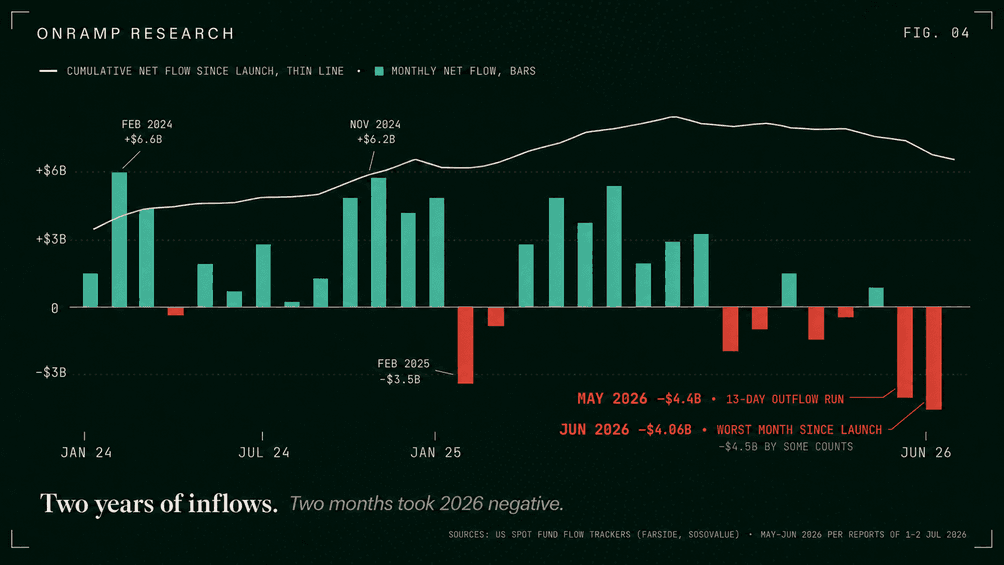
Bitcoin's last nine months are nearly the same chart: a high above $126,000 in October 2025, then a fifty-two per cent fall to around $60,000 now. And as with silver, the selling is coming through the wrappers. The American Bitcoin ETFs have just had the worst month since they launched in January 2024. More than four billion dollars was withdrawn in June 2026, four and a half by some counts, on top of $4.4 billion that left during a thirteen-day run of withdrawals in May. Across the two months over $8 billion came out, and the annual funds' flows for 2026 as a whole turned negative for the first time in their history.
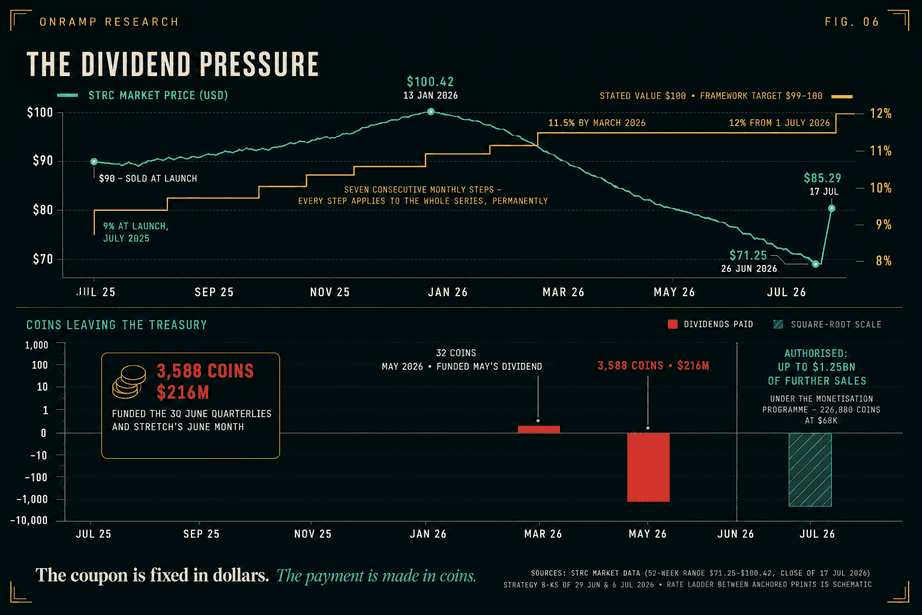
Strategy, the largest corporate holder, shows the same pressure from a different angle. The company has sold bitcoin before: in December 2022 it sold 704 coins for about $11.8 million to realise a tax loss, and bought 810 coins back two days later. That was housekeeping. What it did between 29 June and 5 July 2026 was different in kind. It sold 3,588 coins for $216 million, its largest sale ever, at an average near $60,000 against an average cost of roughly $75,500 per coin, to pay the dividends on its five series of preferred shares, after a first, smaller dividend-funding sale of 32 coins in May. They just did the same again. A tax trade returns the coins within days. A dividend is an operating obligation on a standing calendar: the four fixed-rate series pay quarterly, and the fifth, the variable-rate STRC, has paid twice a month since June 2026, monthly before that. And on 29 June 2026 the company organised all of this into what it calls a "Digital Credit Capital Framework": a dollar reserve policy requiring at least twelve months of preferred obligations held in cash, standing at $2.55 billion; authority for up to $1 billion of preferred buybacks and $1 billion of common stock buybacks; and a bitcoin monetisation programme allowing up to $1.25 billion of coin sales to fund the reserve, the dividends and the interest. Every fund redemption, and every treasury sale like this one, releases coins to the market in just the way the silver funds shed bars.
It is worth being precise about what kind of trade this is, because the metals have seen it before, run in reverse. In the 1990s the bullion banks borrowed the scarce asset: they leased gold from central banks at one or two per cent, sold it, and invested the dollars at five. They were short gold, and the trade ended in 1999 in forced buying, when the leasing was withdrawn and the metal had to be returned at any price. Strategy borrows the abundant asset instead. It raises dollars through five series of perpetual preferred shares and buys bitcoin with them; the stack stood at $15.5 billion of stated value at the last full count, on 25 May 2026, at a blended cost of about 11.2 per cent a year. It is long bitcoin and short dollars, so its trade comes under strain not when bitcoin rallies but when it stalls, because the coupons come due whatever the price does. The sale of 29 June to 5 July 2026 is that strain made visible: forced selling instead of forced buying.
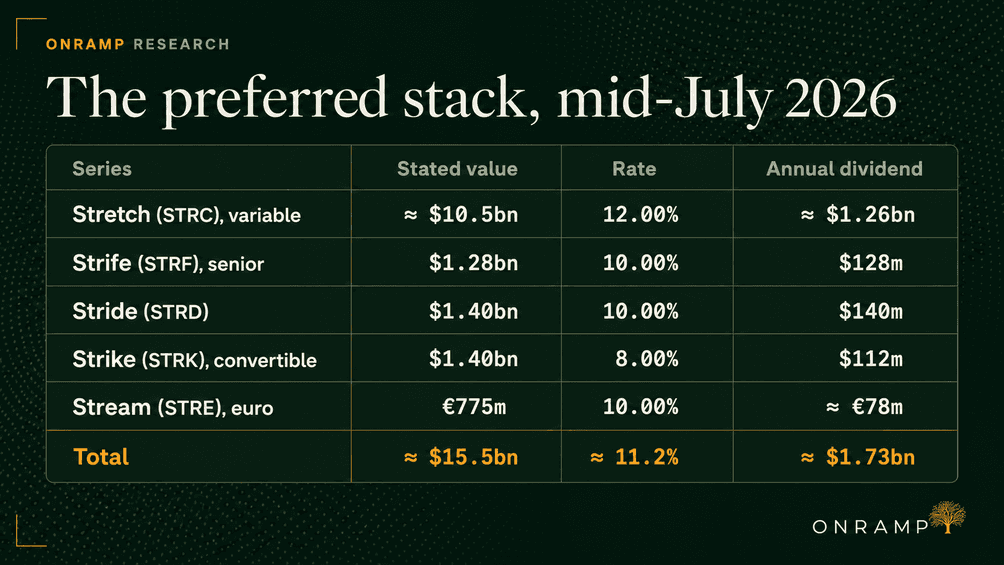
Two checks say the table is right. The framework discloses a $2.55 billion reserve covering a stated 17.4 months of preferred dividends and interest, which implies $1.76 billion a year: our $1.73 billion of dividends plus interest on the remaining convertible notes. And the July sale reconciles almost to the dollar: one quarter of the four smaller series plus one month of Stretch at June's 11.5 per cent rate comes to about $218 million, against the $216 million of coins sold.
The gauge to watch is the mirror image too. In 1999 the signal was the gold lease rate, the cost of borrowing metal. Here it is the cost of borrowing dollars against bitcoin, and it is quoted daily in the preferred shares, above all in Stretch, which is two thirds of the stack. Stretch was sold in July 2025 at $90 against a $100 stated amount, paying 9 per cent. The board raised the rate in seven consecutive monthly steps to 11.5 per cent by March 2026, then to 12 under the June framework, and two features make those numbers heavier than they look: every increase applies to the entire outstanding series, not only to new paper, and every increase is permanent. Each half-point step costs about $53 million a year on the roughly $10.5 billion of Stretch outstanding; that number is our arithmetic, half a per cent of the stated value, and it grows with every share the ATM sells. Then, on 29 June 2026, the framework changed the doctrine. The company said, in effect, that it will not simply keep ratcheting: the rate is now reviewed monthly against a basket of trading levels, credit spreads, bitcoin's price and reserve coverage, with no automatic increase for trading below par, and the job of restoring the price is handed to the other tools, up to $1 billion of preferred buybacks with Stretch first in line, the $2.55 billion reserve, and the coin-sale programme behind it, with a stated objective of $99 to $100. The market's verdict so far: Stretch closed at $85.29 on Friday 17 July 2026. At that price the coupon says 12 per cent, but the yield the market demands for new dollars is about 14, and paper sold at $85 against obligations stated at $100 is expensive paper, which is exactly why the coins are doing the paying. While the preferreds trade near $100, the dividends can be paid with newly issued paper and the coins stay put. The further they fall below it, the more the dividends must be paid in coins. A dividend fixed in dollars is, in effect, a second issuance schedule that the protocol did not write, and it points the wrong way: at $60,000 a coin, every hundred million dollars of dividends costs about 1,700 coins, and the same dividend costs twice the coins if the price halves. This channel is still small next to the network's 164,000 new coins a year, and it works in both directions, since preferreds back at par would turn the same machine into a leveraged buyer again. But these coins sit in the owners' column with one qualification: their owner has already promised away part of the decision.
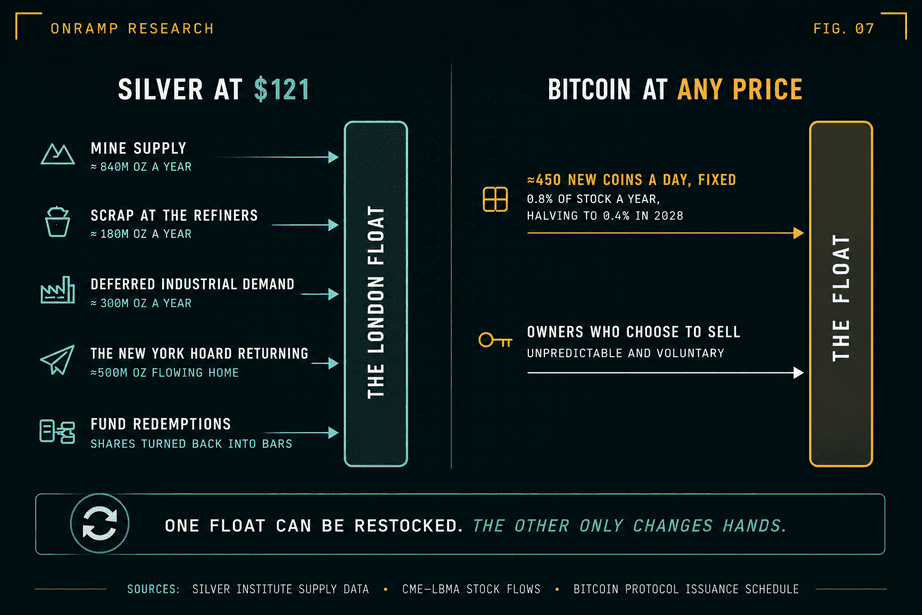
Now apply the two tests, keeping them separate, because they run on different supplies. The production test concerns new supply only. Silver's mines could not answer the price: most silver comes up as a byproduct of copper, zinc and gold mining, so output barely responds to the silver price, and the deficit ran on through the squeeze. Gold's mines barely respond either. Bitcoin's do not respond at all: new coins arrive on a fixed schedule of about 450 a day, roughly 164,000 a year against 20.1 million already outstanding, a growth rate of 0.8 per cent a year that no price can lift, halving to 0.4 per cent in 2028. On the stock-to-flow measure Ammous uses to crown gold, bitcoin overtook gold at the April 2024 halving. All three assets pass the production test. Bitcoin passes it absolutely.
The holder test runs on the other supply: the stock that already exists. Here is where the two markets truly part, so it is worth being exact. Silver's relief came through five channels, and only the first of them was new production. The mines contributed at the margin; the other four, scrap out of drawers, factories deferring purchases, the hoard returning from New York, and owners selling through the funds, were the existing stock changing hands or changing location, and demand stepping aside. Bitcoin keeps the production channel, permanently unresponsive, and of the four stock channels it keeps only the last. There is no scrap, no industrial demand to defer, and no warehouse in the wrong country. So the fixed issuance and the holder lesson do not compete; the first test closes every door except the existing owners selling. If bitcoin's price ever warrants more supply from its stock, that supply can come from one place only: existing owners deciding to sell. Passing the production test does not exempt bitcoin from the holder test. It removes every other way of answering it.
The expectations link sharpens this further. A gold owner believes that no relief is coming from the mines. A bitcoin owner can verify it: the supply schedule is public, fixed, and auditable by anyone running a node, and every holder knows that every other holder can see the same thing. So the one selling motive that has run through every commodity squeeze in history, sell before the new supply arrives, is not merely weakened in bitcoin. It is absent. The motives that remain are the ordinary ones, profit, obligations, a better use for the money, and June 2026 shows they are enough to move a lot of coins. But it means the holder test in bitcoin is purely a question of what other owners will do. That is the only forecast a bitcoin owner has left to make.
There is one more difference in the plumbing, and it answers an objection worth raising directly. The silver funds keep their bars in the same London vaults where the market's lending and settlement happen, so when investors sell fund shares, the bars behind those shares return to the market's working inventory, where they can be borrowed and shipped again. A redemption restocks the very system whose shortage caused the squeeze. The bitcoin funds are built differently. Their coins sit one-for-one in segregated custody, and under their own filings neither the trusts nor their custodians may lend, pledge or rehypothecate them. Whatever paper claims exist on bitcoin, the American spot funds are not a source of them. So a bitcoin redemption does not restock a lending pool. The fund simply sells the coins to whoever bids. If the buyer is a trading desk or an exchange, the coins stay in inventory that can be sold again tomorrow. If the buyer withdraws them to keys he controls, they leave every intermediary's inventory, and they come back only if he chooses to sell. The funds' contribution to this story is not leverage. It is convenience: they are the fastest exit the asset has ever had.
One honest amendment to that taxonomy. The market has rebuilt small versions of silver's missing channels, and it has built them inside the owners' column. The funds are the express exit, a sale at the friction of a tap. Strategy's dividend calendar is the scrap pile inverted: scrap came out of the drawers when the price rose far enough, and these coins come out of the treasury when the price falls far enough, because the coupon is fixed in dollars and comes due whatever the coins are worth. Even the leveraged bid defers like a factory: in the second week of July 2026, with its preferreds below par, the company bought no coins at all. The difference from silver is that all of this is built from owners' coins, it is countable, and it is voluntary. Roughly 2.1 million coins, a little more than a tenth of the stock, sit today where selling is either frictionless or partly pre-committed: about 1.25 million behind the American funds and 844,000 at Strategy. Silver's loosely held stock was vast, structural and impossible to measure. Bitcoin's is measured on-chain every day, and in June 2026 it shrank. So the holder test, stated in full, is not only whether owners sell. It is how much of the stock sits in structures that sell on the owners' behalf, and whether that share is growing or shrinking.
And the record of June 2026 shows bitcoin's two groups of owners moving in opposite directions. Investors in the funds sold, as above. At the same time, coins kept leaving the exchanges, and wallets holding a thousand coins or more added over 270,000 coins in the last two weeks of June, about $16.7 billion worth, by the counts of two analytics desks. Most of that is large private holders taking coins into their own custody. So the people who hold bitcoin through funds are selling it, and the people who hold it through their own keys are accumulating it. Silver's owners, when the price tested them, gave one answer almost unanimously. Bitcoin's owners are giving two.
The honest reading
The case against this essay deserves its space. Silver's shortage was partly a story about location, metal hoarded in the wrong country against a tariff that never came, so the healing was always likelier than the panic suggested. The Silver Institute's April 2026 survey shows the deficit narrowed in 2025 even as the price flew, and the soberest analysts said throughout that this was never the empty-vault shortage of the newsletters. Perhaps $121 was simply a mania, and manias end. It should be added that the deficit has not gone away; Fitch's research arm expects it to persist through 2026, so the squeeze may yet have a second act.
On bitcoin, the honest points cut both ways. The bid has been missing all year, with speculative capital drawn off by the AI buildout, and a fund investor who sells is doing nothing wrong; he is responding to price exactly as silver's owners did. Owners with keys can sell too; keys give an owner control of the decision, they do not make it for him. And the wallet counts deserve caution, because wallets above a thousand coins include exchange cold storage and custodial transfers as well as private buyers, so 270,000 is a strong signal rather than an exact census. But none of these objections touches the fact this essay rests on. When silver's price broke upward, the market could answer it from mines, scrap, factories and warehouses as well as from selling owners. If bitcoin's price ever breaks upward the same way, four of those five answers do not exist. Only the owners do.
What to watch
The lease rate
A second spike in London borrowing costs would say the deficit is reasserting itself and the metal is leaving the shelf again.
The London vault data
The monthly LBMA series will show whether the rebuilt float holds, or drains again into ETFs, industry and the East. The LBMA has discussed publishing silver inventories weekly; if it does, this signal gets faster.
The deficit
A sixth consecutive shortfall is projected for 2026. If it lands while the price sits in the fifties, the spring is being compressed again.
Bitcoin's two doors
Fund flows and exchange balances, read together: whether the wrappers keep releasing coins and the keys keep absorbing them.
Strategy's preferreds against par
This cycle's counterpart to the 1999 gold lease rate, inverted. Watch how far the five series trade below their $100 stated value, and Stretch against the company's own $99 to $100 objective; the further below par, the harder the dividends are to refinance with new paper and the more coins must fund them. The 29 June 2026 framework requires the cash reserve to hold at least twelve months of preferred obligations; watch the stated coverage months move alongside the discount.
Conclusion
Here is what this episode establishes, stated as plainly as we can. The silver squeeze was real. The deficit was real, the vaults did run dry, and the price still made a full round trip, because the owners of silver, millions of them acting separately, sold into the high price, and the wrappers made selling effortless. Scarcity alone did not hold the repricing, because scarcity alone never does. Gold's repricing after 1999 held because gold's dominant owners, a group of central banks, formally agreed to stop supplying the market. Silver's did not hold because silver has no such owners. The price met a scattered crowd, and the crowd took its profit.
Bitcoin will face the same test, and it will face it with less outside help than any asset in history. Its new supply is fixed at about 450 coins a day whatever the price does, and its funds hold their coins unlent, so when its moment comes there will be no mines, no scrap, no warehouses and no leased-out float to draw on. The only source of supply will be the decision of the people who already own it. In June 2026 those people split: fund investors sold more than four billion dollars of bitcoin out of the wrappers, while holders of private keys absorbed roughly sixteen billion dollars of coins in a fortnight. The metal came back because its owners sent it back. Whether the coins ever come back to the market is a decision that now sits, coin by coin, with the people who hold the keys.
Sources: Bloomberg-compiled silver lease-rate data (34.9 per cent peak, 9 October 2025; the 2019 to 2024 pre-squeeze average) and LBMA vault data, as reported; market reports of 6 February 2026 for the weekly fall, the 6.3 per cent lease rate and London prices above the Comex curve; the Silver Institute, World Silver Survey 2026 (April 2026); Bank of America forecast commentary (October 2025) as reported; press reporting on the October 2025 squeeze, including the Indian fund suspensions, transatlantic airfreight, and remarks by the head of the Japan Bullion Market Association; estimates of tariff-driven United States stockpiling as reported; market reports of 16 and 17 July 2026 for the current price and the negative one-month lease rate; the Washington Agreement on Gold (26 September 1999), Greenspan's 1998 congressional testimony and 1990s leasing history, per our brief of 2 June 2026, The Paper Layer, and Ferdinand Lips, Gold Wars; Saifedean Ammous, The Bitcoin Standard (2018), chapter 3, for the easy money trap and gold supply-growth figures (US Geological Survey); US spot bitcoin fund flow data as reported (June 2026 totals differ by count, $4.06 to 4.5 billion); Strategy Forms 8-K of 28 December 2022, 29 June 2026 (the Digital Credit Capital Framework) and 6 July 2026; Strategy's Form 10-Q for the quarter ended 31 March 2026 (preferred stock table) and capital structure update of 26 May 2026 ($15.5 billion preferred stated value); STRC dividend policy and rate history per company disclosures and the 29 June 2026 framework, with the closing price of 17 July 2026; the blended rate, per-step ratchet cost and dividend reconciliation are the author's calculations; spot bitcoin fund prospectuses on segregated custody and the prohibition on lending, pledging or rehypothecating trust bitcoin; exchange-balance and large-wallet tallies as reported by two analytics desks; BMI (Fitch Solutions) deficit projections; bitcoin issuance arithmetic is the author's calculation from the protocol supply schedule. Figures approximate where noted.
The Radar
What matters this week across digital assets, AI, and global markets.
Digital Assets & Regulation
Japan reclassifies bitcoin
The same country whose currency is breaking just legitimized the alternative. Japan's Diet gave final approval to moving bitcoin and roughly a hundred other tokens out of payments law and into the statute governing stocks and bonds: a flat 20 percent tax on gains replaces rates up to 55, losses carry forward three years, and Tokyo-listed ETFs get a 2027 path. Japanese households hold $13 trillion in savings; a 1 percent shift would exceed every US spot fund combined. Nothing bites before 2027, but the cage is unbolted.
A bid for the old rails
Stripe and Advent bid $53 billion for PayPal, $60.50 a share, a 28 percent premium; the board called it inadequate and on Monday formally rejected it, angling for more. The target has lost nearly 90 percent of its peak value and is cutting a fifth of its staff; the bidder is privately worth $159 billion on $1.9 trillion of annual volume. Combined, they would process some $3.7 trillion a year. As tokenized dollars commoditize checkout, the fight is no longer over rails but over who owns the customer.
The market maker moves in
Citadel Securities, the machine at the center of American equities, put $400 million into Crypto.com at a $20 billion valuation, the exchange's first institutional round. The firm that executes a large share of US retail stock orders is buying into the venue where those same customers trade digital assets. With the sector's listed equities still 70 to 90 percent below their debuts, the largest market maker chose to buy in private, where repricing is quieter. Plumbing, not press releases, is what institutionalization looks like.
AI & Financial Infrastructure
The bellwether raises the bet
The company that fabricates nearly every AI chip says the build is accelerating. TSMC's second quarter: 2026 capital spending raised to as much as $64 billion from a $56 billion ceiling, revenue growth guided above 40 percent, gross margin at 67.7 percent, up nine points in a year. Another $100 billion went to Arizona, lifting that campus to $265 billion. Management calls demand "extremely robust" as generative models give way to compute-hungry agents. The scarcest thing in AI is still the foundry, and it is pricing accordingly.
China opens the frontier
Moonshot, the Alibaba-backed lab, released Kimi K3: 2.8 trillion parameters, the largest open-weight model ever announced, weights promised by July 27. It debuted first on the main frontend-coding leaderboard, past the American flagships, and fourth of 189 on an independent intelligence index. Caveats: the benchmarks are vendor-tilted, and the weights are not yet out. But the strategy is legible. China's answer to chip controls is to give the model away, commoditizing exactly what the closed labs plan to take public.
AMD lands Microsoft
The contest has moved from chips to racks. AMD's Helios, its first rack-scale AI system, 72 GPUs plus its own CPUs, networking and software, ships this half; Microsoft joined Meta, OpenAI and Oracle as buyers, deploying it on Azure for frontier inference. The design uses open standards where Nvidia's is a closed loop, and that is the point: Nvidia holds over 95 percent of this market, and its largest customers are deliberately funding a second source. AMD rose 5 percent, up 139 percent this year.
Geopolitics & Markets
The purge in Kyiv
Kyiv's cabinet dissolved, and the casualty was the man who built the drone war. The prime minister resigned at Zelensky's request; two days later defense minister Mykhailo Fedorov, 35, architect of the deep strikes now reaching Russian refineries, was out after six months. Thousands protested in Kyiv and other cities, rare wartime street politics, and Fedorov blamed the army chief for blocking modernization. Parliament approved Serhii Koretskyi, late of Naftogaz, as premier. A fourth wartime reshuffle reads two ways: discipline at the top, or the generals winning the argument.
Britain seizes the furnaces
For the first time since 1988, the British state owns a steelworks. By act of Parliament, London took British Steel from China's Jingye, which paid £70 million in 2020, says it invested £1.2 billion, and was losing £700,000 a day. Scunthorpe is the last plant in Britain that can make steel from ore; 2,700 jobs sit on it, and the government was already running it at £1.3 million a day. Beijing protested. The chip-war playbook, subsidize, protect, seize if necessary, has arrived in a nineteenth-century industry.
The war finds new frontiers
Week three of the resumed war brought the first American deaths: two troops killed in a strike on a Jordanian airbase, a third in Iraq, as Iranian fire reached Saudi Arabia. The targets are becoming systems. Desalination plants have been hit on both sides, leaving 10,000 Iranians without water; US strikes felled 116 telecom towers; Trump has threatened the power grid, and Tehran told the Houthis to close the Red Sea if he does. Escalation is spreading across borders and down into the systems civilians live on.
The Week in Numbers
| Indicator | Reading |
|---|---|
| Japan's new flat tax on digital-asset gains, down from a top rate of 55 percent | 20% |
| Japanese household savings the reclassification opens toward regulated products | ~$13T |
| Stripe and Advent's per-share bid for PayPal, rejected by the board on Monday | $60.50 |
| Citadel Securities' investment in Crypto.com, at a $20 billion valuation | $400M |
| TSMC's Arizona campus after another $100 billion added this week | $265B |
| Parameters in Kimi K3, the largest open-weight model yet announced | 2.8T |
| The last year British Steel was in state hands, until Thursday | 1988 |
| US gasoline prices since the Gulf war began | +34% |
What to Watch This Week
| Date | Why it matters |
|---|---|
| This week | The Senate's window for the Clarity Act: Thune targets a floor vote before recess, with the ethics fight over presidential holdings unresolved. |
| July 27 | Kimi K3's open weights are due, the test of whether the release matches the claims. |
| July 28 | PayPal reports earnings, the first read on the turnaround its board just priced against the bid. |
| July 31 | FTX begins its fifth creditor distribution, roughly $900 million to allowed claims. |
| Aug 2 | The EU AI Act's surviving transparency rules take effect as the delay of everything else becomes law. |