September 15, 2026 Weekly Market Brief

Glenn Cameron, CFA · Global Head of Onramp Institutional
Free. Every week. Institutional insights, connected.
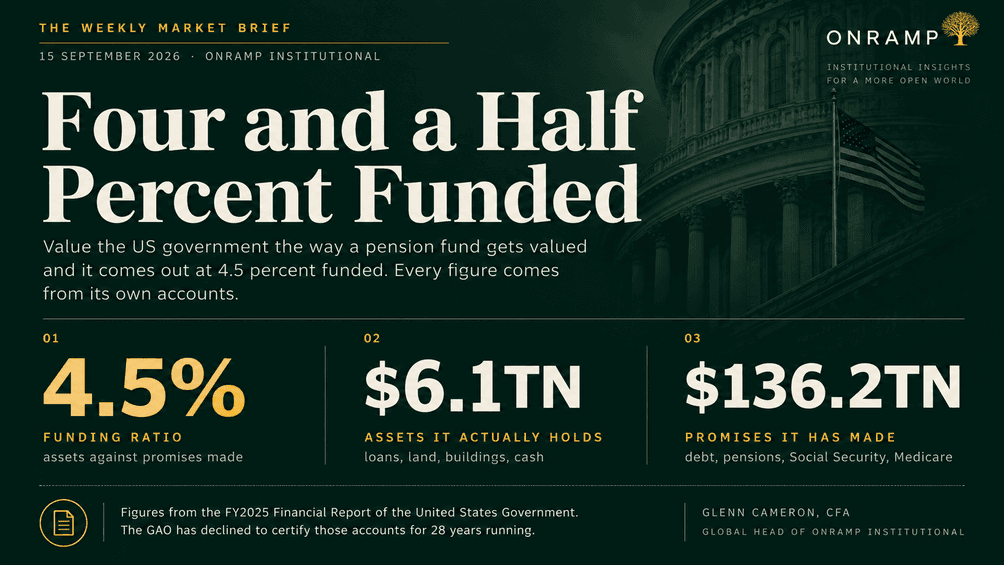
The US government holds $6.1 trillion of assets against $136.2 trillion of promises. Valued the way a company pension scheme is valued, that is 4.5 percent funded, and every figure comes from the government's own Financial Report. The federal trust funds hold nothing but Treasury securities, a concentration ERISA caps at 10 percent for a company scheme in its sponsor's own paper, and the Government Accountability Office has declined to certify the accounts for 28 years running.
Value the US government the way a pension fund gets valued and it comes out at 4.5 percent funded. All based on figures published by the government.
The 4% Funded Number
The US government holds $6.1 trillion of assets. It has made $136.2 trillion of promises. That's 4.5 percent funded.
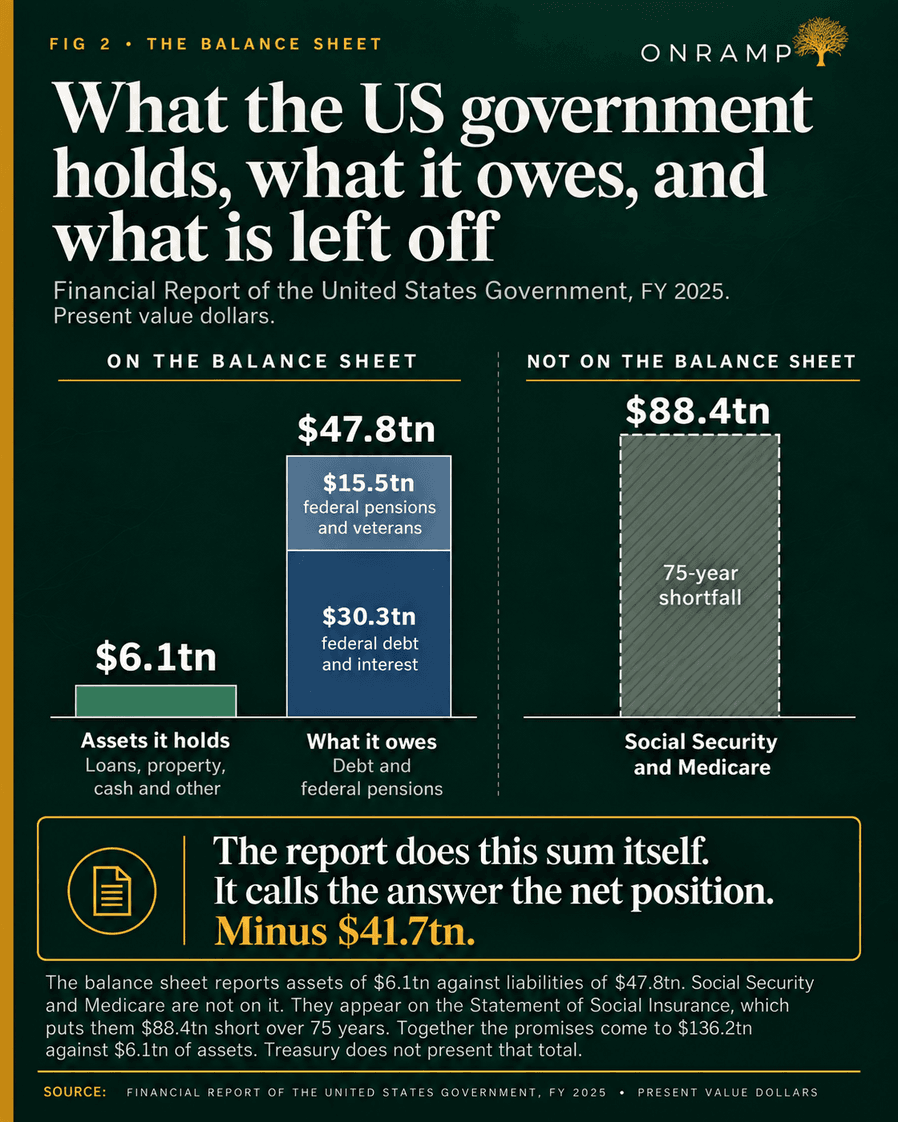
Both numbers come from the government. They're in the Financial Report of the United States Government. It came out on 19 March 2026 with the Treasury Secretary's signature on it. The $6.1 trillion of assets sits on the balance sheet, and so does $47.8 trillion of the promises. The other $88.4 trillion is Social Security and Medicare, and that gets a statement of its own.
Some Terminology
A liability is a promise to pay money later. Say you've agreed to pay someone $1,000 next year. That's a liability of $1,000. It doesn't matter whether you've got the money now.
Some of these promises run eighty years out. And a dollar due in 2090 isn't worth a dollar today. Money held now earns interest in the meantime. So each promise gets shrunk to what it's worth today. Then you add them up. The total is called a present value. Every figure below is one. A promise is funded if money has already been set aside to meet it.
A 401(k) is funded. There's an account with your name on it and real money in it. You can log in and look at the balance. If your employer went under tomorrow the account would still be there.
The balance sheet
Start with the government's own balance sheet. Assets of $6.1 trillion. That's $2.0 trillion of loans it has made. And $1.4 trillion of buildings, ships, land and kit. The rest is cash and money owed to it.
Liabilities of $47.8 trillion. Most of that is two lines. Federal debt and interest, $30.3 trillion. Pensions and benefits owed to federal staff, soldiers and veterans, $15.5 trillion. The report does that subtraction for you. It calls the answer the net position. Minus $41.7 trillion. So on its own accounts, before anything else gets counted, the government is 12.8 percent funded.
The promises that aren't on the balance sheet
Social Security and Medicare aren't in that $47.8 trillion. They appear in the same document but on a different statement, called the Statement of Social Insurance. Over the next 75 years they're set to pay out $88.4 trillion more than they take in.
There's a legal reason they're kept off the balance sheet. In 1960 the Supreme Court ruled in Flemming v. Nestor that nobody has a property right to their Social Security payment. Congress can change the terms whenever it likes. So it isn't a debt. And it doesn't go on the balance sheet.
It's still a promise. And the government still expects to pay it. So add it in. The promises come to $136.2 trillion. The assets are still $6.1 trillion. That's the 4.5 percent. The shortfall is $130.1 trillion. US output last year was about $30.5 trillion.
The rule Congress wrote for everyone else
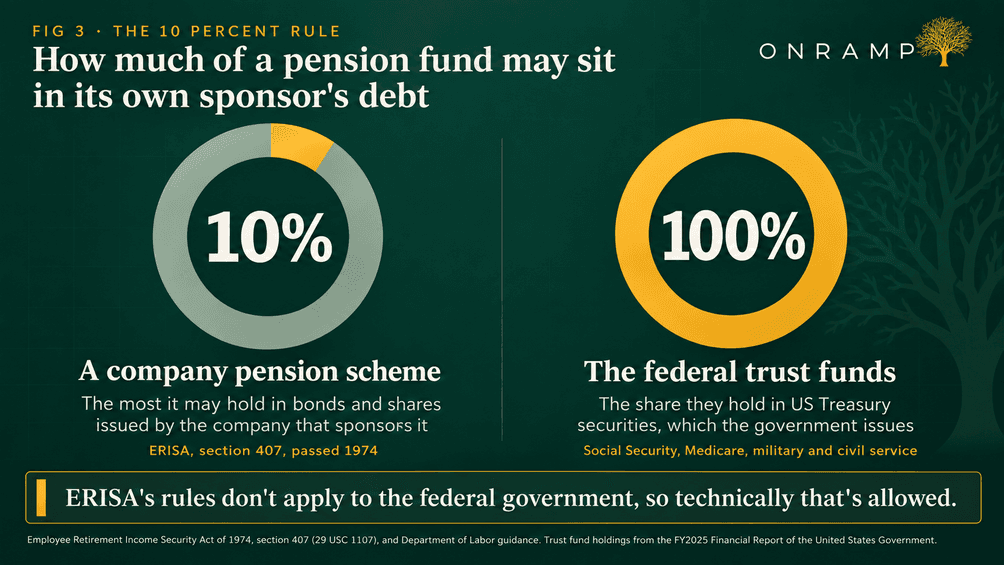
ERISA is the law covering company pension schemes. Congress passed it in 1974, when most large firms still ran what's called a defined benefit scheme. Under a defined benefit scheme the company promises you a set income in retirement. And it has to put money aside to cover that promise. A 401(k) works the other way round. You and your employer pay in, and whatever the account is worth when you retire is what you get. There's a clause in it that says a scheme can't hold more than 10 percent of its assets in the sponsor's own securities. So General Motors can't fill its pension scheme with General Motors bonds. Congress put that limit in because of what happens when a company fails. If the scheme is full of that company's bonds, the bonds are worth little at the moment the workers need the pension most. They'd lose the job and the pension in the same week.
Now look at the government's own funds. Social Security has one. So do Medicare, military pensions and the civil service pension. Every one of them holds Treasury securities and nothing else. That's 100 percent, where a company scheme is capped at 10. ERISA's rules don't apply to the federal government, so technically that's allowed.
It's also why the $6.1 trillion of assets is so small. Take the Social Security trust fund. It holds a couple of trillion dollars, all of it in Treasury securities. A Treasury security is a bond issued by the US government, and a bond is an IOU. So the money set aside to pay Social Security is a stack of IOUs. The US government wrote them. The US government holds them. Each one says the US government will pay the US government.
Say General Motors ran its pension scheme the same way. The scheme holds a billion dollars of General Motors bonds. On the scheme's books that's a billion-dollar asset. On General Motors' books it's a billion-dollar debt. Put the company and the scheme together on one set of accounts and the two lines cancel. General Motors would be owed the money by General Motors.
That's the position the federal trust funds are in. The military and civil service pension funds are the same. The money is there and it comes to nothing. There's a reasonable argument for the difference. A government isn't a company. It doesn't have customers and it doesn't sell anything, it just taxes people, and the US has been taxing people since 1789. Seventy-five years of US tax receipts are a safer bet than seventy-five years of profits from any company you can name. That's roughly what Treasury is leaning on here, and it's fair enough.
What it would take to fix
Treasury publishes that too. Stopping the debt ratio rising over 75 years takes 4.7 percent of GDP. Every year. Starting now. It was 4.3 percent in last year's report. In the report's own terms that's a permanent tax rise of about 25 percent. Or a permanent cut to non-interest spending of about 21 percent.
Debt held by the public was 99 percent of GDP at the end of September 2025. The report has it passing the 1946 record of 106 percent by 2030. And reaching 576 percent by 2100. Treasury calls the path unsustainable. It uses that word every year.
The guarantees
The $136.2 trillion leaves out the guarantees. The government guarantees other people's loans. It insures bank deposits. It backstops pensions, floods and crops. The Congressional Budget Office put new federal loan guarantees at about $1.6 trillion in 2025. And it put the budget cost of writing them at $2 billion. So that's $1,250 per million guaranteed. The rules say to book what you expect to lose. Not what you could lose. And most of those loans will be repaid. So the small number isn't dishonest.
But it does mean the projections assume no bank runs, no pension takeovers and no wave of defaults. Debt has a date on it and comes due on schedule. A guarantee comes due when something breaks.
Nobody has signed off on any of this
The Government Accountability Office has refused to give an audit opinion on these accounts for 28 years running. It did so again this year.
So the figures above are the best anyone has. They are also unaudited, and they always have been.
What it means for a bitcoin holder
Treat all of this as arithmetic rather than a forecast. A government with a taxing power isn't a pension scheme with a bankrupt sponsor. The comparison only goes so far, and it isn't advice to buy anything.
But it does show where the uncertainty sits. The size of the promises is known. What's open is how they get paid. In full, or late, or smaller, or in money that buys less. That gets settled by legislation and by inflation. Not by default.
Bitcoin has one set of accounts and anyone can read them. Every coin ever issued is on the ledger. There's no equivalent of the Statement of Social Insurance, holding promises the main accounts leave out. Nor is there anything guaranteed on somebody else's behalf. And none of it depends on what US tax receipts look like in 2078. People usually sell bitcoin on bigger claims than that. You can check this one yourself in an afternoon.
SOURCES AND NOTES: Financial Report of the United States Government, FY 2025, published 19 March 2026 (fiscal.treasury.gov). Balance sheet: total assets $6.1tn including $2.0tn loans receivable net and $1.4tn PP&E; total liabilities $47.8tn including $30.3tn federal debt and interest payable and $15.5tn federal employee and veteran benefits payable; net position minus $41.7tn.
Same report, Management's Discussion and Analysis: 2025 SOSI net PV excess of expenditures over receipts $88.4tn over 75 years; SLTFP excess of non-interest spending over receipts $79.6tn; debt held by the public $30.2tn at 30 September 2025, 99 percent of GDP; fiscal gap 4.7 percent of GDP against 4.3 percent in the FY2024 projections; debt-to-GDP projected to reach 576 percent in 2100.
Same report, Executive Summary: the fiscal gap equals 25.1 percent of 75-year PV receipts and 20.7 percent of 75-year PV non-interest spending.
Statement of the Comptroller General, FY 2025 Financial Report: debt-to-GDP projected to pass its 1946 high of 106 percent by 2030; GAO disclaimer of opinion, as in each of the past 28 years.
Employee Retirement Income Security Act of 1974, section 407 (29 USC 1107): 10 percent limit on holdings of qualifying employer securities by a defined benefit plan. Department of Labor guidance states the limit in plain terms.
Flemming v. Nestor, 363 US 603 (1960). Congressional Budget Office, Public-Private Risk Sharing in Federal Credit Programs: about $228bn of new direct loans and $1.6tn of new loan guarantees projected for 2025 at an estimated cost of $2bn.
The $136.2tn total is the $47.8tn of balance sheet liabilities plus the $88.4tn social insurance shortfall, both as published. Treasury does not present that total and the two are drawn up on different accrual bases. Every other figure is printed in the source named.
The Radar
What matters this week across digital assets, AI, and global markets.
Digital Assets & Regulation
A tax on every transfer
Illinois will tax digital-asset transactions at 0.2 percent from January 1, 2027, under an act signed on June 16 inside the state budget. On September 9 the Blockchain Association and a second trade group asked a Springfield court to block it before it starts, arguing it can hit one transaction several times and carries criminal penalties. The CFTC's chairman has said it would weaken Chicago as a financial center.
The second bridge in four days
On September 9 Osmosis paused Alloyed BTC after a bug in Nomic's forwarding code let an attacker double-spend its wrapped bitcoin: 39.84 coins, about 36 percent of the backing. It came three days after Liquid's federation lost 95 percent of its reserve. Liquid got 3,400 coins back on September 7; the self-described white hats kept 598.5. Both failed in the code that mints the wrapper, not in bitcoin.
Waiting on a license
Qivalis, the Amsterdam venture owned by 37 European banks, has applied to the Dutch central bank for an electronic-money license and cannot issue until it is granted. It targets a euro stablecoin under MiCA in the second half of 2026, backed one for one; reports on September 8 said it will issue on a public chain. Its American counterpart, announced September 1, has no license, chain or date.
AI & Financial Infrastructure
Backlog: $664 billion
Oracle's quarter to August 31: revenue $19.35 billion, up 30 percent; cloud infrastructure up 121 percent to $7.4 billion; backlog $664 billion, $26 billion more than in May. The finance chief said most new contracts came prepaid or with the customer supplying the hardware, needing no Oracle capital, and about half should become sales within 36 months.
DeepSeek heads for Shanghai
DeepSeek has engaged CITIC Securities to prepare a listing on Shanghai's STAR Market and aims to start this year, Reuters reported on September 9, citing two people. Size, timing and valuation are undecided; a separate round is being raised at roughly $75 billion, a fraction of what the leading American labs are said to seek. The gap, Reuters noted, is revenue, not capability.
A fourth record month
TSMC's August revenue reached NT$514.8 billion, about $16.35 billion, up 53.3 percent on the year and 10.1 percent on July, a fourth consecutive monthly record, filed September 10. That runs ahead of full-year guidance of growth a little above 40 percent in dollars. Nodes at 7 nanometers and below were 77 percent of June-quarter wafer revenue. Capacity, not demand, is the constraint.
Geopolitics & Markets
The ECB hikes again
The European Central Bank raised all three policy rates by a quarter point on September 10, taking the deposit rate to 2.50 percent, its second increase since the Iran war lifted energy prices. The vote was unanimous; Lagarde called it a no-brainer. Inflation is projected at 3.0 percent this year, 2.5 in 2027 and 2.1 in 2028, the last two revised up. The bank will not pre-commit to the next step.
Seven years for a slogan
A Hong Kong court on September 11 sentenced Lee Cheuk-yan to seven years and Chow Hang-tung to seven years and three months for inciting subversion under the national security law; Albert Ho, who pleaded guilty, got five years and two months. They ran the group behind the city's annual Tiananmen vigil. The judges wrote that the offense was the repeated, peaceful use of the phrase end one-party dictatorship. No violence was alleged.
Venezuela signs
On September 2 in Caracas, Venezuela signed an agreement granting 100-year concessions over 17 oil fields holding some 65 billion barrels of reserves to a private operator, North American Blue Energy Partners. The Pentagon's Office of Strategic Capital takes rights to a 35 percent stake in the operator's parent, with a board veto and an American majority of directors. No text of the agreement has been published.
The Week in Numbers
| Indicator | Reading |
|---|---|
| The Illinois tax on digital-asset transactions from January | 0.2% |
| Coins returned to the Liquid federation on September 7 | 3,400 |
| European banks behind the euro stablecoin awaiting a license | 37 |
| Oracle's contracted backlog at August 31 | $664B |
| The valuation DeepSeek is reportedly raising at | $75B |
| The ECB deposit rate after its second hike of the war | 2.50% |
| Length of the Venezuelan concessions | 100 years |
| Barrels of reserves the deal covers | 65B |
What to Watch This Week
| Date | Why it matters |
|---|---|
| Sept 15 | The Clarity Act cloture vote is scheduled for 2:15 pm Eastern; 60 votes means at least seven Democrats or independents. |
| Sept 16 | The Fed decides, the first meeting since the chair said he would stop guiding. |
| Sept 23 | BitMEX closes at 04:00 UTC, eleven years after it invented the perpetual swap. |
| Sept 24 | Xi Jinping arrives at the White House for a state visit. |
| Oct 5 | CME's futures on GPU rental rates are due to start trading, pending review. |
| Jan 1, 2027 | The Illinois transaction tax takes effect unless the Springfield court stops it. |