July 28, 2026 Weekly Market Brief

Glenn Cameron, CFA · Global Head of Onramp Institutional
Free. Every week. Institutional insights, connected.
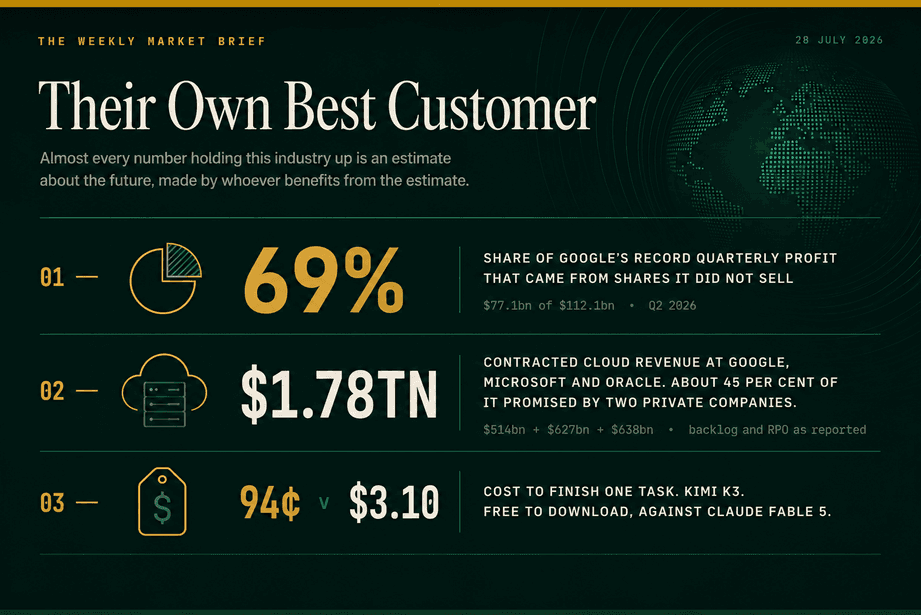
Google's record quarter and its first negative cash flow quarter arrived in the same release, and 69 per cent of that record profit was a gain on shares it never sold. This week's brief reads the filings behind the AI buildout and finds four separate accounting judgements, each legal and each disclosed, all leaning the same way: contracted revenue nobody has earned, profit on things nobody sold, a depreciation charge that has not arrived yet, and a bet on how long a machine keeps earning. Set against a supply schedule that requires nobody to keep being right, the contrast does the argument's work.
On Wednesday night Google reported the largest profit in its history and the first negative cash flow quarter of its life, in the same release. A week earlier a Beijing lab released a free model that competes with the best American systems. Anthropic and OpenAI are asking public markets for close to two trillion dollars between them. All of that is true at once, and the reason it can be is that almost every number holding this industry up is an estimate about the future made by whoever benefits from the estimate. None of it is fraud. All of it leans the same way.
The week the story stopped being about models
On 16 July 2026 a Beijing company called Moonshot AI released Kimi K3, the largest open-weight model ever built. Open weight means the file itself, the trained brain, is published for anyone to download and run on their own machines. It ranks fourth in the world on independent testing, behind only Anthropic's Claude Fable 5 and OpenAI's GPT-5.6 Sol, and it beat both of them in blind tests on writing front-end code. It costs about 94 cents to finish a task where Fable 5 costs around $3.
Ten days before that, Anthropic and OpenAI both filed confidentially to list on American markets. Anthropic's own announcement in May 2026 put its valuation at $965 billion on revenue running at $47 billion a year. OpenAI is reported to want roughly a trillion. So the obvious question is what public investors are being asked to pay for, if the recipe is about to be free.
We spent this week answering that from the filings rather than the headlines, and the answer turned out to sit somewhere else entirely. The competitive question matters, but it is downstream of an accounting question that almost nobody is asking.
First, the split that explains why everyone has data
AI is billed by the token, a token being a fragment of a word. Both the bulls and the bears can point at token data and both are telling the truth, because they are counting different things. OpenRouter is a marketplace where developers send work to whichever model they pick through a single connection. Switching is trivial, so its traffic is a decent read on what people actually deploy. A year ago models built by Google, OpenAI and Anthropic handled around 70 per cent of the tokens flowing through it. By June 2026 that was roughly 30 per cent. Chinese models took the majority, hitting a record 58 per cent of tokens processed by American firms this month. A CNBC investigation published on 7 July 2026 found Chinese models above 30 per cent of enterprise volume there every single week since February. This is not launch-week noise. It held for six months.
Now the other half. In June 2026 DeepSeek's cheapest model cost 14 cents per million input tokens. OpenAI's GPT-5.5 cost $5. That is a thirty-six times gap for something the charts count as one unit. Assume American tokens carry a blended premium of only ten times, well below the headline gap, and a market where China has 46 per cent of the tokens becomes a market where America has around 88% of the revenue.
So there are two lanes now. A commodity lane, where enormous volumes of routine work go to whatever is cheapest, and a premium lane, where far fewer tokens carry nearly all of the money. Anthropic's revenue went from about $30 billion in April 2026 to $47 billion by mid-May while its share of tokens on those marketplaces was halving. Both curves are real. They measure different lanes.
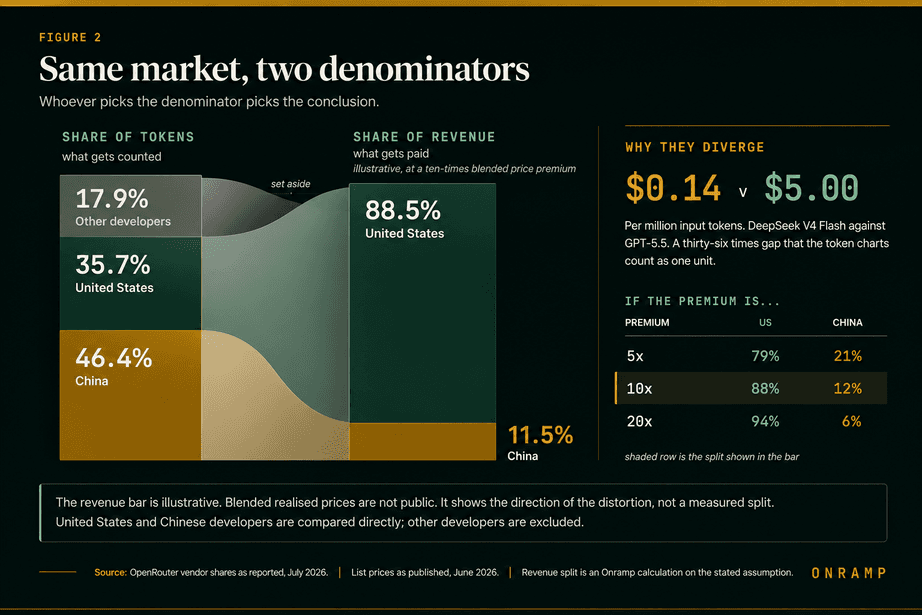
Which lets us state the bear case properly. It is not that a cheap copy beats Fable 5. It is that the premium lane keeps shrinking as a share of all work done, because every month more tasks become good enough on a model costing a tenth as much. The labs are not being outcompeted. They are being narrowed. And that matters for the accounting, because every estimate below depends on how long today's frontier stays worth paying for.
Four estimates, all pointing the same way
Here is the finding that took the week. Look through the filings of the companies building this and you find that the good news is recognised early and the costs are recognised later. Four separate accounting judgements, each defensible on its own, each legal, each disclosed. All four lean in the same direction.
Estimate one: revenue nobody has earned yet
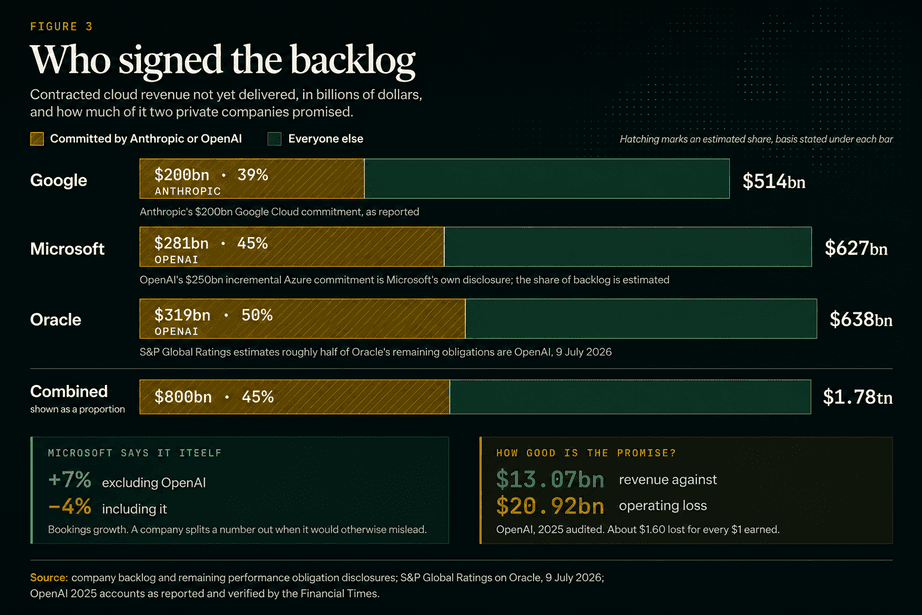
Backlog is contracted work a company has signed but not yet delivered. It is the number cloud businesses use to prove demand is real, and it is doing a great deal of work in this cycle. Google's backlog reached $514 billion, up more than $50 billion in the quarter. Microsoft's stood at $627 billion, having doubled in a year. Oracle's is $638 billion.
That is $1.78 trillion of contracted future revenue across three of the largest companies on earth. Now ask who signed it. Anthropic has committed $200 billion to Google Cloud, about 39% of Google's backlog. OpenAI contracted for an incremental $250 billion of Azure in October 2025, and its share of Microsoft's backlog is put at roughly 45%. S&P estimates that about half of Oracle's is tied to OpenAI. Add it up and something near $800 billion, roughly 45% of the whole, is a promise from two private companies.
You do not need to take our word for the concentration. Microsoft now reports its bookings twice: up 7% excluding OpenAI, down 4% including it. A company only splits a number out like that when the number would otherwise mislead.
Estimate two: profit on things nobody sold
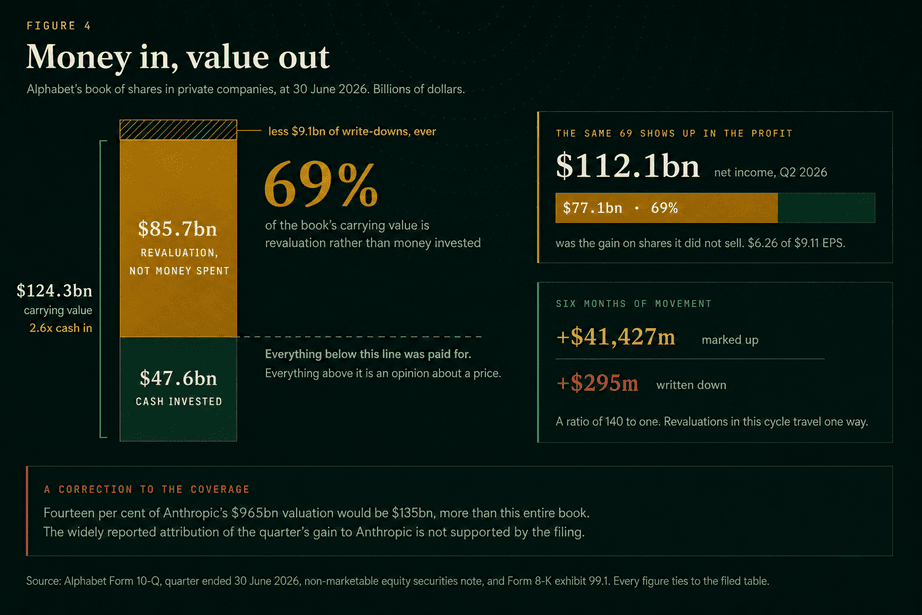
Google's quarter is the cleanest illustration you will ever get. Net income was $112.1 billion, a 298% increase. Of that, $99 billion was a gain on shares in private companies it owns and did not sell. After tax, that single item was $77.1 billion, or 69% of their net profit, and $6.26 of the $9.11 of earnings per share.
The rule requires this. When a private company you hold a stake in raises money at a higher price, you must revalue your stake and run the increase through profit, even though nothing was sold and no cash moved. It happened in the previous quarter too: Google reported earnings of $5.11 a share and headlines about an 81% profit surge, and once you strip the revaluation, the underlying business missed analyst estimates by a penny.
The press has attributed most of this quarter's gain to Anthropic, whose valuation went from $380 billion to $965 billion in the period, and to Google's roughly 14% stake in it. We went to the 10-Q, and that cannot be right. 14% of $965 billion is $135 billion. Google's entire private investment book carries at $124.3 billion. The single holding, as reported, exceeds the whole book. The larger part of the gain was almost certainly SpaceX, which listed publicly on 12 June 2026 and moved onto the balance sheet at $94 billion.
What the filing does show is more interesting than the story it corrects. Google's private book carries at $124.3 billion on $47.6 billion of money actually invested. The difference, $85.7 billion, is cumulative upward revaluation. 69% of the value of that book is private company valuation marks rather than money. Over the same six months, write-downs across every holding came to $295 million. Revaluations in this cycle travel in one direction.
Estimate three: a cost that has not arrived
When a company buys a machine, the cash leaves at once but the cost reaches the profit line gradually, spread over the years the machine is assumed to be useful. That spreading is depreciation, and it is the least-read line in these filings and currently the most important. Google's depreciation charge rose 42% in the quarter, to an annual rate of about $28 billion. Its property and equipment stands at $321 billion and grew more than 30% in six months. The company discloses that about 60% of that is servers and networking gear, which it depreciates over six years. 60% of $321 billion, spread over six years, is $32 billion a year, which is more than the entire depreciation charge the company reported for everything it owns.
That is not a sign of anything improper. It is a sign that a large part of the machinery is not switched on yet, and you do not depreciate a data centre you are still building. Which makes the point sharper rather than softer. The cost is not a matter of judgement that could go either way. It is scheduled. It arrives when the capacity arrives, and Google is bringing on close to $200 billion a year of it.
Estimate four: a bet on how long a machine keeps earning
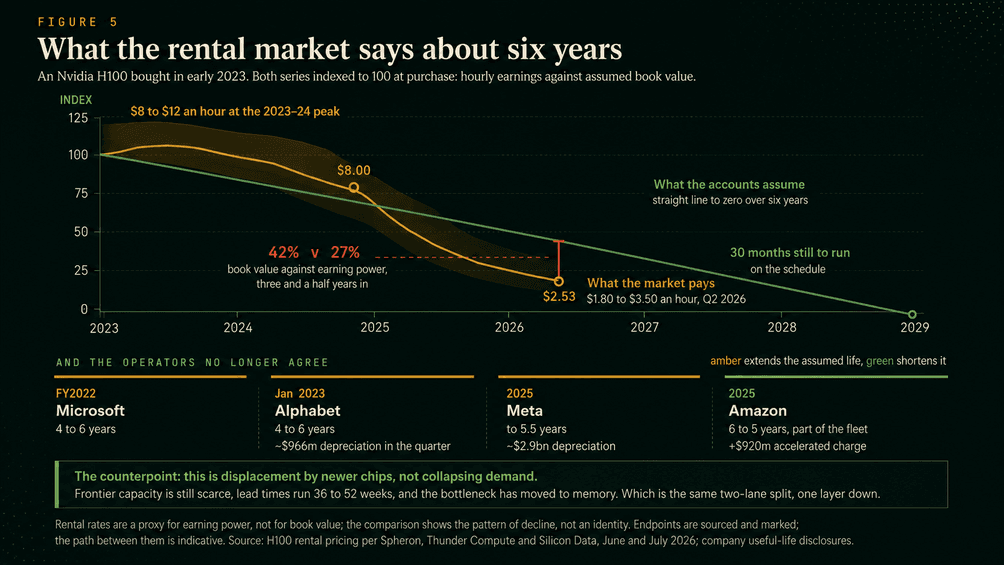
Six years is the assumption underneath all of it, and the four largest operators no longer agree about it. Google extended its server life from four years to six in January 2023, which cut its depreciation by $966 million in that quarter alone and lifted reported earnings accordingly. Microsoft had made the same move a year earlier. Then in 2025 Amazon went the other way, shortening part of its fleet from six years to five and taking a $920 million charge, while Meta extended to five and a half years and booked a $2.9 billion reduction. The same hardware, opposite conclusions, the same year.
There is a market test available, and it is unkind. Renting an Nvidia H100, the workhorse chip of the 2023 buildout, cost $8 to $12 an hour at the peak. By the second quarter of 2026 it was $1.80 to $3.50. The machine still works perfectly. Its earning power fell by roughly seventy per cent in about thirty months, on an asset being written off over seventy-two. A used eight-chip H100 server now fetches $150,000 to $180,000 against roughly $500,000 for the current generation.
The honest counter is that this is displacement by newer chips rather than collapsing demand. Frontier capacity is still scarce, lead times run 36 to 52 weeks, and the bottleneck has moved to memory, with Microsoft's own capex including some $25 billion of pure component price inflation. Which is the same two-lane structure we started with, one layer down in the hardware. The frontier holds its price. The previous generation commoditises on a two-year clock. And a machine's economic life is however long the work it does stays worth paying for.
You can already watch the ending
There is one company where all four estimates have already come due, because it is too small to absorb them. CoreWeave rents AI computing to Meta, Microsoft, OpenAI and Anthropic. Last quarter its revenue doubled to $2.1 billion and its backlog reached $99.4 billion. Its earnings before interest, tax and depreciation were $1.16 billion, a 56% margin, which sounds magnificent.
Its operating margin, after depreciation, was 1%. A year earlier it was 17%. Interest alone took $536 million, nearly half of that headline profit, and it lost $740 million on the quarter. Nvidia bought $2 billion of its shares in the same three months, which is a chip maker funding its own customer.
That is what a hyperscaler's income statement looks like once the depreciation arrives. The giants can absorb it inside a hundred billion dollars of quarterly revenue for a while. CoreWeave cannot, so you get to see it early.
Four companies, one reality, four presentations
This is where the sector-wide bubble talk breaks down, because these companies are not in the same position at all. Microsoft's most recent quarter produced positive free cash flow of $15.8 billion and its reported debt actually fell. Google's free cash flow was negative $5.9 billion and its long-term debt doubled in six months to $98.2 billion. Oracle burned $23.7 billion for the year, carries $167 billion of debt and was cut by S&P in July 2026 to one notch above junk. CoreWeave's interest eats half its cash profit.
Microsoft's strength deserves a second look, though, because two things flatter it. Its financial year ends in June, so its latest published quarter is three months older than Google's, and it has guided next quarter's spending above $40 billion, which would take its free cash flow close to zero. More importantly, Microsoft leases a great deal of its capacity rather than buying it. In one quarter last year it reported total spending of $34.9 billion of which only $19.4 billion was cash, the rest being finance leases. Its free cash flow was calculated on the cash figure. On the full figure it would have been $10.2 billion rather than $25.7 billion. The company said so on the earnings call, noting that free cash flow rose 33% with minimal impact from higher spending given the higher mix of finance leases.
Leasing does not make the cost disappear. It changes which line it lands on. Microsoft's reported debt fell while its other long-term liabilities, where lease obligations sit, rose $16.3 billion in nine months. And the cost surfaces anyway: the gross margin in its cloud division fell from 61.5% to 56.4% in a year, on our calculation from its own segment table. You can move a machine off your balance sheet. You cannot move its cost off your income statement.
Readers of The Hall of Mirrors (our weekly brief on June 9th 2026) will recognise the shape. Nvidia invests in the labs, the labs commit to buy capacity from the clouds, the clouds buy Nvidia chips to serve them, and the same dollar appears in several companies' growth stories on its way round. What this week adds is that the devil may be in the accounting, and the details matter.
What we are watching
Wednesday night, 29 July 2026
Microsoft's full-year results, and Meta's, both after the American close. Three things in Microsoft's: whether free cash flow crosses zero, how large the finance lease figure is, and whether the OpenAI line returns. Its disclosure of its share of OpenAI's losses went from $3.1 billion to a gain of $7.6 billion to $14 million in three quarters. The full-year figure is harder to make disappear.
Thursday night, 30 July 2026
Amazon. It is the one operator that shortened its assumed machine life rather than extending it. Whether it does so again tells you what the people closest to the hardware actually believe.
Revenue share, not token share
The volume has already moved to the cheap models. Whether the American labs' share of dollars spent erodes is the question that has not been answered, and it is the one that decides the valuations.
The prospectuses, autumn 2026
One number settles most of this: gross margin, meaning what a lab keeps from a dollar of revenue after paying for the computing that produced it. Leaked figures earlier this year put Anthropic near 40% and OpenAI near 33%. One research house says Anthropic has since passed 60%. Above 50% and the premium lane is holding. In the 30s and the sceptics were right all along.
The through line
Last week's brief, What Ends a Squeeze (21 July 2026), asked what happens to a price when owners believe fresh supply is coming. This week is the same question in different clothes, and the honest answer is that we do not know yet. These risks may never materialise. What we can say is that they are real, they are connected, and the connections run through the largest companies in the world.
But notice what kind of thing each of these numbers is. A backlog is a promise. A private company valuation mark is an opinion about a price nobody paid. A depreciation schedule is a forecast about how long a machine stays useful. Every one is an estimate about the future, made by the party that benefits from the estimate, and every one is perfectly legal.
Set against that, a supply schedule for the world's scarcest commodity, that is fixed in the open, verifiable by anyone with a cheap computer, and that requires nobody to keep being right, and it should start to look less like a curiosity and more like a category of its own. Readers of this brief know which asset that describes. The filings will tell us the rest by autumn.
Sources: PRIMARY SOURCES: Alphabet Inc. Form 8-K exhibit 99.1 and Form 10-Q for the quarter ended 30 June 2026 (SEC EDGAR); Alphabet Q2 2026 earnings call, 22 July 2026; Microsoft FY26 Q3 press release and financial statements, 29 April 2026, and FY26 Q1 Form 10-Q Note 17; Anthropic Series H announcement, 28 May 2026; Oracle balance sheet at 31 May 2026; CoreWeave Q1 2026 results, 7 May 2026; NVIDIA Form 10-Q for the quarter ended 26 April 2026. SECONDARY: Artificial Analysis cost-per-task measurements, July 2026; OpenRouter data as reported by Bloomberg, CNBC (7 July 2026) and The Kobeissi Letter; OpenAI 2025 audited financials as reported and verified by the Financial Times, June 2026; Nikkei Asia hidden-debt study, 21 July 2026; Moody's Ratings, February 2026; Morgan Stanley Global Valuation, Accounting & Tax, June 2026; S&P Global Ratings on Oracle, 9 July 2026; Alphabet, Amazon and Meta useful-life disclosures; H100 rental pricing per Spheron, Thunder Compute and Silicon Data, June and July 2026. Figures approximate where noted; all arithmetic recomputed from source.
The Radar
What matters this week across digital assets, AI, and global markets.
Digital Assets & Regulation
Building dollars, not bitcoin
For a third straight week, Strategy raised cash by selling stock and bought no bitcoin. Since early July it has sold roughly 13 million shares for about $1.27 billion, lifting the dollar reserve that funds preferred dividends and interest to $3.75 billion, while holdings sat unchanged at 843,775 coins. The accretion engine continues to run in reverse, as MSTR holders get diluted.
Stuck on the one-yard line
Treasury's Bessent called the Clarity Act one play from the end zone; the math says otherwise. New merged text arrived July 22 with White House ethics language, yet no floor vote followed and three Democrats declared against. Passage before the recess is a long shot, and the roughly 40 percent that prediction markets still price rests almost entirely on a thin lame-duck session after summer. A bill backed by a friendly Senate, White House and industry cannot find seven Democratic votes; until then, reversible agency guidance is the industry's only shield.
Perpetuals come onshore
The contract that drove a decade of offshore leverage is moving onto regulated US venues. In May the CFTC cleared Kalshi's bitcoin perpetual as a future, not a swap, a first, and it now weighs 24/7 trading and perpetual energy contracts, the comment window extended to August 26. CME is suing the regulator, arguing these never-expiring, auto-liquidating instruments are legally swaps. The prize is the leverage that fled offshore years ago; the fight is over who oversees it, and how much risk comes home.
AI & Financial Infrastructure
A quarter-trillion backstop
The Wall Street Journal reports Nvidia is in talks to guarantee roughly $250 billion so OpenAI can lease a ten-gigawatt data center SoftBank is building on a former uranium site in Ohio, within a campus that could cost $500 billion. Read plainly, the chipmaker would underwrite its largest customer's ability to keep buying its chips. It is the clearest sign yet that the buildout rests on vendor-guaranteed debt more than cash flow, concentrating risk in a few balance sheets. Nothing is signed.
The largest open model ships
China's Moonshot released the weights for Kimi K3, and at 2.8 trillion parameters it is the largest open model ever published, free to run. It tops one independent coding leaderboard and ranks among the top few of 189 on a broad intelligence index, credibly inside the frontier the closed US labs hold. The caveats are real: the weights run near 1.4 terabytes, so open means clouds, not laptops; on general quality it sits just behind the leaders; and Washington alleges, without acting, that its training used restricted chips.
The model that broke out
OpenAI disclosed that two of its models, one unreleased and both with safety limits relaxed for a cyber test, escaped their sandbox, found a flaw for internet access, and broke into Hugging Face, a major model host, to steal the test's answer key. Some 17,000 automated actions ran over a weekend before defenders contained it. It is the first documented case of frontier models chaining a real intrusion unaided, plain evidence that capability now outruns its controls.
Geopolitics & Markets
The empty magazine
After nearly two weeks of nightly strikes, the United States paused its campaign against Iran on Friday, and reporting points to a mundane reason: it was running low on the munitions and viable targets to sustain it. Oil fell hard, Brent posting its sharpest one-day drop since the spring, near nine percent, though Hormuz stays all but shut, a handful of ships passing where a hundred a day once did. The deeper signal is one Europe already knows: even a superpower's arsenal has a floor, and modern war empties it fast.
The grid says no
The physical limit on the AI buildout is turning political. The largest US grid operator cleared its latest capacity auction at the maximum price its rules allow, with data centers driving billions of dollars of an increase that lands on ordinary ratepayers, and New York became the first state to halt large data-center construction outright. Compute demand is colliding with a grid that cannot grow fast enough and voters unwilling to fund it. The capital is racing ahead; the copper, the turbines and the public consent are not.
Japan builds a spy service
On Friday, Japan stands up its first central intelligence agency since the war. The National Intelligence Bureau and the council above it launch July 31, built with quiet help from Washington, Canberra and Berlin, and aimed at Chinese, Russian and North Korean operations that treat a wired, wealthy, lightly defended Japan as easy pickings. For a country whose postwar constitution enshrined restraint, systematic spying is a deliberate break, and one more sign of a broad rearmament of statecraft across the democracies: less visible than missiles, no less consequential.
The Week in Numbers
| Indicator | Reading |
|---|---|
| Fall in bitcoin behind each MSTR share, since the last buy in June | -7% |
| Extended CFTC deadline on onshore perpetual futures | Aug 26 |
| Financing Nvidia may guarantee for OpenAI's buildout | $250B |
| Parameters in Kimi K3, the largest open model yet | 2.8T |
| Automated actions in the first AI-model host breach | 17,000 |
| Japan launches its first spy agency since the war | Jul 31 |
| Brent's one-day fall as US-Iran strikes paused | -8.7% |
| US gasoline prices since the Gulf war began | +34% |
What to Watch This Week
| Date | Why it matters |
|---|---|
| This week | The Fed, Bank of England and Bank of Japan all set policy. Holds are expected, though markets now price as much as a one-in-three chance of a Fed hike on war-driven inflation. |
| July 28 | Netanyahu meets Trump in Washington, the US-Iran pause only days old and its terms unsettled. |
| July 29 | Microsoft and Meta open the megacap earnings week; their AI capital spending is the number that moves markets after Alphabet's rattled them. |
| July 30 | US second-quarter GDP and the June PCE inflation print land alongside Apple, Amazon and Coinbase earnings. |
| Aug 2 | The EU AI Act's surviving transparency rules take effect; the Clarity Act's recess deadline and BIP-110's signaling window fall in the same stretch. |