August 18, 2026 Weekly Market Brief

Glenn Cameron, CFA · Global Head of Onramp Institutional
Free. Every week. Institutional insights, connected.
The Clarity Act would finally name a referee for the roughly $680 billion of digital assets whose legal nature is still unsettled, and it commands majorities in both chambers. It left for the summer recess without a vote, and the prediction markets had the collapse priced weeks before the Senate walked out. The obstacle is not market structure but a government-ethics division stapled to it, and what bitcoin holders stand to gain is a federal referee for the exchanges plus a statute that outlives a change of administration.
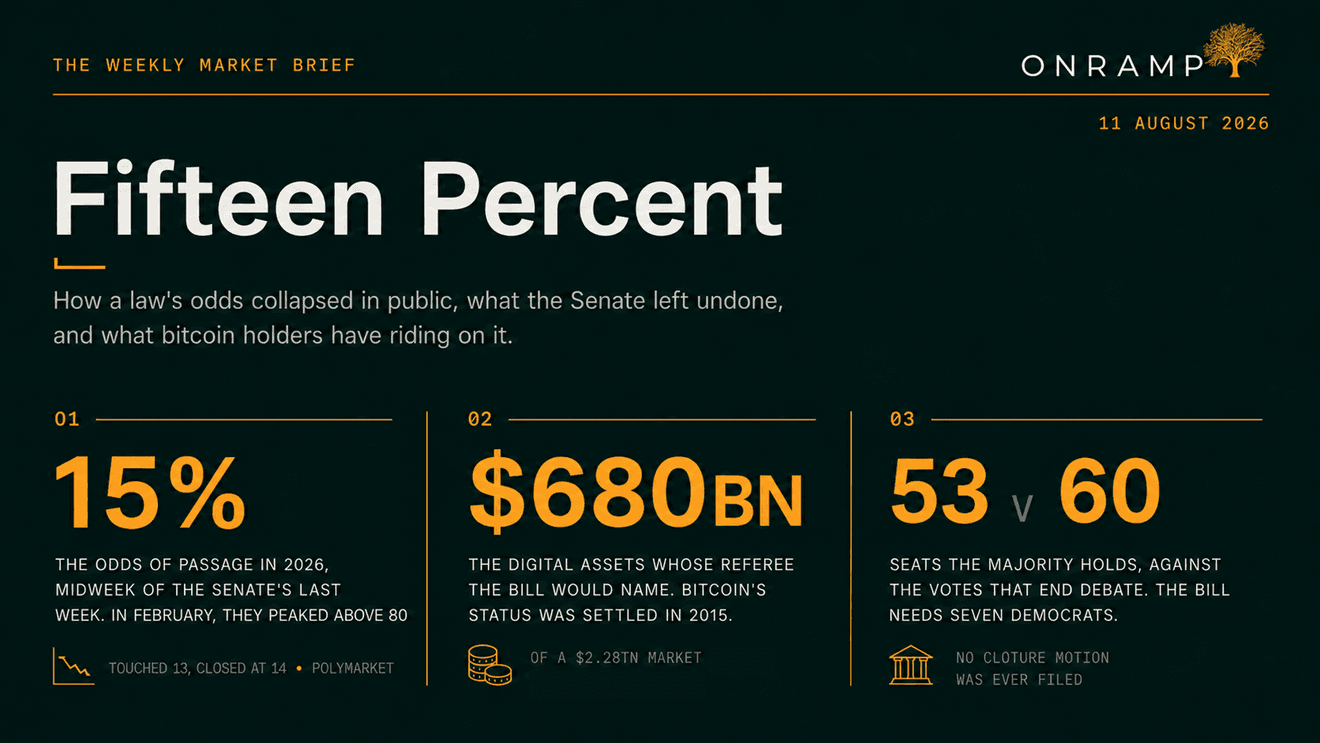
For a decade, American regulators have argued over one question: is a digital asset a security or a commodity? This year Congress finally wrote a law to answer it, the Clarity Act. On a betting market where anyone can wager on whether it passes in 2026, the odds peaked above 80 percent in February. By the middle of the Senate's last working week they were 15, and the week ended with no vote at all. This brief is about why the number collapsed long before the chamber left, and about the two things a bitcoin holder has riding on it: who may buy the asset next, and what else gets its label.
Where the 15 percent comes from
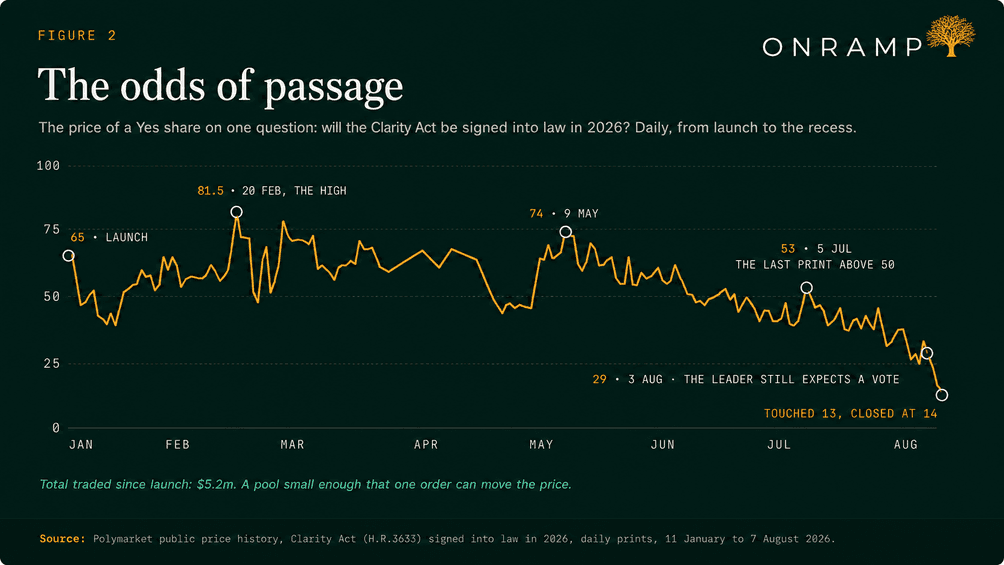
On Polymarket, a prediction exchange, a contract asks one question: will the Clarity Act be signed into law in 2026? A Yes share pays out if it does and nothing if it does not, so the price is a probability. In the middle of the Senate's last week before the recess it traded at 15 percent, and it ended the week at 14. The pool behind it is small, about five million dollars traded since the contract opened in January, so one large order can move the price and the odds are informed opinion, no more.
The contract opened in January at 65 and peaked above 80 in late February, when the bill's momentum looked real. It was still at 74 in early May, in the run-up to the committee vote, drifted to a coin flip by late June as the ethics objections hardened, and printed above 50 for the last time in the first week of July. August opened near 30. By Wednesday 5 August, with four working days left, the price was 15, and it touched 13, the lowest since launch. The close at 14 before the Senate's summer recess only confirmed it: the move that mattered had happened in July.
At longer horizons the picture changes. Kalshi, a second prediction exchange, prices market-structure legislation at 34 percent to become law by July 2027, 41 percent by October 2027 and 45 percent by the start of 2028.
A law's chance of passing used to be something you asked lobbyists about. Now it trades by the minute, in public, with money on it.
Security or commodity
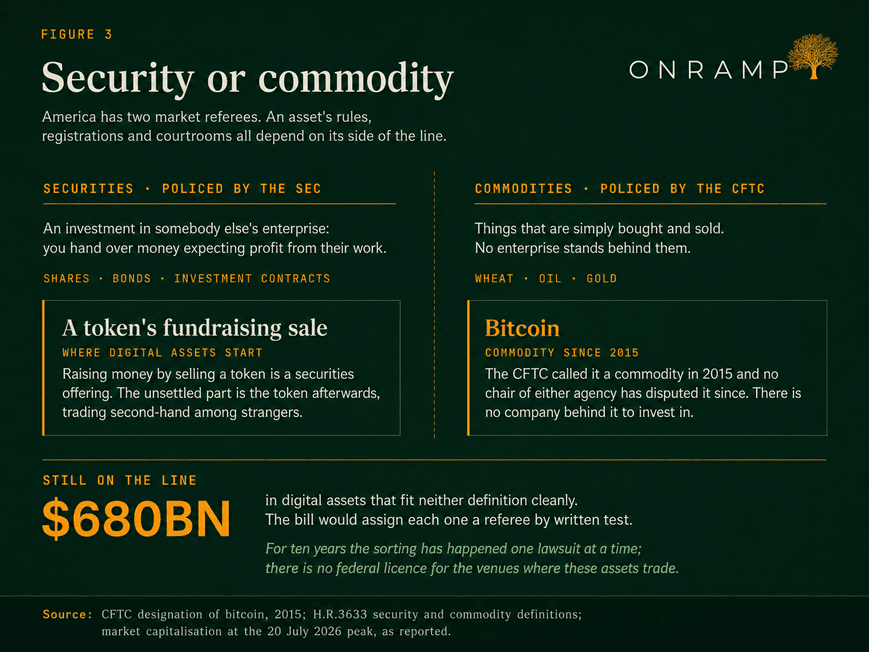
American markets have two main referees. The Securities and Exchange Commission polices securities, which are, roughly, investments in somebody else's enterprise: you hand over money expecting profit from their work. The Commodity Futures Trading Commission polices commodities, things that are simply bought and sold, like wheat or oil or gold. Every rule, every registration, every court you can be dragged into depends on which side of that line an asset sits.
Digital assets never fitted cleanly on either side, and for ten years the answer has come the worst way possible: one lawsuit at a time. Companies structured products around litigation rather than rules. Only one major asset escaped the argument entirely. Bitcoin was declared a commodity by the CFTC in 2015, and no chair of either agency has disputed it since, because there is no company behind it whose efforts you are investing in. The fight was always about everything else, and everything else is worth about 680 billion dollars.
What the law would do
Today, when a company raises money by selling a token, that sale is almost certainly a securities offering; the law is clear on that much. The unsettled question is what the token is afterwards, trading second-hand on an exchange between people who never dealt with the company. That is where most of the money trades, and it stays unresolved until somebody sues, because there is no federal licence a trading venue could apply for even if it wanted one.
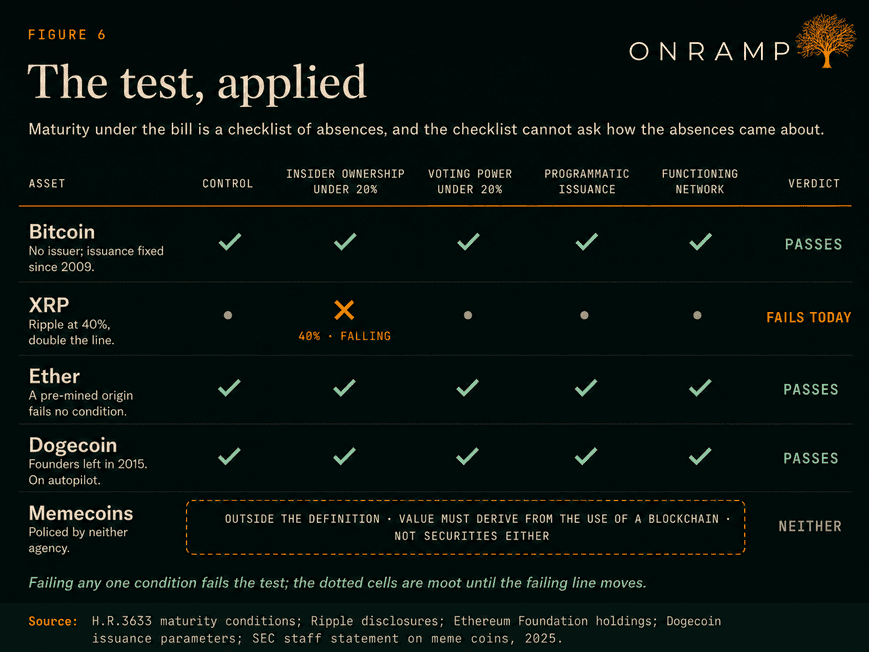
The bill replaces the lawsuits with a written test, and the test measures control. No person or group under common control may run the blockchain or its asset. No one may hold unilateral power to change the system's rules. No insider group may own 20 percent of the outstanding units, or direct 20 percent of the voting power where on-chain governance exists. New units must be created by the system's programmed rules, and the network has to actually function. A system that clears all of this is what the statute calls a mature blockchain system. Its asset becomes a digital commodity, refereed by the CFTC, and the venues that trade it register federally, one licence in place of fifty state ones, with custody, surveillance and capital rules on deadlines. An asset that fails any condition is treated as an investment, refereed by the SEC, with duties to disclose, and putting it on a blockchain changes nothing.
Two mechanics matter. The law separates the asset from the deal it was sold under: the original fundraising can stay a securities offering while the token becomes a commodity once the system matures. And maturity is claimed rather than awarded: a project files a certification with the SEC, which then has 60 days, under the House-passed text, to object with a written analysis. If it does not, the certification as a commodity stands.
The bill passed the House on 17 July 2025 by 294 votes to 134, with 78 Democrats in favour, cleared the Senate Banking Committee 15 to 9 in May, and a merged 616-page Senate text arrived on 22 July. The substance commands majorities in both chambers. The 15 percent needs another explanation.
Why it is stuck
The explanation is ethics. The merged text contains a six-section division of government-ethics rules, enforced by the Department of Justice, which expires on 20 January 2029, the final day of the current presidential term. A Senate Banking Committee minority staff analysis objected that the bill preserves ways for the President to keep profiting from his family's digital-asset ventures, after disclosures showed roughly 1.4 billion dollars of 2025 earnings tied to them. Senators Tillis and Gallego sent a revised ethics compromise to the White House before the recess; the White House has not endorsed it. The Treasury Secretary has demanded the Senate act now. The administration wants the market rules and is resisting the ethics rules, and the two arrive stapled together. The ethics division is the reason seven Democratic votes are hard to find, and seven is the entire question: the majority holds 53 seats, and ending debate requires 60.
The final week
The Majority Leader said on 3 August that he still expected a floor vote before the recess. It never came. He filed no cloture motion, the step that starts the clock on a Senate vote, and late on Thursday 6 August he confirmed there would be none before the break. The chamber's last scheduled day was Monday 10 August; the bill was still on the calendar when it left, and the Senate does not return until 14 September. The prediction markets had it priced by midweek. Kalshi ran a contract on whether the Senate would vote before the recess, and on Wednesday morning it traded at 34 percent: the Leader's promised vote, at one chance in three, two days after he promised it.
A vote held and lost would at least have put every undecided senator on the record. Leaving without one kept every name off the record, which for many of them may have been the point, with funding fights and an election ahead.
What hangs on it
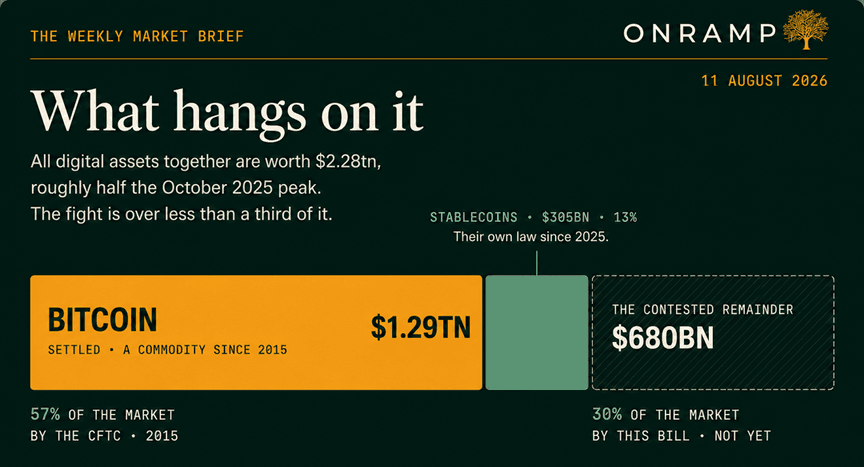
As the Senate left for the summer, all digital assets together were worth about 2.3 trillion dollars, roughly half their October 2025 peak. Bitcoin was 1.3 trillion of that, its legal nature settled a decade ago. Stablecoins, another 305 billion, got their own law in 2025. The contested remainder, the assets whose referee this bill would name, is about 680 billion dollars, held by people who have waited ten years to learn which rules protect them.
What bitcoin holders gain
Bitcoin holders could be forgiven for sitting this one out: their asset's status is settled, and the fight is about everything else. But passage would put two concrete things on their side of the ledger.
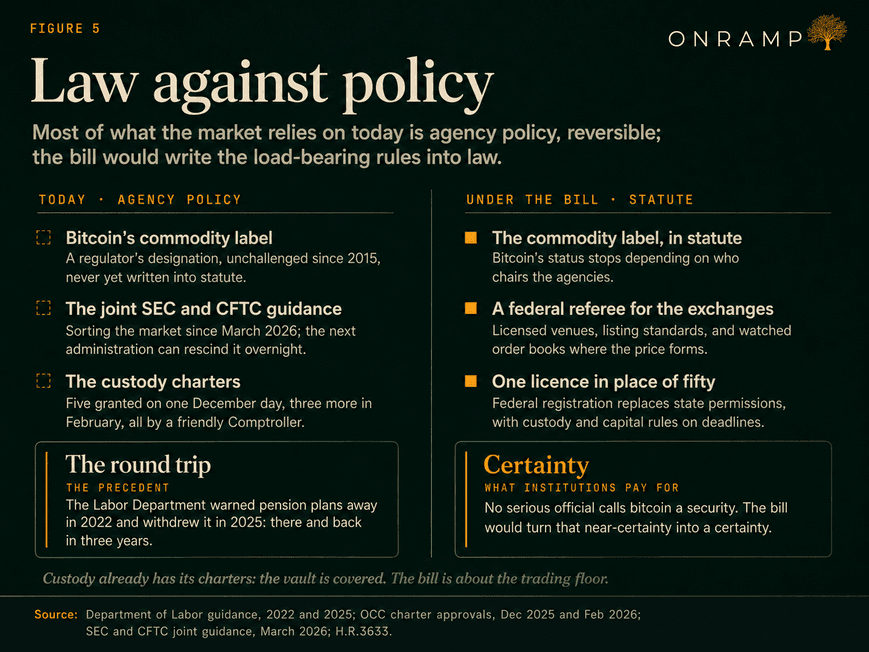
The first is a referee for the venues. The largest pools of money act on checklists: regulated custody, a licensed venue, market surveillance. Custody has been solving itself: Anchorage Digital held the industry's only federal trust charter for four years, then the Comptroller of the Currency approved five more on a single day in December 2025 and three more in February, with Morgan Stanley and Schwab now in the queue. The ETFs solved brokerage access in January 2024, and BlackRock's alone now holds about 45 billion dollars. What nothing yet supplies is the last item: nobody licenses the exchanges where the price forms, sets their listing standards, or watches their order books the way an exchange regulator watches a stock market. The custody charters cover the vault; the bill covers the trading floor. This brief makes no price forecast. The record simply shows that each time permission widens, new buyers arrive, and prices are set by whoever is allowed to bid.
The second is permanence. Bitcoin's commodity status is still custom rather than law, and policy can flip: the Labor Department warned pension plans away from digital assets in 2022 and withdrew the warning in 2025, the charters are the work of a friendly administration, and the joint SEC and CFTC guidance that has been sorting the market since March 2026 can be rescinded by the next administration overnight. A statute survives elections. No serious official argues bitcoin is a security, because there is no enterprise to point to; however a statute would turn a near-certainty into a certainty, and institutions pay for certainty.
The test, applied
The same statute that would settle bitcoin's status for good also extends the commodity label to thousands of assets that began life as somebody's project. At first glance that looks like a legal contortion, but it rests on the oldest idea in American securities law: the law has never classified things; it classifies how they were sold. In the 1946 case that created the test, the oranges were never securities; the investment deal wrapped around them was. A court took the same view of Ripple's token in 2023: selling it to investors on promises was a securities offering, while the same token changing hands between strangers on an exchange was not. The bill is built on that distinction. The people who launch a token stay answerable for how they raised the money. The token itself, trading second-hand among strangers, can graduate once no one is in charge of it.
Bitcoin meets every condition without argument: no issuer, no foundation treasury, no governance vote, and an issuance schedule unchanged since 2009. That is no surprise, because bitcoin is the asset the drafters had in front of them when they wrote the conditions.
XRP fails today. Between a scheduled escrow of about 38 billion units and its own wallets, Ripple still holds roughly 40 percent of the supply, double the statute's insider line, so the asset stays on the securities side for now. In practice the failure is a countdown. The escrow opens up to a billion XRP each month; Ripple sells a slice, relocks the rest, and has run that routine for years, which is why the share sits at 40 percent and falling. Every further sale brings it closer to the 20 percent line, and once below it, with the control conditions also met, the asset can certify as a commodity. The sales that made the founders billionaires are also the sales that qualify the token, and whatever the company keeps, anything up to 19.9 percent, is worth more the day the commodity label arrives, an upgrade its own selling creates.
Ether passes, because the test looks only at the present. Roughly 72 million coins were created and allocated before the network produced a single block, around 12 million of them going to its foundation and early contributors. But the foundation today holds a fraction of one percent, no client team or staking operator holds unilateral power over the rules, and issuance follows the protocol. The origin is real, documented, and irrelevant to every condition on the list.
Dogecoin also passes. It was created in December 2013 as a joke about speculative currencies. Its two founders left by 2015, and one has said he sold his entire holding that year for roughly the price of a used Honda. Because they left, no person controls the system. Because the code fixes issuance at ten thousand coins per block indefinitely, issuance is programmatic. Because nobody kept a treasury, no insider approaches 20 percent. For long stretches its software went essentially unmaintained, and under these conditions that history counts in its favour. On the drafted definition, Dogecoin is as mature as bitcoin.
The same reasoning runs down the long tail. Thousands of chains have founders who moved on and communities that thinned out years ago; nobody controls them, and their issuance runs on autopilot. The Clarity Act's commodity definition cannot distinguish an asset nobody controls because it outgrew control from an asset nobody controls because everyone gave up on it.
There is a gap at the other end. The statute requires a digital commodity's value to derive from the use and functioning of a blockchain. It is hard to argue with a straight face that a memecoin's value derives from the use and functioning of anything, and the SEC's staff position since early 2025 has been that memecoins are generally not securities either. If both of those hold, memecoins land in neither category, policed by neither agency.
How much of this applies to a particular token is also decided by the certification mechanism. A project files; the burden shifts to the SEC to disprove maturity within 60 days, project by project, with a written analysis each time. Against thousands of filings, an agency with finite staff will let most stand. As drafted, nearly everything old enough and ownerless enough becomes a commodity by default.
Is the definition a good one?
Wheat, oil and gold are commodities because no one issues them; there was never a company to step back, so the question of control has no meaning. The Act works from a different premise: it takes assets that were issued by somebody and grants the commodity label once that somebody has stepped far enough back, with the 20 percent lines marking how far is far enough.
The case for the approach is practical. Regulators need a rule they can administer, percentages can be measured, and a decade of settling these questions through lawsuits has been good for nobody except the lawyers. If the category has to admit more than one asset, a written test beats an agency's mood.
The case against it is that whoever stepped back can step back in. Ethereum's rules have moved every time its core group has proposed moving them: issuance was cut repeatedly, the consensus mechanism was replaced outright, and in 2016 the chain hard-forked to claw back funds from a hacker after its leadership backed that outcome. The one organised dissent in a decade produced a minority chain worth a fraction of the original. Nobody controls the network alone, which is what the statute asks. A cohesive group sets the agenda and has carried every change it has shipped, which the statute never asks about. Bitcoin's fixed supply is believed for one reason: fifteen years in which nobody has been able to change it, including the people who maintain its software. An asset whose rules change based on the leadership's preferences makes a different promise, and after enactment the same word (commodity) will describe both.
The test also never looks at what the asset pays. Staked ether pays its holders more ether, minted by the protocol, and holders who do not stake watch their share of the total supply shrink: that is the return profile of a capital asset, whatever the legal form. Gold pays nothing, and wheat does not pay wheat. The SEC spent years circling exactly this point, shutting down Kraken's staking service in 2023, before the posture changed in 2025. The bill settles the question without ever examining it: an asset that pays a yield to its holders and an asset that pays nothing at all will carry the same statutory "commodity" word.
Until the bill passes, bitcoin remains the only major asset whose commodity status is settled, the other 680 billion dollars stays unclassified, and the exchanges still have no federal referee.
What we are watching
The odds through the recess.
The Polymarket contract runs to 1 January 2027 and Kalshi's horizons stretch to January 2028; together they are the cleanest running indicator of whether the September window is alive.
September 2026.
The Senate returns on 14 September to a calendar crowded with funding deadlines and an election. Whether the ethics compromise at the White House gets an answer over the recess is the best early signal.
The maturity conditions in the merged text.
The 616-page draft can still tighten or loosen the 20 percent lines and the commodity certification clock. Those details, more than the vote count, decide which digital assets graduate from security to commodity.
The through line
The law that stalled last week would decide the legal nature of about 680 billion dollars of digital assets. The other 1.29 trillion never needed the ruling. Bitcoin's status was settled in 2015 and has survived every change of chair, party and fashion since. No statute protects it; its definition does not depend on anyone's enterprise, so it was never Washington's to give or withdraw. A market just spent seven months handicapping whether Congress can define the rest of the digital asset market. Nobody has ever needed a definition for bitcoin, because it was never Congress's to decide.
SOURCES: Polymarket contract on Clarity Act (H.R.3633) passage in 2026, about $5.2 million traded, with daily prices 11 January to 7 August 2026 from Polymarket's public price history; Kalshi markets on the act (Senate vote before the recess, about $410,000 traded; market-structure law by July 2027, October 2027 and January 2028, more than $5.4 million traded), odds and volumes as of Friday 7 August 2026; the Senate Majority Leader's statements of 3 August and 6 August 2026, as reported; House roll call of 17 July 2025 and Senate Banking Committee vote of 14 May 2026; merged Senate text of 22 July 2026, as reported; House-passed text of H.R.3633 (mature blockchain system and digital commodity definitions) and CRS overview IN12583; Senate Banking Committee minority staff analysis and related disclosures, as reported; SEC and CFTC joint guidance of 17 March 2026, as reported; SEC staff statement on meme coins, February 2025; the 2023 Kraken staking settlement and the 2025 SEC staff statement on protocol staking, as reported; Ethereum issuance and hard-fork history as publicly documented; OCC trust charter approvals of December 2025 and February 2026, per agency releases; Department of Labor 2022 guidance and 2025 rescission; Ripple escrow holdings per company quarterly disclosures; Ethereum genesis allocation and Dogecoin issuance parameters as publicly documented; the 2023 federal ruling in the Ripple case, as reported; market capitalisation figures as of the 20 July 2026 peak, as reported; CoinDesk, Decrypt, CryptoSlate, CryptoBriefing and Cryptonews reporting, July to August 2026. All arithmetic recomputed from source.