September 8, 2026 Weekly Market Brief

Glenn Cameron, CFA · Global Head of Onramp Institutional
Free. Every week. Institutional insights, connected.
Two weeks after the Treasury promised to buy its own long bonds, the effect is gone and the selling has gone global. Japan, Germany, France, Britain and the United States all sold off on the same days, and every date those yields last touched falls before the year that country's central bank became the largest buyer of its own government's bonds. Behind it is a supply problem no ceasefire fixes: the OECD expects $29 trillion of bond issuance in 2026, about 78 percent of the government share simply refinancing old debt, into a buyer base that now cares what it is paid.
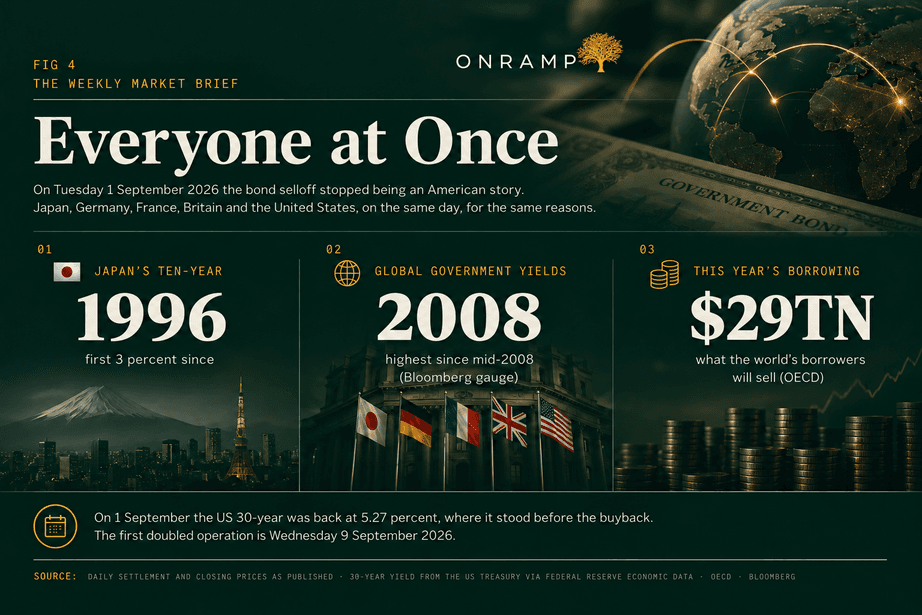
On Tuesday 1 September 2026 the bond selloff stopped being an American story. Japan's ten-year yield touched 3 percent for the first time since 1996. Germany's reached a level last seen in 2011, France's and Britain's levels last seen in 2008. And the 30-year Treasury climbed back to 5.27 percent, the level it stood at moments before the Treasury Secretary announced he would buy it.
The two days that held
Two weeks ago this brief described how the United States Treasury, facing its highest long-term borrowing cost since 2007, announced it would double its purchases of its own long bonds (The Bond Salesman, 25 August 2026). The announcement worked for two trading days. The 30-year yield fell from 5.34 percent on Tuesday 18 August to 5.196 percent on Wednesday 19 August. By Tuesday 1 September it was back at 5.27 percent, the level it stood at moments before Scott Bessent announced the move. The ten-year was at about 4.8 percent by Wednesday 2 September, its highest since early 2025 and roughly ten basis points above where it stood on announcement day. A basis point is one hundredth of a percentage point. The selling eased into the weekend: the 30-year closed at 5.25 percent on Thursday 3 September and the ten-year ended the week near 4.76 percent.
That is the American half of the story, and on its own it would be a footnote to the earlier brief. What changed last week is that the same thing happened everywhere, on the same days, for the same reasons.
The Map
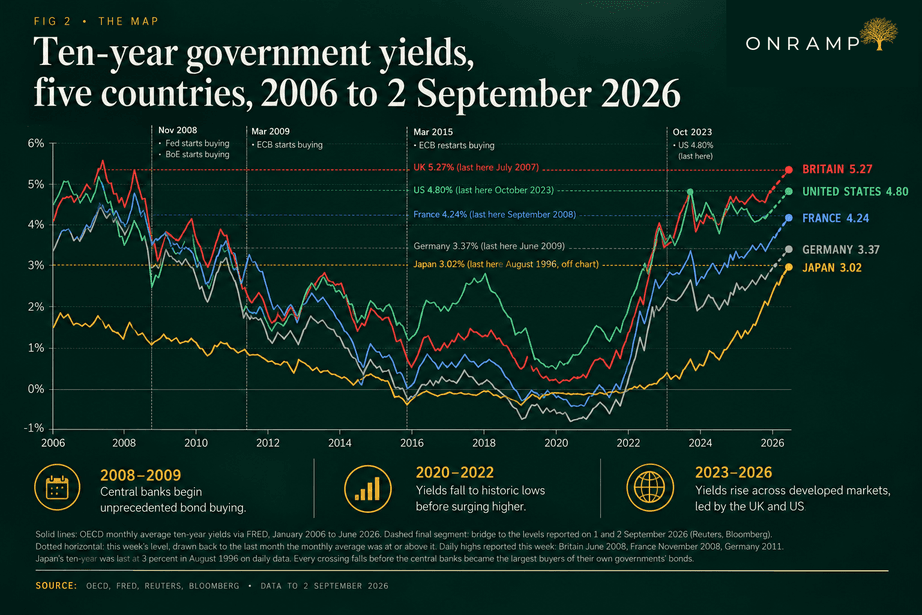
Japan. The ten-year government bond yield reached 3 percent on Tuesday 1 September 2026 for the first time since September 1996, and 3.02 percent the following day. The 30-year closed at a record 4.18 percent. The Japanese government assumed a 3 percent long-term rate when it calculated the cost of servicing its debt in this year's budget, so on that day the market reached the number the budget was built on. Japan's debt is above 200 percent of what its economy produces in a year. Debt service is estimated at more than a quarter of government spending this fiscal year. The yen passed 160 to the dollar. A well-received sale of 30-year bonds on Thursday 3 September pulled the ten-year back to about 2.9 percent by the end of the week, where it stood on Monday 7 September, and the yen recovered to about 157. A rate rise from the Bank of Japan this month remains priced as likely.
Germany. The ten-year Bund yield reached 3.35 percent on Tuesday and 3.37 percent on Wednesday, its highest since 2011. The 30-year passed 3.84 percent, also a 2011 high. Germany is the one member of the G7 whose debt is below 100 percent of national output. It sold off with everyone else.
France. The ten-year yield reached 4.21 percent on Tuesday and 4.24 percent on Wednesday, levels last seen in November 2008, in the middle of the financial crisis. It is higher than Italy's. French debt is projected at 118 percent of output this year and the deficit at 5.2 percent, with a presidential election due in 2027.
Britain. The ten-year gilt reached 5.268 percent on Wednesday 2 September 2026, its highest since June 2008, and the 30-year is near 5.9 percent, its highest since 1998. In September 2022 the 30-year rose from 3.38 percent to nearly 5 percent in a few weeks after an unfunded budget, pension funds were forced into emergency sales, and the Bank of England had to buy bonds to stop it. Today's 30-year is about 90 basis points above that 2022 peak, and nobody has needed rescuing. The ten-year ended the week at 5.14 percent and opened Monday 7 September a little higher. The new Prime Minister, Andy Burnham, and his Chancellor, John Healey, present their first budget on 28 October 2026. Money markets put a Bank of England rate rise in November 2026 at about 70 percent.
The United States. The 30-year at 5.27 percent on Tuesday and the ten-year at about 4.8 percent on Wednesday, as above. The market's odds of a Federal Reserve rate rise on 16 September, which stood at about 35 percent before Chair Kevin Warsh spoke at Jackson Hole on Friday 28 August, were at about 66 percent by Tuesday 1 September. They fell to about 50 percent on Thursday 3 September after Governor Christopher Waller said he would support leaving rates unchanged if inflation kept easing, and stood at about 52 percent on Friday 4 September after August payrolls came in at 162,000 against a forecast of 53,000.
Bloomberg's gauge of government bond yields across the world rose to 3.72 percent on Monday 31 August, its highest since the middle of 2008.
Read the dates together: 1996, 2011, 2008, 2008, 2007. Every one falls before each country's central bank became the largest buyer of its own government's bonds: the Bank of Japan in 2001, the Federal Reserve in 2008, the Bank of England in 2009, the European Central Bank in 2015. The world's long-term borrowing costs are back where they were before the buying started.
Three reasons, one of which does not go away
Oil is the first. On Sunday 30 August American forces struck two Iranian rocket launchers on Larak Island in the Strait of Hormuz, the first known American strike on Iran since late July; Brent crude went back above $90 on Monday 31 August. Eurozone inflation for August 2026 came in above 3 percent, with energy prices 14.3 percent higher than a year earlier.
Central banks are the second. Warsh said at Jackson Hole that the Fed still has "work to do" on inflation. Fed governor Michael Barr said on Tuesday 1 September that the central bank should be prepared to raise rates if inflation fails to subside; Waller pulled the other way two days later. Markets price a European Central Bank rise this month, a Bank of Japan rise this month, a Bank of England rise in November 2026. In every country on the map, the central bank is either expected to raise its short-term rate, or openly debating it, into a bond market that is already falling.
Supply is the third, and it is the one a ceasefire does not fix.
The supply
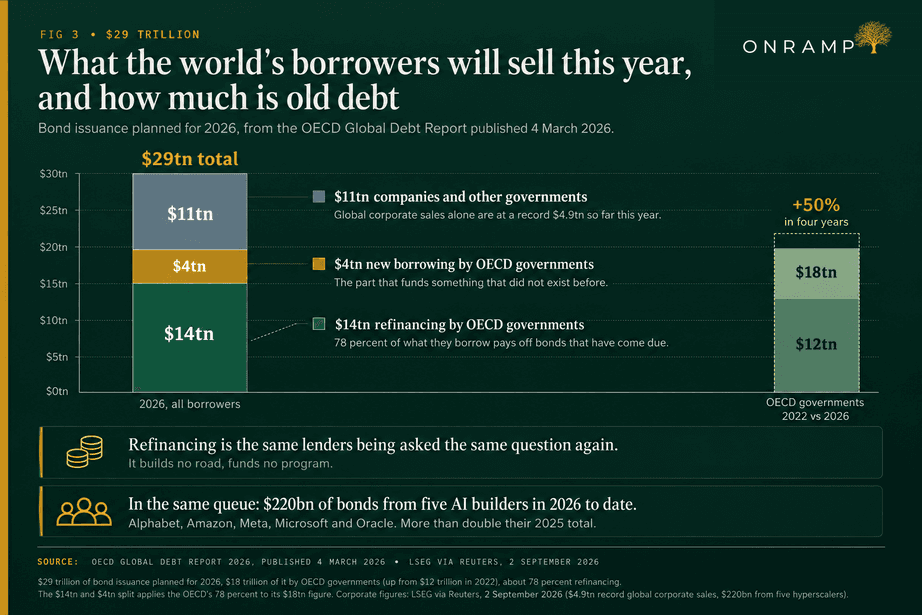
In March 2026 the OECD published its Global Debt Report. Governments and companies, it said, are set to borrow $29 trillion from bond markets in 2026. That is $4 trillion, or 17 percent, more than in 2024, and double the amount of ten years ago. Governments in the OECD's member countries will account for about $18 trillion of it, up from $12 trillion in 2022.
About 78 percent of what OECD governments borrow this year will go to refinancing. Refinancing means paying off an old bond that has come due by selling a new one. It builds no road and funds no program. It is the same money being asked for again, from the same lenders, at whatever price those lenders now demand.
Companies are in the same queue. Global corporate bond sales reached a record $4.9 trillion so far this year, 14 percent ahead of 2025, according to LSEG figures reported by Reuters. Five of the largest AI builders, Alphabet, Amazon, Meta, Microsoft and Oracle, have sold $220 billion of debt in 2026 already, more than double last year's full-year total. The OECD wrote, in March 2026, that this AI financing "will increasingly be supplied by a more price-sensitive investor base."
Put those numbers beside the map. Every borrower on it is selling bonds to the same lenders at the same time. When Japan asks for more, the lender to Britain notices what Japan is paying. No country's auction happens in private any more.
Who is on the other side
The OECD report has a phrase for what has changed on the buying side: a "structural decline in long term demand." It explains what it means. Central banks have reduced their bond holdings. The traditional long-term buyers now operate alongside shorter-term investors, sometimes with significant leverage.
A price-sensitive buyer is one who will lend only at a rate he thinks fair, and who will sell if he changes his mind. For fifteen years the largest buyers of government bonds were not like that. Central banks bought at any price, because buying was the policy. British pension funds bought because their rules required it. Japanese savers bought because there was nowhere else to go. Those buyers did not set the price. They accepted it.
They are leaving. The Fed is running down its holdings, the Bank of England is selling gilts back into the market, the Bank of Japan is buying less each quarter, and the European Central Bank's balance sheet is shrinking. What remains is the buyer who cares what he is paid. The Bond Salesman (25 August 2026) described the Treasury's buyback as the borrower stepping in as its own buyer. Seen from here, it is an attempt to put one price-insensitive buyer back into a market that has lost most of the others, one $4 billion operation at a time.
The same move, everywhere
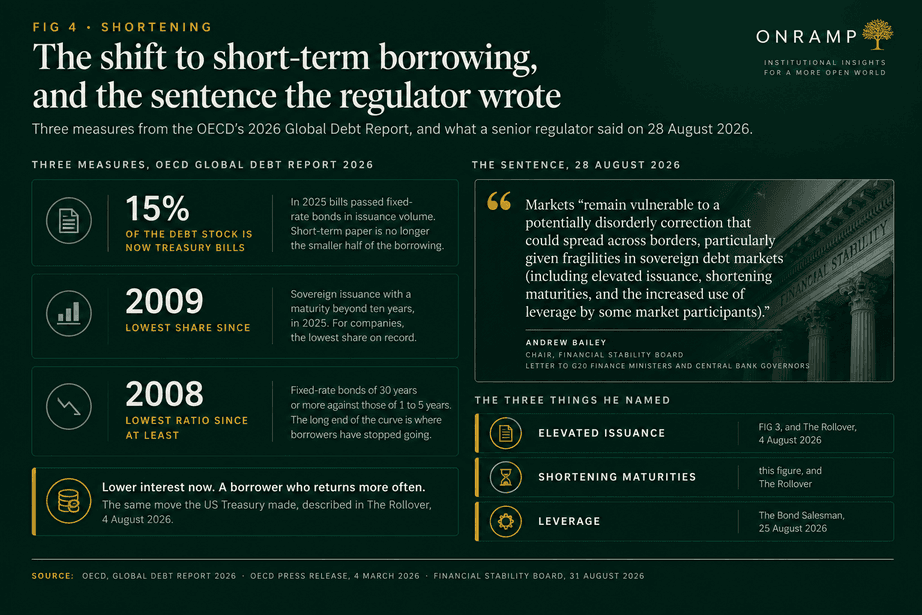
The Rollover (4 August 2026) described how the United States Treasury had shifted its borrowing toward short-term bills to avoid paying today's long-term rates, and what that does to the frequency with which the government must return to the market. It turns out to be the global move, not the American one. The OECD reports that sovereign and corporate borrowers everywhere have responded to higher long-term costs by shifting issuance toward shorter maturities. Short-term paper now accounts for close to half of what OECD governments borrow. Lower interest now, and a borrower who must come back to the market more often.
On 28 August 2026, Andrew Bailey wrote to the finance ministers and central bank governors of the G20 ahead of their meeting in Asheville, North Carolina, on 31 August and 1 September. Bailey is the Governor of the Bank of England and chairs the Financial Stability Board, the body set up after 2008 to watch the world's financial system for the next crisis. His letter said that markets "remain vulnerable to a potentially disorderly correction that could spread across borders, particularly given fragilities in sovereign debt markets (including elevated issuance, shortening maturities, and the increased use of leverage by some market participants)."
That is one sentence, and it names the three things these briefs have described since July 2026: too much borrowing, too much of it short, and too much of it bought with borrowed money. On the Tuesday the ministers met, the correction he warned about began, in every major bond market at the same time. It is not disorderly yet. He did not say when.
The second letter
Bailey's was not the only letter. On 1 September 2026, the day the selloff went global, Ida Wolden Bache, the Governor of Norway's central bank, and Nicolai Tangen, the chief executive of the country's sovereign wealth fund, wrote to Norway's finance ministry about how the fund should hold bonds. The fund manages $2.3 trillion and held about $215 billion of Treasuries at the end of June 2026. It was published on 2 September and reported by Reuters on 4 September.
The recommendation is to cut the share of government bonds in the fund's bond benchmark from 70 percent to 50 percent, and to weight what remains by the size of each country's bond market instead of the size of its economy. The stated reason for the second change is worth reading twice: "high government debt is now a general feature of developed economies rather than a distinctive feature of a few countries." The economy-based weighting was introduced in 2012 to tilt the fund away from Japan and southern Europe. The fund's view now is that there is nowhere left to tilt to.
On Reuters' arithmetic, Treasuries would fall from 34.1 percent of the index to 21.9 percent, a cut of nearly $80 billion. Euro-area government bonds fall too. Japan rises from 4.6 percent to 7.4 percent. Britain is unchanged. The money goes into American mortgage bonds and corporate bonds, so the fund's dollar weight barely moves, from 52.9 percent to 52.5 percent. It is not leaving the dollar. It is leaving the government.
Two other sentences belong here. The fund writes that central banks' large purchases and the safe-haven role of government bonds "may affect pricing in ways that deviate from what fundamentals would imply," and that mispricing "related to buyers that are not price-sensitive" can be captured by active management. That is the largest fund in the world saying it intends to trade against the buyers described two sections above. And on why bonds are held at all: "one might expect government bonds to not have the same volatility-dampening effects in a government bond crisis."
None of this happens quickly. The ministry replies, an expert group reports by 25 January 2027, parliament holds a hearing, and any change is made gradually. The size is not the point. The most patient lender in the world has looked at the same map and decided to hold less of what is on it.
The buyback, two weeks on
This is why the Treasury's answer held for two days. It was a domestic answer to a global problem. The Treasury can buy Treasuries, with borrowed money or with the cash in its own account. It cannot buy Japanese government bonds. It cannot make a Japanese life insurer prefer 5.27 percent in dollars, with currency risk, over 4.18 percent at home with none. For thirty years a great deal of Japan's savings was lent to Washington because a Japanese bond paid almost nothing. When a Japanese ten-year pays 3 percent, some of that money has a reason to stay home. That is logic rather than data, because official figures on foreign holdings arrive months late, but the thinning of foreign official buyers in Treasuries has been reported for some time.
The first of the doubled operations takes place on Wednesday 9 September 2026, the day after this brief is published. It will buy at least $4 billion of long-dated Treasuries. On the OECD's figures, the world's governments will sell about $18 trillion of bonds this year, which is roughly $70 billion for every trading day. The operation on Wednesday will absorb, in one afternoon, about one eighteenth of what the world's governments sell on an average day. The reduction Norway's fund has proposed is about nineteen such operations.
None of this makes the buyback pointless. It changes what it is: not a fix for the price of long-term money, but a statement that the Treasury will show up. Last week the market weighed that statement against the world and priced it at about seven basis points.
Nowhere inside the system to go
When one country's bonds fall, money moves to another country's bonds. That is what happened in 2022: money left gilts for Treasuries and Bunds, and the damage stayed in London. Last week there was nowhere inside the system to go. The escape from British bonds was German bonds, which were falling; from those, Treasuries, which were falling; from those, Japanese bonds, which were falling fastest of all. The dollar rose to a two-week high because American rates rose with a central bank talking about raising them further. That is the ordinary reason a currency rises, not a vote of confidence in the borrower.
Two things sit outside the system: gold and bitcoin. Both fell last week, and this brief does not pretend otherwise. Gold dropped almost 6 percent over three sessions to a two-week low near $4,330 an ounce, after rising about 10 percent in August 2026. Bitcoin, which had touched about $81,000 at the start of the week, was near $76,500 by Wednesday 2 September, still about 20 percent above where it stood before the buyback was announced. The reason is the plain one. When a lender can earn 5 percent from a government, holding something that pays nothing costs more than it did. That is true of gold and bitcoin equally. A rate shock is a rate shock.
What is different
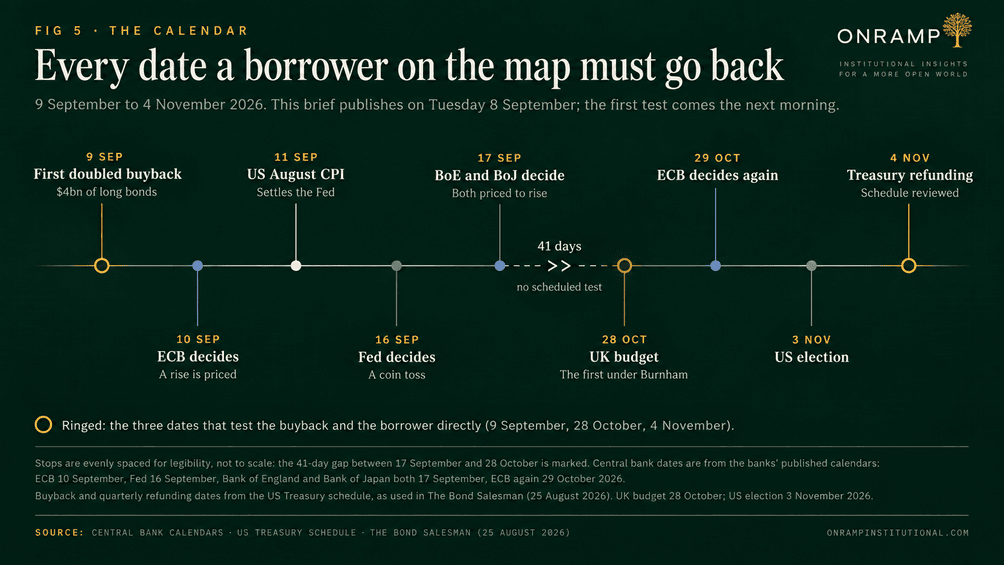
Every item on the map has one thing in common that bitcoin does not share. It has to go back. Japan must refinance debt worth two years of its output, and its budget was written on the assumption that the market would charge 3 percent. Britain must find its money on 28 October at whatever the gilt market is charging that morning. France must sell more bonds at 4.24 percent to fund a deficit of 5.2 percent. Of the $18 trillion OECD governments will borrow this year, about $14 trillion is the same lenders being asked the same question again.
Bitcoin has no maturity date. There is no auction, no budget assumption, no debt-service line, no refinancing requirement. It issued about 450 coins a day last week and it will issue about 450 coins a day next week, whatever the ten-year does. Its price fell last week like everything else that pays no yield. What it does not do is return to the lenders next year and ask them again. That is the whole difference. It is a smaller claim than the one usually made for it, and it is the reason it exists.
What to watch
The 30-year on Wednesday 9 September 2026 and the two days after
The first doubled operation is the test the announcement never got. It ended last week at 5.25 percent. If it is above 5.27 percent by the close on Friday 11 September, the announcement effect is fully gone and the operations are what remains.
Four central banks in nine days
The European Central Bank decides on Thursday 10 September, August CPI lands on Friday 11 September, the Fed decides on Wednesday 16 September, and the Bank of England and the Bank of Japan meet the following days. The market has the ECB and the Bank of Japan raising and the Fed at a coin toss that the CPI figure will settle. A hold from all four would be the surprise.
Japan's ten-year against 3 percent
It is the number in the budget. It touched it on 1 September and ended the week at about 2.9 percent after the 30-year auction. If the yield settles above it, the finance ministry is carrying an assumption in its own accounts that the market has already rejected, and Japan is the largest foreign holder of Treasuries.
28 October 2026
Britain's first budget under a new government, priced in a gilt market at 2008 levels. Before that, the Debt Management Office is selling a 30-year gilt by syndication in the week of 7 September, the first hard reading of long-end demand since the move. The interest assumption the Office for Budget Responsibility uses is drawn from market yields over a window before the budget, so the next few weeks set the number.
4 November 2026
The Treasury's next quarterly refunding, the day after the election, when the buyback schedule is reviewed. If yields are still here, the question will be whether $4 billion was ever the right number.
SOURCES: Bloomberg, 1 September 2026, "Bessent's Bond Gains Wiped Out as 30-Year Yields Jump Once Again" (30-year 5.27 percent, ten-year about 4.8, the pre-announcement level). Reuters, 1 September 2026: Japan's benchmark ten-year reaches 3 percent for the first time since September 1996; 30-year record 4.18 percent; budget assumption of 3 percent; debt above 200 percent of GDP. Reuters, 1 September 2026, via BNN Bloomberg: Bund ten-year 3.35 percent (highest since 2011), OAT ten-year 4.21 percent (highest since 2008), gilt ten-year 5.25 percent; eurozone August inflation above 3 percent. Euronews, 1 September 2026: 30-year Bund above 3.84 percent, OAT above 4.215 percent; France debt 118.4 percent and deficit 5.2 percent (IMF, Banque de France). Investing.com, 2 September 2026: Bund 3.370, OAT 4.244. Reuters, 2 September 2026: ten-year gilt 5.268 percent, highest since June 2008; Burnham and Healey budget 28 October. crypto.news, 2 September 2026: 30-year gilt near 5.9 percent, highest since 1998; the 2022 30-year path 3.38 to nearly 5 percent. FX.co, 1 September 2026: BoE November rise about 70 percent. Bloomberg, 1 September 2026: global bond yields at highest since 2008; Bloomberg global sovereign gauge 3.72 percent on 31 August. Reuters explainer, 2 September 2026: five hyperscalers $220 billion of debt in 2026 (LSEG), global corporate issuance record $4.9 trillion, G7 debt at or above 100 percent of GDP except Germany. OECD, Global Debt Report 2026 (published 4 March 2026): $29 trillion borrowing in 2026, 17 percent above 2024; OECD sovereign issuance $18 trillion in 2026 from $12 trillion in 2022; refinancing about 78 percent; outstanding $61 trillion; "structural decline in long term demand"; shift to shorter maturities; "more price-sensitive investor base." Financial Stability Board, FSB Chair's letter to G20 Finance Ministers and Central Bank Governors, dated 28 August 2026, published 31 August 2026. CNBC, 28 and 31 August 2026: Fed rise odds from about 35 percent to 56 percent after Jackson Hole, 64 percent by 31 August; Warsh "work to do." Cryptobriefing and CME FedWatch, 1 September 2026: above 66 percent. Mining.com, 1 September 2026: Barr remarks; gold to a two-week low; gold up about 10 percent in August 2026. Bloomberg, 1 September 2026: gold down almost 6 percent over three sessions to about $4,330. FXStreet, 2 September 2026: bitcoin near $76,500 after about $81,000. CNBC, 21 August 2026: bitcoin week from about $62,800 to $76,943.90. Reuters and CNBC, 31 August 2026: Larak Island strike, Brent back above $90. Norges Bank Investment Management, letter to the Ministry of Finance, "The Government Pension Fund Global: analyses and assessments of the investment strategy for bonds," dated 1 September 2026, published at nbim.no on 2 September 2026 (English translation); all quotations are from the letter. Reuters, 4 September 2026 (Withers and Reggiori Wilkes): 34.1 to 21.9 percent, nearly $80 billion of about $215 billion, 16.8 to 14.1, 4.6 to 7.4, 4.2 unchanged, 52.9 to 52.5. CNBC, 4 September 2026: $1.65 trillion equities, $592 billion fixed income. Bureau of Labor Statistics, Employment Situation, 4 September 2026: payrolls 162,000, unemployment 4.1 percent, June and July revised up 55,000. CNBC, 4 September 2026: consensus 53,000. Week-end and Monday levels: FRED DGS30 and DGS10 (30-year 5.27, 5.27, 5.25 percent on 1, 2 and 3 September 2026; ten-year 4.79, 4.79, 4.77); Trading Economics, 4 and 7 September 2026: US ten-year near 4.76 percent Friday, rise odds about 50 percent Thursday and 52 percent Friday, gilt ten-year 5.14 percent Friday close and 5.15 Monday morning, Japan ten-year about 2.9 percent Friday and 2.92 on 7 September; CNBC, 3 September 2026: Waller remarks; Japan 30-year auction and yen to about 157, as reported 3 September 2026; UK Debt Management Office notice of 21 August 2026 on the syndicated reopening of the 2056 gilt in the week of 7 September. Prior briefs cited: The Rollover (4 August 2026); The Bond Salesman (25 August 2026). Market levels are as reported on the dates stated and are deliberately not restated at publication.
The Radar
What matters this week across digital assets, AI, and global markets.
Digital Assets & Regulation
Nearly all of it, in half an hour
On September 6 about 3,998 bitcoin left the wallet backing Liquid, Blockstream's federated sidechain, in two transactions twenty-seven minutes apart. That was 95 percent of the reserve; about 200 coins remain. Blockstream says no key was compromised and points at a software validation failure. The recipient wrote on-chain that they are white hats. Bridge nodes are down, the peg is closed, the base chain untouched.
Twenty-one banks, no name
Bank of America, Citi, Goldman, Deutsche Bank, UBS and sixteen others said on September 1 they will form a company to issue a dollar stablecoin in the first half of 2027, with a euro token to follow. The company has no name yet. Neither does the token, and the chain and custodian are undecided. What is being announced is distribution, arriving late to a market others built.
Perpetuals come for equities
Coinbase said on September 3 it has filed notice registration documents with the SEC to offer equity perpetuals on its US derivatives exchange, which would also need the commodities regulator's approval. Perpetual futures never expire and never need rolling, which is how they became the most traded product in digital assets. Moving that mechanism onto American stocks takes it into a far larger market.
AI & Financial Infrastructure
Custom silicon, six customers
Broadcom's AI revenue reached $16.7 billion, up 221 percent and now 56 percent of the company. It guided the current quarter to $21.7 billion and sketched $230 billion of AI revenue by fiscal 2028. Six customers account for most of it. The shares still fell 6 percent on a total revenue guide $230 million light. Concentration cuts both ways.
Micron's workers want a share
Two unions covering 10,000 of Micron's 15,000 Taiwan staff are moving toward a strike ballot after mediation failed on September 4. They want profit sharing at 15 percent of operating profit, against bonuses averaging 2.6 months of salary. The May quarter produced $33.3 billion of operating income on $41.5 billion of revenue.
A slowdown, from the inside
OpenAI's chief scientist argued in a September 6 essay that no lab has solved alignment and monitoring well enough to keep scaling at full speed, and that voluntary slowdowns should become common until shared standards exist. He wrote that the method it uses to watch a model reason is losing reliability. The chief executive called it important. Capital is being committed on the other assumption.
Geopolitics & Markets
Concern, not condemnation
Eighteen Pacific nations met in Palau and settled on a word. The communique registers concern about a Chinese ballistic missile test in July that overflew members without adequate notice, and asks for twenty-four hours of warning next time. Seventeen signed and Nauru did not. Beijing calls the launch routine annual training and says the countries were told in advance. The summit was overshadowed by China's objection to Taiwan attending at all.
Germany loses 4,200 megawatts
A drone carrying explosives was found at Leipzig and Halle airport, a NATO logistics hub and the European base for Ukraine's heavy-lift cargo fleet. Within a day, vandalism at a substation in North Rhine-Westphalia took lignite units totaling 4,200 megawatts off the grid, and devices damaged lines at a critical high-voltage node in Brandenburg. Nobody has been charged. The Commission promised more sanctions, which is the tool it holds.
Xi's road to Washington
Before his September 24 state visit to the White House, Xi Jinping has been traveling: a Shanghai Cooperation Organization summit in Kyrgyzstan on September 1, with state visits to Egypt and probably India to follow. He had left China once this year, to North Korea in June. The itinerary is the point. He arrives having collected partners, at a meeting expected to cover trade, AI, Taiwan and the war.
The Week in Numbers
| Indicator | Reading |
|---|---|
| Coins that left the Liquid sidechain's reserve wallet | 3,998 |
| Share of that reserve gone in half an hour | 95% |
| Banks forming a company to issue a dollar stablecoin | 21 |
| When Coinbase filed to offer equity perpetuals | Sept 3 |
| Micron Taiwan workers polled who backed a strike | 80% |
| Pacific nations that signed the missile statement | 17 of 18 |
| German generation knocked off the grid | 4,200 MW |
| When Xi reaches the White House | Sept 24 |
What to Watch This Week
| Date | Why it matters |
|---|---|
| This week | Whether the coins taken from the sidechain come back, and whether the peg reopens. |
| Sept 11 | August inflation, the last full price reading the Committee sees before it decides. |
| Sept 14 | The Senate returns and the parked market-structure bill's cloture motion ripens. |
| Sept 15-16 | The Fed meets, with the first fresh projections since June. |
| Sept 24 | Xi Jinping arrives at the White House for a state visit, with trade, AI and Taiwan on the agenda. |
| Later this month | Micron's next mediation round in Taiwan; failure opens the way to a formal strike ballot. |