August 25, 2026 Weekly Market Brief

Glenn Cameron, CFA · Global Head of Onramp Institutional
Free. Every week. Institutional insights, connected.
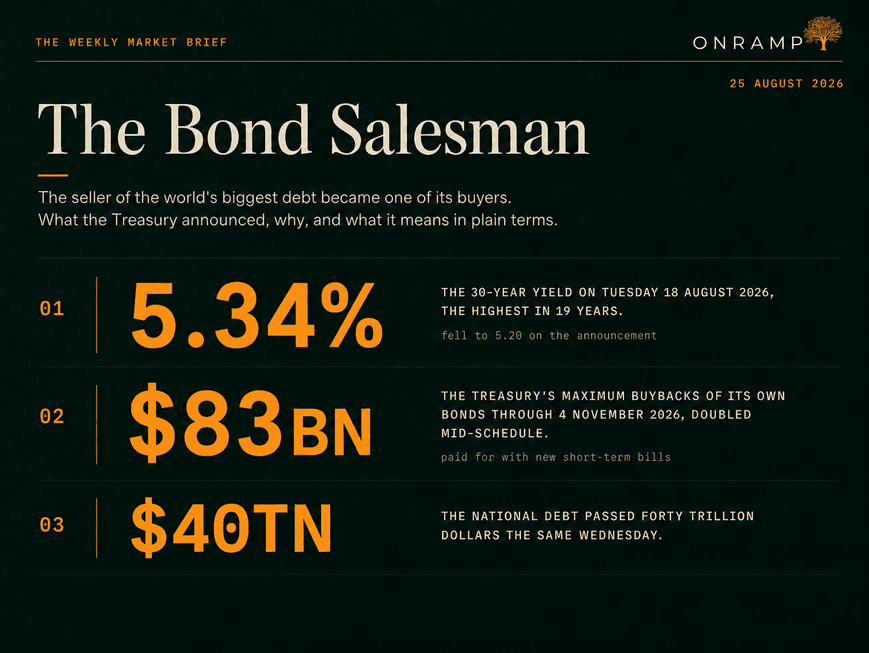
On the afternoon the national debt passed 40 trillion dollars, the Treasury announced without warning that it would at least double its buybacks of its own long-dated bonds. The 30-year yield fell 9 hundredths of a point on the day, gold jumped, and bitcoin rose 6 per cent within hours. The operation is paid for by selling short-term bills, which shortens the debt profile further and makes any future Fed rate rise more expensive for the government. One arm of the state is holding short rates up while the other buys long rates down.
On Wednesday 19 August 2026, the United States government's debt passed 40 trillion dollars. The same afternoon, the Treasury announced it would double its purchases of its own long-term bonds. The seller of the biggest debt in the world became one of its biggest buyers. Scott Bessent, the Treasury Secretary, once described his job plainly: "my job is to be the nation's top bond salesman." Last week the salesman started buying. This brief explains what happened, why, and what it means for anyone with a mortgage, a pension, or a view on where money is headed.
The buyer steps in
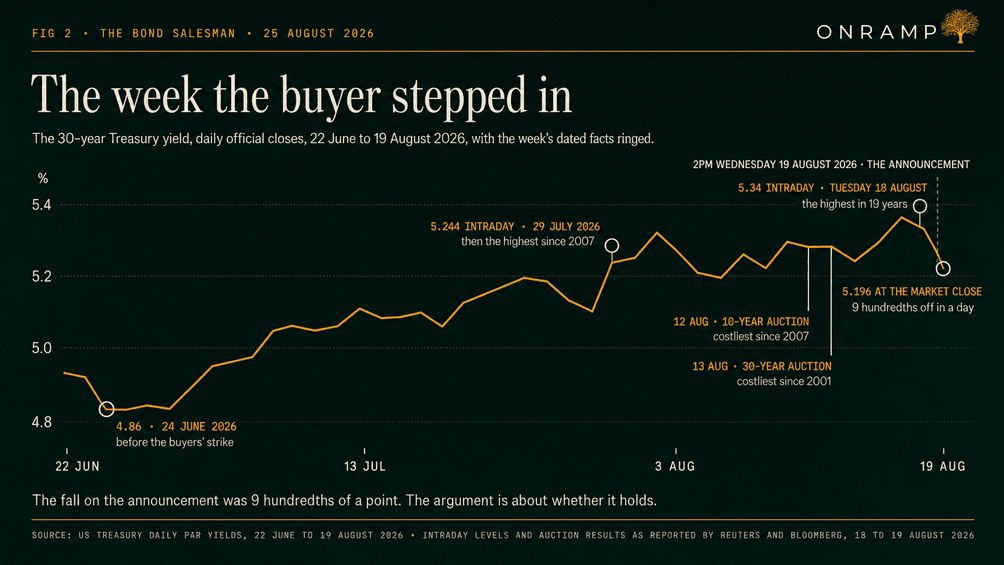
For two months, buyers of America's longest-dated debt had been thinning out. In the second week of August 2026 the strain showed. An auction of 10-year government bonds cleared at the highest borrowing cost since 2007, and a 30-year sale at the highest since 2001. On Tuesday 18 August 2026 the yield on the 30-year bond touched 5.34 per cent, a level last seen 19 years ago, pushed by fears of a wider war with Iran and by worry about the government's own finances.
Then, on Wednesday afternoon, with no warning, the Treasury announced it would at least double its buybacks of long-dated bonds: each operation used to be capped at 2 billion dollars, and the new cap will be at least 4 billion, with the exact figure to come in an updated schedule. The number of long-end operations goes from two a quarter to four, and the change runs from 9 September to 4 November 2026. And a note on the arithmetic, because the headline invites a fair question: if the buying doubled, why does the total rise only a fifth? Because the 69 billion dollar ceiling covered all of the Treasury's buyback operations over the three months to early November 2026, across every maturity from short bills to 30-year bonds, and only the long-dated slice is being doubled. Seven long-end operations remain in the window, each gaining at least 2 billion dollars of capacity, so the overall ceiling rises by at least 14 billion, to 83. The long end doubles. The whole does not. The effect was immediate. The 30-year yield fell 9 hundredths of a point that day to 5.196 per cent, the 10-year fell 6 to 4.647, stock futures rose, gold jumped to its highest since June, the dollar slipped against every major currency, and bitcoin rose 6 per cent on the day to nearly 70,000 dollars, its highest since early June and its biggest one-day rise since March, as more than a billion dollars of bets against it were forced to close. By the early hours of Thursday morning, 20 August 2026, it had climbed further, to about 72,000, roughly 12 per cent above Wednesday's low. By early Friday morning it had extended its gains above ~$76,000.
The reference price for long-term money
A short primer, because everything else follows from it. When the government borrows for 30 years it sells a bond: a fixed stream of interest payments, and the principal returned in the 2050s. The yield is the return that clears the market, the price at which enough lenders are willing to carry three decades of a government's risks, its inflation, its politics, its arithmetic. When lenders hesitate, that price rises until they stop hesitating. At 5.34 percent, three decades of American risk cost more to place than at any time since 2007.
And it is not Washington's number alone. The long Treasury yield is the reference price for long-term money in general. Thirty-year mortgages, which averaged about 6.67 per cent in the week of the announcement, are priced off it; so are corporate borrowing costs, the discount rates that decide whether pension schemes are solvent, and the value of the bonds sitting inside retirement accounts. When it moves, the repricing reaches nearly everyone, with a lag but without exceptions.
What a buyback is, and how the Treasury pays for one
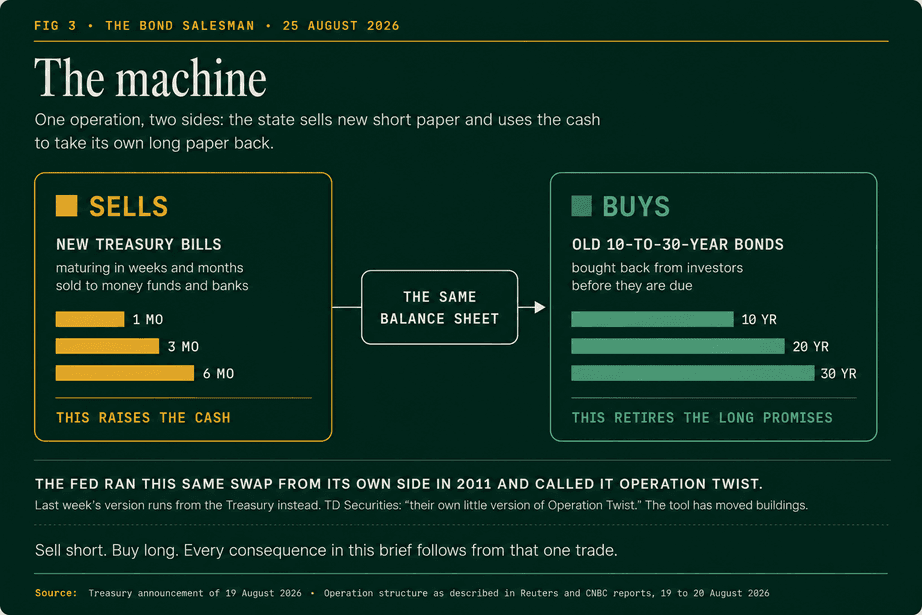
A buyback sounds simple: the Treasury offers cash for old bonds before they are due. But the government runs a deficit; it has no spare cash. So it pays for the old bonds by selling new debt, and the new debt it sells is overwhelmingly short-term, bills that mature in weeks or months. Strip away the language and the operation is a swap: the state sells three-month paper and uses the proceeds to take thirty-year paper off the market. Sell short. Buy long.
If that sounds familiar, it should. In 2011 the Federal Reserve did the same swap from its own side and called it Operation Twist, selling short-dated holdings to buy long-dated ones and pull long-term rates down. A senior rates strategist at TD Securities described last week's move in exactly those terms: "This is not QE... this is their own little version of Operation Twist." The tool has moved buildings. It used to live at the central bank. It now lives at the Treasury. And there is a name for the complete version of this policy. When a central bank openly pins long-term yields at a chosen level, it is called yield curve control; Japan ran it from 2016 to 2024, capping its 10-year rate near zero. Nobody in Washington has announced a target, and this is not that, yet. But an operation that succeeds when yields fall, run by a Secretary who calls the 10-year yield his benchmark, belongs to the same family. The difference between supporting a market and steering it is only a target you admit to.
The reason they give
Here is the Treasury's stated case, in full: the increase "reflects Treasury's desire to provide greater liquidity support in longer-dated nominal sectors where there is consistent strong sponsorship from market participants, as evidenced by the significant volume of high-quality offers Treasury routinely receives in longer-dated buyback operations." Bessent has called the buyback programme "a success so far." Notice, though, what kind of truth this is. Liquidity support is real: a standing buyer does make old bonds easier to sell, and easier-to-sell bonds are easier to own. But when the standing buyer is the borrower itself, the claim stops carrying information. Of course the offers are plentiful and of high quality: the invitation is to hand 30-year risk back to the very government that issued it. The sentence is true the way it would be true of any borrower repurchasing any debt. It explains the mechanics of the operation. It does not explain the timing, the surprise, or the doubling. For those, the market supplied its own reading.
The reasons the market heard
Now the reading nearly every professional made within the hour, and the evidence for it. First, the timing. The Treasury has spent five decades building a doctrine called regular and predictable: publish the schedule, never surprise, so that its actions carry no message. This announcement came two weeks after the schedule was published, unscheduled, on a thin August afternoon, hours before a 16 billion dollar auction of 20-year bonds. The chief US economist at Jefferies said it plainly: the surprise upends the Treasury's tradition of consistent communication. You do not ambush your own published calendar to provide liquidity. You do it to send a message.
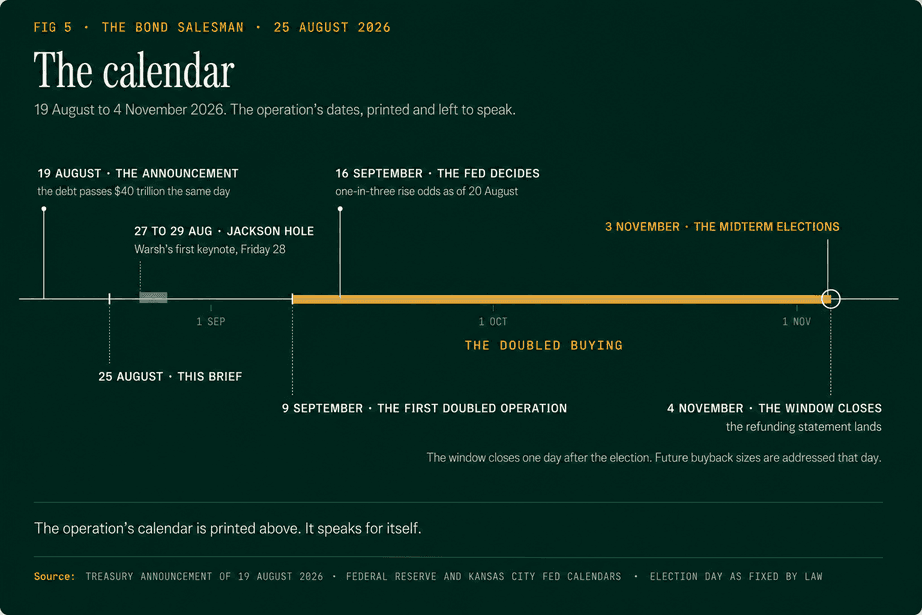
Second, the Secretary's own scoreboard. Bessent has said his benchmark is the 10-year yield, has spoken of a "big toolkit" for the bond market, and this month has already used another of its tools, intervening to support the Japanese yen. Bloomberg's summary of Wall Street's reaction: the move was billed as liquidity support and understood as the toolkit being used to keep yields in check, a stated goal of the administration. A strategist at Saxo put it in one sentence: the Treasury has decided that higher US yields are unacceptable. And third, the calendar. The doubled buying runs from 9 September to 4 November 2026. The midterm elections are on 3 November. The chief economist at RSM drew the conclusion under his own name: "Bessent is a political actor. His interest is purely short term and is organized around the upcoming election and not a return to price stability." Those are his words, not ours.
Two policies at once
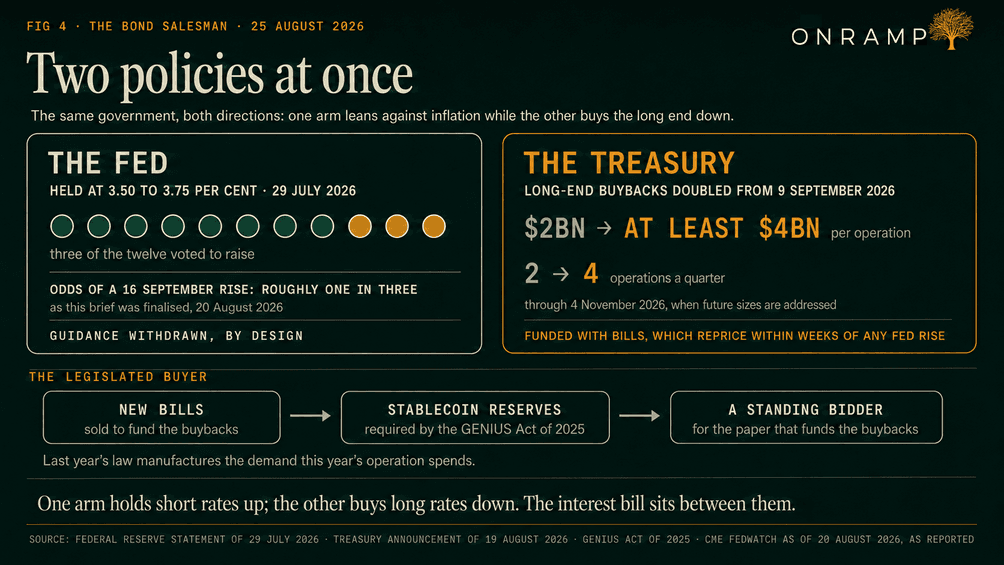
Here is the part that makes this bigger than a market story. Interest rates are supposed to be set by the Federal Reserve, which is independent of the government precisely so that elected officials cannot lower the cost of money when it suits them. The Fed is currently leaning the other way. At its July 2026 meeting it held its rate at 3.50 to 3.75 per cent, and three of the twelve voters dissented because they wanted to raise it, with inflation running at 3.4 per cent. Markets are currently pricing roughly a one-in-three chance of a rise on 16 September. The new Fed chair, Kevin Warsh, has also stopped telling markets what comes next, a deliberate withdrawal of guidance that Bessent himself defended as a "detox." And the two men are not pretending otherwise: both have publicly pushed for the Treasury and the Fed to work more closely together. Pause on that sentence, because familiarity hides how strange it is. The reason the two institutions are separate has a date: March 1951, the Treasury-Fed Accord. For the previous nine years the Fed had been required to hold the government's borrowing costs at fixed, low levels to pay for the war, and when inflation surged after it, the Fed fought to be free. The Accord that ended the arrangement is the founding document of central-bank independence, and its lesson was learned expensively: the borrower and the setter of its interest rate must not be teammates. Working more closely together is not a technical adjustment. It is the pre-1951 arrangement, being reassembled politely, one operation at a time.
So the United States now runs two monetary policies at once. One arm of the state holds short rates up, and a third of its committee wants them higher. The other arm buys long bonds to pull long rates down. And the second arm's method quietly raises the stakes for the first: paying for buybacks with bills makes the government's interest bill more sensitive to any future Fed rate rise, because bills reprice in weeks. Readers of our weekly brief entitled "The Rollover" (4 August 2026) will remember the arithmetic: on roughly 6.4 trillion dollars of bills, a single quarter-point rise costs about 16 billion dollars a year, arriving almost at once. Every bond bought back with bills makes that number bigger, which makes a Fed rate rise more expensive for the government, which raises the pressure on the Fed never to make one. The interest bill is already 963 billion dollars for the first ten months of this fiscal year, about 15 per cent of all federal spending. And the demand for those bills is not being left to chance. Last year's stablecoin law, the GENIUS Act of 2025, requires the new digital dollars to keep their reserves in exactly this paper: short-dated government bills. Every dollar that flows into a regulated stablecoin becomes, by legal requirement, a bill buyer, and the largest issuer (Tether) already holds more bills than most countries. Bessent has said publicly that he expects stablecoins to create trillions of dollars of new demand for Treasury debt. Put the two policies side by side and notice how neatly they fit: the government funding its long-bond purchases with bills is the same government that wrote, one year earlier, the law that manufactures a class of buyer legally obliged to keep buying them.
Does it work, and what does it cost
Both answers deserve honesty. On the day, it worked: yields fell, and Citi's head of dollar swaps trading expects "a huge impact on the long end." Over any longer stretch, the sceptics have the numbers. Evercore doubts a material impact over an extended period, because the government still has to finance what its own analysts called a tidal wave of maturing debt and deficits. The doubled programme is 83 billion dollars at most, in a market of roughly 28 trillion: about a third of one per cent. But smallness misleads here, for a reason worth knowing: prices are set at the margin. The yield is not set by the whole 28 trillion, most of which never trades; it is set by the last trade, by whichever marginal seller and buyer meet that day. A modest bid, placed where the trading actually happens, moves the price that everything else is marked against. Last week proved the mechanism in both directions: a 2 billion dollar operation on Tuesday failed to stop the selloff, then Wednesday's announcement alone, before a single new dollar was spent, moved the entire market. The size is small. The margin is where prices live. And a defended price has a known weakness: once traders learn where the defender's pain begins, they trade against the defence. The costs are also plain. Buying back 30-year bonds with 3-month bills makes the national debt even shorter-dated than the profile The Rollover (4 August 2026) described, where 61 per cent of everything owed comes due by the end of fiscal 2028. The country is not reducing its debt. It is shortening its fuse. And there is one more cost, the quiet one: nothing in this design tells you when it ends. The window closes on 4 November 2026, but Treasury has already said future buyback sizes will be addressed that day, which is a review, not a sunset, and the review is written by the same hand. Consider the incentives on that morning, the election just past. If yields behaved, the programme worked, so why stop. If yields rose anyway, the programme was too small, so why not enlarge it. And stopping now carries a cost that starting never did: withdrawing a known buyer is itself a signal, an invitation to the very selloff the buying was meant to prevent. Japan needed eight years to exit its version. The honest answer to what would make Washington stop is an inflation problem too large to ignore, or a Fed willing to fight in the open.
Why this reaches you
If you hold a mortgage, or hope to, the long end is your rate; a successful cap makes borrowing cheaper into the autumn, and the first day's move was worth about a tenth of a point. If you hold a pension or an annuity, the bonds inside it just rose in value, and a steadier long end steadies what you own. But the same coin has another face: a price that has been publicly defended and then breaks moves faster than one that was never defended at all. Both outcomes are possible. Nobody should pretend to know which will arrive.
There is a third way it reaches you, and it explains Wednesday's whole tape. A bond pays fixed dollars. If the state arranges for the yield on its debt to sit below what lenders would freely charge, then holders of that debt are being paid less than the risk deserves, and the claim is being quietly cheapened without a single payment being missed. Money that suspects this does two things. It moves into assets that cannot be cheapened the same way, which is why gold jumped 3.5 per cent to its highest since June and bitcoin gained close to 20 per cent in two days, and why a strategist at 21Shares told Fortune the market read the move as a quiet form of quantitative easing that sends scarce, debasement-hedge assets higher. And it re-marks everything that is valued by discounting future cash at that suppressed rate: a lower discount rate makes tomorrow's earnings worth more today, which is part of why stocks rose on the news. On Wednesday, nearly everything that is not the debt went up against the debt.
And for holders of bitcoin, here is the interesting part. Long-dated government yields are the ruler the financial world measures everything with: the so-called risk-free rate against which every asset is judged. Last week the ruler's issuer began adjusting the ruler, and bitcoin's six per cent jump within hours showed how directly that ruler now reaches it. That's another entry in the ledger this weekly brief series keeps: the terms of the official system are set by officials, and can be reset by them, at 2pm on a quiet Wednesday, without a vote. The appeal of a monetary system whose supply and rules sit outside anyone's control does not need to be argued here. It only needs the contrast restated.
What we are watching
Jackson Hole, Friday 28 August 2026
Three days after this brief publishes, Warsh gives his first keynote as Fed chair at the central bankers' summit, and the question hanging over it is now unavoidable: how does the Fed see a Treasury that has taken up rate management of its own?
9 September 2026
The first doubled operation runs. The offers it draws, and the yields it prints, are the first hard data on whether the market sells to the new buyer or backs away.
16 September 2026
The Fed decides. A rate rise into the middle of the Treasury's buying window would turn a quiet disagreement into an open one.
4 November 2026
The buyback window closes and the next refunding statement lands, one day after the election. Treasury has said future buyback sizes will be addressed then. That document will say whether this was an operation or a policy.
The through line
Three weeks ago, The Rollover (4 August 2026) showed the world's biggest borrower funding itself week to week at the short end because thirty-year money had become too expensive to promise. Last week the same borrower went a step further: it began paying to take its own long-term promises back. Each step is defensible on its own terms. Together they describe a debtor arranging its affairs so that the price of its debt tells you less and less about what anyone freely thinks it is worth. A price that is being defended is a price that tells you nothing. On the day the debt passed 40 trillion dollars, that was the afternoon's real news, and only one of the two events was a surprise.
SOURCES: US Treasury press release, Increased Sizes of Nominal Long-End Liquidity Support Buybacks, 19 August 2026; Reuters, Bloomberg, CNBC, CNN, Axios, Fortune and Quartz reporting of 19 to 20 August 2026; quotations as attributed: TD Securities (Gennadiy Goldberg), Jefferies (Thomas Simons), Evercore ISI (Krishna Guha), Saxo Markets (Neil Wilson), RSM (Joseph Brusuelas), Citi (Dan Gottlander), and Secretary Bessent's prior public remarks as reported; buyback window and schedule figures from the Treasury announcement and August 2026 refunding materials as reported; Federal Reserve statement and vote of 29 July 2026; the GENIUS Act of 2025 as enacted, and Secretary Bessent's public remarks on stablecoin demand for Treasury bills, as reported; CBO net-interest figure for the first ten months of fiscal year 2026, as reported; market levels of 18 to 19 August 2026 as reported. All arithmetic recomputed from source. All market levels are stated as of their dated days, 18 to 20 August 2026, and are deliberately not restated at publication.
The Radar
What matters this week across digital assets, AI, and global markets.
Digital Assets & Regulation
The shorts break first
From July 8 bitcoin held between roughly $62,000 and $66,900, volatility ground down to lows rare in its history, and traders sold the top of that range each time it was tested. On August 19 the ceiling gave way. The unwind cleared between $2.7 billion and $3.1 billion of short positions, depending on the window and the data provider, the largest short-side wipeout in records going back to 2021, against roughly $260 million of longs.
The SEC files the rule it pulled
Four days after canceling the meeting called to vote on it, the commission issued the proposal anyway. Regulation Crypto Assets offers tailored exemptions for raising capital, a $5 million startup tier, and a safe harbor that lifts an asset out of securities treatment once nobody is performing the essential managerial work behind it. Industry groups welcomed it and credited the chairman by name. The rule arrived without the public vote it had been scheduled to get.
Tokenization reports a quarter
Securitize published its first results as a public company: revenue of $14.4 million, down 5 percent on the year and well short of the $20.6 million expected, an adjusted loss of $5.5 million, and a 2026 outlook cut to $70 million to $80 million from about $110 million. Transaction volume rose 147 percent while tokenization revenue fell 12 percent. The pipes are being used more; the toll is not yet being collected.
AI & Financial Infrastructure
Nvidia buys the ground
Nvidia said on August 17 it has secured land, power and shell capacity at a decommissioned uranium enrichment site in Pike County, Ohio, guaranteeing 4.25 gigawatts with an option on 3.75 more. OpenAI is the customer on a twenty-year lease from SB Energy, which with SoftBank will add ten gigawatts of generation. Nvidia is putting $1.5 billion into the developer. First capacity is due in 2028.
Samsung raises the price of silicon
Samsung lifted quotes on new advanced foundry orders in July, by 10 to 15 percent on its four and five nanometer lines and nearly 10 percent on an eight nanometer process. Reuters had it from two people; Samsung declined to comment. The reason is capacity: TSMC's leading edge is booked out, and Samsung, on 7 percent of foundry revenue against TSMC's 70, takes the overflow.
The labs start borrowing
Anthropic is arranging a revolving credit facility expected to price above its roughly $10 billion target, Bloomberg reported, with terms undisclosed. A revolver that size is unusual for a private company, and it points where Nvidia's Ohio guarantee does: the buildout has moved past equity. Compute is financed like infrastructure now, which works while the payments arrive.
Geopolitics & Markets
The Fed debates its own calendar
Minutes of the July meeting, published August 19, show the case for a rise ran well past the three regional presidents who voted for one. Many participants judged tightening would likely be needed if inflation did not fall, and some doubted financial conditions were restrictive enough. The record also carries something structural: the chair floated cutting the calendar from eight meetings a year to six. Nothing was decided, but fewer meetings would mean fewer chances to react.
Taiwan crosses a trillion
Taipei's cabinet approved a 2027 budget on August 20 setting defense at NT$1.1225 trillion, 18 percent above this year, past NT$1 trillion for the first time and just over 3 percent of projected output. Reported dollar equivalents run from $31 billion to $35 billion, a wide spread for one number. The opposition controls the legislature and cut the last special defense package by about 40 percent.
Evergrande's founder is jailed
A Chinese court sentenced Hui Ka Yan to life in prison on August 20, closing the personal chapter of a collapse that left more than $300 billion of liabilities and ended in delisting last year, almost five years after the default. The sentence changes nothing for creditors. For everyone else it shows how Beijing has chosen to end its property cycle: punishing the promoter, not repairing the balance sheet.
The Week in Numbers
| Indicator | Reading |
|---|---|
| Short bets cleared as BTC's 6-week range broke | $3B |
| Raise cap in the rule the SEC pulled at the door | $5M |
| Tokenization's first public quarter, against $20.6M expected | $14.4M |
| Capacity Nvidia has guaranteed at its Ohio site | 4.25 GW |
| The steepest of Samsung's July foundry price rises | 15% |
| Meetings a year the Fed chair floated, down from eight | 6 |
| Taiwan's proposed 2027 defense budget, a first | NT$1.12T |
| Liabilities left by the Evergrande collapse | $300B |
What to Watch This Week
| Date | Why it matters |
|---|---|
| Aug 2026 | Nvidia reports after the close. Its own guidance was about $91 billion for the quarter, which makes the print the buildout's clearest report card. |
| Aug 27-29 | Jackson Hole: the chair's first symposium in the job, and the Fed has withdrawn the written guidance markets used to read instead. |
| Sept 11 | August inflation, the last full price reading the Committee sees before it decides. |
| Sept 14 | The Senate returns and the parked market-structure bill's cloture motion ripens, fourteen working days from the end of the session. |
| This autumn | Taiwan's legislature takes up the defense budget. The opposition cut the last special package by about 40 percent. |