Multi-Institution Custody
Secured by three. Controlled by you.
Your bitcoin is secured by three independent institutions, eliminating any single point of failure. Onramp maintains custody insurance through Canopius, a Lloyd's of London syndicate: up to $50M in aggregate coverage across its custody operations.
Multi-Institution is the next generation of custody
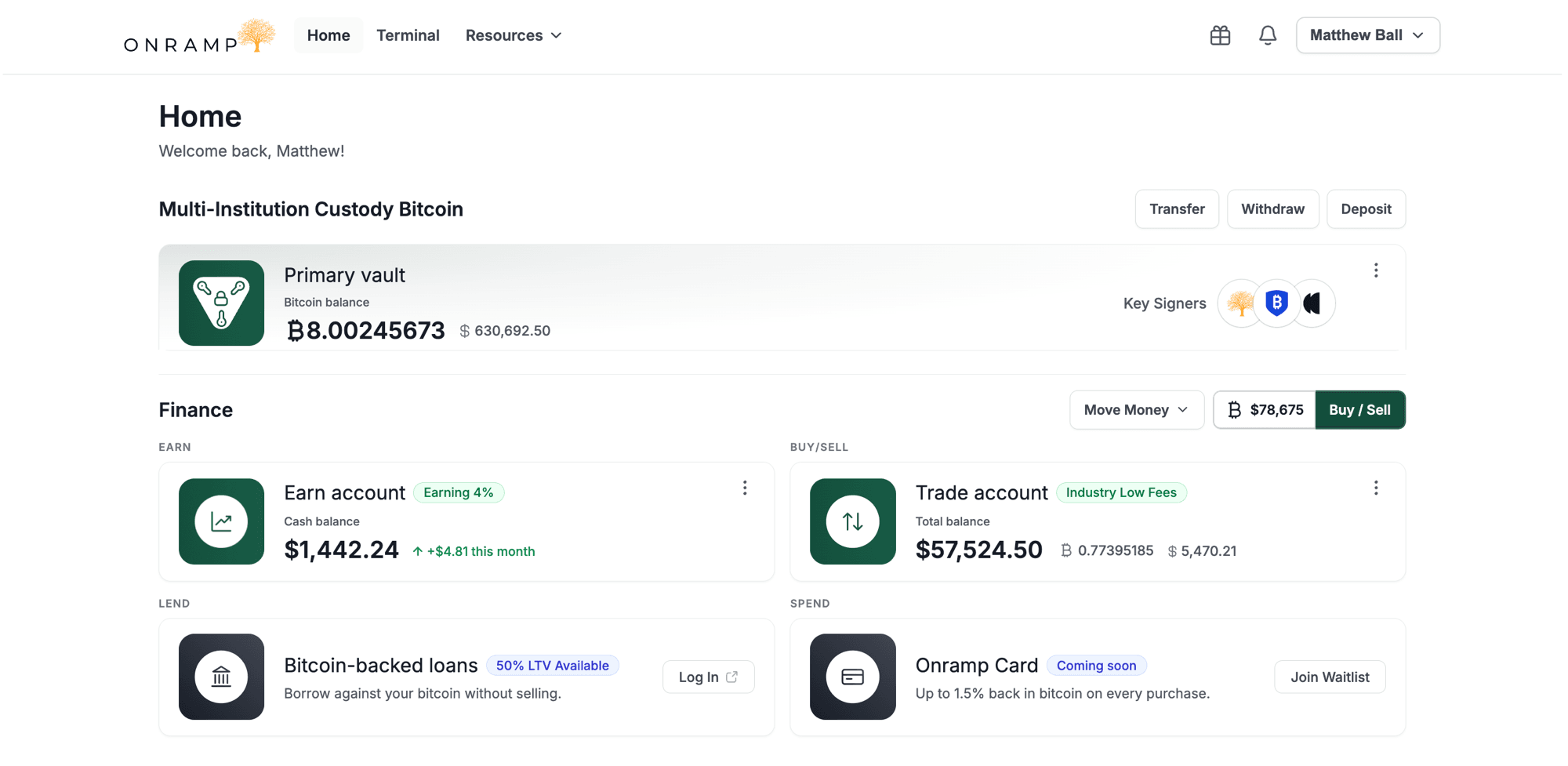
Your bitcoin is protected by three independent institutions. Every transaction starts with you, and it takes two of three institutions to complete it. No single party, not the client, not Onramp, not any individual custodian, can move your bitcoin alone.
You retain full control, but offload the operational burden. You eliminate single points of failure without needing to manage seed phrases or maintain hardware.
Multi-Institution Custody provides the foundation for securing your bitcoin wealth and unlocking financial services like inheritance planning, loans, and IRAs.
Getting underwritten is itself an examination: Lloyd's only prices residual risk after the architecture has removed what it can. What the policy covers, and what it does not, is on Custody Insurance. The full argument is in The True Cost of Bitcoin Custody and Insurance.
What is Multi-Institution Custody?
Multi-Institution Custody (MIC) is a bitcoin custody model in which three independent institutions form a 2-of-3 multisignature quorum, and the client holds no private keys. No single institution can move the bitcoin, no single institution's failure can lose it, and the client never performs key ceremonies, firmware updates, or seed backups. Any two of the three institutions must co-sign a withdrawal for funds to move. Onramp operates the model with Onramp, BitGo Trust, and CoinCover for individual and IRA accounts, and with Onramp, Tetra Trust, and CoinCover for business accounts.
- A 2-of-3 institutional quorum. Three separate institutions protect the vault on separately operated infrastructure. It takes two of three institutions to move the bitcoin, and nothing moves without the client's permission.
- The client holds no private keys. There is no seed phrase, hardware wallet, firmware update, or personal key ceremony for the client to manage.
- No single institution can act alone. One compromised, unavailable, or uncooperative institution cannot move funds or prevent the other two institutions from reaching quorum.
- Withdrawals require two signatures. Withdrawals require the client's instruction and independent verification by multiple institutions before two institutions co-sign.
- Each vault is visible on-chain. Clients receive a dedicated vault and can independently verify its balance and transaction history on the bitcoin blockchain.
Benefits
Key benefits at a glance
Three independent institutions protect your bitcoin. It takes two of three institutions to move your bitcoin, and nothing moves without your permission. Multi-Institution Custody delivers stronger security, resilience, and ease of use than any single-custodian model. No single custodian can freeze or compromise your bitcoin on its own, giving you the confidence to hold for the long term.
Eliminate single points of failure
No single institution can fail and cost you your bitcoin. Multi-Institution Custody is built to survive the collapse of any one institution, including Onramp.
Protected against physical threats
You can't be physically coerced into moving your bitcoin. Even under threat, no one can force a transaction, because you don't hold the keys.
Protected against political and regulatory risk
Your bitcoin is protected by independent institutions in more than one country. No single government action, executive order, or regulatory event can reach your bitcoin.
No seed phrases. No hardware. No stress.
Get institutional-grade security without managing keys, devices, or backup procedures yourself. Set up your account in minutes, with your dedicated Onramp account manager available whenever you need them.
Lloyd's of London custody insurance (Onramp operations)
Onramp maintains custody insurance through Canopius, a Lloyd's of London syndicate: up to $50M in aggregate coverage across its custody operations. The world's most established insurance market only underwrites custody architectures it considers low-risk, which is why single-custodian models rarely qualify for comparable coverage. See what the policy covers.
On-chain transparency
You don't have to take Onramp's word for it. Every Onramp account has its own segregated, on-chain vault you can verify independently, 24/7.
Keyholding Institutions
The institutions behind your custody
Independent institutions with specialized roles, working together to protect your bitcoin. See what each keyholder does.

Built and operates Multi-Institution Custody. Onramp is one of the three institutions protecting every account, with billions in client bitcoin secured since 2022.

BitGo Trust Company, the South Dakota-chartered trust subsidiary of BitGo. BitGo was founded in 2013 and invented bitcoin multisig technology.
Learn More →
Tetra Trust, Canada's first regulated digital asset custodian. Registered under Alberta's Loan and Trust Corporations Act.
Learn More →
For anyone holding bitcoin for the long term, Multi-Institution Custody is the most secure way to do it. Get started in minutes, or schedule a consultation to talk through your situation.
Built for continuity
What happens if…
…Onramp is unavailable?
MIC is designed to survive the failure of any one institution, including Onramp. The remaining two institutions retain the quorum needed to coordinate recovery into a replacement vault.
…one institution is unavailable?
The other two institutions can still reach the 2-of-3 quorum needed to move bitcoin, and the unavailable institution cannot move funds on its own.
…the client dies?
The custody plan can rely on documented estate instructions rather than an heir finding a seed phrase or learning a signing ceremony. Learn more about bitcoin inheritance planning.
Compare custody
MIC compared with other custody models
| Model | Who can move funds alone | Client holds keys | Client responsibility | Best fit |
|---|---|---|---|---|
| Exchange / single custodian | The custodian | No | Low | Trading and smaller balances |
| Collaborative multisig | Depends on the quorum | Yes | Ongoing key management | Technical holders who want direct control with provider support |
| Self-managed multisig | Depends on the quorum | Yes, all keys | Full setup, backup, and recovery | Experienced holders prioritizing maximum sovereignty |
| Multi-Institution Custody | Nobody | No | No personal key management | Long-horizon wealth, estates, trusts, and advisors |
MIC providers
Who offers Multi-Institution Custody
Onramp
Onramp operates MIC using a standard 2-of-3 quorum of independent institutions: Onramp, BitGo Trust, and CoinCover for individual and IRA accounts, and Onramp, Tetra Trust, and CoinCover for business accounts. Onramp launched its first product using multi-institution custody in April 2023. The same architecture supports Onramp's Bitcoin IRA and inheritance planning.
AnchorWatch
AnchorWatch offers 2-of-3 MIC Vaults powered by its Trident platform, with AnchorWatch, BitGo, and CoinCorner as listed keyholders and optional insurance for eligible US customers.
Aureo
Aureo is developing a Latin America-focused MIC offering in partnership with Onramp.
Whoever you evaluate, ask the same questions: who holds the keys, where they operate, what agreements govern the vault, and what happens if one institution becomes unavailable.
Finding your fit
Who MIC is for, and who it is not for
MIC is built for
- Long-term holders who want institutional separation by design
- Estates and trusts that need an operable custody process
- Advisors and family offices that require institutional accountability
- Plans for a spouse or heir who should not need to manage private keys
MIC is the wrong choice for
- Holders who require personal possession of a private key
- Small balances for which institutional pricing is not economical
- People who do not want multiple independent institutions involved
- Anyone who needs to move bitcoin unilaterally and immediately
MIC trades unilateral action for protection against unilateral failure. If that trade does not fit, collaborative multisig or self-custody may be a better model. Compare each option using the published Custody Independence Standard.
FAQs
Common questions about Multi-Institution Custody
How MIC compares with other custody models, what the client is and is not responsible for, and what happens when an institution becomes unavailable.
Get started with Multi-Institution Custody
Schedule a consultation to walk through how Multi-Institution Custody fits your situation. Or sign up and get started in minutes.