September 1, 2026 Weekly Market Brief

Glenn Cameron, CFA · Global Head of Onramp Institutional
Free. Every week. Institutional insights, connected.
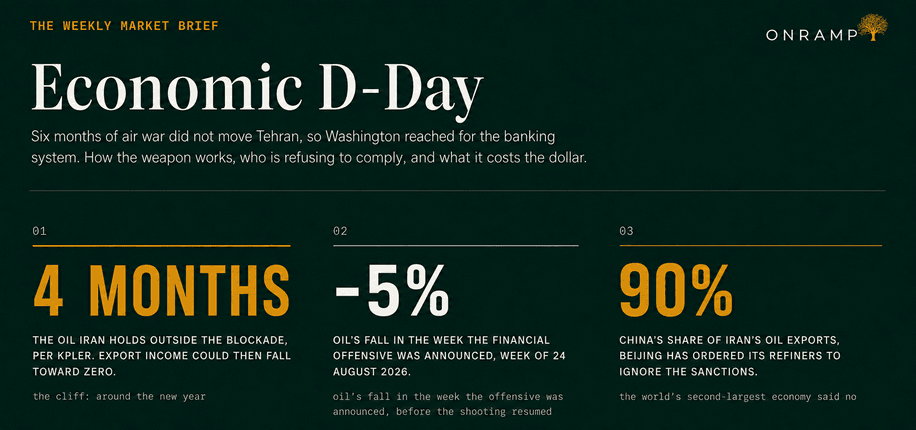
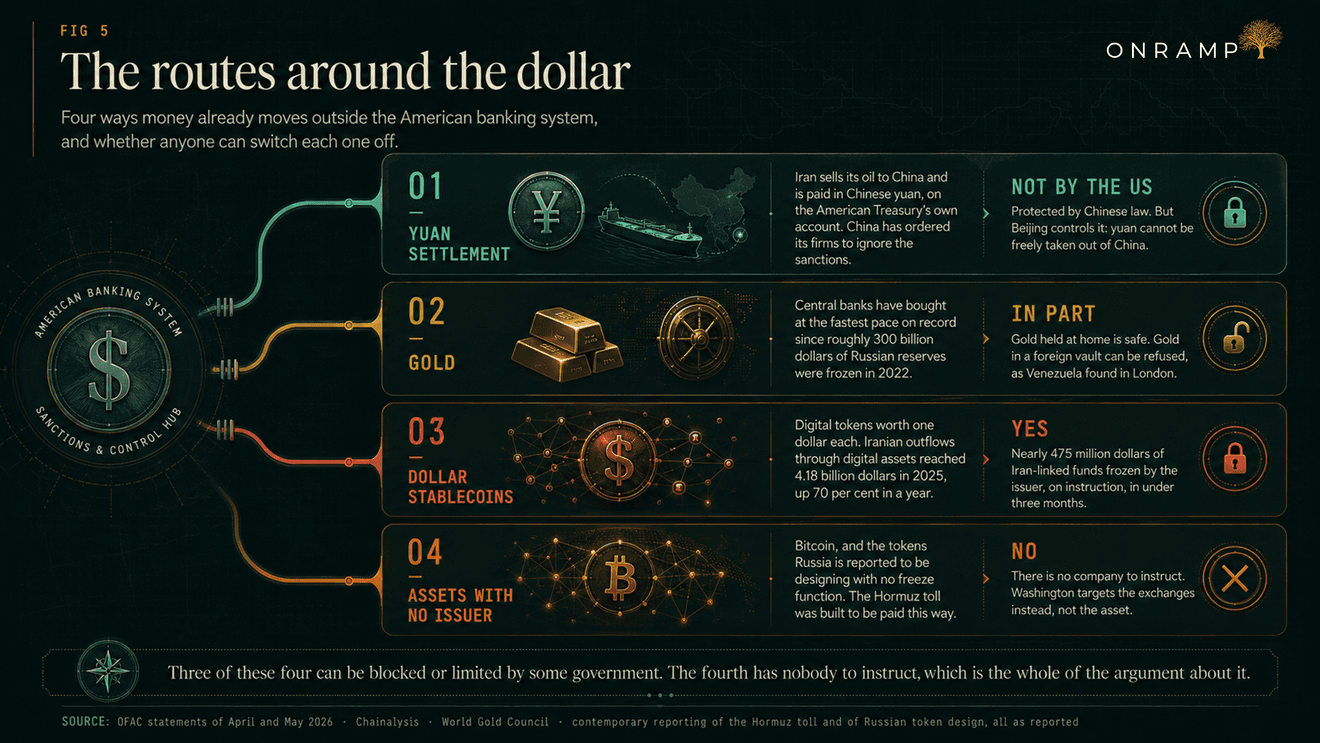
Washington opened Operation Economic Outcast, telling every bank on earth to choose between Iranian business and access to the American banking system. China refused the choice outright and keeps buying roughly 90 per cent of Iran's oil, paid in yuan. The same week showed what each escape route is worth: a stablecoin issuer froze nearly 475 million dollars of Iran-linked funds on instruction, Venezuela's gold still sits in a London vault that will not open, and bitcoin had no company for anyone to call.
Six months of war have not changed Tehran's mind, so this week Washington changed weapons. The Treasury Secretary promised the single greatest financial offensive ever marshalled against an adversary, and put a choice to every government and bank on earth: keep doing business with Iran, or keep your access to the American banking system. China has already refused to choose. This brief explains how the weapon works, who is defying it, what Iran can do in return, and the question underneath all of it: if the dollar can be used this way, what could the world possibly use instead?
What changed this week
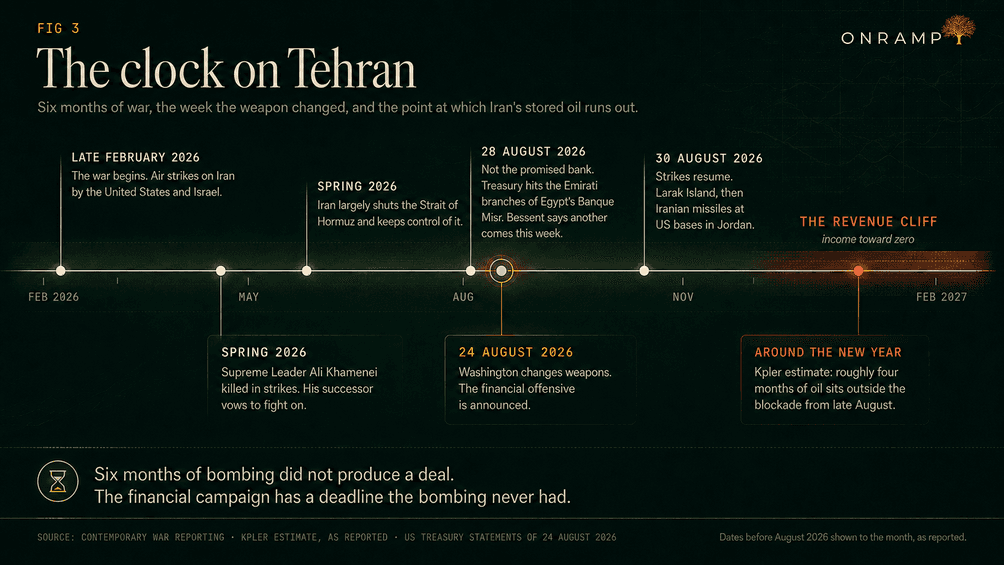
The war is nearly six months old. American and Israeli strikes have killed Supreme Leader Ali Khamenei and other senior officials, but the government in Tehran still stands and his successor has vowed to fight on. Iran has largely shut the Strait of Hormuz, which normally carries about a fifth of the world's oil, and has kept control of it. Months of fighting and several rounds of diplomacy have produced no deal.
So this week Washington reached for the banking system instead. President Trump wrote that Iran would now face "economic warfare and isolation on an unprecedented scale." Treasury Secretary Scott Bessent promised "the toughest sanctions in history" in a CNBC interview on 20 August 2026, and wrote in the Financial Times that this would be "the single greatest financial offensive ever marshalled against an adversary." At a press conference on Monday 24 August 2026 he set out the aim: to "sever every economic lifeline that sustains this tyrannical regime until Tehran stands alone." Countries must choose between the United States and Iran. Anyone "part of the ecosystem that turns Iranian oil into money" will be targeted. "No one," he said, "is above the reach of US sanctions." The campaign has a name, Operation Economic Outcast. It opened by widening the categories of Iranian business that can trigger secondary sanctions, designating around sixty entities, individuals and vessels across several countries, and issuing sectoral determinations covering digital assets, technology, gold, aviation and shipping.
How the weapon works
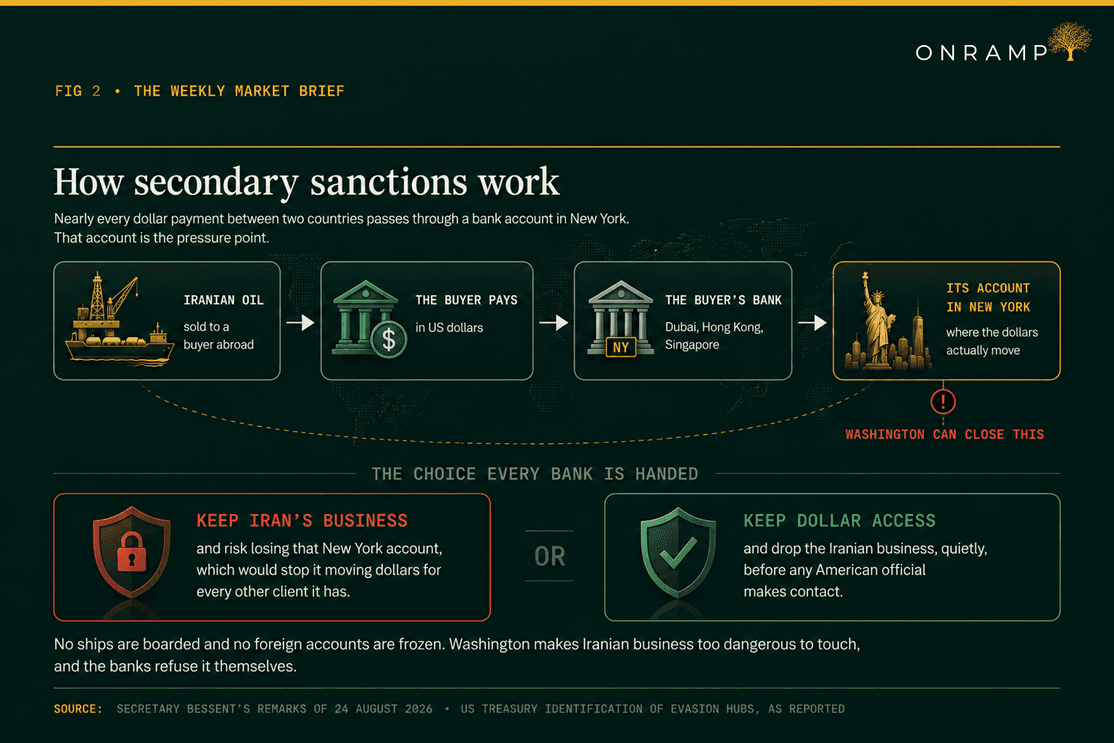
Most international trade is paid for in dollars, and nearly every dollar payment between two countries passes through banks that hold accounts in the United States. That is the pipe. A bank in Dubai, Singapore or Hong Kong that moves money for a sanctioned Iranian buyer risks losing its American accounts, and a bank without American accounts cannot move dollars for any of its customers. Faced with that, almost every bank drops the Iranian business voluntarily, before any American official contacts it. That is what secondary sanctions means: Washington does not board ships or freeze accounts one at a time. It makes Iranian business too dangerous for the world's banks to touch, and the banks then refuse it themselves.
Sanctions on Iran are not new. Washington cut Iranian banks out of the dollar system in 2012 and again in 2018, and those campaigns mostly punished Iranian firms and a named list of foreign buyers. Three things are new this time, on the administration's own description: the threat now runs to any bank in any country; groups that help Iran launder money will be expelled from the American financial system entirely; and Bessent told the public to expect a major sanctions announcement against one specific financial institution, which he did not name, by the end of this week. He called Monday a "warning shot."
Who is still buying, and how they pay
The campaign is aimed at banks because Iran's trade already lives outside the official system. China buys roughly 90 per cent of Iran's oil exports. The trade does not appear in Chinese customs data, which last recorded an official Iranian shipment years ago; the oil arrives indirectly, much of it processed by independent Chinese refineries known as teapots. Payment does not happen in dollars. The American Treasury's own sanctions office said in May 2026 that Iran settles its oil sales primarily in Chinese yuan, with Iranian exchange houses converting part of the proceeds into other currencies.
Beijing has answered the pressure directly. After Washington sanctioned a major Chinese refiner and four teapots in April 2026 for processing Iranian crude, China ordered its companies to ignore the American sanctions and keep buying, invoking its own Anti-Foreign Sanctions Law and calling the American measures an unlawful reach beyond US borders. Any company or bank operating in both countries is now caught between two legal systems: comply with Washington and face penalties in China, or comply with Beijing and lose access to the dollar. So the answer to who is helping Iran is China, openly, as state policy, paid in China's own currency. The world's second-largest economy has formally refused the choice Bessent offered, and that refusal is the central test of the campaign. The refusal is not total. Bessent said on Sunday 30 August 2026 that Beijing had agreed on the need to reopen the Strait fully and to keep Tehran from nuclear weapons. China is refusing on the oil and talking on the waterway.
The digital front
There is a second route around the banks, and both sides use it. As sanctions cut Iran out of banking and its currency collapsed, money moved into digital assets: the research firm Chainalysis puts Iranian outflows through them at 4.18 billion dollars in 2025, up 70 per cent in a year, with a clear preference for stablecoins, digital tokens that hold their value one-to-one against the dollar.
Washington attacks that route in a new way. A dollar stablecoin has an issuer, and the issuer can freeze it. This year the Treasury designated Iranian exchanges and wallet addresses tied to Iran's central bank, and Tether, the company behind the largest stablecoin, froze the money on instruction: nearly 475 million dollars of Iran-linked funds made unusable in under three months. So this summer produced a clean test of two kinds of digital money. One kind has a company behind it, and when Washington asked, that company switched off 475 million dollars. The other kind, bitcoin, has no company behind it, so there was nobody for Washington to ask. Iran and Russia have both drawn the obvious conclusion: reporting this year describes Iran using bitcoin for cross-border payments including weapons purchases, the toll Iran charges ships passing Hormuz was designed to be paid in digital assets, and Russia is reported to be building a stablecoin of its own with the freeze function deliberately left out. Washington has drawn the same conclusion, which is why its sanctions now target the exchanges where these assets are bought and sold. This week it went further, issuing a sectoral determination for digital assets, which brings the whole category inside the sanctions perimeter rather than naming targets one at a time.
What the oil market said
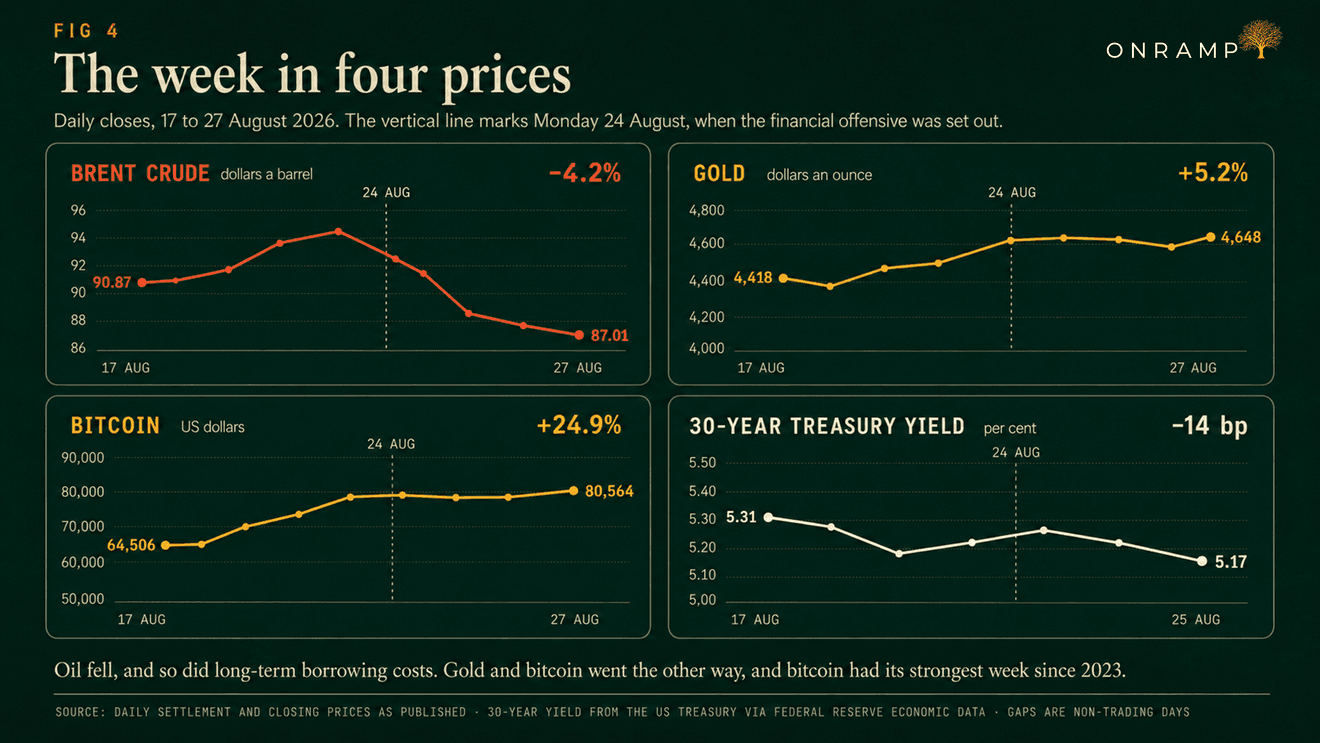
The oil market's reaction was the opposite of what most people would expect. The price fell. Brent, the international benchmark, dropped 3.9 per cent on Tuesday 25 August 2026 to 88.58 dollars a barrel, and American crude fell 3.1 per cent to 82.36. Brent had peaked at 94.39 on Friday 21 August; by Wednesday 26 August it was 87.84, a fall of about 7 per cent in three trading days. Traders read the change of weapons as a step away from the shooting: Bessent said the shift to sanctions means renewed war is unlikely for now, and the State Department was reported to be preparing to return evacuated diplomats to the region. Part of the oil price has been fear of the next strike, and moving the war from the sky to the banking system takes some of that fear out, even while the pressure on Iran goes up.
That reading lasted four days. On Sunday 30 August 2026 American forces struck two Iranian launchers on Larak Island in the Strait, which Central Command said were being prepared to fire rockets carrying sea mines into the waterway. It was the first publicly acknowledged American strike on Iranian territory since late July. Iran answered overnight with missiles and drones against two American bases in Jordan, eight of which Jordanian defences intercepted, and against the Emirates; no American personnel were reported hurt, and Qatar condemned both attacks. President Trump said the United States would respond. Brent rose about 2.5 per cent on Monday 31 August to around 90.30 dollars, touching 91.52, its highest since 25 August, and was above 91 as this brief went to press. The fear premium the announcement took out came back within the week, which tells you what the oil price is actually pricing: not the sanctions, but the next strike.
The clock on Tehran
How long can Iran hold out? The tanker-tracking firm Kpler estimates Tehran has enough oil already positioned outside the blockade for roughly four months of export revenue, after which, if the offensive works, oil income could fall toward zero. The pain inside the country is already severe: food prices have more than doubled in a year, and Iran's own state-affiliated news agencies describe eggs, rice, meat and bread as luxury goods for many families.
Against that stands nearly fifty years of practice. Iran has lived under some form of American sanction since 1979 and has built what one Rystad Energy analyst calls a survival economy. Its economy minister said this week the country is fully prepared to withstand more. Both things can be true: sanctions have a strong record of making countries poorer and a weak record of making governments give in. The diplomacy has not stopped either. Pakistan's army chief was in Tehran on Monday carrying, by Iranian accounts, a message from Washington urging a return to talks.
What Iran can do in return
Iran is not only absorbing pressure. Its biggest weapon is geography: it sits on the Strait of Hormuz and has turned passage into revenue, charging ships a toll reported at 5 to 7 per cent of cargo value, against the 3 per cent Oman charges for its alternative arrangement. It has answered strikes all war with missile and drone attacks across a region full of American bases and Gulf energy facilities. And its partners matter: Beijing buys its oil as state policy, and Moscow has for years helped route payments between China and Iran.
How much this adds up to is disputed, and honest people land in different places. Robert Pape, the University of Chicago political scientist who studies air power and coercion, argues the war has failed on its own terms: bombing cannot destroy Iran's buried missile and drone arsenals, Iran now controls a fifth of the world's oil at the Strait, and it is becoming what he calls a fourth centre of world power alongside the United States, China and Russia. His starkest arithmetic is that Iran's fifth of world oil plus Russia's tenth, with China absorbing the supply, could deny the West nearly a third of the world's oil. His critics answer that this overreads endurance: Iran's navy, air force, nuclear programme and much of its defence industry have been destroyed and its leadership killed, and surviving a war is not winning one. This brief takes no side, but the sanctions campaign is a bet that the critics are right.
The war is also thinning American forces elsewhere. The aircraft carrier George Washington is moving from the Pacific to the Middle East, which, as reported, leaves the Pacific without a single American carrier. Days earlier President Trump ordered the annual military exercises with South Korea substantially scaled back just before they began, citing his "very good relationship" with North Korea's Kim Jong Un, the cost, the "hostile" signal the drills send to a country he called "unthreatening and respectful" and South Korea's refusal to support the war on Iran. North Korea tested ballistic missiles the same week and gave nothing in return. A superpower fighting an expensive war in one region has fewer forces for another, and every government in Asia can see that.
The risk to the dollar itself
So what does using the dollar this way do to the dollar? Two things at once. Every use teaches the world to build around it: after roughly 300 billion dollars of Russian central bank reserves were frozen in a weekend in February 2022, central banks outside the Western alliance bought gold at the fastest pace on record and have kept buying. Every use also proves how much power the dollar still holds, because a threat from one official moved banks on three continents in a week, and the dollar still sits on one side of nearly nine in ten currency trades. Both are true, so the real question is whether the world's trade has anywhere else to go.
What could replace it
Start with the yuan, since that is where Iran's oil money already goes. In May 2026 the yuan was about 2.75 per cent of global payments by value across the SWIFT system, against the dollar's 50.73 per cent; in trade finance it reached about 7 per cent against the dollar's 82.5. China's own payment system, CIPS, is growing but remains small beside SWIFT and still leans on it for messaging. The obstacle is not plumbing. China maintains capital controls, so yuan cannot move freely in and out of the country. A government paid in yuan can buy Chinese goods, hold the money in Hong Kong, or convert it at a cost, which is exactly Iran's difficulty now. A currency you can be paid in but cannot freely take out is a payment method, not a place to keep national savings. Beijing could remove the controls tomorrow, and has declined to for over a decade, because that would mean giving up control of its exchange rate and letting money leave. The yuan can settle trade with China. It cannot become the world's settlement currency unless China becomes a different country.
Then gold, which has no issuer and which central banks are buying in record size for that reason. The problem is delivery. Gold is heavy, slow and expensive to ship and insure, so most of it stays in a few vaults in London, New York and Zurich, and settling means changing the name on an account at one of those vaults. That puts the permission problem straight back. Venezuela is the proof: 31 tonnes of Venezuelan gold, worth around 4.6 billion dollars, has sat in the Bank of England since 2008. Caracas asked for it back in December 2018 and the Bank refused, on the ground that the British government did not recognise the government asking. The case ran to the Supreme Court, which blocked the return in 2021, and the gold is still in London, with the Foreign Secretary telling Parliament in January 2026 that recognition had still not changed. China has noticed the same problem and is building an alternative. It keeps its own gold at home, held by the People's Bank of China rather than in any foreign vault, and since 2014 it has run an international arm of the Shanghai Gold Exchange for foreign counterparties. Bloomberg reported in September 2025 that the central bank has been urging friendly countries to buy bullion and store it inside China, with at least one Southeast Asian country interested, the metal being new purchases credited to that country's reserves rather than bars moved out of London. It is a serious offer, and it also shows the limit of the idea. A country storing gold in Shanghai has not escaped the permission problem. It has changed whose permission it needs, from London's to Beijing's. Gold held at home is truly yours but settles nothing quickly across a border. Gold held anywhere else settles quickly and can be refused by whoever holds the keys. That is why central banks buy it as savings rather than as a way to pay.
Which brings us to bitcoin, and this is a bitcoin company writing, so the claims here are limited to what can be demonstrated. It has no issuer, so there is no company any government can instruct, which is why the freeze that hit 475 million dollars of stablecoins this summer had no equivalent in bitcoin. It settles directly between two parties across a border in about an hour, with no correspondent bank in New York and no vault in London, which is the property gold lacks. Its supply is fixed and publicly verifiable, so no official can create more of it. And it is already used at this level, in the Iranian flows and the Hormuz toll described above.
The objections are just as real. Bitcoin is far too small to carry world trade today: the whole asset is worth on the order of a trillion and a half dollars against foreign exchange turnover of several trillion dollars every day. It moves too much to price a cargo, having risen about 25 per cent between 17 and 27 August 2026, which is welcome if you own it and useless if you are quoting a delivery price for March. And most people reach it through exchanges and custodians, which are companies with addresses and licences that Washington has already sanctioned in Iran's case, so the entrances remain controllable even when the asset is not. Anyone saying bitcoin ends American financial power this year is selling something.
The realistic path is narrower and more interesting. Money does two jobs: it pays for things now, and it stores value for later. Sanctions attack the second job hardest, because savings sit still and can be seized while payments only pass through. So savings move first, and they have already started, which is what record central bank gold buying since 2022 actually is. Stated plainly, bitcoin's case is this: it is the only asset with gold's independence from any government that can also cross a border in an hour without permission. That combination did not exist before 2009.
Which raises the question of whether central banks will ever hold it. The obstacle is not the asset. It is what buying it would say, and what reserves are legally for. A central bank exists to defend confidence in its own currency, so buying an asset whose entire premise is that government money loses value over time reads as the issuer betting against its own product. That reading carries a real cost, in the exchange rate and in what the government pays to borrow. Gold escapes this only because every central bank has held some for a century, so buying more says nothing new. The second obstacle is the mandate. Reserves are not a savings account. They are the fund a central bank uses to intervene in currency markets, which means the test is whether a large amount can be sold at once, in a crisis, to counterparties who will take it, and many central banks are also limited by statute in what they are allowed to hold at all.
That is the European Central Bank president's stated objection almost word for word: reserves must be liquid, secure, and free of any suspicion of criminal use. The Czech National Bank shows both obstacles at work. Its governor proposed putting up to 5 per cent of reserves into bitcoin, the board refused, and the compromise was a one million dollar test portfolio, approved on 30 October 2025 and held deliberately outside the international reserves, with the bank stating plainly that its reserve strategy had not changed. So the first real allocation is unlikely to come from a large economy protecting its currency's reputation. It is likelier to come from a country with less to lose and more to gain, one already outside the dollar's good graces or expecting to be. As for the idea that China will get there first, its own behaviour points the other way. Beijing's strategy rests on capital controls, and an asset that crosses borders without permission is the opposite of what a government enforcing capital controls wants in circulation. China is building gold vaults, not buying bitcoin.
Which leaves a probability rather than a prophecy. Whether the world adopts bitcoin is a different question from whether it works, and today it is being tested at the edges, under sanction, where the alternatives have already failed. The reserve case is stronger than the trade case for a simple reason. Reserves have three requirements: that they are not somebody else's promise, that they can be moved when they are needed, and that they can be sold in size. Dollars fail the first, as this week showed. Gold fails the second, as Venezuela shows. Bitcoin fails the third at the scale a large economy needs, and that is the only one of the three failures that gets smaller as more people own it.
How this might end
The rest of this brief is reporting. This section is our judgment, and should be read as speculation.
Three endings are possible for the war. A deal is what Washington is designing for, with the four-month oil clock as the deadline and the Pakistani channel as the door; the reason to doubt it is that Tehran has absorbed this kind of pressure for decades and treats surrender under bombardment as fatal to itself. Escalation is second, and is what Pape expects: the failure of air power pointing toward a ground operation to secure the Strait and the nuclear material. Third is a grind, in which sanctions bite, Iranian oil keeps leaving through China, and nothing resolves before the American midterm elections in November 2026. We think the grind is most likely, because it is the outcome that requires nobody to change their mind. The weekend's exchange of fire does not settle which of the three this is, but it does show that the financial campaign has not replaced the military one. The two are now running together.
On the money our view is firmer, because it does not depend on who wins. This week's lesson cannot be untaught. Every government watching now knows that a dollar reserve is usable at Washington's discretion, that a foreign gold vault can refuse to open, and that a dollar stablecoin can be switched off from an office in the United States. None of that reverses if Iran signs a deal in November. The dollar is not about to lose its place and the yuan is not about to take it. What is likely instead is a slow separation of money's two jobs: trade keeps being paid for in dollars because that is where the liquidity is, while more of the world's savings move into assets no government issues. That is already visible in the gold figures. Whether bitcoin takes a meaningful share of that second job is the open question of the next decade, and the thing to watch for is the first central bank that buys it and says so out loud.
What this means for you
Through your fuel bill first. The oil price now depends less on shipping lanes than on sanctions design: if the offensive works and Iran's stored oil runs out around the turn of the year, supply tightens and prices firm; if it fails and the shooting resumes, the fear premium returns. The cost of petrol and heating this winter is being set partly in the Treasury building.
Then through your savings. This week showed in public what money in a bank account is: a claim that works because the system it sits in permits it. For most people in allied countries that permission will never be questioned, and nothing here suggests otherwise. But the governments on the receiving end of these threats do not get that assurance, and their response is measurable, in gold reserves, in yuan settlement, and in money moving through assets nobody can freeze. If you hold bitcoin, this week's argument for it was made by officials rather than advocates: they showed that dollars can be denied, that stablecoins can be switched off, and that a foreign gold vault can decline to open. Bitcoin exists because none of those three can be done to it. Ray Dalio told Bloomberg the same week to sell bonds and buy gold and bitcoin. This brief makes no price forecast.
What we are watching
The named institution
Bessent promised a major sanctions announcement against a financial institution by the end of the week of 24 August 2026. It did not arrive in that form. What arrived on Friday 28 August was an action against the Emirati branches of Banque Misr, Egypt's second largest bank, over alleged Iranian links, which is a considerably smaller thing than the promise. On Sunday 30 August Bessent told the Associated Press that another bank would be sanctioned this week and described what is coming as financial violence if it has to be, and told Reuters to expect new secondary sanctions every week, with a full cut-off from the dollar system as a possible next step. The first target sits in the Emirates rather than in China, and that is the answer to the question of reach so far: Washington has started with a hub, not with Beijing.
Beijing's answer
China's blocking order and the American threats now point directly at each other. Watch whether a Chinese bank is named, whether Beijing retaliates, and whether banks in the Emirates, Hong Kong and Singapore announce compliance or go quiet. The first place to look is the G20 finance meeting in Asheville on 31 August and 1 September 2026, where Bessent said he would press his counterparts to cut ties with Iran and meet the Chinese delegation, with all options open on sanctioning Beijing itself.
The four-month clock
Kpler's estimate points to a revenue cliff around the turn of the year. Tanker-tracking data will show whether the offensive is closing the routes, and whether traffic through Hormuz continues to pay the toll.
The exit door
The Pakistani channel and any return to talks. These campaigns end at a table or grind on for years, and the first sign of which this is will be whether negotiations restart while the pressure builds.
The through line
This series has written all summer about who controls money and what that control is worth. The Rollover (4 August 2026) and The Bond Salesman (25 August 2026) showed that controller managing the price of its own debt at home. This week it aimed the same system at an enemy abroad, and the enemy's partners, including the second-largest economy on earth, refused to comply and kept building routes around it: yuan settlement protected by Chinese law, gold vaults offered in Shanghai instead of London, digital money designed so nobody can freeze it. Washington is demonstrating how much power lives inside the dollar system. Its adversaries are demonstrating how much the rest of the world will spend to get out from under it. Both lessons point the same way.
SOURCES: Secretary Bessent's CNBC interview of 20 August 2026, Financial Times article and press conference of 24 August 2026, quotations as reported by CBS News, CNN, Al Jazeera and The Epoch Times; President Trump's statements of the week of 17 August 2026, as reported; OFAC statements of April and May 2026 on Chinese refiners, yuan settlement and Iranian exchange houses, as reported; Beijing's directive to refiners under the Anti-Foreign Sanctions Law, per OilPrice and Fortune, May 2026; Chainalysis on Iranian digital-asset outflows and the freezing of nearly 475 million dollars of Iran-linked stablecoins; the Hormuz toll design as reported in August 2026; CNBC reporting of 25 August 2026 for oil prices; Kpler's estimate and the US Treasury's identification of evasion hubs, per CNN; Iranian food-price figures per the Statistical Center of Iran via the Iranian Labour News Agency, as reported; Robert Pape's April 2026 New York Times article and subsequent interviews, and published criticism of it; the carrier movement per Axios as reported by Fortune; the South Korea exercise reduction per the President's 16 August 2026 statement and CNN and Al Jazeera reporting; the February 2022 Russian reserve freeze and subsequent record central bank gold buying, per contemporary coverage and World Gold Council data; the Shanghai Gold Exchange International Board and the People's Bank of China's approach to foreign central banks per Bloomberg reporting of September 2025 and exchange materials; the Czech National Bank's test portfolio (approved 30 October 2025, one million dollars, held outside the international reserves), Governor Michl's rejected 5 per cent proposal and the ECB president's objections, per the bank's own press release and contemporary coverage; SWIFT currency shares for May 2026 (yuan 2.75 per cent of payments and about 7 per cent of trade finance, against the dollar's 50.73 and 82.5) as reported by the South China Morning Post, with CIPS scale per contemporary coverage; the Venezuelan gold dispute (31 tonnes, about 4.8 billion dollars, held at the Bank of England since 2008, return refused from December 2018, blocked by the Supreme Court in 2021, and the Foreign Secretary's statement to Parliament in January 2026) per Reuters, the Guardian, City AM and Euronews; BIS triennial survey data for the dollar's share of currency trades and for foreign exchange turnover; bitcoin market size per public market data; bitcoin's week and Ray Dalio's remarks per CoinDesk and Bloomberg, as reported. Market levels are stated as of their dated days, 17 to 27 August 2026, and the daily closes behind Figure 4 are provided in the accompanying data file. Developments of 28 to 31 August 2026 are dated in the text where they appear: the Banque Misr action and Secretary Bessent's remarks to the Associated Press and Reuters of 30 August 2026, as reported; the Larak Island strike per US Central Command and the Iranian response per Iranian state media and Jordanian and Qatari statements, as reported; oil levels for 31 August and 1 September 2026 per Reuters.
The Radar
What matters this week across digital assets, AI, and global markets.
Digital Assets & Regulation
The SEC reopens custody
Amendments to the Custody Rules reached the White House review office on August 25, the step before the commission can vote to publish it. The stated aim is to clarify how investment advisers and funds may hold digital assets, and to strip out provisions the agency calls outdated. The text stays sealed until review ends, so every claim about what it permits is inference. Its predecessor died in 2025 after advisers said it left them fewer options, not more.
A lifeboat, not a fix
Block 964,199 carried bitcoin's first quantum-resistant spend on August 26, moving 10,000 satoshis. The method swaps elliptic-curve signatures for hash-based ones, with no soft fork, no new opcode and no change to consensus rules. It did need a miner to accept it directly, because nodes will not relay the format, and it does nothing for keys already exposed. Its author still wants the protocol upgrade.
The house that built perpetuals
From August 26 BitMEX stopped letting anyone open a position, ahead of closing on September 23 after eleven years. The board says the decision followed a strategic review, not distress, a hack or regulatory pressure. BitMEX invented the perpetual swap, now the most traded product in digital assets, then watched its own daily volume fall from billions at the 2021 peak to a few hundred million. The product outlived the house that built it.
AI & Financial Infrastructure
Nvidia buys the ground
Nvidia said on August 17 it has secured land, power and shell capacity at a decommissioned uranium enrichment site in Pike County, Ohio, guaranteeing 4.25 gigawatts with an option on 3.75 more. OpenAI is the customer on a twenty-year lease from SB Energy, which with SoftBank will add ten gigawatts of generation. Nvidia is putting $1.5 billion into the developer. First capacity is due in 2028.
Samsung raises the price of silicon
Samsung lifted quotes on new advanced foundry orders in July, by 10 to 15 percent on its four and five nanometer lines and nearly 10 percent on an eight nanometer process. Reuters had it from two people; Samsung declined to comment. The reason is capacity: TSMC's leading edge is booked out, and Samsung, on 7 percent of foundry revenue against TSMC's 70, takes the overflow.
The labs start borrowing
Anthropic is arranging a revolving credit facility expected to price above its roughly $10 billion target, Bloomberg reported, with terms undisclosed. A revolver that size is unusual for a private company, and it points where Nvidia's Ohio guarantee does: the buildout has moved past equity. Compute is financed like infrastructure now, which works while the payments arrive.
Geopolitics & Markets
The chair declines to guide
Marking his hundredth day, Warsh used the Jackson Hole keynote to argue that forward guidance has overstayed its welcome, and that a Fed and a market reading each other produce a hall of mirrors. He offered no path for rates, said he would be hard pressed to call financial conditions restrictive, and closed that if underlying inflation is not moving to target, the Fed has work to do. Two-year yields rose; the long end fell.
The number underneath
The Fed's preferred inflation gauge ran 3.7 percent over twelve months. The six-month pace was 4.1, which is the direction that matters. Warsh disaggregated the index in public: 54 percent of its 199 components rose more than 3 percent over the year, against 32 percent across the two decades before the pandemic. He put the responsibility for 65 months of elevated inflation with the central bank. Summer's better prints did not change the trend.
Two elements nobody stockpiled
China processes essentially all the world's yttrium and supplies all its erbium oxide. Yttrium goes into ceramic capacitors and filters, erbium into the amplifiers that push light down fiber. Shipments to the United States are down about 75 percent this year, and the controls covering erbium, suspended last November, fall due for decision on November 10. There is no commercial-scale erbium producer outside China, and the nearest new yttrium
The Week in Numbers
| Indicator | Reading |
|---|---|
| Nvidia's quarter, more than double a year ago | $96.2B |
| Where it expects gross margin to bottom, on memory | 71% |
| The block carrying bitcoin's first quantum-safe spend | 964,199 |
| When the exchange that invented perpetuals closes | Sept 23 |
| When the SEC aims to publish its custody proposal | October |
| PCE inflation; the six-month pace runs 4.1% | 3.7% |
| Months of elevated inflation, by the chair's count | 65 |
| Fall in yttrium and erbium shipments to the United States this year | -75% |
What to Watch This Week
| Date | Why it matters |
|---|---|
| Sept 9 | Treasury's first operation under the enlarged long-end buyback schedule. |
| Sept 11 | August inflation, the last full price reading the Committee sees before it decides. |
| Sept 14 | The Senate returns and the parked market-structure bill's cloture motion ripens, fourteen working days from the end of the session. |
| Sept 15-16 | The Fed meets, with the first fresh projections since June and a chair who will not pre-commit. |
| Nov 10 | China decides whether to extend or lift the suspended controls on erbium and four other rare earths. |