October 23, 2026 Roundup: The Highest Number on the Page

Brian Cubellis | Chief Strategy Officer
Free. Every week. One story that matters, read all the way down.
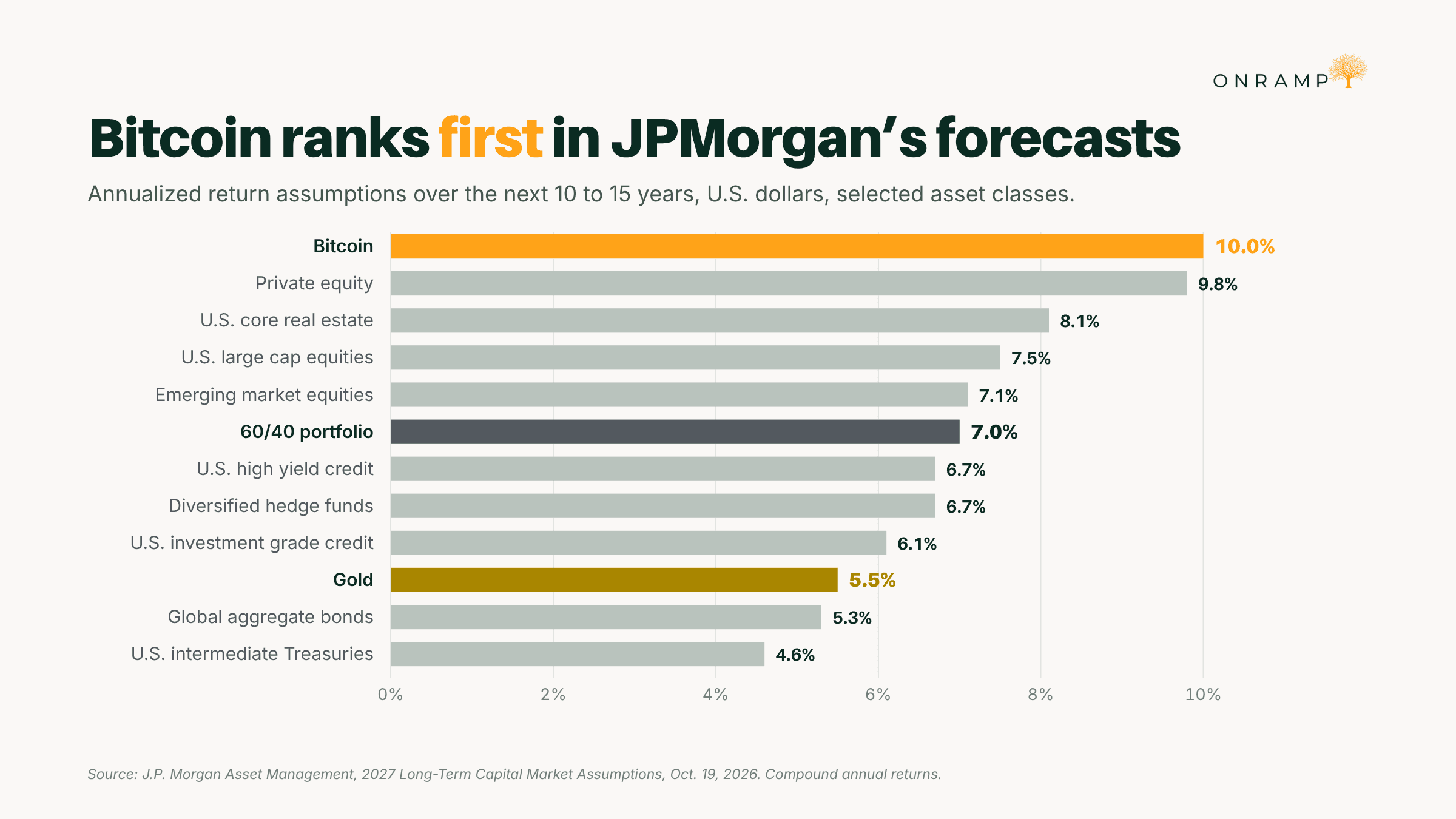
On Monday, J.P. Morgan Asset Management released the 2027 edition of its Long-Term Capital Market Assumptions. It is the thirty-first annual edition and the first to include bitcoin. JPMorgan assumes bitcoin will compound at 10.0% a year over the next 10 to 15 years, with 55% annualized volatility and an arithmetic expected return of 20.9%. No other asset class in the published assumptions scores higher. Private equity comes next at 9.8%, followed by U.S. core real estate at 8.1%, U.S. large caps at 7.5%, a 60/40 portfolio at 7.0% and gold at 5.5%.
The firm hedged the forecast. Bitcoin sits in a separate, smaller covariance matrix rather than the main one, and the authors write that “the volatility and unstable correlation of assets like bitcoin remain an obstacle to their widespread inclusion in portfolios.” They also call the currency-debasement case for bitcoin “wide of the mark.” Those are JPMorgan’s views, and we report them as such. The more significant fact is that bitcoin now has a row in one of the most widely read assumption sets in institutional finance.
Who it’s written for
Capital market assumptions are written for long-term investors. Pension funds, endowments, insurers and the consultants who advise them use these numbers to set a policy portfolio for the next decade or more. Each asset class gets an expected return, a volatility and a set of correlations, and those inputs go into a mean-variance optimizer of the kind Harry Markowitz described in 1952. Actuaries use the same figures to set discount rates, and Horizon Actuarial surveys dozens of these assumption sets every year because plan sponsors need a documented basis for every line in the portfolio.
An asset class without an assumption has no row in the optimizer, so in practice it gets no allocation. Bitcoin now has a row. JPMorgan stopped short of its main matrix, but a consultant who wants to run bitcoin through a portfolio study can now cite one of the largest asset managers in the world.
That audience also shapes how the 55% volatility figure should be read. For an investor with a ten-year mandate, risk is permanent impairment, capital that is lost and never recovered. Volatility measures how far the price swings around its trend, in both directions. The two are related but distinct, and the long-horizon investor’s advantage is the ability to sit through the swings as long as the trend is rising.
A low bar
Measured against bitcoin’s own history, 10% is a low bar. Bitcoin has compounded at about 62% a year over the past ten years, on Onramp Terminal daily prices. Point-to-point returns depend heavily on the start date, so we tested every one. Starting from each day since January 1, 2012, we measured the annualized return of every hold from three to ten years that ended on or before October 22, 2026.
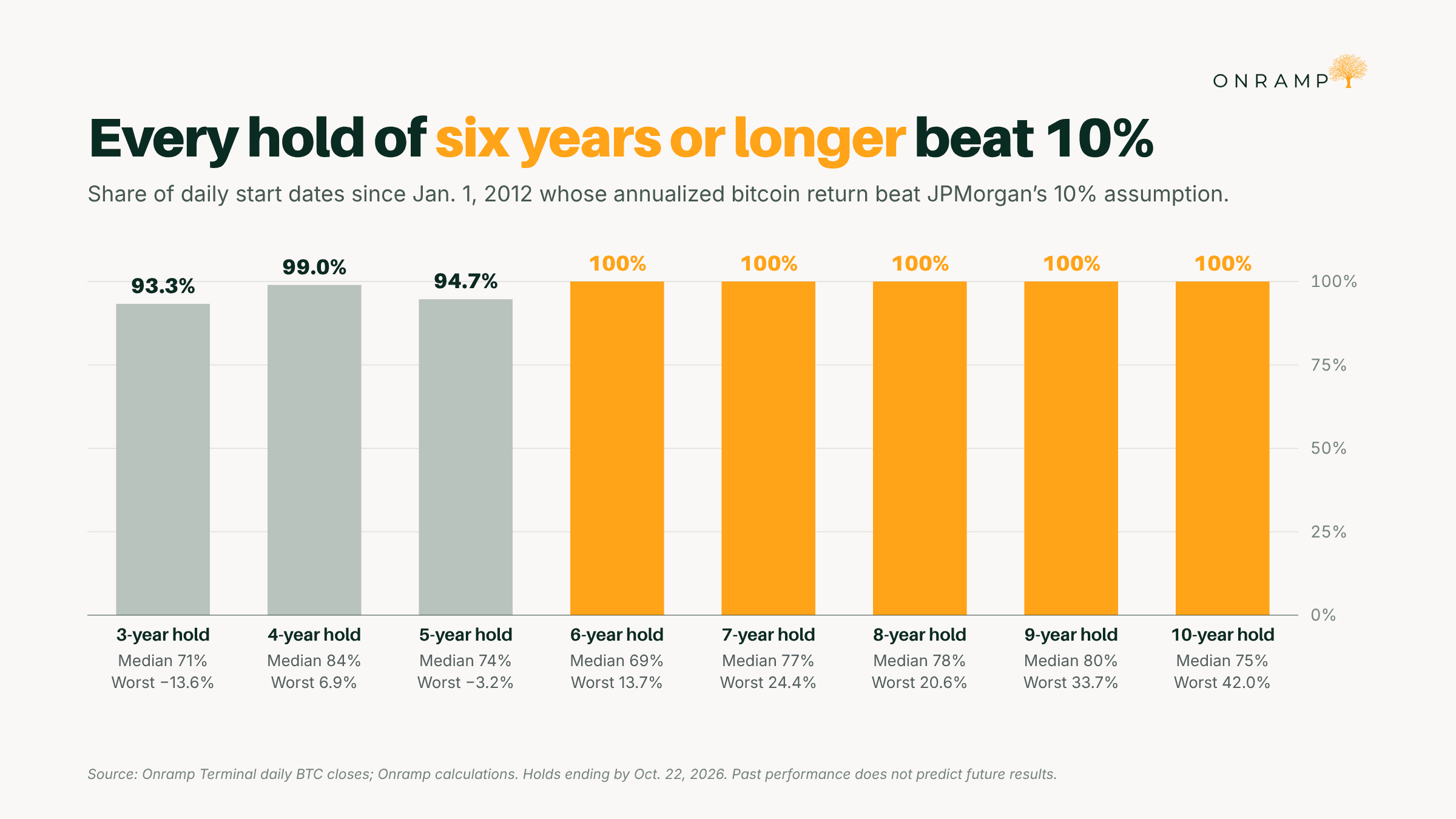
Every holder who stayed six years or longer beat JPMorgan’s base case. That is 12,436 start dates without a single miss, including buyers at the December 2017 peak. Even from the worst possible starting day for a ten-year hold, bitcoin compounded at 42% a year, more than four times the assumption. Every shortfall came from a hold of five years or less that began near the 2013, 2017 or 2021 highs, and buyers at the 2013 and 2017 highs who held one more year cleared 10%.
Over short horizons the entry price and the swings decide the outcome. Over long horizons the trend does. One point of honesty: the five-year windows that began in November 2021 close next month, and at today’s price they would fall short as well.
Historical returns describe the past, and JPMorgan’s 10% describes a larger and more mature asset than the one that compounded at more than 60% a year. Still, the record shows how much room separates JPMorgan’s base case from what patient holders have actually earned.
Volatility is a feature
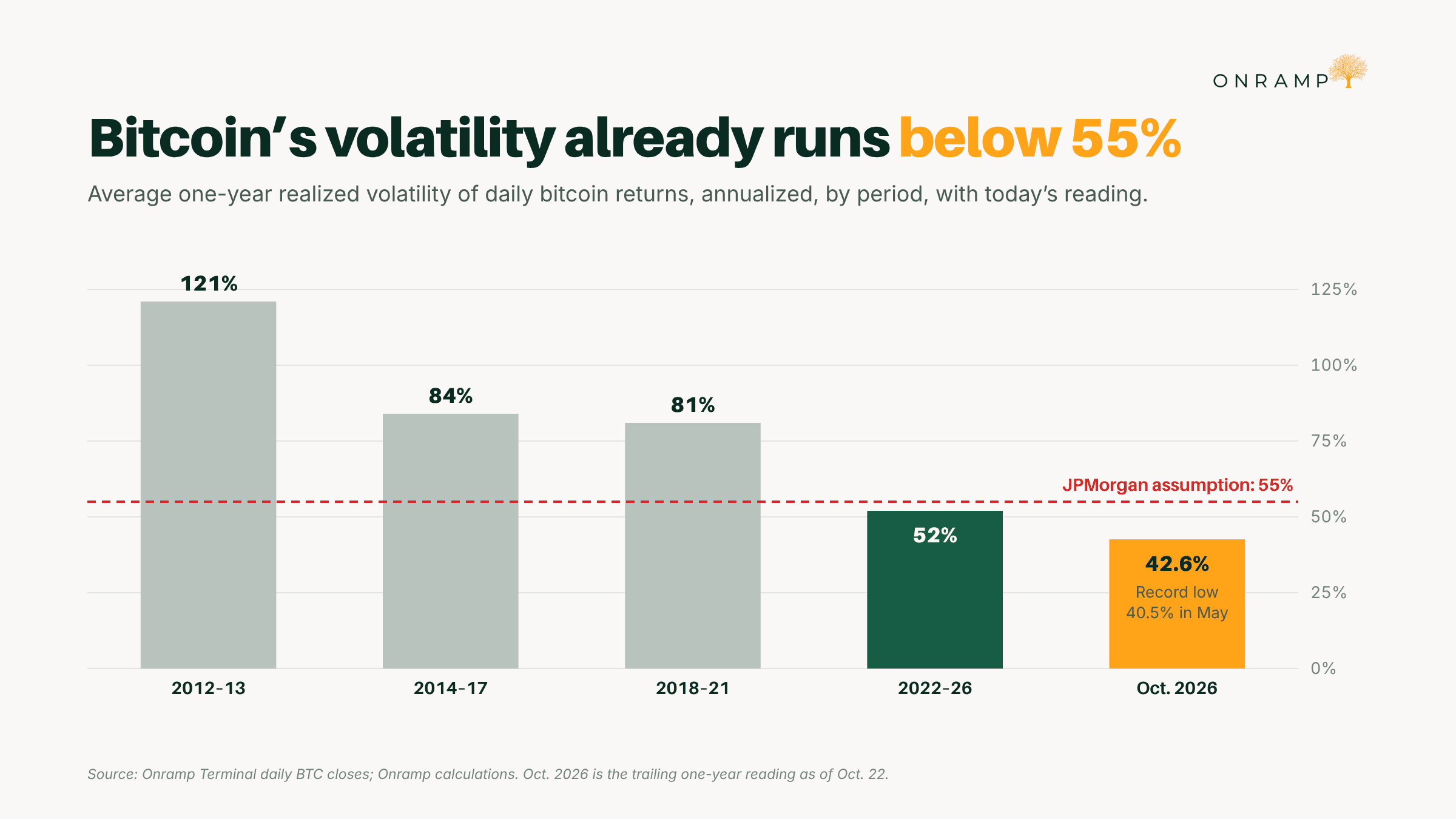
Most of the gap between JPMorgan’s 20.9% arithmetic return and its 10.0% compound return is volatility drag, and the three figures fit the standard lognormal relationship. Hold the arithmetic return at 20.9% and swap in bitcoin’s trailing one-year realized volatility of 42.6%, and the implied compound return rises to about 14%. That is a sensitivity check rather than a forecast, but it shows how much of the 10% rests on a single input.
That input looks high. On Onramp Terminal data, one-year realized volatility averaged about 121% in 2012 and 2013, 84% from 2014 to 2017 and 81% from 2018 to 2021. From 2022 through this year it averaged 52%, and in May it hit a record low of 40.5%. JPMorgan’s 55% sits above both the current-era average and today’s reading. JPMorgan’s own authors allow that their treatment “may evolve” if volatility continues to decline and correlations stabilize.
The direction of bitcoin’s volatility matters more than its size. Standard deviation counts a 20% rally and a 20% decline as the same amount of risk, a convention that comes from assets where the two rarely arrive in equal measure. Stocks and credit have negatively skewed returns. Their gains tend to accumulate gradually, and their largest moves are mostly sharp declines, so for those assets higher volatility usually means more downside and treating volatility as risk is a reasonable shortcut.
Bitcoin’s returns skew the other way. Its largest moves have tended to be to the upside, so a large share of what its volatility measures is gains, and its declines have historically been recovered within the hold periods tested above. The Sortino ratio was built for this distinction. It divides excess return by downside deviation alone, so it measures return against the outcomes an investor actually wants to avoid.
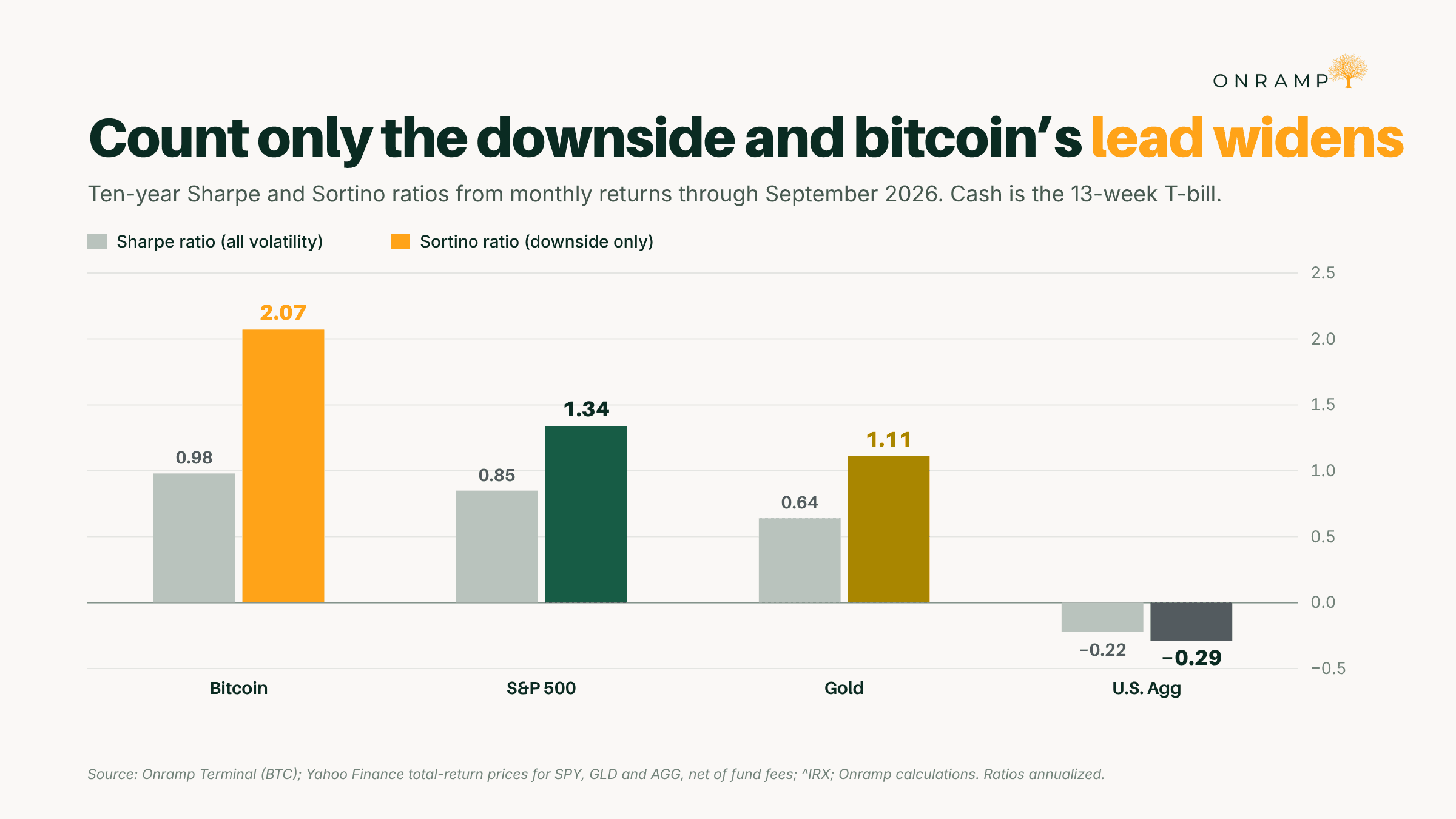
Over the past decade, bitcoin leads on both measures, and the downside measure widens the lead. Moving from Sharpe to Sortino roughly doubles bitcoin’s ratio, while it raises gold’s by about 1.7 times and the S&P 500’s by about 1.6 times. That gap is the positive skew showing up in the numbers. A large share of what a 55% volatility figure penalizes is the part of the distribution holders want.
When volatility returns
The consensus view is that bitcoin’s volatility will keep falling as ownership broadens and liquidity deepens, and that view sits underneath JPMorgan’s suggestion that its treatment may evolve. There are good reasons to doubt it.
Bitcoin’s supply cannot respond to demand, so every shift in demand shows up entirely in price. Adoption has not arrived smoothly either. It has come in waves, and the next one could be set off by accelerating debasement or by institutional understanding reaching a tipping point. Either would bring a fast repricing that shows up in the data as volatility, and given the skew of bitcoin’s returns, most of it would likely be to the upside. A model that reads falling volatility as maturity, and maturity as lower returns, would record that episode as added risk. For a holder with a ten-year horizon, most of that volatility would arrive as return.
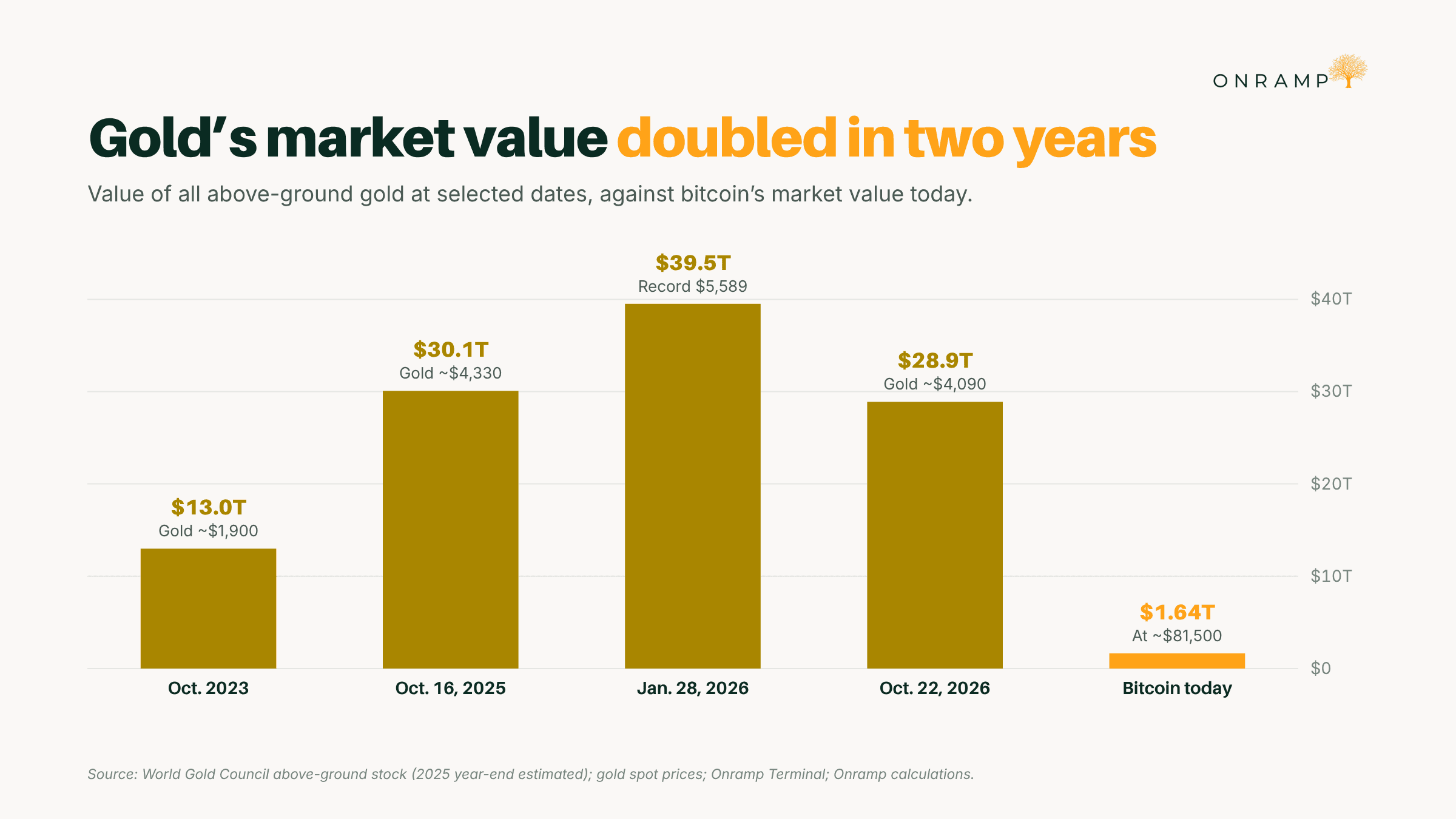
The same models usually assume that an asset’s returns fade smoothly as it grows. The asset JPMorgan placed beside bitcoin argues otherwise. In October 2023 the world’s gold stock was worth about $13 trillion. It crossed $30 trillion on October 16, 2025, and reached about $39.5 trillion at January’s record before settling near $29 trillion today. The oldest and largest monetary asset in the world more than doubled in two years, from a base nearly eight times bitcoin’s current value of about $1.64 trillion, while nearly every model treated it as mature. Size did not stop gold from repricing once the monetary backdrop changed, and we see no reason it would stop bitcoin, whose supply schedule is fixed.
Bottom line
JPMorgan has given bitcoin a return assumption, and it is the highest number in the firm’s published tables. It rests on a volatility estimate above any recent reading, and it treats upside swings as risk. The rolling record, the Sortino ratio and the upside skew of bitcoin’s returns all suggest the figure is conservative.
The audience for this document is long-term by construction, and for that audience volatility is the price of holding the best-performing asset of the past decade rather than the definition of risk. Allocators who needed a citable basis before acting now have one.
Closing Note
Onramp provides bitcoin financial services built on multi-institution custody. To learn more about our products for individuals and institutions, schedule a consultation to chat with us about your situation and needs.
Until next week,
Brian Cubellis