November 13, 2026 Roundup: The Key-Man Discount

Brian Cubellis | Chief Strategy Officer
Published
Free. Every week. One story that matters, read all the way down.
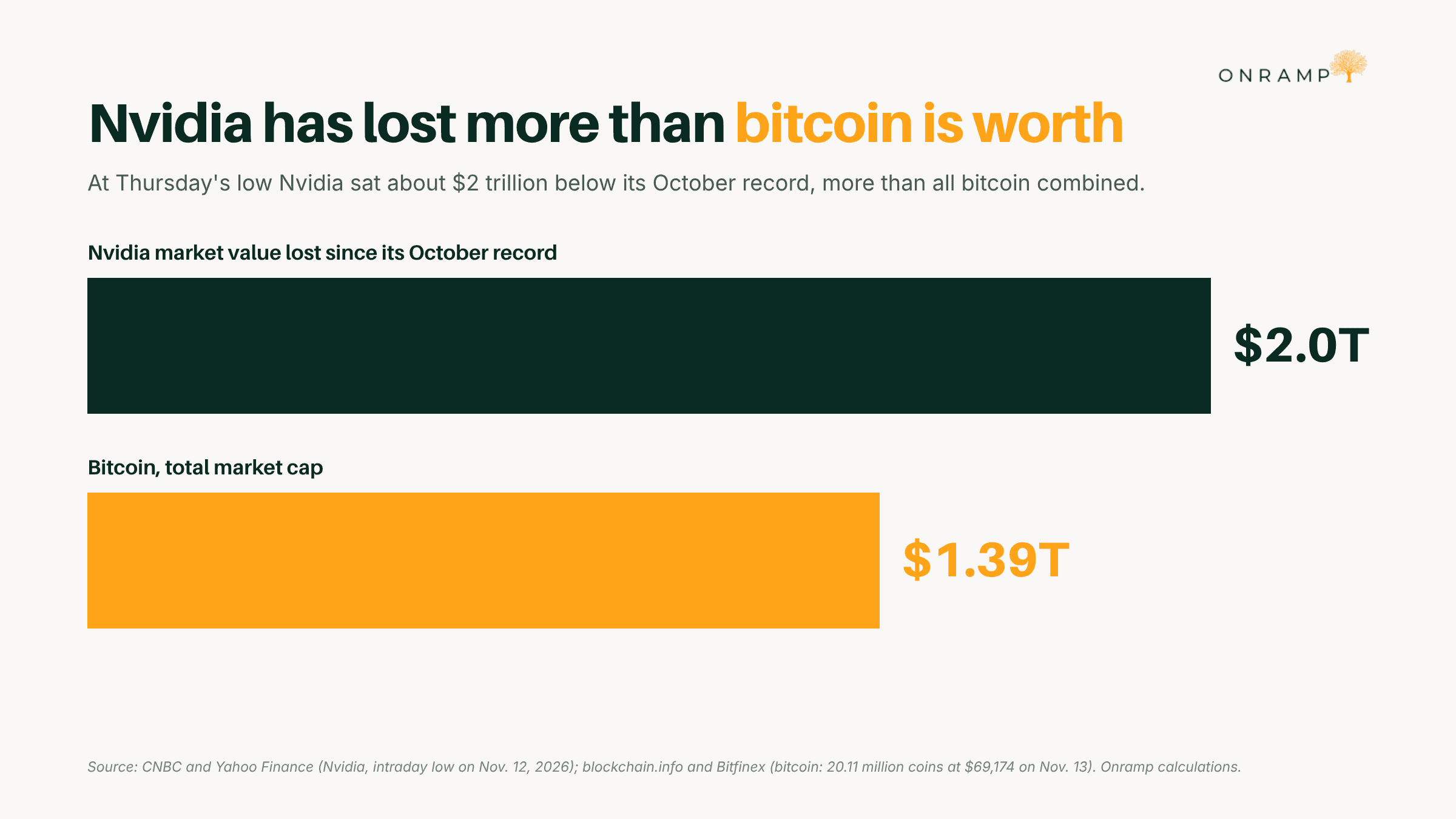
Jensen Huang resigned from Nvidia on Thursday morning, four days after the board opened an investigation into his relationship with a woman US intelligence officials believe was working for Beijing. The stock opened 13% lower and, at its lows, had wiped out about $2 trillion of market value since early October, a sum larger than the entire market capitalization of bitcoin. Bitcoin fell with it, breaking below $70,000 this morning to its lowest level since August.
The scandal will hold the headlines for a while, but the affair is the least interesting part of the week. For three years the market has treated AI as a single, self-evident bet and Nvidia as the safest way to own it. The last five sessions showed how conditional that bet has always been. It needs a particular founder, a balance sheet willing to finance its own customers, a permissive stance in Washington and a central bank that stays out of the way, and it lost or strained all four at once.
Bitcoin traded as if it belonged to that structure, even though it shares none of those conditions.
The key man
Equity analysts apply a ‘key-man discount’ to small companies whose value walks out the door with one person. Nobody thought to apply it to what was, until this week, the most valuable company in the world. Wall Street is applying it now. Dan Ives puts the haircut at 25% to 30%, ten analysts cut their targets in four days, and the stock trades at roughly 13 to 14 times forward earnings, close to its lowest multiple since 2012. Colette Kress, the CFO, takes over on an interim basis and reports earnings on Tuesday.
The tape was precise about what it was repricing. Rival chipmakers rose on Thursday while the neoclouds Nvidia finances fell hardest. What sold was anything whose financing runs through Santa Clara.
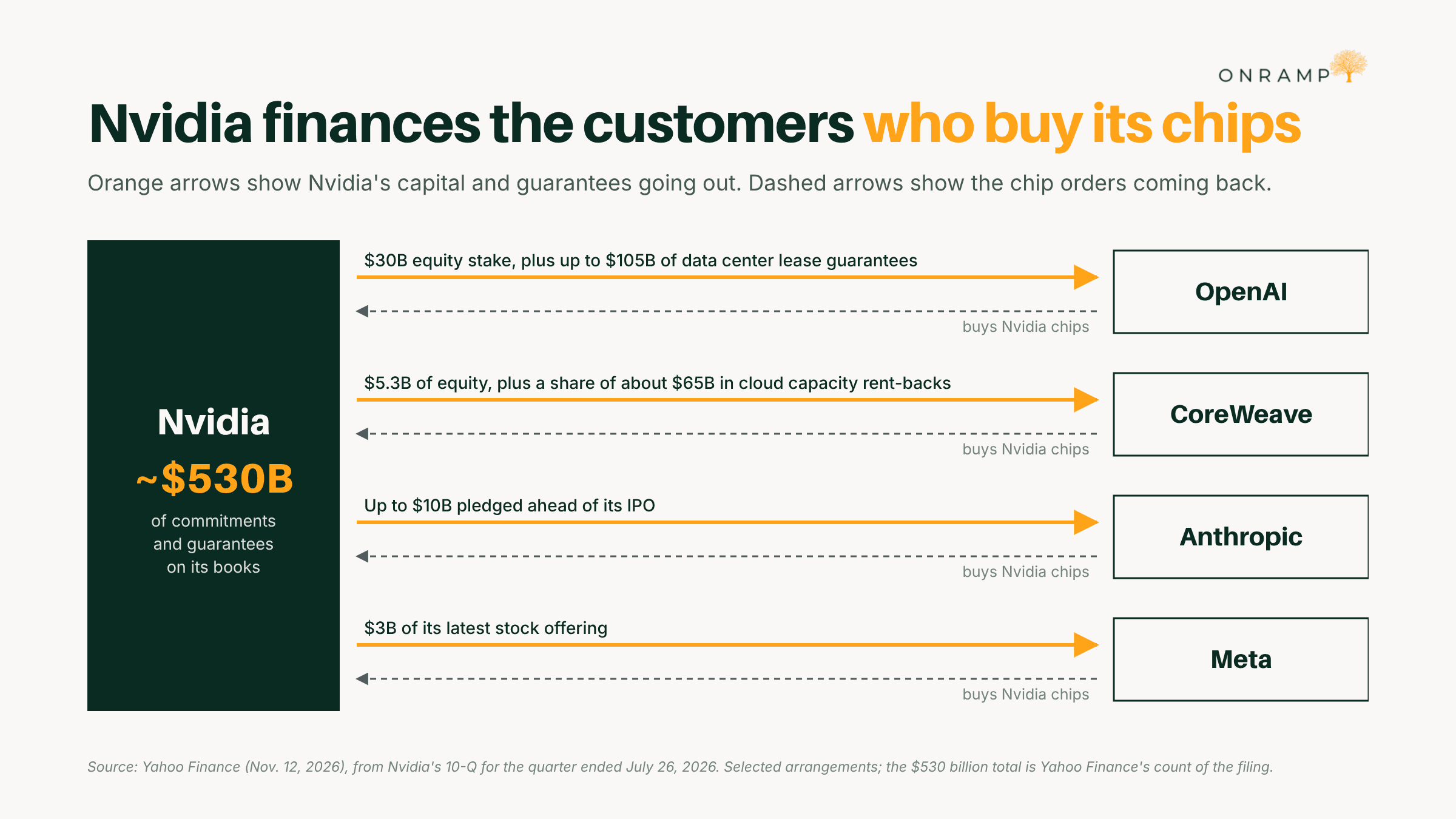
Nvidia’s customers are, to an uncomfortable degree, Nvidia’s borrowers. The company has guaranteed data center debt, prepaid for capacity from the neoclouds that buy its chips, and put at least $30 billion into OpenAI, which spends the money on compute. Yahoo Finance counts roughly $530 billion of commitments and guarantees in Nvidia’s latest quarterly filing, and CNBC reports that the Fed and the IMF are both studying the exposure. The nickname that has stuck is “the central bank of AI.”
Anyone who covered telecom equipment in 2000 has seen this arrangement before. Lucent and Nortel lent their customers the money to buy their gear, booked the sales as revenue, and found out when the capital markets closed that they owned the credit risk of an entire industry. Hyman Minsky distinguished borrowers who can pay out of cash flow from those who can pay only by refinancing, and much of the AI complex sits in the second group. That works for as long as new money keeps arriving at higher marks.
New money was harder to find this week. OpenAI went out for $30 billion at a $1.4 trillion valuation and closed $15 billion at $1.25 trillion. Anthropic began its roadshow on Tuesday for an IPO that would raise as much as $64 billion, the largest on record, and is reported to be pricing next week. The exposure that should worry people sits one layer out from Nvidia, in private credit funds that lent against GPU collateral and long-dated capacity contracts on the assumption that the sponsor behind them was beyond question.
The empty seat in Washington
Huang was more than an operator. He was the industry’s most persuasive voice in Washington, and the two causes he pressed hardest were keeping open-source models available and keeping the Chinese market open to American chips. He had the president’s confidence on both. That seat is now empty. Members of both parties spent Thursday calling for tighter export controls, and Elizabeth Warren, in line to chair Senate Banking after last week’s sweep, has made clear the inquiry continues without him.
The timing deserves a few thoughts. The story surfaced days after an election that reassigned the committee gavels, in the middle of an open fight over export controls, and a week before the largest AI listing on record. It may well be coincidence, and nothing in the reporting says otherwise. The counterintelligence findings came from US officials, and Huang has admitted the relationship while denying that anything sensitive changed hands.
Markets are still entitled to notice who is better off. The most prominent defender of open models and of Chinese demand is gone, and the closed-model labs, the rival chipmakers and the export hawks all inherit a more favorable field than they had a week ago.
The Fed is on the other side
None of this would matter as much if money were getting cheaper. It is getting more expensive. Consumer and producer prices both ran hot in October, futures treat a December hike as a certainty, and the 10-year yields 5.15%.
Beth Hammack of the Cleveland Fed said on Thursday that AI investment is part of the demand she wants higher rates to restrain, which closes an awkward loop. The capex boom feeds the inflation, the inflation brings the hikes, and the hikes raise the cost of funding the capex boom.
From here the paths narrow to two. The Fed can hold its nerve, in which case the trade deflates and takes equity-linked tax receipts and household balance sheets down with it, at a time when the Treasury is already buying back its own bonds to support liquidity and 30-year paper clears above 5.6%. Or Washington can conclude that the buildout is a strategic asset and ease before inflation is beaten. Neither path ends with fewer dollars in circulation.
What sold, and why
Bitcoin’s drawdown has ordinary explanations. Spot ETFs have bled for six straight sessions, about $1.5 billion in total. More than $1.4 billion of leveraged positions were liquidated in the 24 hours through Friday morning, nearly all of them longs. To the marginal seller, bitcoin lives in the same brokerage account as QQQ, is financed with the same margin, and goes out on the same call.
Gold fell too, down nearly 4% on the week and to a 13-month low near $3,850 on Thursday, and that should discipline the argument. A 5% risk-free rate is competition for anything without a coupon, and it will remain so until the Fed is finished.
Correlation with tech in a week like this one is real, and it is also episodic. Onramp’s research on a decade of daily returns puts bitcoin’s rolling three-month correlation with the Nasdaq between 15% and 36% depending on the window, with episodes above 70% that have not lasted. It is a fact about who holds bitcoin at the margin and how they are financed, and it tends to pass when they are done selling.
A shorter list
An investor who wants to own the AI trade for the next decade has to believe that Nvidia finds a successor capable of holding the franchise together, that $530 billion of commitments is money good, that Congress leaves the China business and open models alone, that the labs can keep raising at trillion-dollar marks, that the capex eventually earns its cost of capital, and that rates cooperate along the way. These are correlated bets, and a miss on one raises the odds of a miss on the next.
The equivalent list for bitcoin is short. There is no chief executive to compromise and no board to convene. There are no earnings to miss, customers to finance or debt to roll. The supply schedule has not changed since 2009 and takes no input from the Fed, from Congress or from the price. Governments can tax it and regulate the on-ramps, and those are real frictions, but the network does not need anyone’s license to produce the next block.
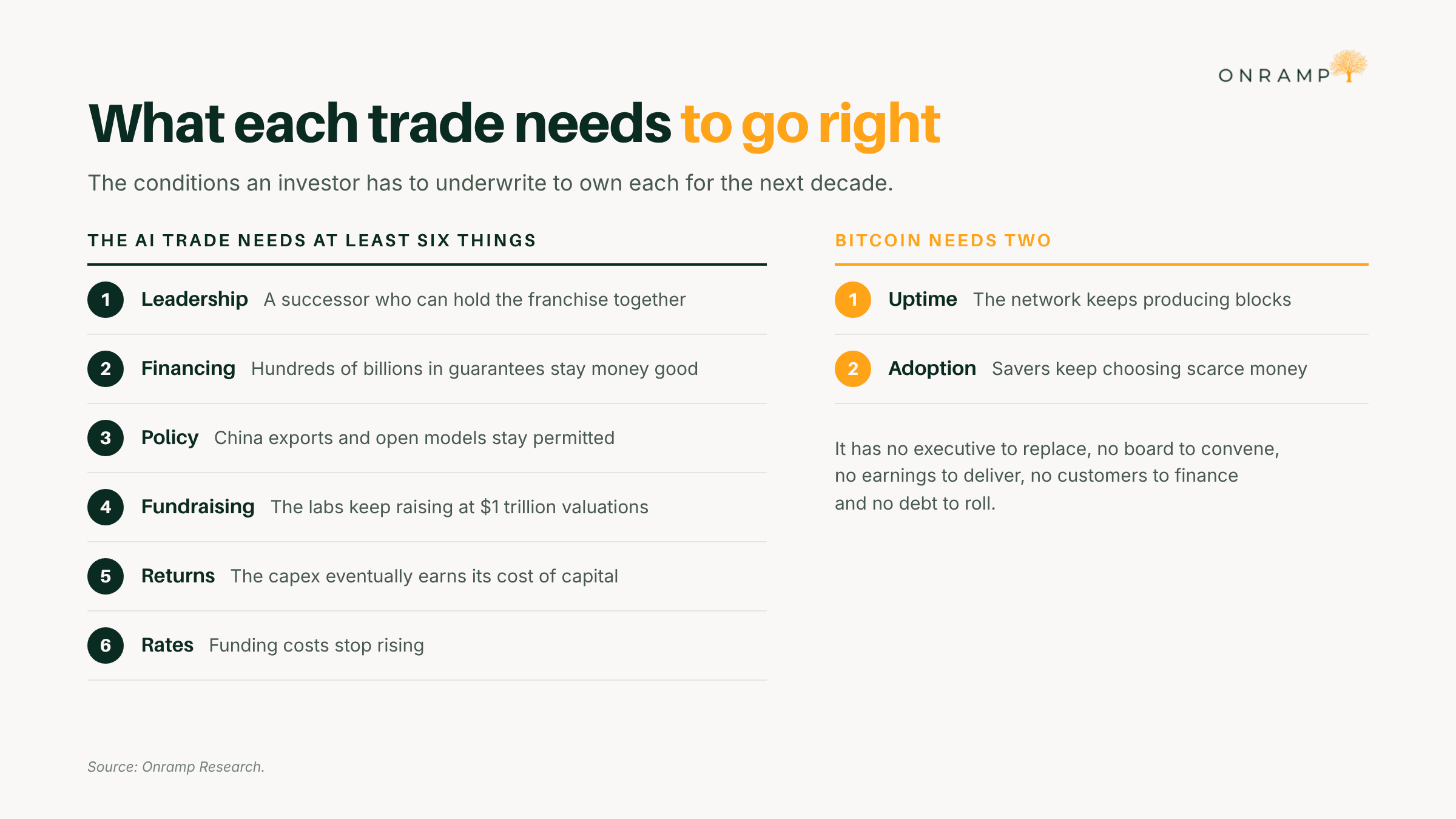
What remains to underwrite is whether the network keeps working, which it has through every drawdown since 2009, and whether the number of people who want a monetary asset that cannot be diluted keeps growing. The second question is the one this week speaks to.
Both exits from the Fed’s bind run through the public balance sheet, and the public balance sheet is ultimately the currency. The buyers who set bitcoin’s long-run price are the ones who watch the market’s largest company turn on one man’s private life and decide to hold some of their savings in something with fewer ways to fail.
That is a claim about the destination and it comes with no promise about the route. If the Fed hikes into a deflating AI trade, bitcoin can keep falling alongside everything else. The thesis survives the drawdown because nothing in it depended on Nvidia, on the Nasdaq or on the Fed’s patience.
Closing Note
Onramp provides bitcoin financial services built on multi-institution custody. To learn more about our products for individuals and institutions, schedule a consultation to chat with us about your situation and needs.
Until next week,
Brian Cubellis