November 6, 2026 Roundup: The Uniparty Spigot

Brian Cubellis | Chief Strategy Officer
Published
Free. Every week. One story that matters, read all the way down.
Tuesday’s Democratic sweep will move committee gavels in January, and the talking heads are already treating it as a critical turning point. For the dollar it will be nothing of the sort. The new majorities inherit the same balance sheet, the same interest bill and the same incentive to keep both growing.
That continuity is the foundation of the bitcoin thesis. The case for a neutral, finite money has never depended on which party wins an election. It rests on a fiat credit system whose trajectory no election changes, run by two parties that face the same incentives, the same fiscal constraints and the same temptation to resolve both with new money. An asset that sits outside that system becomes more valuable the longer the system runs, regardless of who is running it.
One trajectory
Since 1969 the federal debt has grown in every presidential term, under six Republican presidents and four Democratic ones, and through every combination of House and Senate control the country has produced. It went from about $360 billion at the end of 1968 to $40.5 trillion this week. The money supply grew in every one of those terms as well.

The deficit debates that fill every campaign are debates over pace and over who receives the money. Reagan’s first term grew the debt 16% a year. Obama’s first term, which opened inside the financial crisis, grew it 11% a year. The first Trump term added $7.8 trillion, and the Biden term added $8.5 trillion. The most restrained stretch in fifty-five years, Clinton’s second term with a Republican Congress, still added $340 billion. No arrangement of power in Washington has ever made the debt smaller.
One set of incentives
There is a Uniparty in Washington, and its one durable platform is the expansion of the fiat debt system. Its members argue loudly about where the money goes and almost never about whether it should be created. The reason is structural. Spending builds constituencies, taxes cost votes, and borrowing lets both parties hand the bill to future taxpayers and to everyone who holds dollars. When the borrowing outruns the market’s appetite, the Federal Reserve absorbs the excess, and the cost arrives as a tax on savings.
That tax falls unevenly. New money reaches the government, the banks and the owners of financial assets first, and it reaches wage earners and savers last, after prices have already moved. Richard Cantillon described the mechanism in the eighteenth century. It also explains why neither party will ever surrender the power to create money. Control over the currency is control over who gets paid first. An election decides who sits closest to the spigot. It has never decided whether the spigot stays open.
One set of fiscal realities
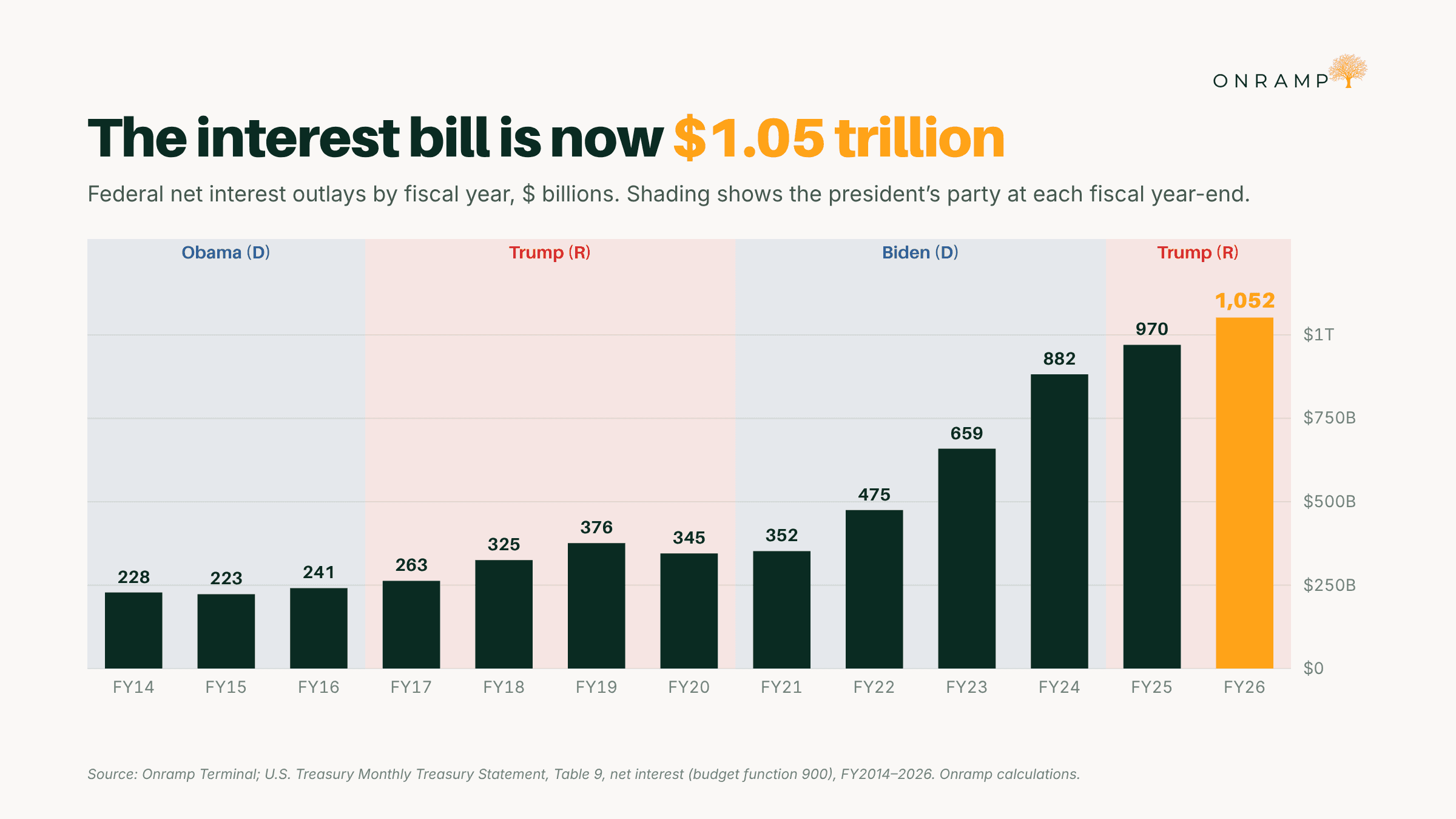
Whatever their preferences, both parties now govern inside the same arithmetic. Net interest on the federal debt reached $1.05 trillion in fiscal 2026, roughly triple its 2020 level, and roughly $10 trillion of Treasury debt has to be refinanced every year. Every rate hike adds to that bill, and every attempt at real spending restraint runs into Social Security, Medicare and the interest payments themselves, which together claim about half the budget before Congress votes on anything.
The buyers are changing too. Foreign investors held 49% of publicly held Treasury debt in 2008, and today they hold about 30%. Foreign central banks have spent the past several years buying gold instead. The Treasury needs a new source of demand for its paper, and the answer both parties have converged on tells you everything about the shared incentive.

That answer is the dollar stablecoin. The GENIUS Act passed the Senate 68 to 30 in June 2025 and the House 308 to 122 a month later, with Democratic votes in both chambers. It requires every dollar stablecoin to be backed one for one by cash and short-term Treasuries, which turns every issuer into a mandated buyer of government debt. Treasury Secretary Scott Bessent has called a $2 trillion stablecoin market reasonable and said the policy will “lock in” the dollar’s position in the world.
The market is worth nearly $300 billion today, and Tether alone reported $122.8 billion in Treasury bills in its September 30 attestation, more than the United Arab Emirates holds. A saver in Buenos Aires or Lagos who buys a dollar token to escape their own currency becomes a lender to Washington without even knowing it.
Democrats have been the louder critics of digital assets, and they will keep attacking the Trump family’s token ventures. Very few of them will vote to dismantle a system that finances the deficit with demand from abroad. Whichever party controls the Treasury next will want that buyer as badly as this one does.
The funding question
The election did move one market. On Thursday the Nasdaq had its worst day since April 2025, erasing roughly $2.5 trillion in market value, while the Nasdaq-100 had its worst since 2020 and semiconductor stocks fell more than 12%. Chipmakers, data-center operators, neoclouds and the utilities powering the AI buildout were at the center of it. Traders tied the selloff to Tuesday’s results, which reached several key data-center states and brought in newly elected officials who, as one strategist put it, are “looking to slow the pace of AI infrastructure development.”
The election was the trigger, and the fragility was already there. A day earlier, Citrini Research argued that growth in AI capital spending is peaking, with the largest commitments already made and ecosystem revenue of roughly $200 billion still far short of what the buildout costs. A growing share of that spending is financed with debt and equity issued into a market whose appetite for new paper is thinning, and the largest AI listings are meeting resistance.
OpenAI has pushed its listing into next year, and three major investors in Anthropic’s planned IPO told the Wall Street Journal on Thursday that its $1.5 trillion valuation target will likely have to come down, with one putting the figure closer to $1 trillion. None of this ends the buildout. It shows where private balance sheets begin to run out of room.
When that gap grows large enough to threaten the economy, the response will look like every response before it, with more liquidity, more guarantees and more Treasury paper. Both parties share that reflex, whichever one is promising to slow the data centers down. A new majority can change the rules for AI infrastructure. It cannot change who ends up underwriting the economy when private financing tightens.
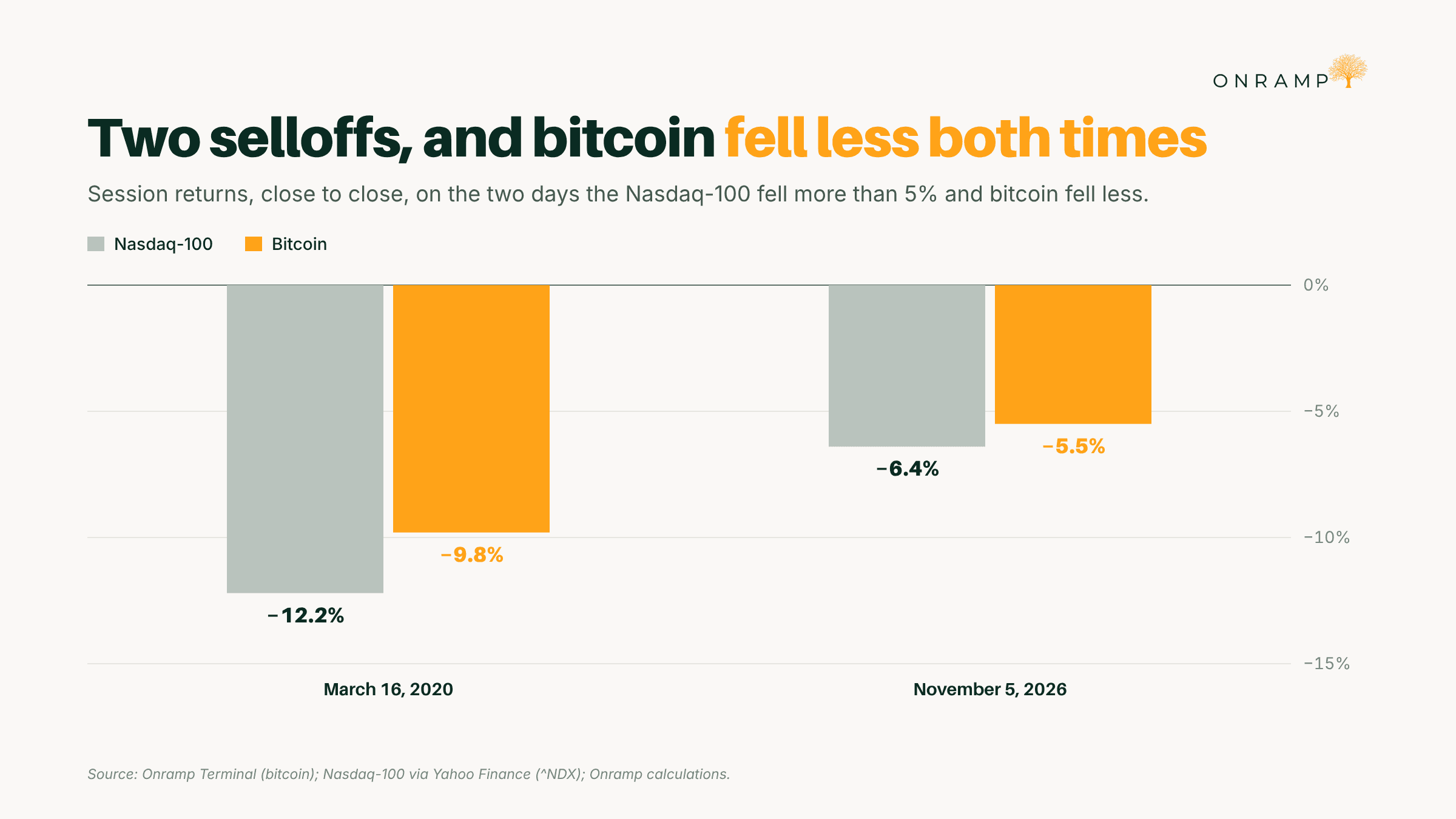
Bitcoin fell on Thursday too, by 5.5%, against a 6.4% drop in the Nasdaq-100. That has happened only once before on a day the index fell more than 5%, on March 16, 2020, the first trading day after the Fed cut rates to zero and restarted quantitative easing. One session proves little by itself, but it is a fair preview of how an asset outside the credit system trades when that system starts to strain, and of the policy response that usually follows.
The asset outside the system
In late 2023 I described bitcoin as apolitical money. Three years and two federal elections later, the description holds better than ever. Bitcoin has no issuer and no board. Its supply is capped at 21 million coins, its issuance schedule has been public since 2009, and its rules are enforced by tens of thousands of independent nodes that no government controls. Changing its monetary policy would require persuading a global, adversarial network of holders to accept the dilution of their own savings.
That inverts the arrangement behind every fiat currency. The dollar’s supply is set by the people who gain the most from expanding it. Bitcoin’s supply is set by a rule those people cannot reach.
Economist Albert Hirschman argued that people dissatisfied with an institution have two responses available, voice and exit. Elections are voice, and fifty-five years of the debt chart show how little voice accomplishes when the issue is the currency itself. Bitcoin is the exit. For the first time, an ordinary saver can hold money whose supply no election, appointment or emergency can change, and can move and verify it without anyone’s permission.
Gold filled this role for most of monetary history, until 1971 cut the last link between the dollar and anything scarce. Bitcoin restores a hard monetary base in a form native to the digital rails now being built for the dollar itself. The stablecoin buildout extends the dollar’s reach, and in doing so it extends the reach of the system bitcoin was designed to stand apart from. Every new holder of a digital dollar holds the same debasement, on rails that already connect to the alternative.
Neutral by design
The past two years have made that neutrality harder to see. For many voters, bitcoin was folded into the administration’s broader digital asset brand, alongside the $TRUMP meme coin and World Liberty Financial. The conflicts of interest and the carnival around those projects soured a large part of the public on the entire category, and most people still cannot separate bitcoin from the token market that surrounds it.
The differences are structural. The political tokens have issuers, insiders who hold large shares of supply and founders who profit from every sale. Bitcoin has none of those things. Its creator stopped communicating in 2011 and never moved the roughly one million coins he mined.
What an election can change
Elections change regulators, committee chairs and the tone of hearings, and as Thursday showed, they can reprice an entire sector in a day. The arithmetic is another matter. The winners inherit $40 trillion of debt compounding against an interest bill above $1 trillion a year, and no majority in either party will vote for the cuts it would take to stop it. When that bill comes due, both parties will settle it the way they always have, with new money.
Bitcoin’s issuance schedule has run unchanged since 2009 through four presidential elections and nine Congresses, a monetary policy no vote can amend.
Closing Note
Onramp provides bitcoin financial services built on multi-institution custody. To learn more about our products for individuals and institutions, schedule a consultation to chat with us about your situation and needs.
Until next week,
Brian Cubellis