November 20, 2026 Roundup: The Trillion-Dollar Bounty

Brian Cubellis | Chief Strategy Officer
Published
Free. Every week. One story that matters, read all the way down.
In the span of eight days, Microsoft’s email and collaboration tools went down for 36 hours in more than 70 countries, the FAA grounded departures nationwide for four hours, Chase’s online banking failed, and the NSA lost part of a classified communications network. Apple, Schwab, United and Gmail all had outages. Attackers planted malicious code in a website tool used by nearly 200 companies. Google reported the first case it has seen of an AI system finding and exploiting software flaws with no human involved. On Thursday a ransomware group published customer data belonging to Visa, Mastercard and JPMorgan Chase.
Meanwhile, bitcoin traded back to the low $60,000s, about 20% below where it was a month ago. The network added a new block roughly every ten minutes, as it has for almost eighteen years. It secures about $1.3 trillion with its code open for anyone to study, and in that time no one has forged a signature, permanently inflated the supply, or gathered enough mining power to reverse settled transactions.
The software the world runs on is getting easier to break, and quickly. Bitcoin has been under open attack since 2009 with more money at stake than any other software, and it is still running.
A series of random coincidences
Officials have treated each of these as a separate event. The Director of National Intelligence told Congress the outages were unrelated problems caused by maintenance and technical changes. Microsoft blamed a network upgrade, the FAA aging equipment, Chase a software bug, Apple an internal update and the NSA routine maintenance. JPMorgan says the leak of its customer data has nothing to do with its outage earlier in the week.
Even if those explanations are accurate, none of them accounts for the timing, and the reporting since points to a shared cause. The Washington Sun reported this week that NSA and Wall Street officials told members of Congress that the outages trace to institutions pushing through emergency security patches faster than their systems can absorb, because AI models are turning up serious vulnerabilities faster than anyone can fix them. Reuters heard the same from security researchers and officials on Wednesday. Microsoft alone patched more than 1,200 vulnerabilities in November, nearly twenty times what it patched in the same month last year.
Other incidents were outright attacks. A single vulnerability in a tool made by Optimizely put malicious code on the websites of nearly 200 of its customers, reportedly including Zoom, HSBC and Equifax. On Thursday a ransomware group published data on thousands of customers of Visa, Mastercard and JPMorgan Chase after a 48-hour ransom deadline passed. The data was taken from an outside vendor in Asia that the companies have not named, and all three say their own systems, payment networks and card numbers were not touched. Three weeks earlier, hackers took $6.3 billion from Binance.
The public argument has been over whether this was one coordinated attack or a run of coincidences, and the evidence supports neither. Several pressures are acting on the same systems at once. AI models are finding flaws in old software faster than vendors can fix them. Institutions are rushing those fixes into production and breaking their own systems in the process. Criminal and state groups are using the same tools to get in before the fixes land. Much of the infrastructure involved is decades old and reaches thousands of organizations through a small number of vendors. Every large centralized system is now either under attack or being changed in a hurry for fear of one.
The cost of finding a flaw
On Monday Google’s Threat Intelligence Group published its findings on that AI-driven attack. On an attacker’s server it found a framework that compared the patched and unpatched versions of a web application, worked out which flaw the patch fixed, wrote an exploit and ran it, with no person involved at any step. Until now a published patch gave defenders days or weeks before someone reverse engineered it. That head start is disappearing.
The security firm Forescout said the same week that it used AI tooling to find 66 new vulnerabilities in ten widely used networking stacks in 90 hours, for about $935. That is less than $3 a flaw. Roughly 100,000 vulnerabilities have been publicly disclosed this year, about twice the total for all of 2025.
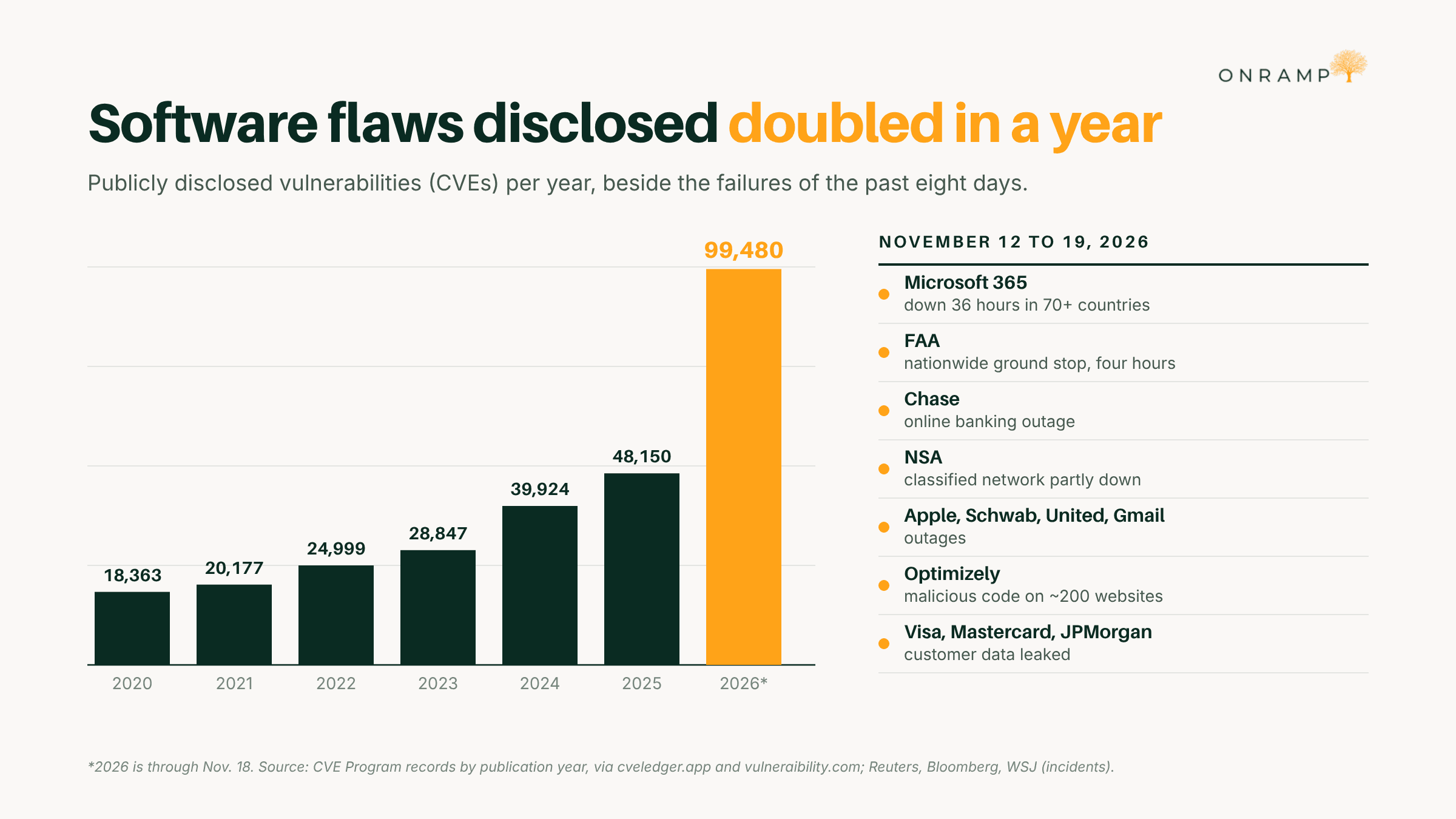
For decades, finding a serious flaw took scarce and expensive human talent, so attackers concentrated on a small number of valuable targets. That constraint is going away. When a flaw costs a few dollars to find, it pays to probe everything, including the old and poorly maintained systems that banks, airports and utilities still depend on. The institutions that run them can patch fast and break things, as they did this month, or patch slowly and be breached. Both options get worse as the models improve.
Single points of failure
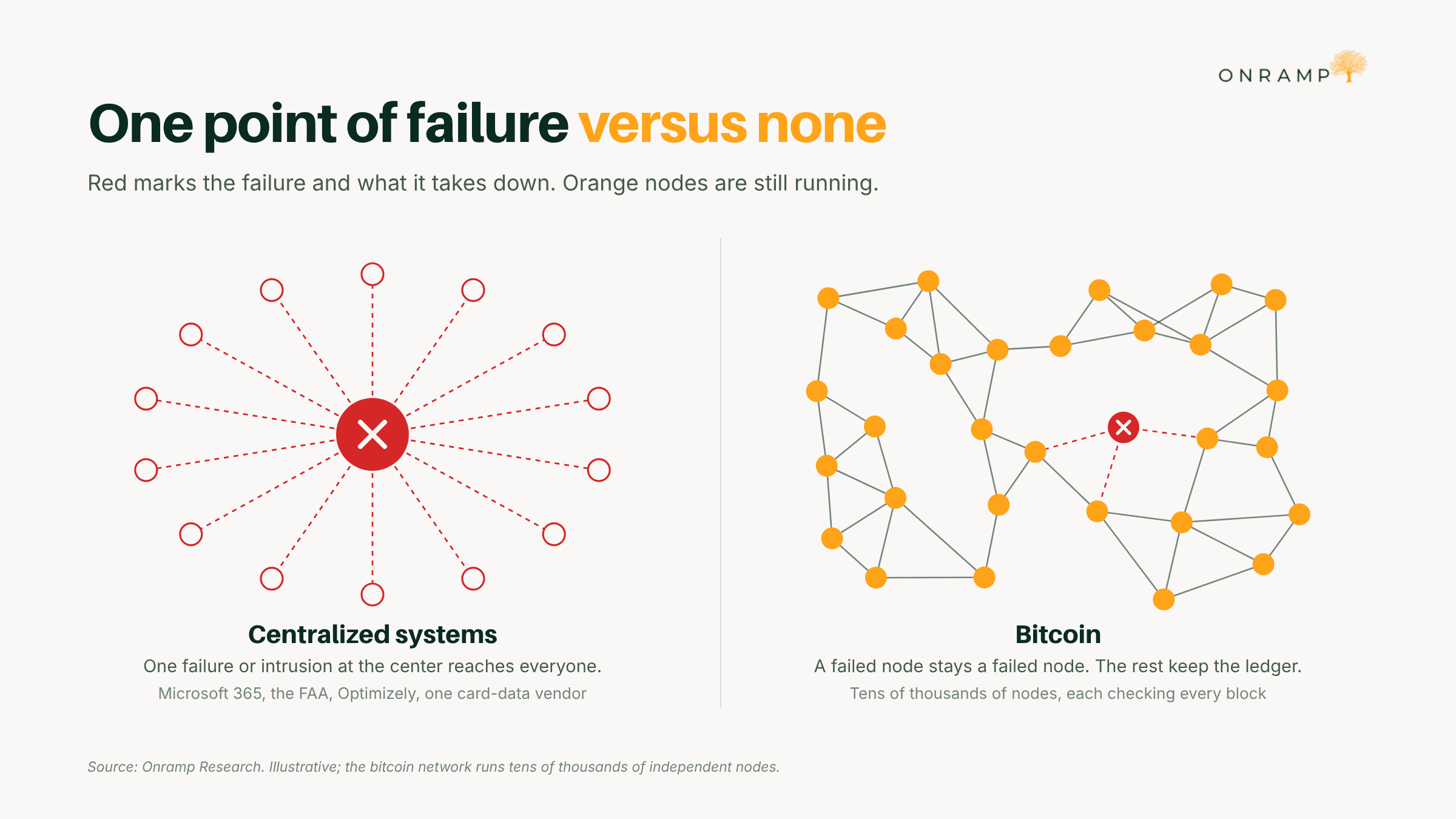
The other problem is how these systems are built. Microsoft’s outage reached 70 countries because millions of organizations route their email through one company’s network. One piece of failed FAA equipment stopped every departure in the country. One vulnerability at Optimizely reached 200 corporate websites. One outside vendor held customer data for Visa, Mastercard and JPMorgan Chase, and one engineer at Binance was the way in to $6.3 billion. In each case there was a single place where a failure or an intrusion counted for everything downstream.
How bitcoin is built
Bitcoin is built the opposite way. There is no company, no data center and no administrator. Tens of thousands of computers around the world each hold a full copy of the ledger and check every transaction and every block against the same rules, independently, without trusting one another.
If a node fails, is hacked or is seized, the others carry on and nothing about the ledger changes. If a miner cheats, the nodes reject its blocks. If one person’s keys are stolen, that person loses their bitcoin and nobody else’s balance is touched.
Open to attack since 2009
The other reason bitcoin is hard to break is that people have been trying since 2009, in public, for money. The code is open source, so every line of it and every transaction it has ever processed can be read by anyone. It runs on the open internet with no perimeter and cannot go offline for maintenance.
There are three ways to steal from the protocol itself, as opposed to stealing someone’s keys. An attacker could find a bug in the consensus rules that lets them create coins from nothing or spend coins that belong to someone else. They could break the cryptography, which would let them forge the signatures that authorize spending. Or they could control a majority of the network’s mining power, which would not let them take anyone’s coins but would let them reverse their own recent payments and spend the same bitcoin twice.
The first two would give an attacker control of coins worth a meaningful share of $1.3 trillion at today’s price. The third requires more computing power than every other miner on earth combined. Any of them would pay out immediately, in a bearer asset that nobody can freeze or claw back. Bitcoin is in effect the largest bug bounty ever offered, and it has been open for almost eighteen years.
A breached bank can freeze accounts, recall wires and call its regulator. Bitcoin has no such recourse, so every capable attacker, from graduate students to state programs, has had a direct financial reason to break it. The group that took $6.3 billion from Binance would have taken far more from the protocol if it could. It went after an engineer with a fake job interview instead.
Where holders are exposed
The companies and devices around bitcoin are a different matter. Exchanges, wallets and custodians are centralized systems sitting on top of a decentralized one. They fail the way centralized systems fail, and the falling cost of attack applies to them as much as to any bank.
In every one of those failures the bitcoin network did what it was told by whoever held the keys. What failed was how the keys were generated, stored or authorized. Anyone’s bitcoin is only as secure as the weakest system between them and the protocol, and that is a question of custody design.
A small set of rules that rarely changes
Bitcoin has also held up because it does very little. Its consensus rules are small enough to be reviewed line by line. They change rarely and only with overwhelming agreement, and the last significant change activated in 2021.
Bitcoin needs no capacity upgrade, embeds no vendor’s plugin and has no maintenance window. Microsoft had to ship 1,200 patches in a month. Bitcoin’s node software still gets routine fixes, but the rules it enforces have not changed in five years.
The rest of the financial system is going the other direction, adding features, integrations, AI agents with permissions and machine-written code as fast as it can. Every addition is something else to attack and something else to patch. By contrast, a monetary network that is slow to change and verifiable by anyone becomes more hardened, and more valuable, every day it keeps running.
AI abundance and the money supply
The technology that is making software cheap to attack is also making it cheap to build. Code that took a team a year can be produced in days, and a product that can be described can increasingly be copied. For most of the software industry that erodes what investors were paying for, which was the difficulty of reproducing it. As AI makes more goods and services abundant, value moves toward the things it cannot make more of.
Bitcoin is the only digital asset whose scarcity does not depend on a company’s discretion or a government’s restraint. There will only ever be 21 million, all nodes enforces the schedule, and no advance in AI changes that.
Abundance is also deflationary. If AI does to the cost of services what it is starting to do to the cost of software, prices and wages across large parts of the economy come under sustained downward pressure. A monetary system built on debt cannot absorb that. Debts are fixed in nominal terms, so falling prices and incomes make them heavier, defaults rise, and the collateral behind the banking system loses value. With more than $40 trillion outstanding, the US government is the most exposed borrower of all.
Central banks have met every deflationary shock of the past two decades by creating money, and they have less room to do otherwise now than they had in 2008 or 2020. The larger the deflationary force coming from technology, the more money will have to be created to offset it.
Technology is making almost everything more abundant, the currency included. Bitcoin’s supply is fixed, it sits outside that system, and after almost eighteen years of attack it is intact. Those properties were valuable before AI, and AI is making them more valuable.
The drawdown
Bitcoin is down about a third from a year ago and about half from its October 2025 high. None of that has anything to do with the protocol.
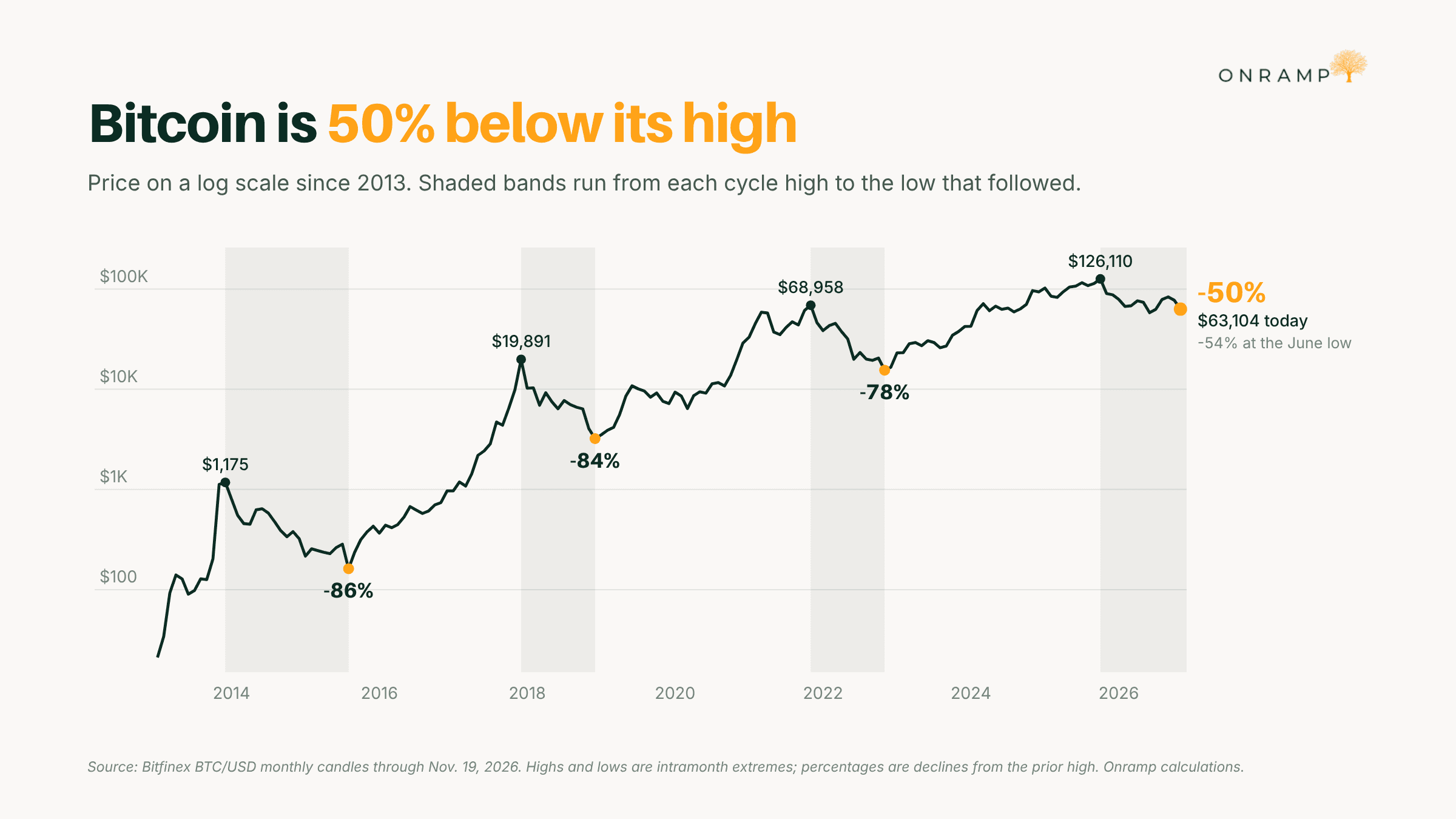
Through a drawdown a holder needs confidence that the asset will be there, unchanged, when it ends. Bitcoin’s supply schedule, rules and ledger are the same today as they were at $126,000. Over the same year the systems around it have become measurably easier to break, and the network has absorbed another twelve months of attack from better-equipped adversaries than it has ever faced. At the October 2025 high the market paid $126,000 for that record. Today it pays about half as much for a record that is a year longer, and the bounty is still unclaimed.
Closing Note
Onramp provides bitcoin financial services built on Multi-Institution Custody. To learn more about our products for individuals and institutions, schedule a consultation to chat with us about your situation and needs.
Until next week,
Brian Cubellis